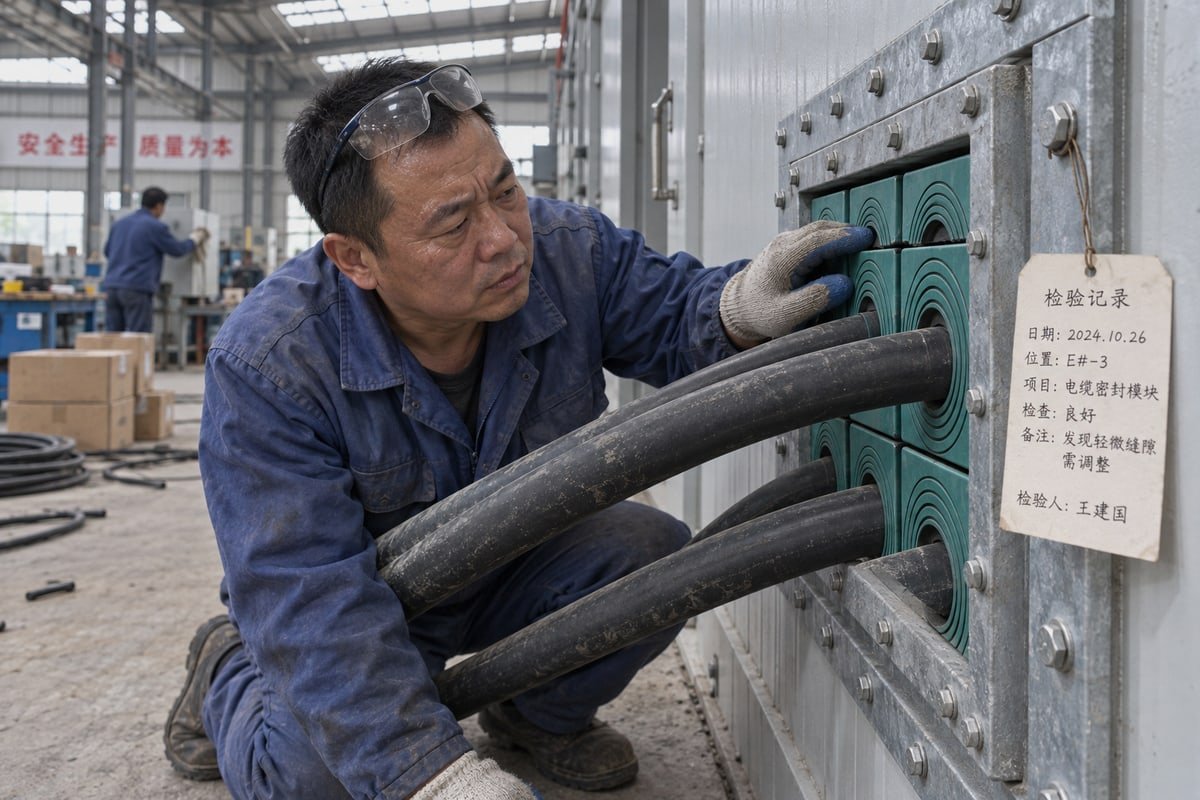
Every fire-rated e-house fails at its weakest opening. Pick the wrong fire- and waterproof multi cable transit and one leak defeats the compartment. Here is how our factory specs one.
Choose a fire- and waterproof multi cable transit by matching certified fire class (A-0/A-60 or EI rating), water and gas tightness (IP68, tested pressure), cable mix, and frame dimensions to the exact e-house boundary, then verify third-party test reports before ordering.
The four questions below follow the order a sourcing engineer actually works through. Ratings come first. Fit comes second. Paperwork comes third. Money comes last. I will show the checks we run in our own plant so you can copy them on your bench.
What fire rating and sealing performance do I need to verify for an E-House MCT system?
Last quarter our QC bench pressure-tested a benchmark sample alongside our TSC modules at 0.4 MPa. Watching a fire-rated sample weep showed fire and water ratings must be checked separately.
Verify fire integrity (E) and insulation (I) for the tested boundary, marine A-0/A-60 or EN 13501-2 EI class, IP68 ingress protection, gas-tight pressure in MPa or bar, halogen-free low-smoke modules, and that every rating comes from a third-party report for that frame-and-module combination.

Fire integrity versus fire insulation
Passive fire protection at a cable entry has two jobs. Integrity (E) means flame and hot gas do not pass through the seal. Insulation (I) means the unexposed face stays below a temperature limit, so cables and busbars behind the wall do not ignite from radiated heat. A fire-rated e-house normally needs both. Marine class notation makes the same split. A-0 gives 60 minutes of integrity with no insulation requirement. A-60 adds a limit on cold-side temperature rise for the same 60 minutes. Our TSC and TSR assemblies carry A-0/A-60 ratings 1, and our reports state which frame, module stack, and cable fill sat in the furnace. Ask every supplier for that same detail.
On land, the reference is EN 13501-2 classification 2 based on EN 1366-3 penetration testing, with classes from EI 60 up to EI 240. In North America, UL 1479 fire testing 3 gives F and T ratings in hours, and some tested systems reach 4 hours. IEC 60331 is a cable circuit-integrity test, not a transit test, so do not accept it as a substitute.
Water, gas, and pressure are three different tests
IP68 ingress protection proves the seal survived immersion under conditions the maker declared. It does not tell you how much one-sided pressure the seal holds. Gas-tight seals are proven with a pressure differential held for a set time. We test our modules for watertight and gas-tight sealing across 0.01 to 0.4 MPa. Some premium systems are marketed up to 4.5 bar for deck and subsea-adjacent duty. Basic modular cable entry frames 4 start at IP54, while IP67, IP68, and IP69K sit above that. Match the number to your real scenario: washdown, roof leak, temporary flooding, or standing water on a container floor.
| Rating | What it proves | What it does not prove | What to ask for |
|---|---|---|---|
| A-0 / A-60 | 60 min integrity; A-60 adds insulation | Any water or gas performance | Class-society test report with frame and module list |
| EI 60–EI 240 | Integrity plus insulation for stated minutes | Pressure tightness | EN 1366-3 report and EN 13501-2 classification |
| UL 1479 F/T | Flame and temperature rating in hours | Equivalence to EN classes | Listed system number |
| IP68 | Survives declared immersion | Fire behaviour or high pressure | Depth and duration used in test |
| 0.01–0.4 MPa | Holds stated differential pressure | Long-term immersion | Test pressure, hold time, leak criterion |
Smoke, suppression gas, and the hazards people forget
Cable sealing modules should be halogen-free and low-smoke so a fire inside the e-house does not fill the room with toxic gas or kill visibility. Our step-core modules are halogen-free EPDM 5 for that reason. If the e-house uses a clean-agent suppression system, confirm the elastomer is compatible with the agent and that the seal holds concentration during discharge. Where shielded control cables cross an EMC boundary, ask whether electromagnetic compatibility (EMC) modules are offered. On petrochemical sites, a blast resistance rating for the frame may be required by the plant specification.
One objection I hear is that an indoor e-house only needs the fire rating. That is a false sense of security. A deluge system, a burst chiller line, or a roof leak brings water to the same opening. A fire-rated transit that is not pressure tested can then wick water onto live terminals.
Can I confirm dimensional compatibility with my existing 120-frame cutouts before switching suppliers?
A sourcing manager at a European BESS integrator once sent me a photo of his container cutout and asked: will your modules fit without grinding? We answered with drawings.
Yes. Send the frame model number, cutout dimensions, and panel thickness. A drop-in second source like DewinMCT returns a model cross-reference (existing model → DEWIN model), CAD/STEP files, and free validation samples, so you confirm fit on your own bench before any purchase order.

What 120-frame compatibility really means
Most modular cable entry systems on the market share a common packing geometry. The frame opening is built around a 120 mm module row. Modules of different widths stack inside that row until the sum fills the space. A stay plate separates rows. A compression wedge unit at the top expands to lock everything under pressure. When we say our TSC and TSR products are dimensionally compatible with common 120-frame standards, we mean the module widths, heights, and stay plate thickness follow that same packing logic. The modules drop into an existing frame that is already welded or bolted into your e-house wall. You do not cut a new opening.
A five-step fit check before you switch
- Photograph the nameplate of the installed frame and read the model code.
- Measure the internal opening, frame depth, and panel thickness with a caliper.
- List every cable: count, outer diameter, and how many spare positions you want.
- Send the list to us and request the cross-reference table plus STEP files.
- Fit our free validation samples in a spare frame, compress them, and pressure test if you have the rig.
| Dimension to record | Why it matters | Common mistake |
|---|---|---|
| Frame internal width and height | Sets total module stack | Measuring outside flange instead of opening |
| Frame depth vs panel thickness | Determines weld or bolt method | Ignoring paint and insulation layers |
| Stay plate positions | Rows must match plate spacing | Assuming plates are optional |
| Compression unit clearance | Wedge needs room to expand | Filling the space with an extra module |
| Cable OD per position | Step-core range must cover it | Using nominal instead of measured OD |
Cable density optimization and spare capacity
Design for 20–30% spare capacity inside the frame. Fill the spare positions with blank modules today, then swap them for cable modules during a future expansion. Our step-core EPDM adapts to a range of cable diameters within one module size, so a small change in cable spec does not force a new part number. Modules split in two halves, which lets pre-terminated cables with connectors pass through without cutting. For dense power bundles, run a thermal de-rating calculation. A tightly packed transit can trap heat around power conductors, and the transit may become the limiting point for ampacity.
Frame material and mounting
Choose stainless steel frames for coastal, offshore, or washdown sites. Galvanized carbon steel frames suit painted steel container walls. Match the frame metal to the wall metal to avoid galvanic corrosion at the weld or bolt line, because a corroded joint breaks the fire-rated bond long before the modules fail. Our frame drawings state material and finish, and our in-house mold shop can cut custom sizes when your cutout is not a catalog size.
How do I validate a new MCT supplier's certifications and test documents without disrupting my project timeline?
Speed against certainty is the trade-off I weigh whenever an EPC team asks for our BV factory approval and A-60 report by Friday. Both are possible, in the right order.
Run validation in parallel with design: request the certificate register, third-party test reports, and ISO 9001/IATF 16949 scope on day one, check certificate numbers against the issuing body, test free samples on your bench, and release a pilot order only after fit and document review pass.

Which documents actually matter
Skeptical buyers read spec sheets before they reply. That is the right instinct. The trick is to ask for the full document set with the RFQ, not after the quote. Here is the register we send on request.
| Document | What to check | Red flag |
|---|---|---|
| ISO 9001 6 and IATF 16949 certificates | Scope names sealing modules and frames; dates valid; number verifiable with registrar | Scope lists only trading or general hardware |
| BV factory approval | Approved site matches the shipping factory | Approval belongs to a different legal entity |
| A-0/A-60 fire test report | Lab name, frame size, module stack, cable fill, orientation | Report for a different frame series |
| IP68 test report | Immersion depth and time stated | Only a self-declaration |
| Pressure test report | 0.01–0.4 MPa range, hold time, leak criterion | No hold time given |
| Material data sheet | Halogen-free EPDM, smoke class, temperature range | Generic rubber sheet |
| Hazardous area certifications | ATEX or IECEx on the assembly if the e-house sits in a zone | Certificate covers modules only |
| Vibration or seismic test | Required if the e-house ships as a module | No data for transport loads |
Read a test report like an auditor
Scope match is everything. A report that shows EI 120 on a masonry wall with a 4-row frame does not cover a 2-row frame in a 3 mm steel container panel. Check that the tested orientation matches yours, because floor penetrations behave differently from wall penetrations. Confirm the report separates integrity from insulation. Confirm UL 1479 and EN 1366-3 results are not being swapped as equivalents. If a report is older than the current product drawing, ask what changed.
Keep the timeline moving
Validation does not need to block design. Send the RFQ and document request on day one. Do the desk review while your panel drawings are still being finalized. Fit-test free samples during panel fabrication, when a spare frame is easy to find. Release a pilot order for one e-house before the framework agreement. During the pilot, tag each frame with a QR code or RFID label that links to the cable schedule, the cross-reference table, and the certificate register. That record feeds the e-house digital twin or BIM model, and it makes the next audit a five-minute task instead of a document hunt.
What cost savings can I realistically expect from switching to a drop-in second-source MCT manufacturer?
Cheapest unit price never wins the long game. That lesson cost us orders in our first years, and it shaped how we now quote 40–60% savings without dropping certification.
Expect 40–60% lower component cost on cable sealing modules and frames versus incumbent 120-frame brands, plus savings from shorter spare-part lead times and fewer field cutouts. Real net savings depend on volume, freight, and whether your fire and IP68 certification requirements are met unchanged.

Where the savings actually come from
The 40–60% figure is a component-level number. It comes from factory-direct pricing, in-house mold making, and no distributor layer between our line and your dock. It does not come from thinner rubber or skipped tests. Below is how the cost lines usually move when an integrator qualifies us as a second source for a fire- and waterproof multi cable transit.
| Cost line | Incumbent brand | Drop-in second source | What drives the difference |
|---|---|---|---|
| Module and frame unit price | Baseline | 40–60% lower | Factory-direct, in-house tooling |
| Qualification effort | Paid samples, engineering time | Free validation samples, cross-reference table | Shared 120-frame geometry |
| Custom sizes | Long lead, tooling charge | In-house mold shop | Own mold making |
| Spare sealing modules | Distributor stock and lead time | Fast delivery from factory stock | Direct supply |
| Field rework | None if fit is right | None if fit is validated first | Sample fit test |
| Freight and duties | Regional warehouse | Must be added to landed cost | Export from China |
Objections I hear, and how I answer them
Some engineers say cable glands are cheaper and everyone knows them. That holds for a handful of cables. When forty cables of mixed diameter enter one fire-rated panel, glands mean forty drilled holes, forty gaskets, and forty potential leaks. Cable density optimization with one modular frame is cheaper to install and far easier to certify as one tested system. Others say modular transits cost more upfront than liquid sealants. True, but a sealant must be cut out and re-poured after every cable change, and the original fire rating rarely survives that. A compression system lets you add cables without touching the certification. A third objection is second-source risk. We answer it with documents: ISO 9001, IATF 16949, a BV-approved factory, 38+ granted patents, and test reports for A-0/A-60, IP68, and 0.01–0.4 MPa sealing available on request.
The hidden cost of under-specification
The most expensive transit is the one that fails. A leaking entry in a BESS container means downtime, a rework crew, and a compliance report. Savings only count if the replacement carries the same fire class, the same IP68 ingress protection, and the same gas-tight seals as the part it replaces. Calculate your net saving on landed cost per e-house, add the lead-time benefit on spares, and subtract nothing for certification, because you should not give any up.
Conclusion
Under-specified cable entries sink fire-rated e-houses. Match the transit to your real fire, water, and cable data, then validate a second source with documents and samples. Our drawings are ready.
Footnotes
1. Authoritative source for marine fire safety standards and A-class division ratings mentioned in the article. ↩︎
2. Provides technical context for the European fire classification system used for building elements and penetrations. ↩︎
3. Official site of the organization that developed the UL 1479 standard for fire tests of penetration firestops. ↩︎
4. Authoritative explanation of IP ratings (IEC 60529) applicable to modular cable entry systems. ↩︎
5. Technical reference for the elastomer material properties used in high-quality cable sealing modules. ↩︎
6. Official standard page for the quality management system required for authoritative MCT manufacturing. ↩︎



 English
  Español de México
  Deutsch
  Français
  العربية
  Русский