
Every multi cable transit order raises the same question on our production floor: per-batch inspectors or resident QC? Choose wrong, and hidden defects surface after compression, when fixing means dismantling.
Per-batch inspectors are more cost-effective for most multi cable transit orders with stable, certified production. Resident QC pays off only on large offshore or safety-critical projects where rework, mobilization fees, and certification delays outweigh a daily inspector rate. A hybrid model usually wins.
That short answer hides a lot of arithmetic. Below, I break down the real cost drivers, the risks of under-inspecting, what certifications actually buy you, and the volume where resident QC starts to pay.
How do I calculate the true cost difference between per-batch inspection and resident QC for MCT orders?
A sourcing manager 1 in the Netherlands once asked me to justify a fourth inspection visit on a BESS enclosure order. His spreadsheet only listed hourly rates. That was the problem.
Calculate total cost of quality, not hourly rates. Add inspection labor, mobilization fees, sample size, waiting time, rework, scrap, schedule delay, and certification risk for each model. Per-batch cost scales with visit count; resident QC cost scales with project duration. Compare the totals.

Hourly or daily rates are the visible part of the bill. The invisible part is what decides the outcome. When we ship TSC square modules or TSR round seals to an integrator, the inspection model the buyer picks changes their project lifecycle costs far more than the rate card does.
The two cost curves
Per-batch inspection is a step curve. Each visit adds a fixed block of cost: the inspector's man-day fee, travel, and the mobilization fees charged by most third-party inspection agencies. If a batch fails, you pay for a second visit and you pay for the days the line waited. Resident QC is a flat line. You pay a daily rate for the whole duration, whether the inspector is busy or idle.
| Cost driver | Per-batch inspection | Resident QC |
|---|---|---|
| Inspector labor | Paid per visit or man-day | Paid daily for full project duration |
| Mobilization and travel | Repeated every visit | Paid once at start and once at end |
| Sampling depth | Sample-based, limited by visit length | Up to 100% oversight of critical steps |
| Waiting and idle time | Line waits for inspector to arrive and sign off | Inspector may sit idle during slow output |
| Rework exposure | Higher; defects found after lot completion | Lower; defects caught before compression |
| Schedule delay risk | Failed lot can halt the next phase | Issues resolved in real time |
| Documentation | Report per lot, bound to lot numbers and drawings | Continuous register, as-built accuracy |
A simple break-even test
I use a plain formula with buyers. Let F be the all-in cost of one batch visit, including mobilization fees. Let B be the number of batches. Let R be the resident daily rate and D the number of days on site. Per-batch cost is B × F. Resident cost is D × R. Then add the expected rework and delay cost for each model. Rework is where the gap opens. A standard commercial MCT unit is cited at roughly $50 to $500, while a certified offshore-grade transit can run $200 to $2,000 per unit. A complex offshore platform with 10,000 units can represent $5 million to $15 million in procurement value including engineering and documentation. On that scale, one batch of mis-packed frames that must be dismantled after compression costs more than a resident inspector for a month.
What quality risks do I face if I skip resident QC on cable transit shipments?
Our OQC team once held a TSC lot because an installer peeled a step-core layer too deep in a trial fit. Caught before compression, it cost minutes. After, a dismantle.
Skipping resident QC exposes you to undetected packing errors, wrong module sizing, incomplete cable registers, and failed class inspections. A sealed transit with a hidden defect must be dismantled to fix. Sparse sampling can miss it, halting construction until re-inspection.
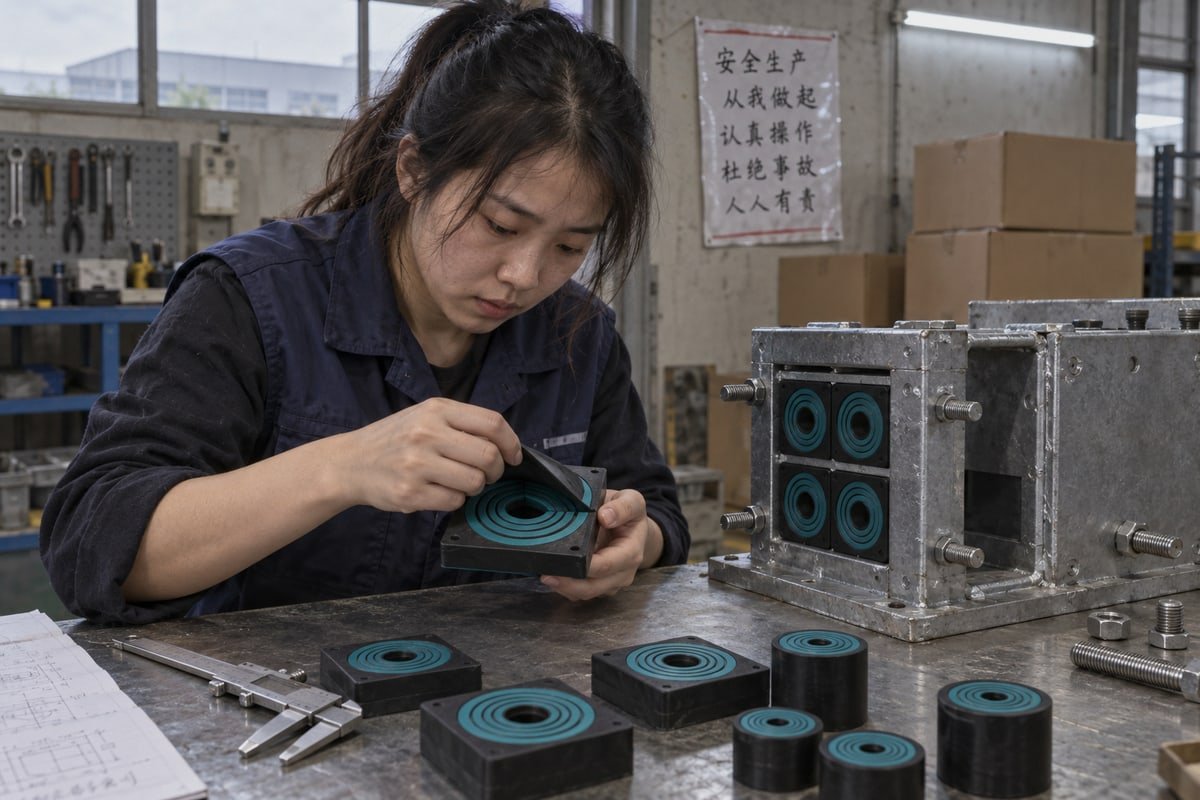
The core problem with cable penetration seals 2 is that the defect and the fix live at different times. Most errors happen during packing. Most consequences appear after compression, during a Factory Acceptance Test 3, or years later during a class survey. Per-batch inspection looks at the finished lot. It sees the outside of a compressed frame. It cannot see whether a step-core module was peeled to the correct cable diameter inside.
Defects that hide until compression
Our step-core EPDM modules adapt to a range of cable diameters within one module size. That flexibility is the reason integrators like them as a drop-in second source. It is also the reason installers can get it wrong. Peel one layer too many and the module no longer grips the cable. Peel one too few and the compression unit cannot close. Both faults are invisible once the stay plates are in and the bolts are torqued. A resident inspector watches the peel. A per-batch inspector reads the report.
| Risk | Where it originates | When per-batch finds it | When resident QC finds it |
|---|---|---|---|
| Wrong step-core peel depth | Installer trial fit | After compression, or never | During packing |
| Module size mismatch to frame | Material selection | At lot check, if sampled | At material receipt |
| Missing filler or spare module | Cable arrangement | At Factory Acceptance Test | During arrangement |
| Incomplete as-built cable register | Documentation | At class survey | Daily |
| Wasted modules from trial-and-error | Installer habit | On the material invoice | In real time |
Documentation and compliance risk
Passive fire protection depends on records as much as rubber. Classification societies working under IACS requirements 4 expect each transit to be traceable to a drawing, a revision, and a lot number. If your register is incomplete, you get non-conformance reports and a delayed sign-off. A failed batch can halt the next construction phase until a re-inspection is scheduled. Owners on high-value projects now demand an evidence trail for every transit, and a verified audit trail of fire and flood barrier reliability can also support insurance negotiations. Resident QC also acts as a material conservation officer. It stops installers from peeling and discarding expensive sealing modules by guesswork.
Can supplier certifications like ISO 9001 and BV approval reduce how much inspection I actually need?
Weighing a BV-approved factory's paperwork against a buyer's own gate inspection is a trade-off we face at every audit in Shaanxi.
Yes. ISO 9001, IATF 16949, and BV factory approval verify the process, so you can shift from 100% oversight to risk-based sampling. They do not remove inspection entirely. Keep first-article checks, Factory Acceptance Tests, and site installation supervision on safety-critical cable penetration seals.

Certification does not replace inspection. It changes what inspection needs to prove. When a buyer qualifies us as a second source, they are not asking whether our EPDM is good rubber. They are asking whether the lot they receive matches the lot we tested. Each certificate answers a different part of that question.
What each certificate actually covers
| Certificate or approval | What it proves | What it does not prove | How it reduces inspection |
|---|---|---|---|
| ISO 9001 | Documented Quality Assurance protocols and traceability | That one specific lot is defect-free | Allows sampling instead of 100% incoming checks |
| IATF 16949 | Automotive-grade process control and defect prevention | Fitness for a specific marine approval scope | Reduces need for repeated process audits |
| BV factory approval | Factory and process recognized by a classification society | Installation quality on your site | Shortens class acceptance of supplied product |
| Type test reports (A-0/A-60, IP68, 0.01–0.4 MPa) | Product performance in an independent lab | Site installation matches tested configuration | Removes need to retest product performance per lot |
Certification-based testing for transit products is normally handled in independent labs. Our fire rating of A-0/A-60, IP68 ingress protection 5, and watertight and gas-tight sealing from 0.01 to 0.4 MPa come from that route, and we provide the test documents on request. Buyers targeting other class bodies, such as DNV GL certification for a specific vessel, still need the installed configuration to match the approved drawing. That is a site question, not a factory question.
Where inspection can be reduced, and where it cannot
In our experience exporting to Europe, a qualified second source with a full document set lets buyers cut incoming inspection sharply. Our model cross-reference tables map existing 120-frame-compatible modules to DEWIN part numbers, and free validation samples let the buyer's own QA team confirm dimensional fit before the first purchase order. After first-article approval, per-lot checks can drop to dimensional sampling and a document review bound to lot numbers and drawing revisions. What should not be cut is installation supervision on safety-critical frames. No factory certificate covers how a shift team peels a module at two in the morning. Certification buys you fewer factory visits. It does not buy you fewer eyes on the bulkhead.
At what order volume does resident QC start paying for itself over per-batch checks?
The lesson from our first large 120-frame-compatible export order was blunt: below a certain lot count, a resident inspector spends most days waiting for rubber to cure.
Resident QC pays for itself when continuous production runs long enough that the sum of per-batch visit fees, mobilization fees, and waiting time exceeds a full-time daily rate. In practice this means large newbuilds or offshore platforms with thousands of transit units, not small maintenance orders.
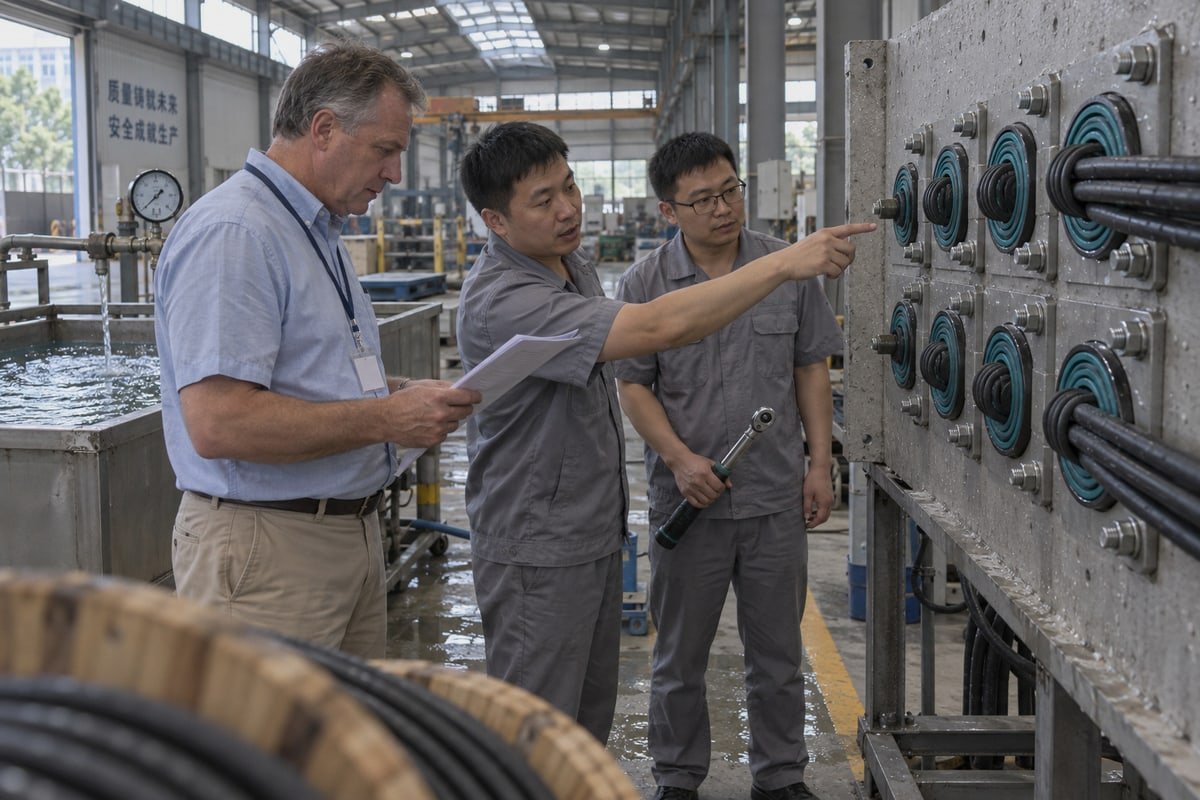
There is no single unit count where the answer flips. The break-even depends on three things: how continuous the output is, how severe a defect escape would be, and how many parties are involved. I group projects into three tiers when I discuss QC plans with EPC procurement teams.
Three project tiers
| Project profile | Typical scope | Recommended model | Why |
|---|---|---|---|
| Small or maintenance | A few frames, intermittent work, one installer | Per-batch inspection | Volume does not justify a full-time rate; idle time would dominate |
| Mid-size OEM series | Repeat BESS containers, modular data centers, switchgear cabinets | Hybrid: resident during first-article and ramp-up, per-batch after | Process stabilizes quickly; standardized product suits lot-based checks |
| Large newbuild or offshore | Thousands of units, multiple subcontractors, class survey | Resident QC or hybrid with digital register | Mobilization fees compound; defect escape triggers schedule and compliance risk |
The MCT market is estimated at about $1.8 billion in 2025, and most of that value sits in the second and third tiers. In the second tier, a resident inspector for the first two or three lots catches the process faults. After that, per-batch checks are enough because the product is repeatable. In the third tier, the arithmetic changes. When 10,000 units carry $5 million to $15 million in value, the daily rate of a resident inspector is small against a single dismantled deck section.
The hybrid model most teams should use
- Resident QC during first-article approval and the first production ramp.
- Resident oversight at critical stages: frame welding, module peel training, first compression.
- Per-batch inspection once defect rates stabilize and the register is clean.
- A digital transit management system that binds each inspection report to lot number, drawing, and revision.
- Re-escalate to resident oversight when a new subcontractor, shift team, or module type enters the job.
Digital tools are pushing the break-even lower. The emerging digital resident model uses AI-vision and AR to verify installation in real time. It gives the oversight of a resident inspector at a cost closer to per-batch services. Cloud-based registers now matter for both models, because IACS-aligned class surveys want the as-built cable register, not a stack of signed lot sheets. Inspection intensity should follow risk class and certification scope, not habit.
Conclusion
The cheapest inspector prevents the most downstream cost. Match inspection intensity to risk, lean on certified documentation, and use a hybrid model; we supply the evidence to make that possible.
Footnotes
1. Sourcing managers oversee procurement and quality assurance strategies for complex industrial components like cable transits. ↩︎
2. Cable penetration seals are passive fire protection systems designed to maintain the fire resistance of walls and floors. ↩︎
3. A Factory Acceptance Test is a quality control process used to verify that equipment meets specifications before delivery. ↩︎
4. IACS establishes technical standards and requirements for ships and offshore structures to ensure maritime safety. ↩︎
5. The IP Code classifies the degrees of protection provided by mechanical casings and electrical enclosures against intrusion. ↩︎


 English
  Español de México
  Deutsch
  Français
  العربية
  Русский