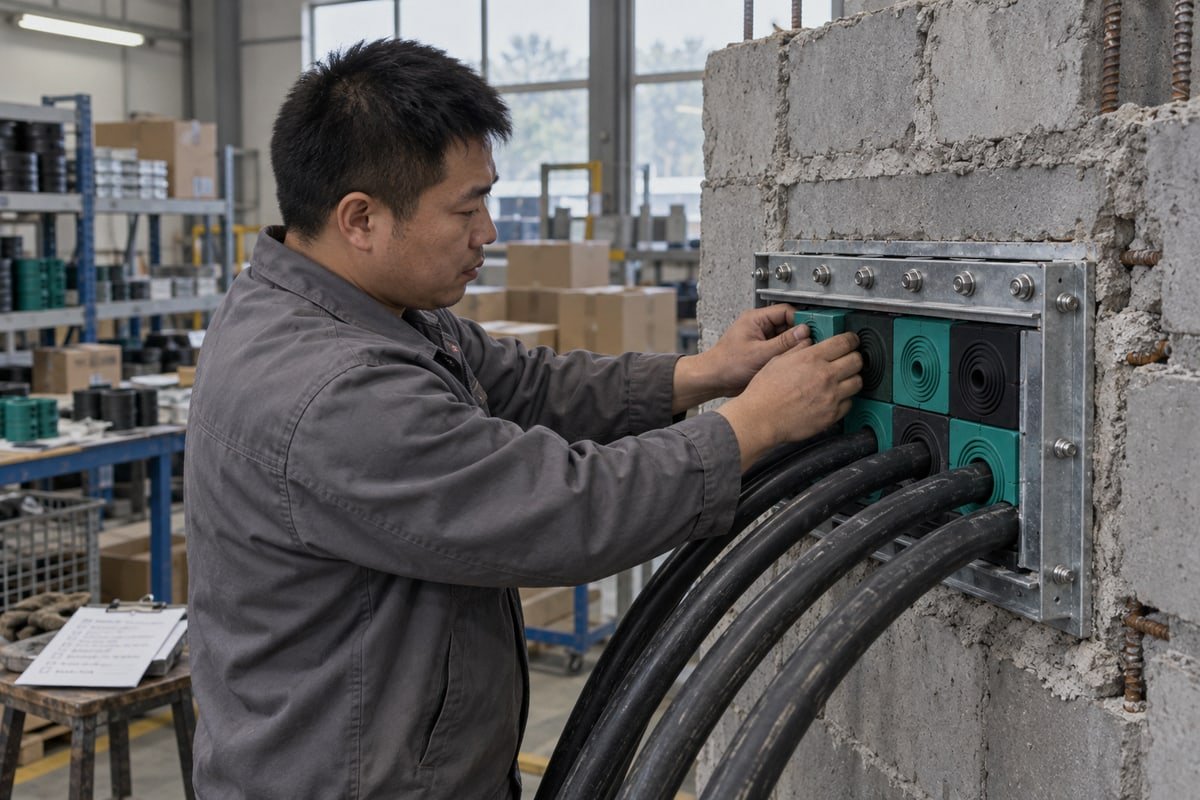
A wrong UL 1479 1 fire-stop rating stalls data center acceptance for weeks. I have watched buyers panic. On our MCT production line, we start with the assembly, not the label.
MCTs should meet a UL 1479 fire-stop rating tied to a listed through-penetration firestop system that matches the wall or floor assembly. The F-rating must equal the barrier’s hourly rating, a T-rating is usually required for floors and IT-room walls, and W- or L-ratings apply where owners demand them.
That answer sounds simple. In practice, it hides four separate checks. Below, I walk through each one. I also explain what documents to ask for, when a drop-in module keeps its rating, and why water sealing matters as much as fire.
How do I verify a UL 1479 fire-stop rating matches my data center's wall or floor assembly requirements?
A sourcing engineer in Germany once sent me a 2-hour wall drawing and asked which module to pick. I asked for the listing number first. He did not have one.
Verify by matching four items against the UL 1479 system listing: the barrier's hourly fire-resistance rating, the assembly type and thickness, the penetrant type and cable fill ratio, and the opening size with annular space. If any item differs, the rating does not transfer to your penetration.

UL 1479 is a test method, not a product grade. It is the UL version of ASTM E814 2. Both expose a sample penetration to a furnace fire, then hit it with a hose stream. The result is a set of ratings for that exact tested configuration. Nothing more. So the first thing I tell buyers is this: a module does not "have" a rating on its own. A system does.
The four UL 1479 ratings in plain English
| Rating | What the test measures | Why it matters in a data center |
|---|---|---|
| F-rating | Flame passage through the seal, plus survival of the hose stream | Must equal or exceed the hourly rating of the wall or floor |
| T-rating | Temperature rise on the unexposed side, limited to 325°F above ambient | Stops heat from igniting cable jackets or damaging racks on the safe side |
| L-rating | Air leakage in cubic feet per minute at ambient and at 400°F | Keeps smoke and clean-agent suppressant from migrating between halls |
| W-rating | Water resistance; Class 1 is tested under a 3-foot head for 72 hours | Protects floors from sprinkler discharge and pipe leaks above |
F-rating and T-rating are the two most inspectors ask about first. L-rating air leakage and W-rating water leakage come up when the owner's spec is strict, which in my experience is most of the time for hyperscale work.
A five-step match
- Read the barrier rating from the life-safety drawings. A 1-hour wall needs at least F-1. A 2-hour floor needs F-2 and, in most codes, T-2.
- Confirm the assembly type. Gypsum on steel studs, CMU, and poured concrete each appear in different listings. Thickness matters too.
- List the penetrants. Cable count, jacket material, and any liquid cooling lines sharing the transit. Hybrid penetrations need a listing that names both.
- Measure the opening and the annular space. Listings state minimum and maximum values.
- Check NFPA 75 3 and the owner's spec for extra T, L, or W demands.
The objection I hear most
Some project teams argue that a 2-hour wall simply needs a "2-hour product." I understand the logic. But it is not how listings work. A module tested in a concrete floor with twelve power cables is not proven in a gypsum wall with sixty fiber cables. When the parameters fall outside the listing, you need a firestop engineering judgment or a new listing. Skipping that step is the fastest way to fail the first inspection.
What test documentation should I request from my MCT supplier to prove UL 1479 compliance?
Every module batch leaving our Shaanxi plant carries a traceable test file. We built that habit because one missing report once held a container shipment at the customer's dock.
Request the UL system listing number and drawing, the full ASTM E814 / UL 1479 test report showing F-, T-, L-, and W-ratings, the manufacturer's installation instructions, a cable fill ratio chart, material certificates, and a statement confirming the tested configuration matches your assembly.

I read a lot of supplier brochures from competitors. Many say "fire-rated" in large type and say nothing else. That word alone will not pass a data center submittal review. Our ISO 9001 and IATF 16949 systems force us to keep evidence behind every claim, and I recommend buyers demand the same discipline from any MCT source.
The submittal checklist I recommend
| Document | What to check | Red flag |
|---|---|---|
| UL system listing and drawing | Assembly type, rating, penetrant list, opening range | Listing covers a different barrier or fill |
| Full UL 1479 / ASTM E814 test report | Test date, lab, sample description, hose stream result | Summary sheet only, no lab name |
| Installation instructions | Compression torque, module sequence, stay plate positions | Generic instructions with no system reference |
| Cable fill ratio chart | Maximum and minimum fill per module size | No stated limits |
| Material certificates | Rubber compound, halogen-free declaration, frame steel grade | Missing or undated |
| Configuration statement | Written match to your wall or floor | Supplier refuses to sign |
Closeout is part of acceptance
Documentation does not stop at the submittal. During closeout, commissioning teams expect a location log for every penetration, installation photos before and after compression, and inspection records. A growing number of projects now ask for digital firestop passports. These are QR codes on the MCT frame that link to the system drawing and photos inside the BIM model. We stamp a nameplate on every frame already, so adding a code is a small step.
What we can and cannot hand over
I want to be direct here. Our modular cable seals ship with A-0/A-60 fire test documents, IP68 4 ingress reports, and watertight and gas-tight test data from 0.01 to 0.4 MPa. Those come from a BV-approved factory and are available on request. For a UL 1479 fire-stop rating, we tell buyers plainly which listed systems the installed configuration must follow, and we supply our test data to support any engineering judgment. We do not paste a rating onto a module that was never tested in that assembly. That honesty saves everyone time at inspection.
Can I use a UL 1479-rated MCT as a drop-in replacement without re-testing the whole penetration assembly?
Dimensional compatibility with 120-frame cutouts saves our customers 40–60% on modules. But I weigh that saving against one question: does the listing still hold after the swap?
Yes, but only when the replacement MCT is itself part of a UL 1479 listed system covering the same assembly, frame, opening, penetrants, and fill. A dimensional fit alone does not carry the rating. Otherwise you need a firestop engineering judgment approved by the AHJ.
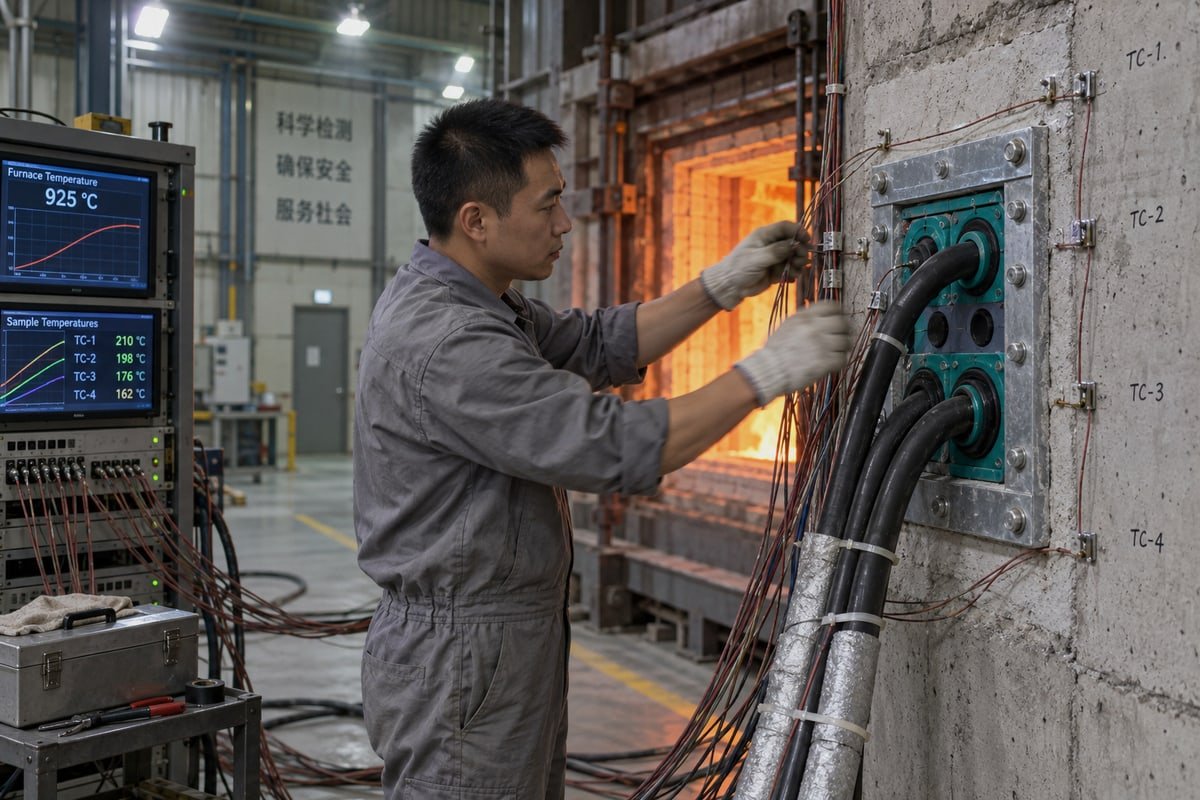
This is the section where second sourcing gets real. A module that slides into an existing frame cutout is a mechanical fact. A module that inherits the original supplier's fire listing is a different thing entirely. I have seen procurement teams confuse the two, and I have seen inspectors catch it.
What changes and what does not
| Change made in the field | Original listing still applies? | Action needed |
|---|---|---|
| Same brand, same module, more cables within fill limit | Yes | Log the change |
| Same brand, cable count above fill limit | No | Re-seal or engineering judgment |
| Different brand module, same frame dimensions | Not automatically | Check replacement brand's own listing or seek judgment |
| Adding a liquid cooling line to a cable-only transit | No | Find a hybrid penetration listing |
| Moving the frame to a thinner wall | No | New listing match required |
How I qualify a second source honestly
- Compare the frame cutout and module dimensions using the cross-reference table. Our table maps each existing model to a DEWIN model, and we send free validation samples so your engineers can test the fit.
- Check the replacement module's own test evidence. Ask for the same package described in the previous section.
- Compare cable fill ratio and compression torque limits. A second-source module with a different step-core profile may allow a different range.
- Bring the proposal to the AHJ early. AHJ approval on an engineering judgment is far easier before the wall is closed than after.
- Record the swap in the penetration log with photos.
The data center twist
Data centers churn cables constantly. Moves, adds, and changes never stop. That is why re-enterability matters. Our step-core EPDM modules let a technician open the frame, peel the core to the new diameter, and re-compress without cutting sealant. But every re-entry must land back inside the listed fill range. High-density fiber adds another wrinkle. For 800G and 1.6T deployments, some owners now specify low compression on fiber bundles to avoid micro-bending and attenuation. A traditional caulk-based firestop cannot manage that. Modular cable seals can, because compression is controlled by the bolt torque and the stay plates.
Why does my data center project acceptance depend on both fire rating and IP68/watertight sealing performance?
The lesson that shaped our IP68 testing came from a BESS container builder, not a data center. Water found the one un-compressed module. Fire never had the chance.
Acceptance depends on both because a data center barrier must stop fire, smoke, and water together. The UL 1479 F-rating protects the fire barrier, the T-rating protects equipment from heat, the W-rating and IP68 sealing block sprinkler discharge and leaks, and L-rating air leakage preserves containment and suppression gas.

Fire is the event everyone plans for. Water is the event that actually happens. A sprinkler head trips on the floor above. A chilled-water line for a liquid-cooled rack drips onto a cable tray. In both cases, the penetration is the path of least resistance to the servers below. That is why the W-rating and IP68 sealing sit next to the fire rating on modern acceptance checklists.
Three sealing claims that get mixed up
| Claim | Test basis | What it proves | Where it applies |
|---|---|---|---|
| W-rating (UL 1479) | Class 1: 3-foot water head, 72 hours, then fire test | Firestop remains water-resistant and still performs in fire | Floor penetrations, wet mechanical rooms |
| IP68 (IEC 60529) | Dust-tight, plus immersion beyond 1 meter under agreed conditions | Enclosure-style ingress protection for the seal | Outdoor, containerized, and below-grade entries |
| Watertight / gas-tight pressure | Pressure hold, our modules tested from 0.01 to 0.4 MPa | Seal holds against a defined pressure difference | Pressurized halls, suppressant retention, flooding |
These are not interchangeable. A module with an IP68 report has not been through a UL 1479 W-rating fire sequence. A W-rated system has not necessarily been pressure tested at 0.4 MPa. I make this distinction on every spec review, because a buyer who asks for one and receives the other will lose time at acceptance.
Should a W-rating be mandatory?
This is a genuine debate. One camp says every data center penetration should carry a W-rating. The other says it is over-specification. My view sits in between. UL 1479 does not require a W-rating for every penetration. But where incidental water exposure is plausible, or where the owner's uptime target justifies a stricter spec, the W-rating is worth its cost. For a floor above a data hall, I would not skip it. For a dry interior wall between two IT rooms, the F- and T-ratings plus an L-rating for smoke may be enough.
Smoke, gas, and even sound
L-rating air leakage matters for two reasons in data centers. It keeps hot-aisle and cold-aisle containment efficient. It also keeps clean-agent suppressant inside the protected hall long enough to work. Our halogen-free EPDM modules are gas-tight by design, and our pressure tests cover that range. Some high-velocity cooling projects now add Sound Transmission Class 5 ratings to the MCT spec as well, to limit fan noise transfer between halls. The same compressed rubber that blocks smoke also helps here, though STC is a separate test.
Conclusion
A mismatched rating fails inspection and delays go-live. That risk compounds with every penetration. Specify the listed system, demand the documents, and qualify your second source with evidence.
Footnotes
1. Official UL standards body reference for the core fire-stop test method discussed throughout the article. ↩︎
2. Links to ASTM International, publisher of the companion fire-testing standard referenced alongside UL 1479. ↩︎
3. NFPA is the authoritative source for the data center fire protection standard cited for compliance checks. ↩︎
4. Explains the IEC 60529 ingress protection classification system referenced for sealing performance. ↩︎
5. Provides background on the acoustic rating standard mentioned for high-velocity cooling projects. ↩︎



 English
  Español de México
  Deutsch
  Français
  العربية
  Русский