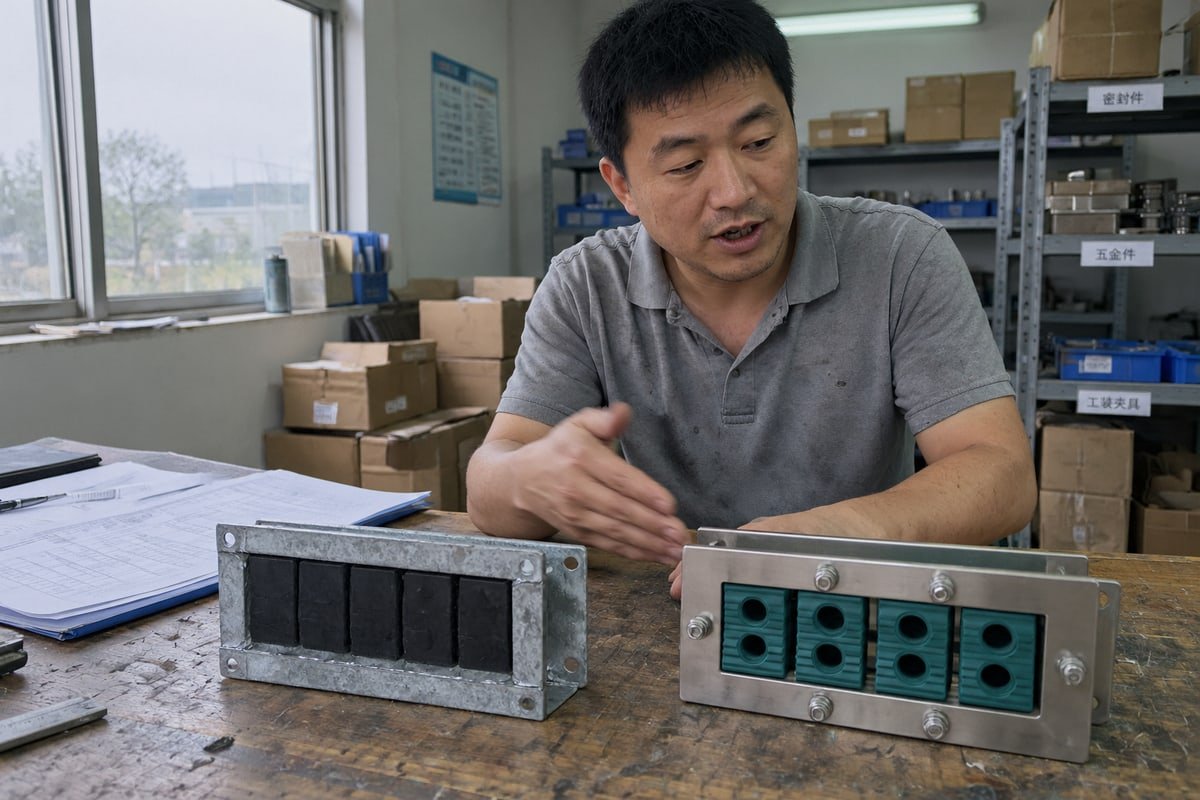
Three multi cable transit supplier quotes land on your desk for one frame cutout IATF 16949 1. The prices differ by 3x. On our factory floor in Shaanxi, we see why every week.
Multi cable transit supplier quotes vary because suppliers price different things: cable capacity, block material, fire rating certifications, IP68 testing, frame steel grade, engineering support, freight, duties, and price-escalation risk. Two quotes rarely cover the same scope, so the headline unit price alone is misleading.
Below, I break the quote into its real cost drivers. Then I show how to check certification, find hidden line items, and use a cross-reference table to compare fairly.
A German BESS integrator once sent us two competitor quotes for the same 120-frame cutout. One was double the other. Both said MCT frame, 120 size, 24 cables.
The same cable transit frame size carries different prices because frame size fixes only the cutout. Steel grade, weld or bolted design, block material, cable capacity, spare capacity, fire and pressure tests, and order volume all change the cost inside that fixed dimension.
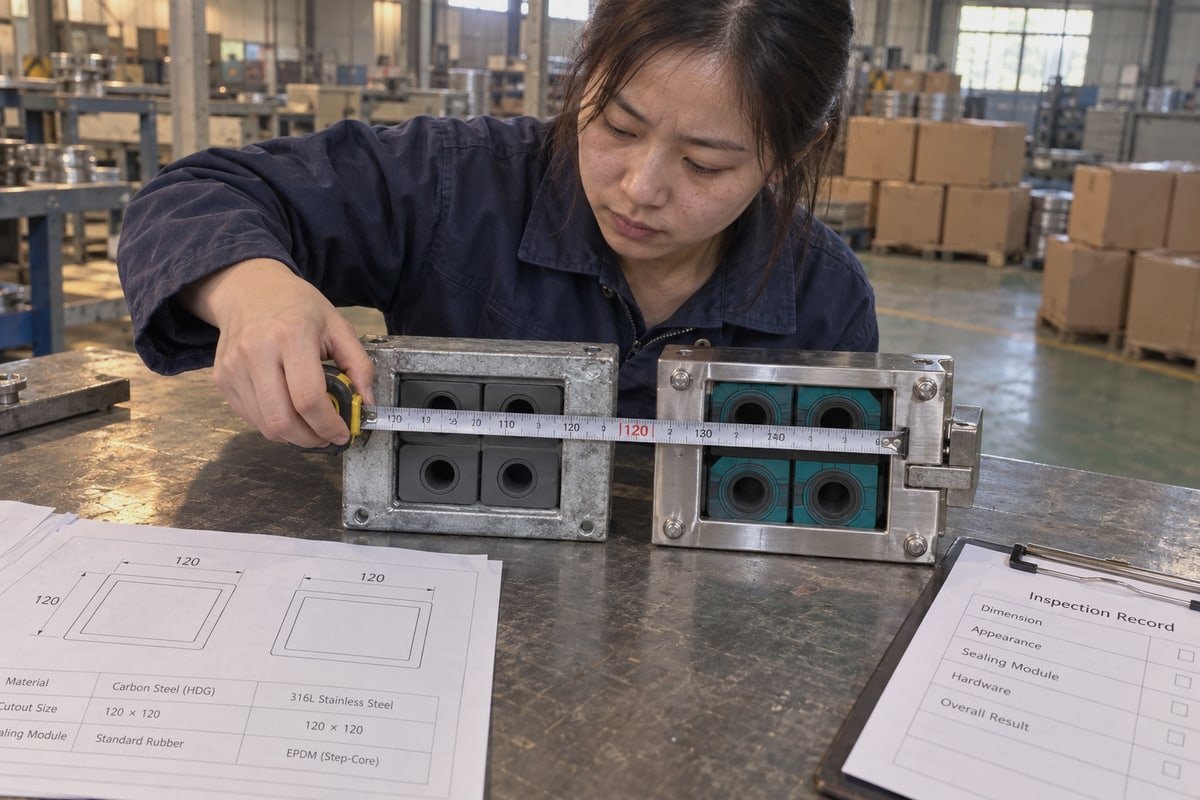
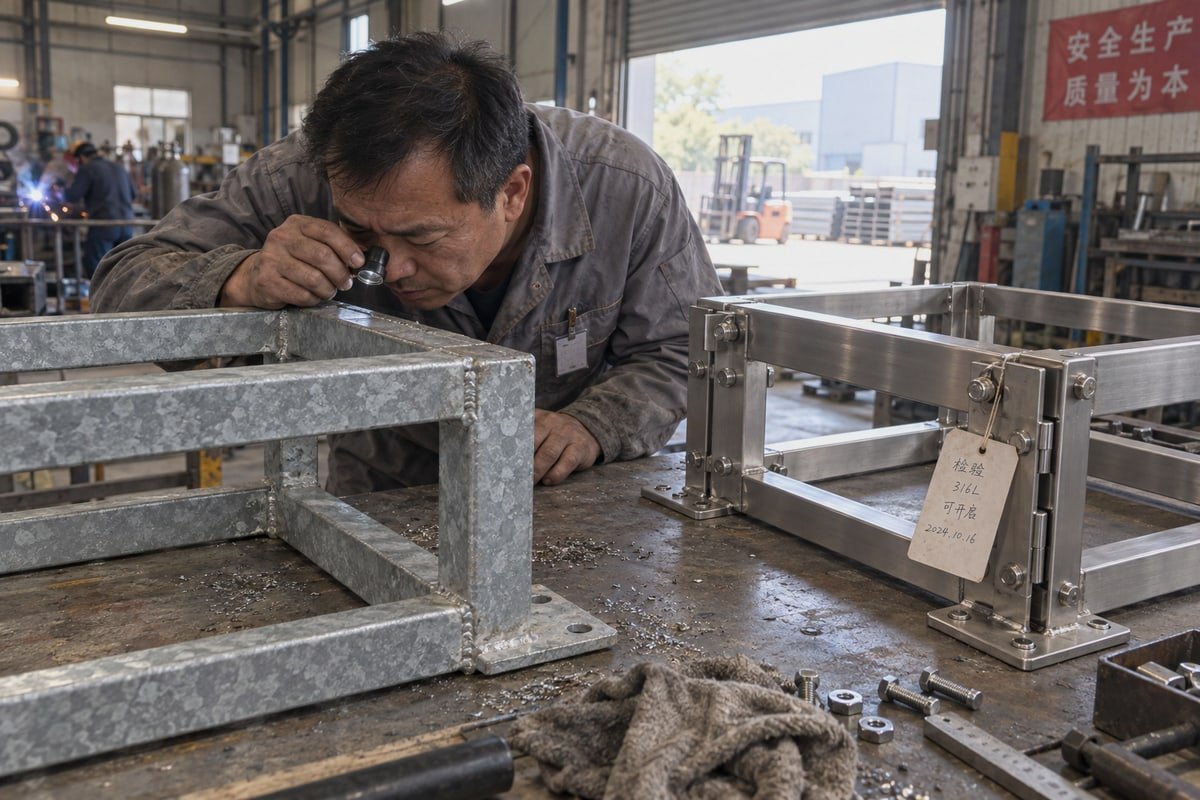
When we opened those two quotes side by side, the gap made sense within ten minutes. One frame was 316L stainless steel 2 with an openable bolted design. The other was hot-dip galvanized carbon steel with welded corners. One included halogen-free blocks 3 tested to A-60. The other listed standard rubber with no fire class named. The frame size matched. Almost nothing else did.
What a frame size actually defines
A frame size is a dimension. It tells you the cutout in the wall or bulkhead and the internal packing space. That is all. The cable sealing system inside that space is where the money goes. It includes the modular sealing blocks, the stay plates, and the compression wedge assembly that squeezes the blocks into a watertight bulkhead penetration. Each of those parts has its own material and test cost.
Stainless steel vs galvanized frames
Material grade is the first big split. Stainless steel vs galvanized frames can change frame cost several times over before any block is added. Within stainless, 316L costs more than 304 because of molybdenum content and corrosion performance in marine and offshore standards. Welded frames need skilled labor and inspection of every seam. Bolted or openable frames cost more to machine but install faster and allow later re-entry.
| محرك التكلفة | Lower-cost quote | Higher-cost quote | Why the price moves |
|---|---|---|---|
| Frame material | Galvanized carbon steel | 316L stainless steel | Raw material and corrosion life |
| Frame construction | Welded, fixed | Bolted, openable | Machining and re-entry design |
| Block material | Standard rubber | Halogen-free EPDM, step-core | Compound cost and flame test behavior |
| Cable capacity | Exact count, no spares | 20–30% spare capacity planning | More blocks per frame |
| Test scope | Ingress only | Fire class, pressure, gas-tight | Lab time and documentation |
| Order volume | One-off maintenance buy | Project framework order | Fixed costs spread over units |
Block material and spare capacity
Our own modules use step-core, halogen-free EPDM. One module size accepts a range of cable diameters, so buyers stock fewer part numbers. That compound costs more than commodity rubber. It also removes a hidden cost on the buyer side: fewer spare part numbers to hold. Spare capacity planning matters too. A frame quoted with blank blocks for future cables costs more today and saves a wall cutout later.
The market spread behind the numbers
Published market data puts standard commercial modular MCT frames at roughly $50 to $500 per unit. Offshore and marine-grade certified systems sit at about $200 to $2,000 per transit unit, depending on fire class, pressure rating, and approval scope. The reported average selling price across all applications was about $180 per unit in 2025. Marketplace listings from $50 to $200 sit well below engineered project pricing. So a 3x spread between quotes is not unusual. It is the normal shape of this market.
One more factor: since 2020 the gap between Western and Asian suppliers has narrowed, because certified Chinese and Korean factories now sell into international projects. Some suppliers compete on manufacturing cost. Others compete on approval breadth and brand support. Both appear in your inbox with the same frame size on the cover page.
How do I verify whether a lower-priced MCT quote still meets IP68 and fire-rating requirements?
Every batch of our TSC modules goes through a water immersion check before packing. That habit shapes how I read a competitor's IP68 claim.
Verify a lower-priced MCT quote by requesting the test reports, not certificates alone: an IP68 report stating depth and duration, a fire test report naming the class such as A-60, the accredited lab or class society, and confirmation the tested configuration matches the quoted frame, blocks, and cable count.
A low price is not a red flag on its own. A low price with thin paperwork is. Our engineers apply the same rule when we qualify our own raw material suppliers, and I suggest buyers apply it to us. Here is the process I recommend.
عملية تحقق من خمس خطوات
- Ask for the report, not the summary. A one-page certificate says a product passed. The full report says what was tested, at what pressure, for how long, and by whom. IP68 in particular needs a stated depth and duration. Without those two numbers, IP68 is a marketing word.
- Match the tested configuration to the quoted one. شهادات مقاومة الحريق apply to a specific build: frame type, block compound, packing pattern, and wall or deck construction. If the quote swaps the block compound or frame steel, the report may not cover it.
- Name the fire class and the standard behind it. A-0 and A-60 come from الامتثال لمعايير IMO SOLAS 4 and its fire test code for bulkheads and decks. H-120 covers hydrocarbon fire on offshore structures. These are different tests at different heat curves. A quote that says "fire rated" with no class is incomplete.
- Check the pressure and gas-tight integrity range. Our sealing modules are tested watertight and gas-tight from 0.01 to 0.4 MPa. Ask each supplier for their tested range and the leak-rate method. Gas tightness matters in switchgear rooms and BESS containers where off-gassing must be contained.
- Confirm the quality system and factory approval. Certificates tied to a factory, not a trading office, are worth more. We run ISO 9001 5 and IATF 16949 systems, and our factory is BV-approved. Ask any supplier where the product was made and whether the site itself was audited.
Document checklist by application
| التطبيق | Documents to request | Watch for |
|---|---|---|
| Indoor switchgear, data center | IP66/تقرير IP68 6, halogen-free declaration, smoke and toxicity data | Missing duration on IP test |
| حاوية BESS | IP68 report, gas-tight test, fire class, EMC data if electromagnetic shielding is specified | Compound not matching report |
| Marine bulkhead | A-0 or A-60 report per IMO SOLAS, class society approval | Report for deck used to claim bulkhead |
| Offshore, hazardous area | H-120 report, ATEX explosion protection or IECEx assessment, pressure rating | Frame tested but blocks substituted |
Why the free sample matters
Paperwork tells you what a lab saw. A sample tells you what your line will see. We send free validation samples so an engineer can fit the module in an existing frame, torque the compression wedge assembly, and run a basic pressure check on their own bench. In my experience this single step resolves more supplier doubts than any certificate scan.
Sea freight from Qingdao to Rotterdam or express air for an urgent spare module: I weigh that choice with customers often, and the landed cost swing is real.
Hidden costs in multi cable transit supplier quotes include freight, packing, duties and VAT, insurance, engineering drawings, CAD files, installation training, spare modules, price-escalation clauses, and minimum order surcharges. Always compare on landed cost with an identical scope of supply.

The cheapest ex-works price is often not the cheapest delivered price. Public tenders for MCT supply have learned this the hard way. One tender I have read evaluated bids explicitly on overall lowest landed cost. That is the right frame of mind. Below is how I break a quote apart before I compare it.
The line items that hide
| Hidden item | Ask the supplier | Typical effect on comparison |
|---|---|---|
| Freight and Incoterm | EXW, FOB, CIF, or DAP? | Can shift totals by a large share on small orders |
| Packing and forwarding | Export crate included? Fumigation? | Small per-unit, but real on samples and spares |
| Duties and VAT | Who pays import duty and GST/VAT? | Often the largest gap between domestic and import bids |
| Insurance | Marine cargo insurance included? | Cheap to add, expensive to miss |
| الهندسة | Are drawings, STEP files, and packing plans included? | Some vendors bill hours separately |
| Installation support | Onsite training or remote only? | Often bundled into premium quotes |
| Spares | Are spare sealing modules and stay plates priced? | Missing spares delay commissioning |
| Price basis | Firm fixed, or variable with escalation formula? | One bidder carries raw material risk, another passes it on |
| Minimum order | Surcharge below MOQ? | Maintenance buys pay more per unit |
Firm price or variable price
Tender rules often force a choice between firm-and-fixed and variable pricing. A firm price means the supplier absorbs rubber and steel cost changes across the delivery period. A variable price with an escalation formula pushes that risk to the buyer. Two bids can differ by a meaningful margin for this reason alone. Neither is wrong. They just are not comparable until you put them on the same basis.
Volume, resilience, and the newer premiums
Scale changes unit economics sharply. Industry estimates put a complex offshore platform at around 10,000 MCT units and a total procurement value of $5 million to $15 million including engineering and documentation. A five-unit maintenance order sits at the other end. Some suppliers also charge a supply-chain resilience premium for guaranteed availability or local warehousing. Others add cost for RFID-tagged or QR-coded modules that feed a digital asset register. ESG reporting on carbon footprint and sourcing adds overhead too. None of these are hidden if they are listed. They become hidden when one bidder includes them and another does not.
Cheap upfront or low total cost of ownership
Here is the objection I hear most: the cheaper supplier is always the better value. Sometimes yes. But MCT systems are justified over a 20 to 30 year asset life. Published data shows MCT installations carry a 35% to 60% premium over equivalent traditional firestop. Buyers pay it because modular sealing blocks allow non-destructive re-entry when cables are added. A one-time-use sealant is cheaper on day one and costs a wall cutout on day 800. Our own position sits between these poles. We aim to deliver 40 to 60% lower cost than incumbent brands as a drop-in second source, without losing the re-entry benefit, the test documents, or stable lead times. Cost saving and lifecycle value are not opposites when the spec is held constant.
Can I get a true apples-to-apples comparison using a model cross-reference table before I switch suppliers?
Early on, we learned that a cross-reference table only earns trust if it lists tolerances, not just model names. Buyers checked our first tables with calipers.
Yes. A model cross-reference table gives a true apples-to-apples comparison when it maps each existing module to its replacement by outer dimensions, cable diameter range, block material, and test ratings, and when you confirm the fit with a free validation sample in your actual 120-frame cutout.

A cross-reference table is only as good as its columns. A table that says "Model X equals Model Y" is a sales sheet. A table that shows why they are equal is an engineering document. When we build ours, we start from the incumbent module's physical envelope and work outward.
What a useful cross-reference table contains
| Column | Why it belongs | Example of what to expect |
|---|---|---|
| Existing module reference | Anchors the row to your current BOM | Incumbent 120-type, 60 mm square module |
| مكافئ DEWIN | Names the drop-in part | TSC series, 60 mm module |
| Outer dimensions and tolerance | Confirms fit in existing frame cutout and stay plate pitch | Width, height, depth with stated tolerance |
| Cable diameter range | Confirms one module still covers your cable list | Step-core range in mm |
| Block compound | Confirms fire and smoke behavior stays aligned | EPDM خالٍ من الهالوجين |
| Test ratings | Confirms the row does not downgrade the penetration | A-0/A-60, IP68, 0.01–0.4 MPa |
| Optional variants | Flags EMC or special sizes | Electromagnetic shielding version, custom mold |
Our modules are dimensionally compatible with common 120-frame standards. That means the module drops into an existing frame, sits against existing stay plates, and compresses under the existing compression unit. The cross-reference table documents that claim row by row. Round sealing assemblies from our TSR series follow the same logic for pipe and single-cable penetrations.
The qualification path I recommend
- Send us your current part list. We return a cross-reference table with dimensions and ratings filled in.
- Request free validation samples for the two or three module sizes you use most.
- Fit the samples into a real frame on your bench. Check the seam against adjacent incumbent modules.
- Torque the compression wedge assembly to the frame maker's value. Confirm the packing height matches.
- Run a simple pressure or water check if your bench allows it.
- Review our test documents against the ratings in the table.
- Place a pilot order for one container or one panel line before you switch the whole BOM.
Where the table cannot help
A cross-reference table compares hardware. It cannot compare service. Lead time, English technical support, STEP files, and spare module delivery still need their own line in your evaluation. Custom sizes also sit outside a standard table. When a buyer needs an unusual cable mix or wall thickness, our in-house mold shop cuts a new module tool and adds a new row. Private-label production works the same way. The table grows with the project. That is what turns a low-price supplier into a qualified second source.
الخلاصة
Wide multi cable transit quotes are not noise. They signal different scope. Normalize spec, documents, and landed cost first, then a qualified second source like ours can safely cut cost.
الحواشي
1. Official site for the automotive quality management system standard. ↩︎
2. Provides technical specifications for marine-grade stainless steel alloys. ↩︎
3. Technical overview of the synthetic rubber compound used for sealing modules. ↩︎
4. Official source for international maritime safety and fire protection standards. ↩︎
5. Official source for the global standard for quality management systems. ↩︎
6. Explains the international standard for ingress protection ratings. ↩︎



 English
 Español de México
 Deutsch
 Français
 العربية
 Русский