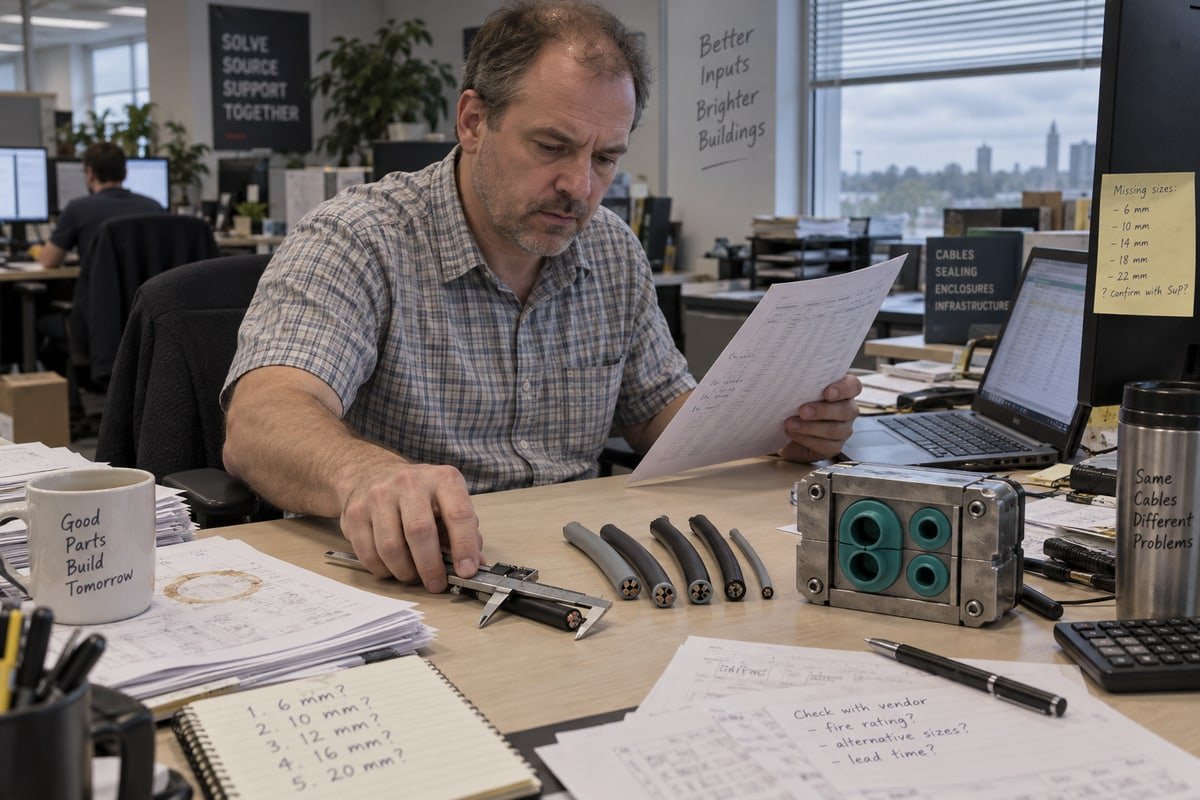
A vague RFQ specification list for a multi cable transit costs weeks. Our factory sees buyers re-quote repeatedly because one cable diameter was missing. A complete list prevents that.
A complete RFQ specification list for a multi cable transit defines the cable schedule with outer diameters and quantities, frame dimensions and mounting method, required fire, IP, water, gas, and blast ratings, spare capacity, certification documents, drawings, installation scope, sample requests, and commercial terms such as delivery and warranty.
An MCT inquiry is a small systems specification. It is not a catalog order. Below I walk through the four parts of the list that decide whether the quote you receive is usable. I start with cross-reference data, then sealing performance, then documents, and finally the commercial structure for samples and custom sizes.
What information do I need to include when requesting cross-reference data for my existing MCT frame?
A European integrator once sent us a photo of a frame and asked for a cross-reference. We needed six more data points before we could match it.
To request cross-reference data, include the existing manufacturer and model numbers of frame, modules, stay plates, and compression unit, the internal frame dimensions, frame material and mounting type, the current module layout with cable outer diameters, and photos or drawings of the installed penetration.
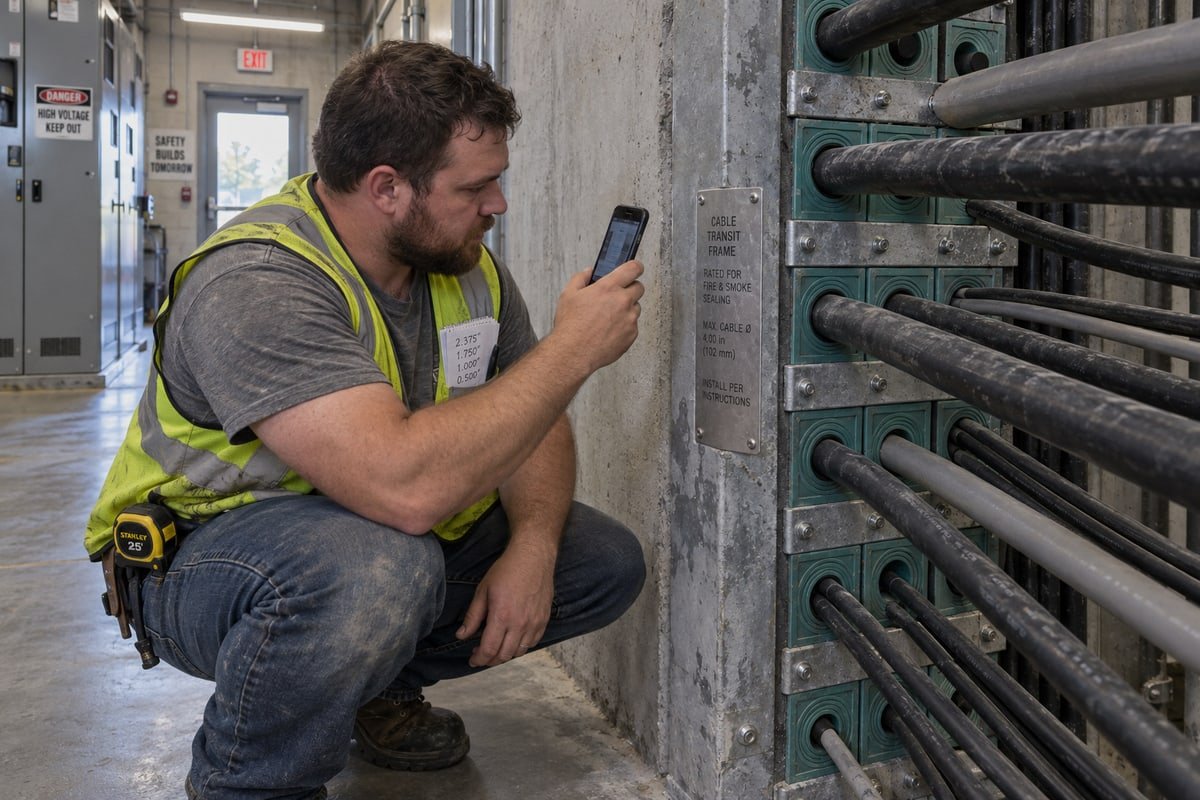
A cross-reference is a dimensional promise. When we say a DewinMCT TSC module drops into a common 120-frame cutout, we are promising width, height, depth, and compression behavior all at once. We can only make that promise if the RFQ gives us the geometry of what is already installed. A photo helps. A nameplate photo helps more. A frame drawing removes all doubt.
Why the 120-frame standard is the starting point
Most legacy MCT installations in switchgear rooms, BESS container 1s, and modular data centers follow a 120 mm frame depth family. Our square modules and stay plates are built to that family, so they act as a qualified second source in an existing opening. But the frame family alone is not enough. Two frames with identical internal frame dimensions can use different stay plate thicknesses or a different compression system. That changes how many module rows fit and how much compression travel remains.
The data fields we ask for before issuing a cross-reference table
| Data field | Why the supplier needs it | Example entry |
|---|---|---|
| Existing brand and frame model | Anchors the cross-reference table entry | Legacy frame type, 4 rows |
| Internal frame dimensions (W × H × D) | Confirms module packing and depth match | 120 × 240 × 60 mm |
| Frame material and grade | Decides weld or bolt fixing and corrosion class | Galvanized steel or stainless steel 316L |
| Mounting method | Welded, bolted, or cast-in changes flange design | Bolted to 6 mm plate |
| Module layout per row | Tells us which module sizes and blank blocks to match | 2×60, 4×30, 1 blank per row |
| Cable outer diameter list | Confirms each module's sealing range covers the cable | 12.4 mm, 18.0 mm, 27.5 mm |
| Compression unit type and count | Matches compression force and travel | Bolted wedge, 1 per frame |
| Stay plate count and thickness | Sets row spacing | 3 plates |
| Photos of nameplate and full frame | Verifies everything above | Attached |
How to read the reply you get back
A serious cross-reference reply lists each existing model next to the DEWIN model, states the sealing range of each module, and flags any row where the match is not one-to-one. Our step-core, halogen-free EPDM modules cover a range of cable outer diameters within one module size, so one DEWIN size sometimes covers two legacy sizes. That is useful, but it should be stated openly, not hidden. We also attach a free validation sample offer to every cross-reference table. A sample in your own frame settles the question in an afternoon. It also supports the 40–60% cost reduction claim with a physical fit test rather than a slide.
How do I specify sealing performance requirements like IP rating and pressure tolerance in my RFQ?
Every extra bar of pressure in a spec pushes compression force and frame stiffness upward. We weigh that against installer effort and cost on each quote.
State each sealing requirement as a number and a test method: IP rating per IEC 60529, watertight and gas-tight pressure in bar or MPa with hold time, fire resistance rating such as A-60 or H-120, blast load in psi, and which side of the penetration faces the hazard.

The most common weakness I see in an RFQ specification list for a multi cable transit is adjectives. "Weatherproof." "Sealed." "Fire safe." None of those can be tested. A number with a method can. Tender documents in energy and infrastructure already do this well. One RFQ we reviewed asked for water tightness at 4 bar, gas tightness at 2.5 bar, blast load resistance at 3 psi minimum, and a 3-hour fire test per UL and OISD 163 2. That is a specification a supplier can price and prove.
Write each requirement as a testable line
| Anforderung | How to write it in the RFQ | Reference values |
|---|---|---|
| Kostenloses Muster anfordern | IP code per IEC 60529, plus immersion depth and duration if beyond the code | IP68 (our tested level) |
| Watertightness | Pressure, hold time, and direction of pressure | 4 bar in one tender; DewinMCT tested 0.01–0.4 MPa |
| Gas tightness | Pressure, test gas, allowable leak rate | 2.5 bar in one tender |
| Fire resistance ratings | Class and duration, plus wall or deck type | A-0/A-60 (our tested classes); H-120 for hydrocarbon fire; 3-hour test per UL and OISD 163 |
| Blast load | Overpressure in psi or kPa and duration | 3 psi minimum in one tender |
| Explosion protection | Hazardous zone and applicable directive | Zone 1 or Zone 2, if applicable |
| Electromagnetic shielding | State if EMC modules or bonding are required | Required or not required |
| Hydrogen permeation | Test method for elastomer modules in H2-ready plant | Required or not required |
| Seal monitoring | Integrated sensors for pressure or seal integrity | Optional line item |
Why direction and hold time matter
A 4 bar hydrostatic pressure testing 3 result on the outside face of a container wall does not describe behavior when pressure comes from inside. The RFQ should say which side faces water or gas. Hold time also matters. A seal that holds 0.4 MPa for one minute and a seal that holds it for thirty minutes are not the same product. Our test documents state pressure, time, and direction, and we release them on request. Ask every bidder for the same three numbers so quotes are comparable.
Do not over-specify by habit
Here is the trade-off. A BESS container in a mild climate does not need an H-120 hydrocarbon fire rating. Specifying it triggers heavier frames and more expensive modules. On the other hand, a switchgear room next to a transformer bay may genuinely need A-60 plus gas tightness. The RFQ should name the application area and let the numbers follow from it. That keeps the supplier honest and keeps your cost down.
Which dimensional drawings and certification documents should I request before sending my MCT inquiry?
One lesson from twelve years of exporting: a certificate without a matching drawing proves little. The tested assembly must be the assembly you buy.
Before sending the inquiry, request general arrangement and cross-sectional drawings, CAD or STEP files, a data sheet per module size, type approval certificates with test reports for fire, IP, and pressure, ISO 9001 or IATF 16949 certificates, and a material declaration for the elastomer and frame.
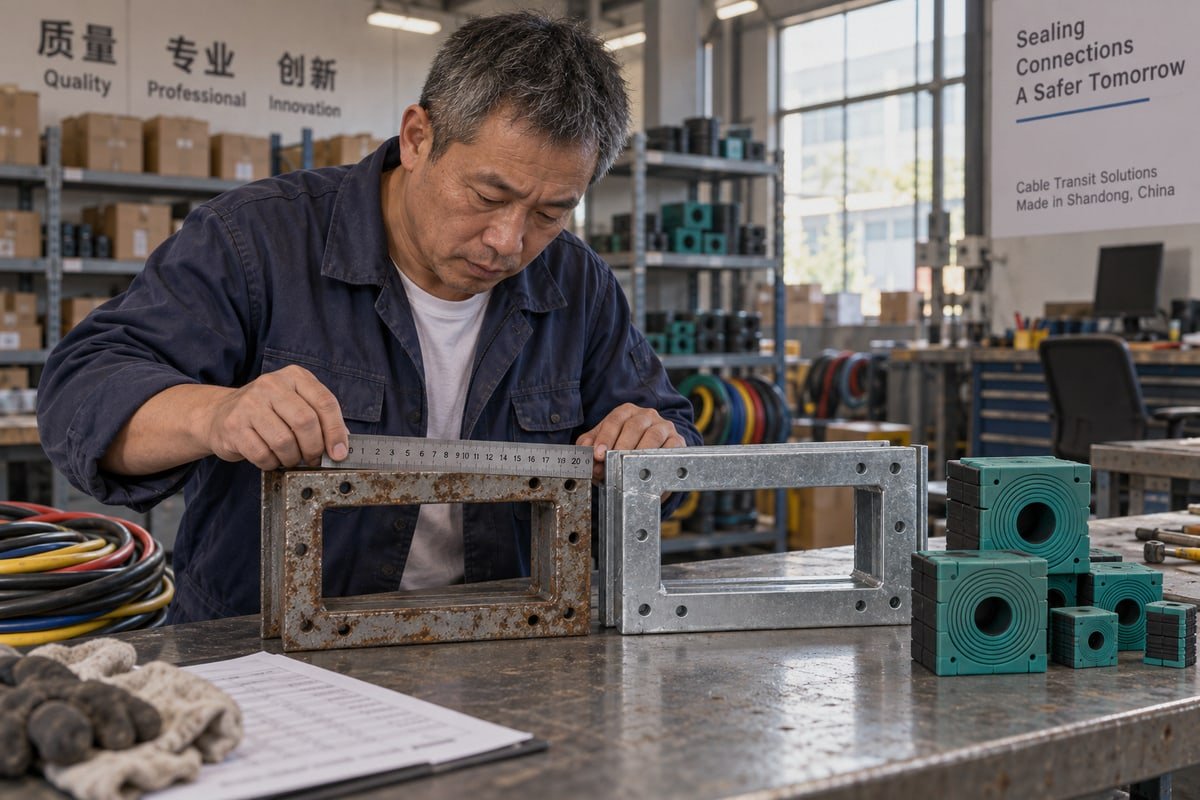
Document requests work best as a numbered checklist inside the RFQ. Bidders then know exactly what proof to attach, and your evaluation team can score each item as present or missing. Below is the order I recommend, from geometry to quality system. Each item answers a specific question that a purchasing engineer will otherwise have to ask by email.
The document pack, in evaluation order
- General arrangement drawing. It shows the frame outline, flange, fixing holes, and internal frame dimensions. Check it against your wall opening or panel cutout.
- Cross-sectional drawing. It shows module stack, stay plates, and compression system in section. This is where depth conflicts appear.
- CAD or STEP files. Your mechanical team drops these into the enclosure model. We supply STEP for TSR round assemblies and TSC square modules so the fit check happens before the sample ships.
- Data sheet per module size. It must state the cable outer diameter range for each step-core module, the material, hardness, and temperature range.
- Type approval certificates and test reports. Ask for the certificate and the underlying report. The report names the tested frame type, module sizes, and elastomer. Compare that list to your drawing.
- Quality system certificates. ISO 9001 4 is the baseline. IATF 16949 5 signals automotive-grade process control, which our factory maintains alongside BV Werkszulassung 6.
- Material declaration. Confirm halogen-free EPDM, and confirm the frame grade, whether galvanized steel or stainless steel 316L.
- Installation and torque instructions. Sealing performance depends on compression, so torque values belong in the pack.
- Inspection options. State whether you want factory acceptance, third-party inspection, or witnessed hydrostatic pressure testing, and who pays.
- As-built and asset data. If your project requires unique digital asset tagging or protected as-built records for lifecycle management, say so now.
Match the certificate to the drawing before award
A type approval certificate lists a tested configuration. If your RFQ calls for a bolted 316L frame with four rows and the certificate covers a welded galvanized frame with two rows, ask the bidder how the gap is bridged. Sometimes the answer is a family approval. Sometimes it is a new test. Either way, you want that answer in writing before the purchase order.
Ask for thermal data in high-density penetrations
Battery containers and modular data centers pack many power cables into one frame. Heat builds up inside the module stack. Request engineering data for thermal de-rating and heat dissipation so your electrical team can check conductor ratings through the seal. If a bidder has no data, that is itself useful information.
How can I structure my RFQ to get accurate quotes for validation samples and custom sizes?
On our mold shop floor, a custom module starts as a dimension sheet, not a drawing. If the RFQ lacks cable outer diameter tolerances, the mold waits.
Structure the RFQ in three blocks: validation samples with exact part numbers and quantities, standard production items with annual volume and delivery schedule, and custom sizes with dimensioned sketches, cable outer diameter ranges, tolerance, and target quantity, so the supplier can quote tooling, unit price, and lead time separately.
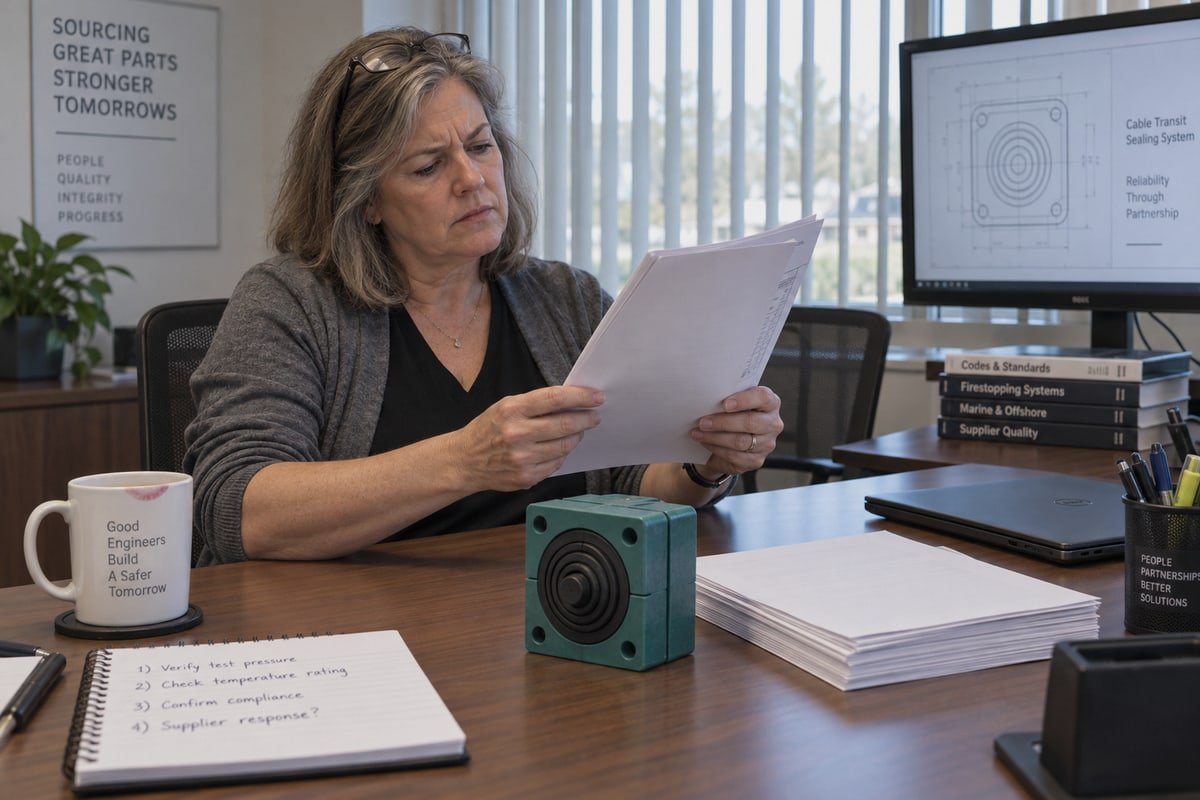
Mixing samples, volume, and custom work into one lump-sum request produces a lump-sum answer. You cannot compare it. Splitting the RFQ into blocks forces each bidder to expose tooling cost, unit cost, and lead time on their own lines. It also lets you award the sample block quickly while the custom block is still under review.
Block-by-block line items
| Block | Line item | Data you provide | What the supplier returns |
|---|---|---|---|
| 1. Validation samples | Modules, blank blocks, stay plates, compression unit | Exact DEWIN or cross-referenced part numbers, quantity, ship-to address | Sample cost or free sample confirmation, ship date, test documents |
| 2. Standard production | Frames, modules, spares | Annual volume, call-off schedule, packaging, Incoterm, delivery location | Unit price per module, per frame, or per penetration; lead time; warranty |
| 3. Custom sizes | Non-standard module or frame | Dimensioned sketch, cable outer diameter min and max, tolerance, material, quantity | Tooling cost, first-article lead time, unit price at volume |
| All blocks | Documentation and inspection | Required certificates, third-party inspection scope | Itemized document list and inspection charges |
How a custom size request should look
Give the cable outer diameter as a range with tolerance, not a single nominal value. Cable makers vary. State the frame opening if the custom module must fit an existing modular sealing system. State the elastomer requirement, which for us means halogen-free EPDM, and state any private-label marking. Because mold making is in-house, we quote tooling and first-article time in the same reply as unit price. That is the difference between a factory and a trading company.
Address the "too much work" objection
Buyers tell me a detailed RFQ takes engineering hours they do not have. That is true, and it is still the cheaper path. A short RFQ shifts sizing risk to the vendor. When the vendor guesses wrong, the mismatch shows up at site as leakage, a failed fire inspection, or a change order. For simple applications with few cables, vendor-led sizing is acceptable. For safety-critical rooms, tender practice clearly favors buyer-defined requirements and explicit acceptance criteria. Reuse your project cable schedule; most of the data already exists.
Do not forget scope, spares, and future expansion capacity
State who prepares the civil opening, who fixes the frame, who installs modules, and who commissions. State mandatory spares: spare modules, blank blocks, and replacement compression parts. State a minimum spare capacity in the frame, often expressed as a percentage of blank blocks, so future expansion capacity is priced in now. Add warranty term, delivery timeline, packaging, and landed-cost basis. Now every quote covers the same scope, and the price comparison means something.
Fazit
Incomplete RFQs cause leaks, re-quotes, and change orders. Each gap becomes a site problem later. Send the cable list, ratings, drawings, and sample request together, and quotes become comparable.
Fußnoten
1. Authoritative Wikipedia article defining battery energy storage systems and their industrial containerized applications. ↩︎
2. UL is the certification body behind the fire test standard referenced in the RFQ example. ↩︎
3. Background on the pressure test method used to verify watertight sealing claims. ↩︎
4. Official ISO page defining the baseline quality management certification mentioned. ↩︎
5. Explains the automotive quality management standard referenced for factory process control. ↩︎
6. Links to Bureau Veritas, the inspection body providing the factory approval mentioned. ↩︎



 English
 Español de México
 Deutsch
 Français
 العربية
 Русский