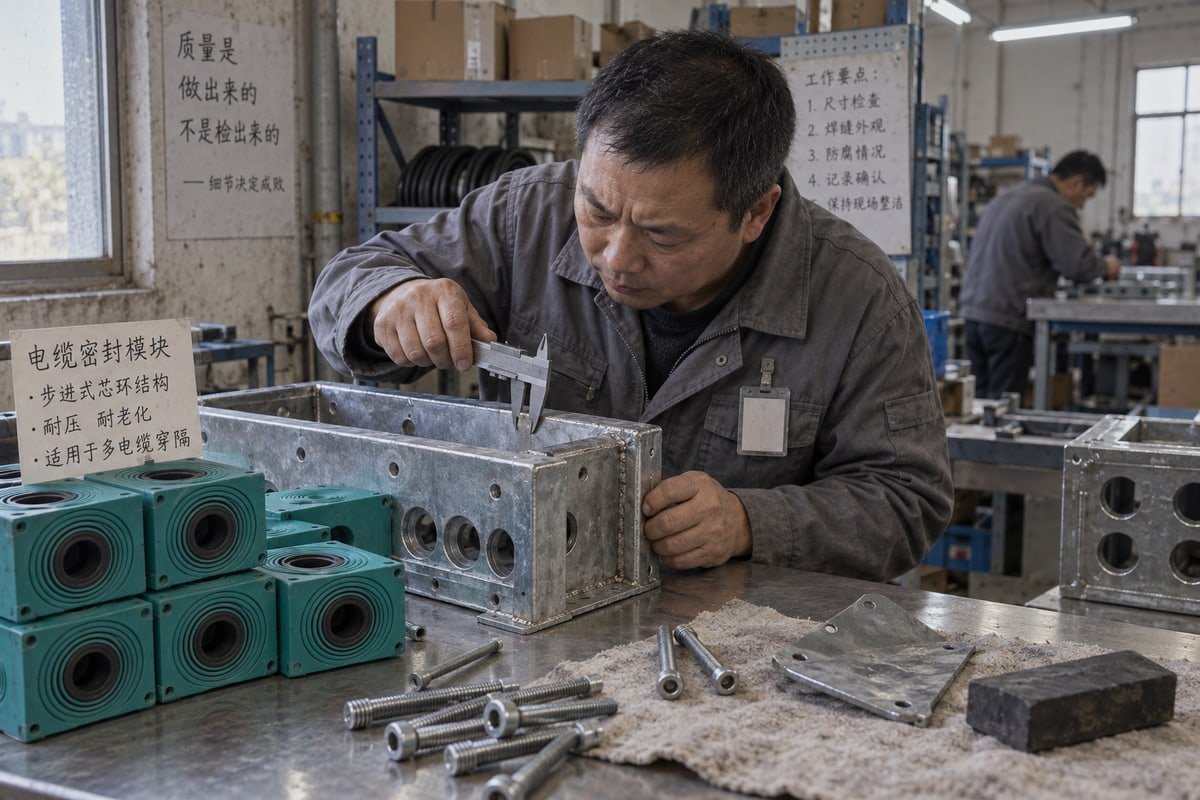
A BESS integrator 1 recently asked our production team whether removed multi cable transit frames and rubber modules could be reused. Guess wrong, a fire seal fails. Here is our process.
Removed multi cable transit frames are usually reusable if undamaged and uncorroded, and metal frames are fully recyclable as scrap. Rubber modules are reusable only after passing condition checks and manufacturer approval; EPDM is thermoset, so recycling means shredding, pyrolysis, or energy recovery.
Reuse and recycling are two different questions. The frame and the rubber answer them differently. I will take each part in turn, starting with the frame, then the modules, then the compatibility check, and finally the recycling routes.
Can I Reuse Removed MCT Frames When Upgrading to a New Cable Transit System?
Our incoming inspection bench in Shaanxi sees plenty of customer-returned frames. Most weld seams survive decommissioning fine. The bolts and stayplates are where we usually find trouble.
Yes. Removed MCT frames can be reused when the frame is straight, uncorroded, weld seams are intact, and the internal opening still matches a standard 120-frame dimension. Replace the compression wedge, stayplates, and bolts, then fit new or verified modules.
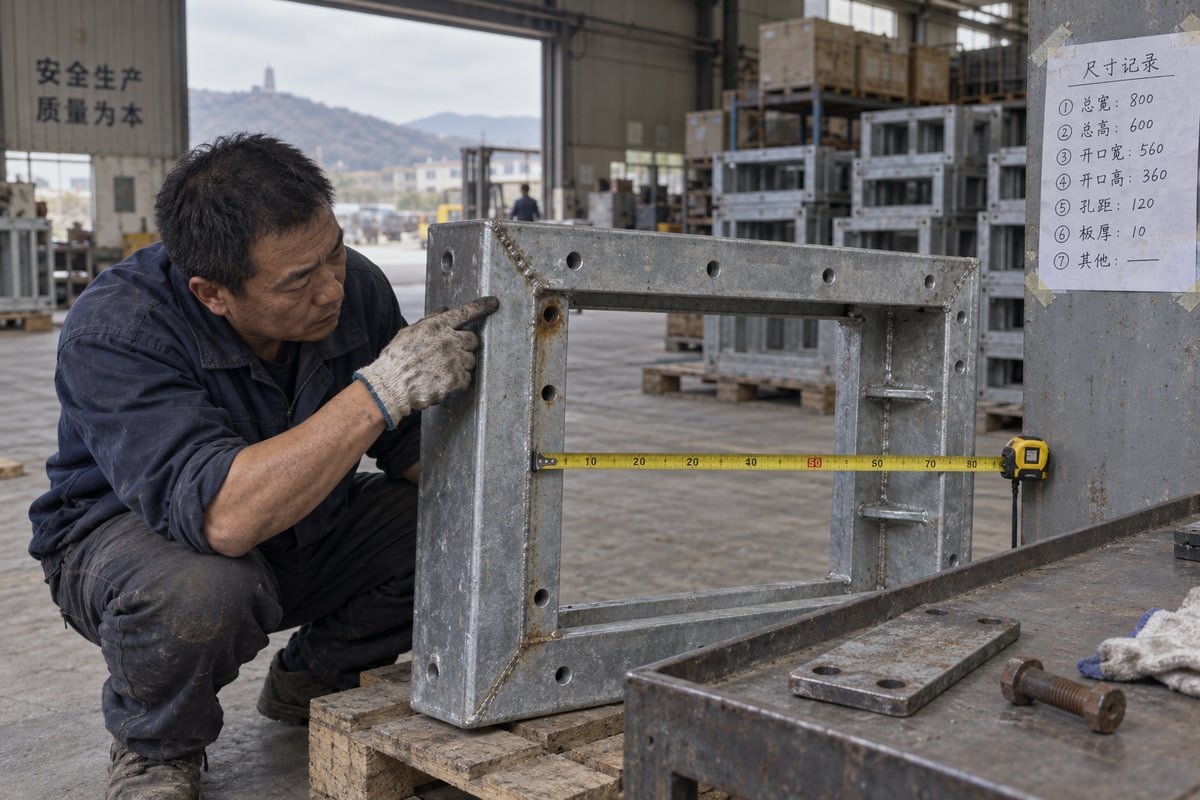
The frame is the easy half of this question. It is a structural steel, stainless steel, or aluminum part. It does not creep, harden, or take a compression set. So when a customer upgrades a container or a switchgear room, the frame is the part I encourage them to keep.
What the frame actually has to do
A multi cable transit frame does three jobs. It holds the module stack square. It carries the load from the compression wedge down through the stayplates. And it provides the bonded, sealed boundary to the wall or bulkhead. If the frame still does those three things, it can go back into service. The fire integrity standards 2 and water-tightness testing apply to the assembled seal, not to the frame alone, so a sound frame does not lose its qualification just because it was removed.
Frame inspection points we use
| Frame component | What we check | Reuse decision |
|---|---|---|
| Weld seams | Cracks, porosity, corrosion under paint | Any crack means scrap the frame |
| Internal opening | Width, depth, squareness against 120-frame standard | Out of square by a visible gap means reject |
| Flange and mounting face | Distortion, pitting, old sealant residue | Clean and reuse if flat |
| Stayplates | Bending, corrosion, worn edges | Replace; they are low-cost wear parts |
| Compression wedge and bolts | Thread damage, seized nuts, deformed wedge | Replace as a matter of routine |
Retrofit frames and the cable run
One trend worth noting: retrofit MCT frames are designed to be installed around existing cable runs. That means the whole cable infrastructure can be reused without disconnection during decommissioning and retrofitting. In that scenario the old frame is cut out and recycled, and the new split frame goes in. Steel and aluminum frames are 100% recyclable as high-value industrial scrap, so the old frame never becomes waste.
The buyer objection I hear most
Some purchasing engineers tell me they would rather replace everything, because a new frame is "cheap insurance." I understand the instinct. But the frame is rarely the weak point. The rubber is. A verified frame plus new, dimensionally compatible EPDM rubber modules gives the same certified seal at a fraction of the cost. That is the honest trade-off.
What Should I Check Before Reinstalling Old Rubber Sealing Modules in a New Project?
There is a real tension we weigh: saving a customer money on spare modules versus signing off a seal we cannot verify. With EPDM rubber modules, we lean toward caution.
Before reinstalling old rubber sealing modules, confirm the manufacturer permits reuse, check that the modules were never pressure-loaded, and inspect for compression set, cracks, hardening, oil contamination, and deformation. Verify the step-core layers still match the new cable diameters, then pressure-test the assembly.
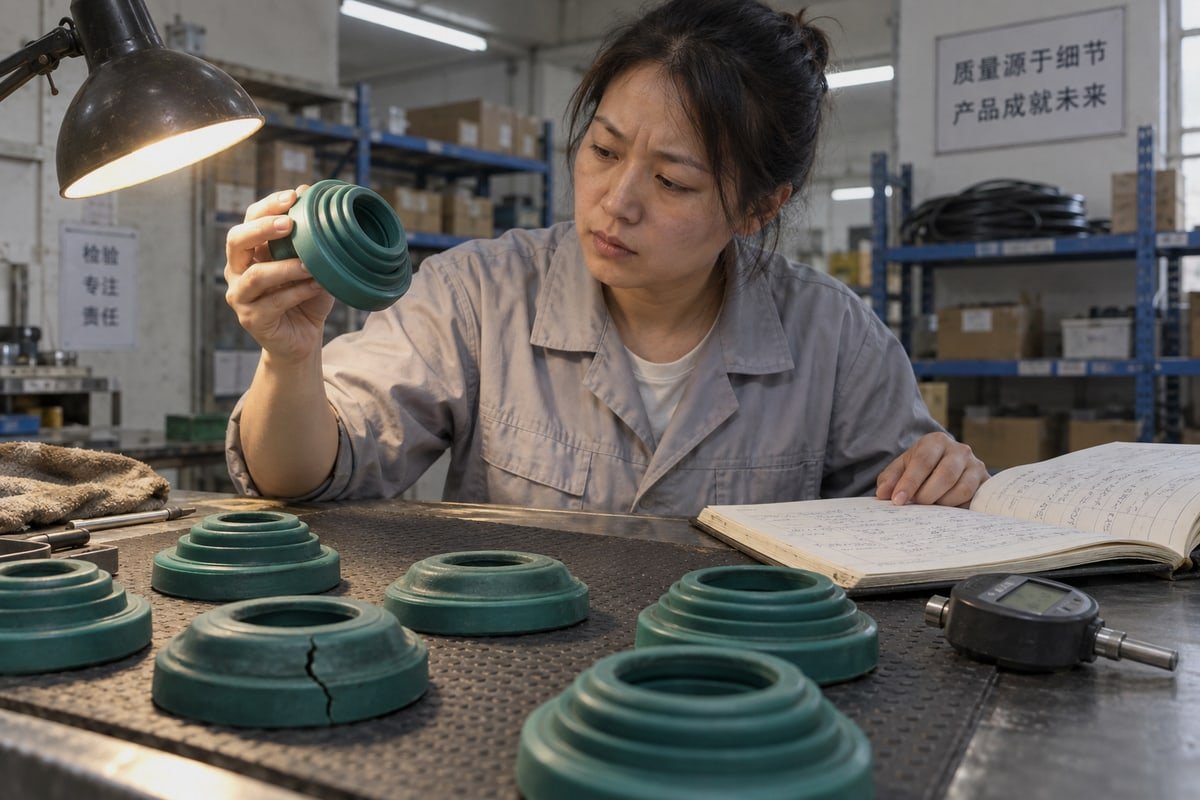
This is where the pro-reuse and cautionary camps disagree, and both have a point. Let me lay out the argument and then give you the checklist we actually use.
Why the two camps disagree
The pro-reuse position says: if the module is still elastic, uncracked, correctly sized, and can hold compression, reuse is economical and cuts waste. Some manufacturers state plainly that their systems can be dismantled and re-used. Others say insert blocks may be reused only if age and environmental impact have left them in a condition that still allows proper sealing.
The cautionary position says: cable penetration seals are safety-critical. If there is any doubt about compression set, chemical exposure, or installation history, replace. One installation guide is blunt about it. If the installation was ever subjected to pressure, all components must be replaced after removal and refitting. Certification regimes such as UL and IMO also generally prohibit reuse of previously compressed modules, because compression set destroys the elastic memory a certified seal depends on.
My view: both are right, and the manufacturer's instructions decide which applies to your specific product.
The inspection sequence
- Pull the paperwork. Find the original installation record. Was the transit ever pressure-loaded or flooded? If yes, stop. Replace all modules.
- Check the age. Older modules and modules from hot or UV-exposed locations show more material degradation. Treat anything with an unknown history as unknown, not as good.
- Look and press. Split each module. Look for cracks at the core, glazing, or a flattened contact face. Press the halves; they should spring back fully.
- Smell and wipe. Oil, diesel, or solvent contamination swells EPDM and softens it. Contaminated modules are scrap.
- Match the core. Our step-core modules adapt to a range of cable diameters within one size. But a core that was peeled to a small diameter cannot be rebuilt for a larger one.
- Test the assembly. After refitting, run water-tightness testing at the rated pressure. Our TSC and TSR assemblies are rated for 0.01–0.4 MPa watertight and gas-tight sealing, and we can supply test documents on request.
Defect-to-decision table
| Finding | What it tells you | Decision |
|---|---|---|
| Halves spring back fully, no cracks, clean | Elastic memory intact | Reuse permitted if manufacturer allows |
| Flattened contact face, slow recovery | Compression set | Replace |
| Surface glazing or hairline cracks | Aging, ozone, heat | Replace |
| Swollen, tacky, or oily | Chemical contamination | Replace |
| Core peeled below new cable size | Wrong size | Replace with correct step-core module |
| Any prior pressure event on record | Seal was stressed | Replace all components |
Spare blocks versus recovered blocks
There is a difference worth respecting. Modules with intact center cores that were installed as blanks are designed as spare blocks for future cable additions. That is design-for-reuse. A block recovered from a compressed, cabled position is a different animal. Some facility teams now use digital material passports to track the age and stress history of individual modules, which makes this decision data-driven instead of guesswork.
How Do I Know If My Existing Frame Cutouts Are Compatible With Replacement Modules?
A sourcing manager in Germany once sent us a photo of a frame nameplate and asked one question: will your TSC modules fit? We asked for three measurements.
Measure the frame's internal opening width, depth, and clear height, then compare them to the 120-frame standard. If the module width, depth, and stack height match, and the compression wedge and stayplates fit, replacement modules from a qualified second source drop straight in.
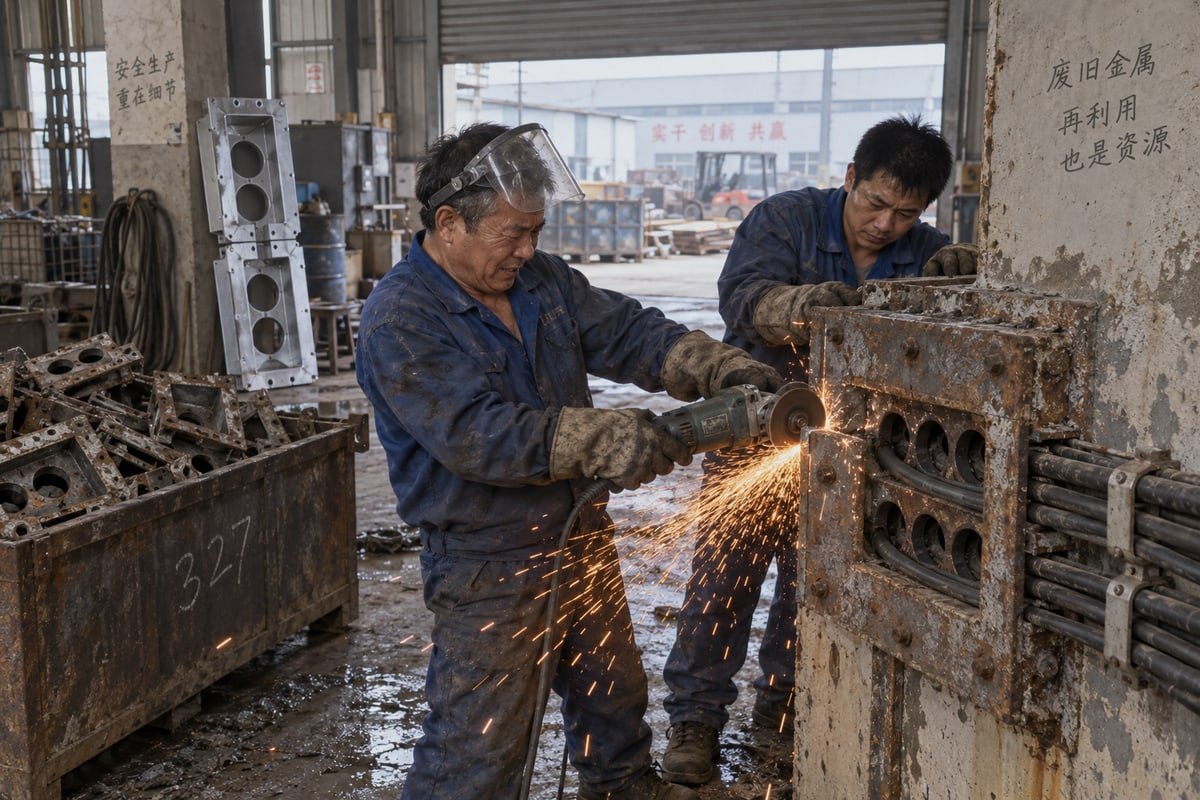
Dimensional compatibility is what makes frame reuse practical. If the replacement modules do not fill the opening correctly, the compression wedge cannot generate uniform pressure, and the seal fails water-tightness testing even with perfect new rubber. So this check matters as much as the rubber inspection.
The three measurements that decide it
Most industrial cable transit frames built for marine, offshore, energy, and enclosure work follow the common 120-frame standard. That means a fixed internal depth and a fixed internal width, with the clear height determined by the frame size. Our TSC square modules and TSR round assemblies are made to those dimensions, so they sit in existing cutouts as a drop-in second source.
Here is what I ask every buyer to send me:
| Measurement | Where to take it | Why it matters |
|---|---|---|
| Internal width | Inside face to inside face, mid-height | Sets module width combinations per row |
| Internal depth | Front face to back face of the frame | Module depth must match, or the wedge cannot load evenly |
| Clear height | Bottom inside face to underside of the top compression zone | Determines how many module rows plus stayplates plus wedge will stack |
| Nameplate data | Photo of the plate between the bolts | Lets us cross-reference the original model |
| Cable list | Outer diameters per cable | Lets us assign step-core module sizes |
Our cross-reference process
We maintain model cross-reference tables that map common existing module designations to the matching DEWIN model. A typical qualification runs like this:
- Buyer sends the three measurements, the nameplate photo, and the cable list.
- Our engineers return a layout drawing with module sizes, stayplate positions, and wedge type. CAD and STEP files are included.
- We ship free validation samples so the buyer can fit-check in the real frame.
- The buyer runs a fit and compression trial. If it passes, the model is added to their approved vendor list as a second source.
This is how integrators in Europe and the Middle East have qualified us at 40–60% lower component cost without changing frames or drawings.
When cutouts do not match
Sometimes a frame is a non-standard custom size. That does not end the conversation. Because we make molds in-house, we can produce custom module sizes or a matching frame. But I always tell buyers that the cheapest path is to confirm the 120-frame match first. Most of the time it is there.
Can I Recycle Halogen-Free EPDM Modules Without Compromising Fire and IP68 Ratings?
One lesson from our early production years: a fire-rated module and a recyclable module are not the same design brief. We had to learn where those two goals collide.
Yes, but only at end of life. Halogen-free EPDM modules can be recycled through mechanical shredding into rubber crumb, pyrolysis into oil and carbon black, or energy recovery. Ratings are never compromised, because recycled material is not put back into certified fire or IP68 seals.
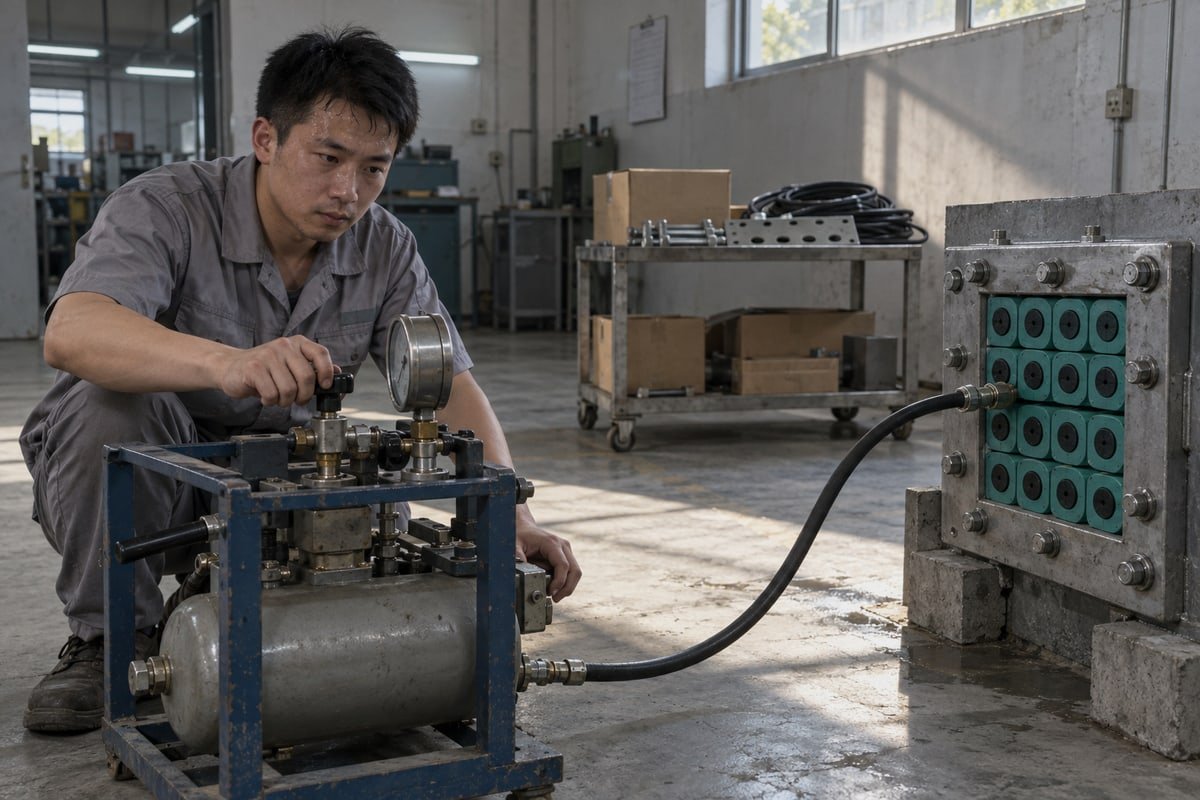
The word "recycle" carries a hidden assumption. People picture the old rubber melting down and coming back as a new module. That is not how EPDM works, and it is not how fire-rated sealing works either.
Why the rating question is a non-issue
Our halogen-free EPDM compound is chosen for A-0/A-60 fire performance and IP68 ingress protection. Those ratings are proven by type testing on virgin material under a controlled process, backed by our ISO 9001 3 and IATF 16949 systems and a BV-approved factory. Recycled elastomer never enters that certified production stream. So the fire and IP68 ratings 4 of a new module are not affected by what happens to an old one. The two questions are simply separate.
Why elastomer recycling is hard
EPDM is a thermoset. Once cured, it cannot be melted and re-molded like a thermoplastic. Fire-rated grades also carry mineral fillers and halogen-free flame retardants. Those additives are good for fire integrity standards but bad for clean material recovery. The stream is also mixed: modules come back with cable jacket residue, sealant, dust, and sometimes oil. Standard rubber recyclers often will not accept it.
| Route | Process | Output | Practical limit |
|---|---|---|---|
| Mechanical recycling | Shredding and grinding | Rubber crumb for mats, playground surfacing, asphalt additive | Downcycling only; contamination lowers value |
| Chemical recycling | Pyrolysis | Industrial oil and carbon black | Limited facility access; economics depend on volume |
| Energy recovery 5 | Controlled incineration with heat capture | Energy | Halogen-free materials burn cleaner, but it is still last resort before landfill |
| Take-back programs | Manufacturer collects removed layers | Research feedstock for closed-loop trials | Pilot scale today, not a routine service |
The recycling-first objection
Some sustainability teams push a recycling-first stance: if reuse is not permitted, recycle rather than landfill. I agree with the goal. But I would reorder it. The cable industry's own guidance puts reuse first, recycling second, energy recovery third. For removed multi cable transit frames and rubber modules, that hierarchy translates to: reuse the frame, reuse only verified spare blocks, then route the rest to a specialist elastomer recycling or pyrolysis partner, and only then to energy recovery.
Where the design is heading
Next-generation modules are being developed with bio-based elastomers and design-for-disassembly features aimed at full material circularity. Halogen-free materials already help here, because they avoid the toxic combustion products that complicate end-of-life handling. Until those materials pass the same fire and IP68 type tests as current EPDM, though, I would not trade certified performance for a recyclability claim.
Fazit
Frames reuse well. Rubber modules reuse only after inspection and manufacturer approval. Recycling is downcycling. Send us your measurements and we will confirm the drop-in fit.
Fußnoten
1. The IEA provides authoritative analysis on Battery Energy Storage Systems (BESS) and their global integration. ↩︎
2. The IMO establishes the international fire integrity standards for cable transits used in marine and offshore environments. ↩︎
3. Official source for the ISO 9001 standard, which defines the quality management requirements for manufacturing certified seals. ↩︎
4. The IEC defines the IP (Ingress Protection) ratings used to certify the water and gas-tightness of sealing modules. ↩︎
5. The EPA provides guidance on the waste management hierarchy, including energy recovery for non-recyclable thermoset materials. ↩︎

 English
 Español de México
 Deutsch
 Français
 العربية
 Русский