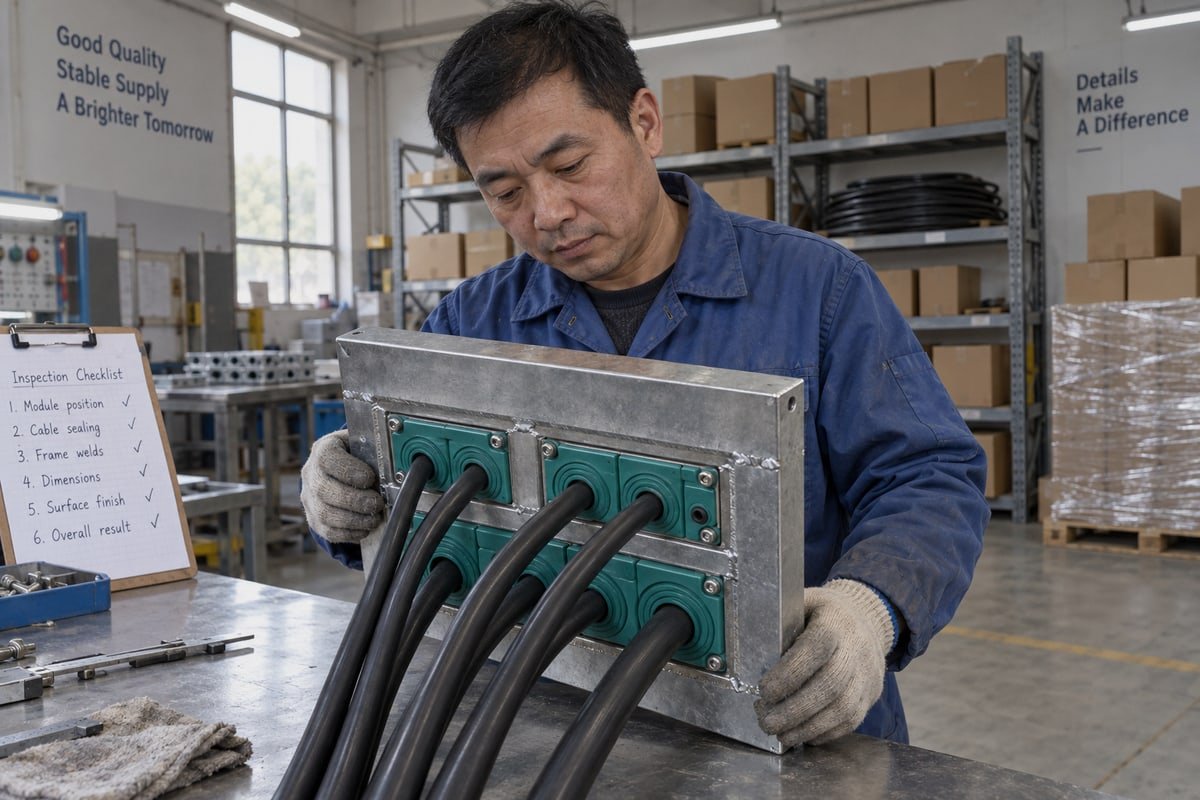
Every week our sales engineers field the same question about sourcing multi cable transit from China: can the price drop without the risk rising? The doubt is fair, and it deserves data.
Sourcing multi cable transit from China typically costs 30–60% less than premium European brands, with comparable A-60 fire, IP68 and gas-tight performance when the factory is certified and audited. Europe still leads on marine class approvals, BIM objects and regional stock; China wins on price, capacity and OEM flexibility.
That is the short answer. The long answer depends on your project. Below I break the comparison into four questions our buyers ask most: cost, certification, drop-in fit, and lead time with support. I will show you what we do at our factory and where a European supplier still earns its premium.
Can I Really Cut My Cable Transit Costs by Switching to a Chinese Supplier Without Losing Quality?
A German switchgear buyer once sent me two quotes side by side. Ours came in at roughly half. His first reply was one line: what did you leave out?
Yes. Switching to a certified Chinese MCT factory typically cuts cable transit component costs by 30–60% without losing quality, provided the supplier proves halogen-free EPDM material traceability, A-60 fire and IP68 test reports, and passes a third-party factory audit. The savings come from scale and direct-factory pricing, not thinner rubber.
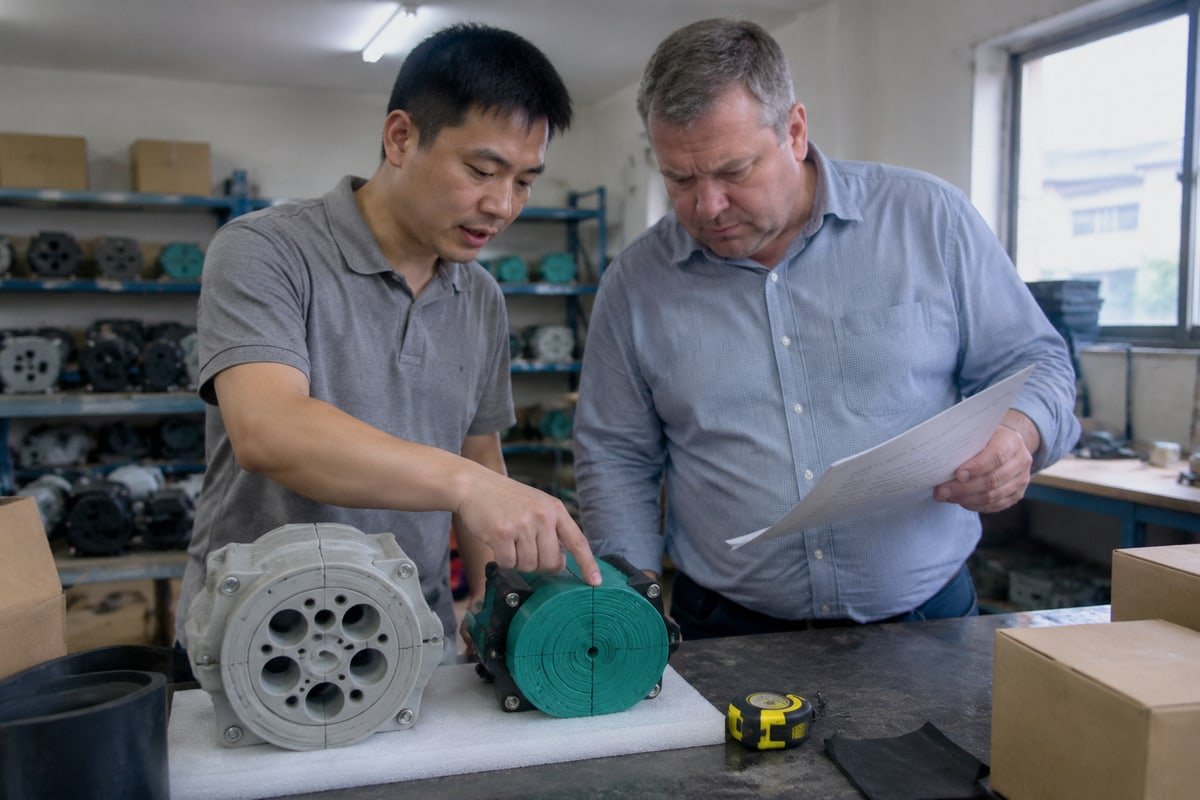
The answer to that buyer was: nothing. We left out the brand margin and the distributor layer. Let me explain where the gap really comes from, and where it does not.
Where the price gap actually comes from
The global MCT market is concentrated. One 2025 report puts the top five players 1 at about 48.3% of global revenue. Roxtec is described as the unambiguous global leader, present in more than 80 countries. MCT Brattberg invented the multi cable transit seal. These companies carry patents, global sales offices, regional stocking centers, and consultant relationships. All of that is priced into every module.
Pages that already rank on this topic quote unit costs 30% to 50% lower from China. Our own factory-direct pricing lands at 40–60% below the European list price for a like-for-like modular sealing system. The difference comes from four places:
- No distributor margin. We sell from the factory in Shaanxi, with plants in Shandong and Hunan.
- In-house mold making. We do not buy tooling from a third party.
- Volume. China's MCT market is growing faster than Europe's in most reports. One estimate puts China at about USD 600 million in 2024 with an 8.0% CAGR, against Europe at about USD 1.0 billion and 7.2%. That volume keeps our lines busy.
- A simpler product range. We focus on TSR round assemblies, TSC square modules, frames, compression units, stay plates and spares. We do not fund a global marketing organization.
Total cost over a 25-year asset life
Here is the fair objection from the research side. A European system can yield lower total cost of ownership over a 25-year asset lifespan through better retrofit-ability and lower maintenance. That is true when the Chinese module fails early, or when it does not fit the existing frame and forces rework. It is not true when the module is dimensionally compatible and passes the same tests.
So the honest comparison is not unit price. It is this:
| Cost factor | Premium European brand | Certified Chinese factory (DEWIN) |
|---|---|---|
| Unit price | Baseline | 40–60% lower |
| Fire / water / gas test evidence | Standard | A-0/A-60, IP68, 0.01–0.4 MPa reports on request |
| Rework risk from poor fit | Very low | Very low if 120-frame compatible and sample-validated |
| Spare module availability | Regional stock | Fast factory dispatch of spare sealing modules |
| Brand margin and distributor layer | Included | Not included |
| Approval delay risk on class projects | Low | Depends on required class body |
The objection: cheaper must mean cheaper rubber
I hear this in almost every first call. My answer is to send a free validation sample and the material data. Our EPDM rubber modules are halogen-free and step-core. You can cut one open, measure the durometer, and burn a sliver to check for halogen. Quality consistency does vary across the Chinese market. That is exactly why I encourage a factory audit rather than a brochure review. A real factory with ISO 9001 and IATF 16949 systems 2 can show you batch records. A trading company cannot.
How Do I Verify That Chinese MCT Modules Meet the Same Certification Standards as My European Supplier?
During a witnessed fire test, our lab ran a TSC module assembly through a full A-60 cycle 3 while the buyer's inspector timed the cold-side temperature rise himself.
Verify Chinese MCT modules by requesting the test reports and certificates, not brochure claims: A-0/A-60 fire test reports, IP68 and gas-tight pressure test data, ISO 9001 or IATF 16949 certificates, class approvals such as Bureau Veritas, DNV, ABS or Lloyd's Register, then confirm batch material traceability through a factory audit.
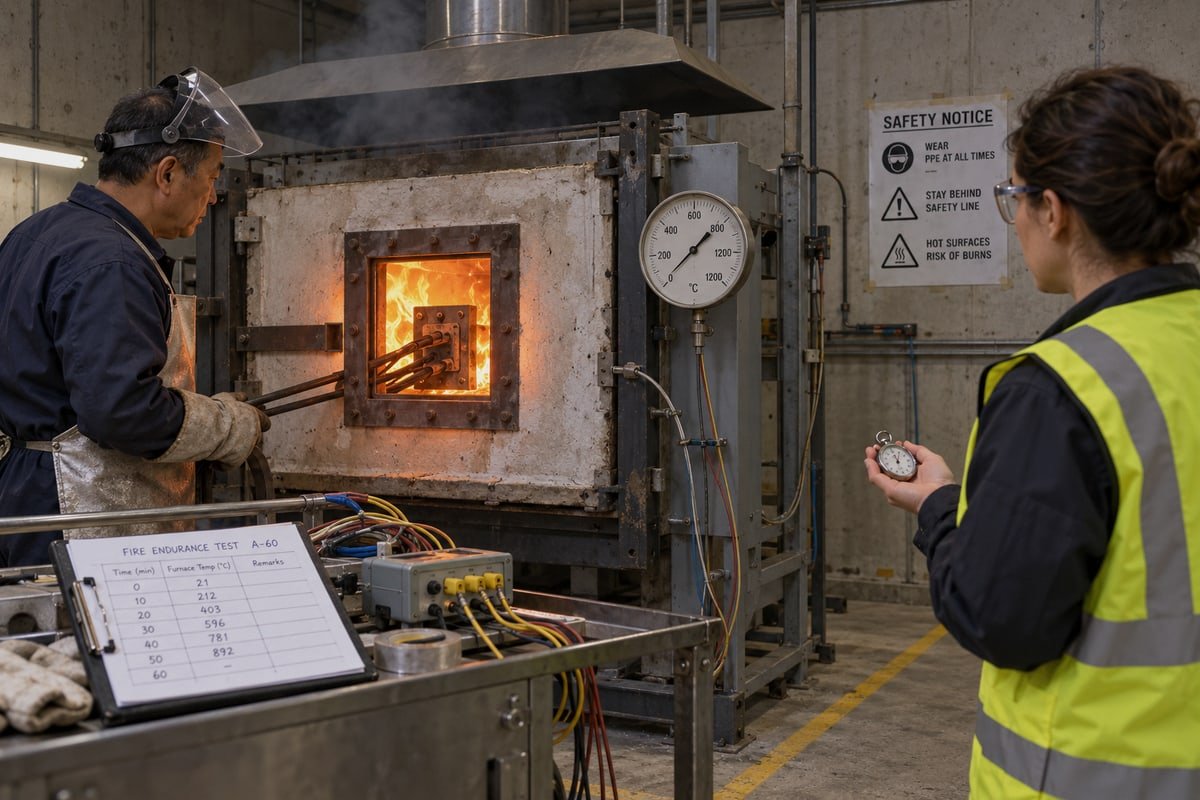
That inspector went home with a stamped report, not a promise. That is the standard I suggest you hold every supplier to, from either region. Certification is where the research and the ranking pages agree most strongly. European brands like Roxtec and MCT Brattberg hold a dominant share of marine and offshore 4 approvals. Those approvals are mandatory in high-risk environments. So the real question is which certificate your project actually needs.
Which certificate covers which risk
| Requirement | What it proves | Who typically issues it | What to ask a Chinese supplier for |
|---|---|---|---|
| A-0 / A-60 fire rating | Fire-rated cable seals hold integrity and insulation for the rated time | Accredited fire lab, class society | Full test report with drawing of tested assembly |
| IP68 ingress protection | Watertight cable penetration under immersion | Accredited test lab | Test report with pressure and duration |
| Gas-tight / watertight pressure | Seal holds at stated pressure | Factory or third-party lab | Pressure test data, 0.01–0.4 MPa in our case |
| ISO 9001 / IATF 16949 | Quality management system | Certification body | Certificate number, scope, expiry |
| Class approval (BV, DNV, ABS type approval, Lloyd's Register certification) | Product accepted for marine / offshore | Class society | Certificate with product range listed |
| Halogen-free EPDM | Low smoke, no corrosive gas in fire | Material test lab | Material data sheet and batch test |
Marine class approvals versus industrial projects
Here is the trade-off stated plainly. If your project is an offshore platform or a classed vessel, the specification will often name DNV, ABS or Lloyd’s Register. European suppliers have decades of certification pathways with those bodies. That is a real advantage and I will not pretend otherwise. Our factory is BV-approved, and we provide A-0/A-60 fire, IP68 and gas-tight test documents 5 on request. For a BESS container, a modular data center, or a switchgear panel, those documents usually cover the specification. For a classed marine hull, check that the exact class body on your drawing is on the supplier's certificate. Do not assume one class approval equals another.
Audit and material traceability
Certification proves a sample passed once. Material traceability proves the module in your hands matches that sample. Our IATF 16949 system means every rubber batch has a compound record, a cure record, and a lot number molded into the block. When a buyer audits us, I show the batch log for the modules in their sample box. I recommend you ask any Chinese supplier for this. If they cannot trace a block back to a compound batch, the certificate is not protecting you.
Will a Chinese-Made Sealing Module Actually Fit My Existing 120-Frame Cutouts Without Redesigning My Panel?
The trade-off we weigh with every new mold is simple: match the 120-frame envelope exactly, or chase a slightly cheaper block that forces the buyer to redesign.
A Chinese sealing module fits existing 120-frame cutouts without panel redesign only if it is built to the same module envelope, stay plate pitch and compression unit height. Dimensionally compatible modules like DEWIN's TSC series drop in; confirm fit with a cross-reference table, STEP files and a free validation sample.
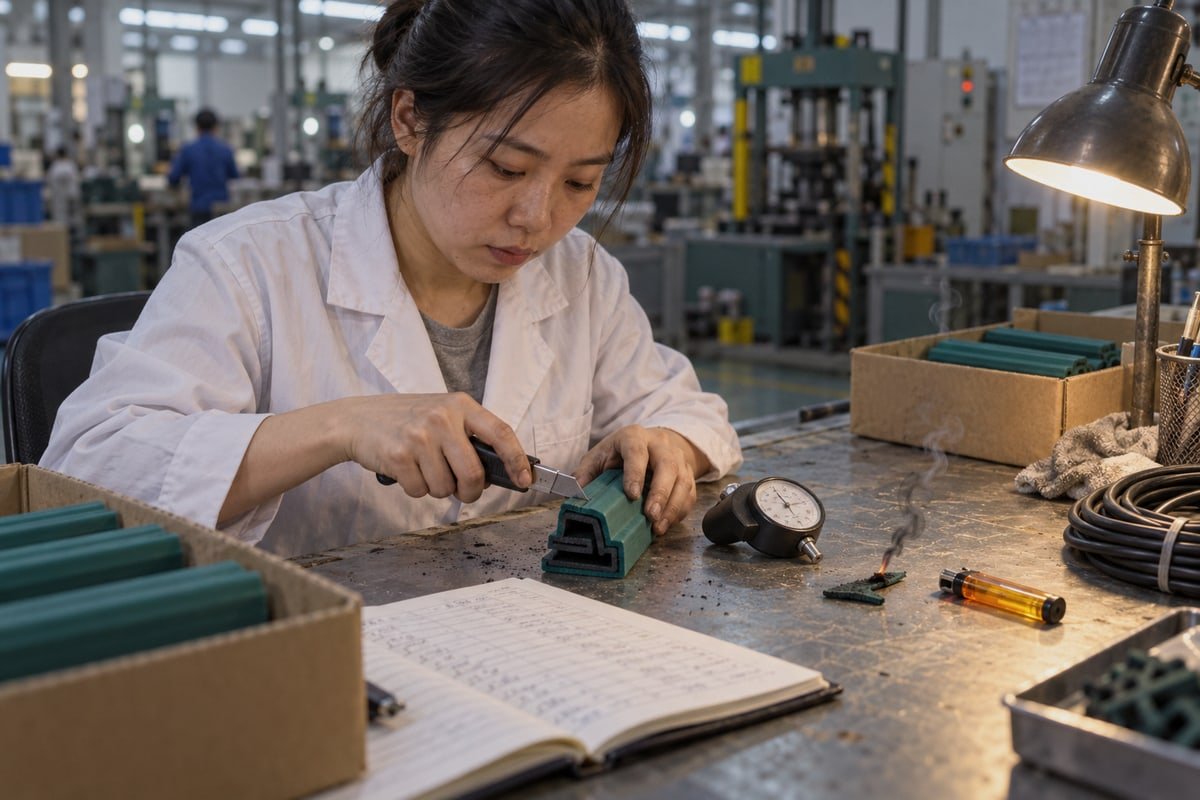
We always choose the exact envelope. A module that saves a few cents but does not fit is worthless to an integrator with hundreds of panels already cut. Drop-in second sourcing is our first differentiator, so let me show what "compatible" means in practice.
What 120-frame compatible really means
A multi cable transit is a stacked system. The frame is welded or bolted into the wall or bulkhead. Inside it, rows of EPDM rubber modules sit between stay plates. A compression unit at the top pushes the stack down so every module seals against its cable and its neighbor. For a second-source module to drop in, five things must match:
| Fit point | Why it matters | How we confirm it |
|---|---|---|
| Module outer envelope | Fills the row width exactly | Cross-reference table, existing model to DEWIN model |
| Row height stack-up | Rows must sum to the frame opening | STEP file overlay against your frame drawing |
| Stay plate pitch and thickness | Plates must sit in the same slots | Sample fit in your own frame |
| Compression unit stroke | Must reach full compression in the same space | Torque and stroke check on sample |
| Cable diameter range per module | Step-core must cover your cable list | Cable schedule review before quoting |
A five-step drop-in validation
This is the process I run with every new OEM buyer. It usually takes a couple of weeks door to door.
- You send us your current module list and frame drawing. Brand names are fine; we work from them.
- We return a cross-reference table mapping each existing model to a DEWIN TSC or TSR model, with CAD/STEP files for each.
- We ship a free validation sample set, including stay plates and a compression unit if you want to test the full stack.
- Your technician installs the sample in a real frame from your production line, with your real cables, and compresses it to your usual torque.
- You send back the result. If a size is missing, our in-house mold shop makes a custom module. We do not ask you to change the panel.
Where Europe still has an edge on the design side
I will be direct here. European manufacturers are further ahead on BIM objects and digital twin integration. If your engineering team designs transits automatically inside a 3D workflow, ask whether the Chinese supplier can supply native STEP and DWG files for every module and frame. We can. A full BIM library is a different matter, and you should check that before you commit. The same applies to special variants such as electromagnetic shielding (EMC) modules. Confirm they are on the supplier's drawing list. Do not assume a standard block covers an EMC specification.
The step-core design helps here too. One module size adapts to a range of cable diameters, so your bill of materials shrinks. Fewer part numbers means fewer chances for a wrong block in the frame.
How Do I Manage Lead Times and Technical Support When Switching from a European to a Chinese MCT Manufacturer?
One lesson from a decade of exporting to Europe: a buyer rarely leaves a supplier over price. They leave when a container slips three weeks and nobody answers the phone.
Manage the switch by dual sourcing: keep the European supplier for urgent stock, qualify the Chinese factory with a pilot order, agree fixed production lead times and safety stock in writing, and require English technical support with CAD/STEP files and a named engineer who answers within one working day.
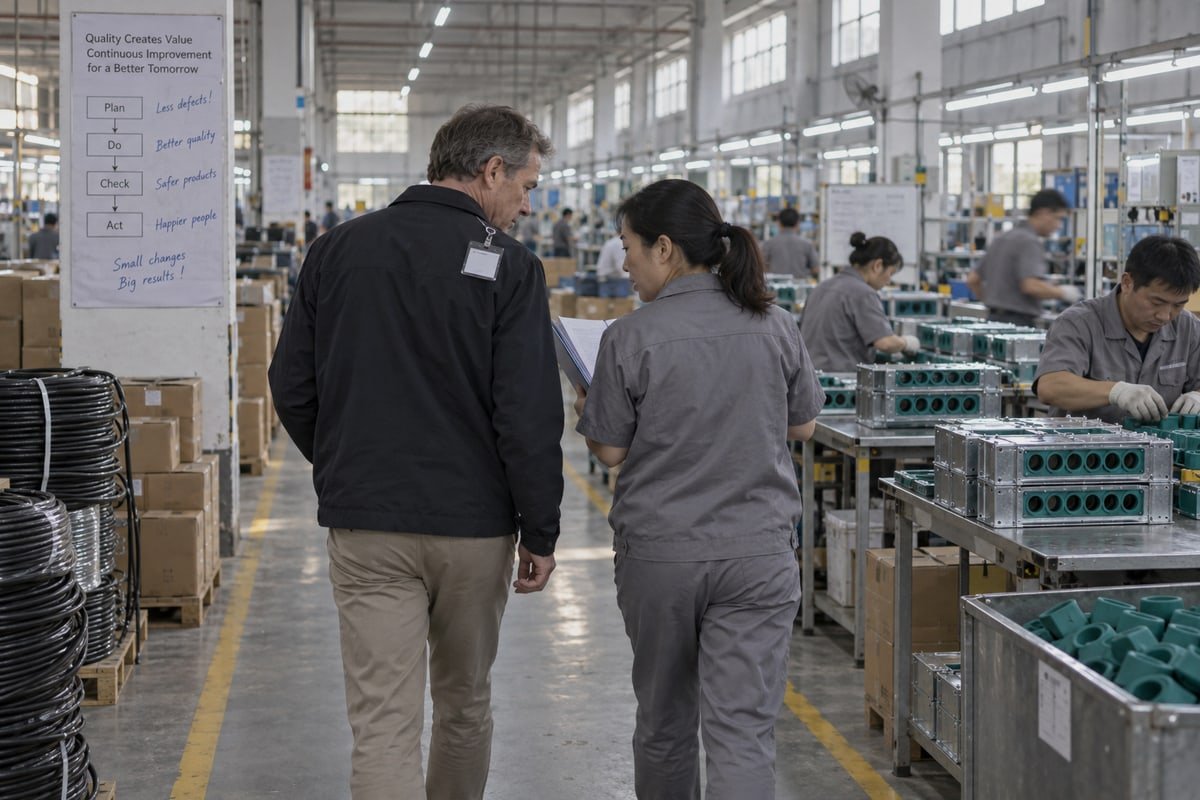
That lesson shaped how we run export orders today. Let me separate the two halves of the question, because they fail for different reasons.
Supply chain lead times: stock versus production
The ranking pages are right on one point. For a Western project, a European brand with a regional stocking center will usually ship an emergency order faster than any factory in China. Sea freight alone adds weeks. So I never tell a buyer to switch overnight. I tell them to plan the switch around two different order types:
| Order type | Best source | Why |
|---|---|---|
| Emergency spares, one or two frames | European regional stock, or your own safety stock of DEWIN spares | Days matter more than price |
| Planned production batches for BESS containers, data center modules, switchgear lines | Chinese factory | Predictable schedule, 40–60% saving, capacity to scale |
| New custom size or private-label run | Chinese factory with in-house molds | Tooling and production in one place |
| Classed marine retrofit with tight class body requirement | European brand or whichever supplier holds that exact approval | Approval pathway drives the timeline |
Chinese factories have scaled capacity fast, which suits high-volume, lower-complexity infrastructure builds. Our three plants let us run standard TSC and TSR modules in parallel with custom molds. What we ask of the buyer is a rolling forecast. With that, we hold spare sealing modules ready and dispatch them quickly, with export documentation handled on our side.
The support model
European firms offer standardized on-site installation training. Most Chinese suppliers offer remote support. That gap is real, and you should price it into your decision. Here is how we close it:
- Every quote comes with CAD/STEP files and a packing drawing for the frame.
- A named English-speaking engineer owns your account, not a shared inbox.
- Video-guided first installation, with your technician on camera and our engineer watching torque and packing order.
- Test documents, cross-reference tables and material data sheets sent before the first order, not after a problem.
Tariffs, regional sourcing and sustainability paperwork
Two more objections deserve a straight answer. First, geopolitical risk 6 and shifting tariffs are pushing some buyers toward regional sourcing. That argues for dual sourcing, not for never qualifying a Chinese second source. The buyer who already holds a validated Chinese module and cross-reference table can switch volume in either direction as duties change. Second, Environmental Product Declarations and Scope 3 tracking are becoming procurement criteria, and European brands hold a first-mover advantage there. If your tender scores on that, ask us for material data and manufacturing location data early. We are a real factory, so we can supply it. A trading company cannot.
Fazit
Overpaying for cable transits is a slow leak in every panel budget. Match sourcing region to the project's compliance load, then qualify a certified second source with samples and documents.
Fußnoten
1. Authoritative source for global market revenue and industrial sector growth statistics used in the cost analysis. ↩︎
2. Official ISO page for the quality management standards required for manufacturing traceability and certification. ↩︎
3. The IMO sets international standards for A-60 fire safety ratings in marine and offshore environments. ↩︎
4. Lloyd’s Register is a primary authority for the marine and offshore class approvals discussed in the article. ↩︎
5. The IEC defines the IP (Ingress Protection) ratings, including IP68, mentioned for sealing performance. ↩︎
6. Official US government resource for managing international trade, tariffs, and geopolitical supply chain risks. ↩︎


 English
  Español de México
  Deutsch
  Français
  العربية
  Русский