
Warranty claims for multi cable transit 1 parts stall when nobody owns the claim. I have watched our export team untangle disputes where downtime cost more than the module itself.
Warranty claims for multi cable transit parts work best under a split model: the local distributor handles intake, triage, and immediate replacement, while the China supplier performs technical validation and reimburses justified costs for verified manufacturing defects, with freight and evidence rules written into the contract.
That answer sounds simple. In practice, it only works if four questions are settled before the first purchase order. Who inspects? Who approves? Who pays freight? Who absorbs downtime? The sections below walk through each one from the factory side of the table.
How can I verify that a China-based MCT manufacturer will honor warranty claims without excessive delays?
A German panel builder 2 once sent our QC team a video of a weeping seal before sending a single email of complaint. That video settled the claim in days.
Verify a China MCT supplier's warranty behavior by requesting its written RMA procedure, response-time commitments, a named English-speaking technical contact, proof of ISO 9001 and third-party factory approval, free validation samples, and references from existing distributors, then test the process with a small trial order.

The phrase "we honor our warranty" appears on every supplier website. It tells you nothing. What tells you something is whether the supplier can hand you a document that describes each step of a claim, who signs off, and how long each step takes.
Ask for the process, not the promise
When a purchasing engineer in Europe asks us about warranty, we send the RMA procedure first and the marketing brochure second. A usable RMA procedure covers written notice, photo and video evidence, defective sample return, the approval point, and the remedy. Market terms we see from other suppliers follow a similar shape. One common term requires claims within 12 months of shipment and asks that the installed cable transit be inspected before removal where practical. Another states that no credit is issued until the defect is verified. Those clauses are not red flags. They are the normal quality assurance standards behind a real claim. The red flag is a supplier who cannot show you any of them in writing.
Signals that separate a reliable factory from a trading desk
| Signal to request | What it proves | What its absence suggests |
|---|---|---|
| Written RMA procedure with time steps | Claims follow a repeatable path | Claims are handled ad hoc |
| ISO 9001 and IATF 16949 certificates | Nonconformance is logged and traced | No formal corrective action loop |
| Third-party factory approval, such as BV | An outside body has audited production | Self-declared quality only |
| Named English technical contact | Technical support availability is real | Sales staff relaying engineer answers |
| Free validation samples | The supplier is confident in dimensional fit | Fear of pre-qualification testing |
| Batch codes on modules | Traceability for warranty eligibility | Cannot link a failed part to a production lot |
Should every claim flow back to the factory?
Some buyers argue that the factory should be the only judge of a claim. The factory controls design, rubber compound 3, and final technical judgment. That view has merit. It prevents a distributor from granting concessions that the factory later refuses to reimburse. But it fails on speed. A module in a BESS container 4 in Rotterdam cannot wait for a video review in Shaanxi during a public holiday. So we position our factory as the technical backstop. We validate, we decide on root cause, and we recover cost for true manufacturing defects. The front line stays close to the site. That is how warranty claims for multi cable transit parts stay fast and still stay fair.
The cheapest way to verify all of this is a trial order. Buy a small lot of spare sealing modules. Then run a mock claim. Ask for a batch trace and a written response. The speed of that reply predicts the speed of a real one.
What documentation and test certificates should I require upfront to support future warranty claims on cable transit modules?
Every document we attach to a shipment costs us time. Skipping them costs the buyer far more when a claim lands twelve months later.
Require batch-traceable test certificates for fire rating, IP68 ingress protection, and pressure sealing, plus material declarations for halogen-free EPDM, a signed warranty statement defining the start date and remedies, installation instructions, and an installation record with torque values and dated photos.
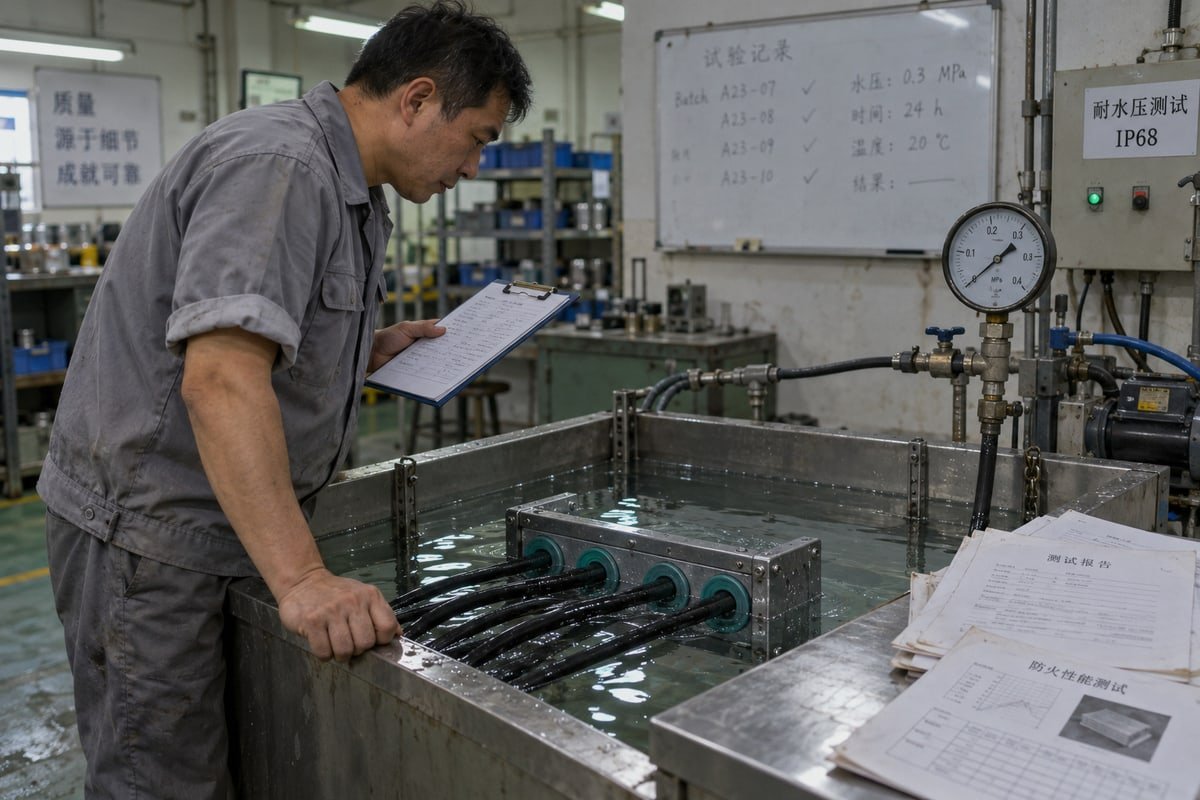
A warranty claim is an argument about facts. The buyer says the module failed. The supplier asks why. Without documents, that argument runs on opinion. With documents, it runs on evidence. Our engineers spend a lot of time on this stage because a well-documented order almost never becomes a disputed claim.
The document pack we recommend before shipment
| Document | Why it matters in a claim |
|---|---|
| Fire test report for A-0 or A-60 rating | Proves the firestop sealing system met its rated performance at production, not just on a datasheet |
| IP68 ingress protection test report | Anchors the water-tightness claim to a tested design |
| Pressure test data across 0.01–0.4 MPa | Shows watertight and gas-tight range for the module family |
| Material declaration for halogen-free EPDM | Rules out compound substitution as a cause of premature aging |
| Batch or lot code list matched to the packing list | Links each module to a production date and inspection record |
| Signed warranty statement | Fixes the start date, remedy, exclusions, and liability cap in writing |
| Installation instructions with torque values | Defines what correct installation looks like before anyone argues about it |
Buyers in marine and offshore work should also ask whether a module carries DNV type approval or another class approval relevant to their vessel or platform. Our factory holds BV approval, so we tell buyers to match the approval body to the project rule set rather than assume one covers all.
Fix the warranty start date
Market listings for cable transit systems often advertise a 12-month warranty from shipment unless otherwise specified. For a site-installed system, that clock can run out before the project is even commissioned. Some buyers therefore negotiate the start date from commissioning or handover. We accept that discussion when the buyer also commits to storage conditions and an installation record. The two go together. A later start date without an installation record just moves the argument, it does not end it.
The installation record that wins claims
- Photograph the empty frame and the module stack before compression, with a visible date.
- Record the compression bolt torque and the tool used.
- Note cable diameters against the step-core range printed on each module.
- Keep the installer's installation certification or training record on file.
- Store the file with the batch codes from the packing list.
This is where the digital twin trend comes from. Some overseas suppliers now ask for timestamped 3D data or structured photo sets so that a claim can be validated remotely. Blockchain-style batch traceability is also emerging to confirm authenticity without manual invoice checks. Neither is required to win a claim today. A dated photo set and a batch code do most of the work. But the direction is clear: the burden of proof is shifting toward documented installation, and buyers who prepare for that will settle claims faster.
Does buying from a local distributor actually reduce my risk compared to sourcing directly from the factory?
A sourcing manager in the Netherlands asked me last year whether buying through a distributor was just paying for a middleman. My honest answer was: sometimes.
A local distributor reduces downtime risk through buffer stock, on-site inspection, and regional legal recourse, but it does not remove product risk; a certified factory-direct supplier with a written after-sales service agreement, spare stock commitments, and third-party inspection can match most of that protection at lower cost.

The question deserves a side-by-side view before any opinion. Here is how the two routes compare on the points that actually decide a warranty outcome.
| Warranty factor | Local distributor | China factory-direct |
|---|---|---|
| Last-mile freight for replacements | Usually absorbed by the distributor | Often billed to buyer, plus shipping and customs duties |
| Technical inspection | On-site assessment possible | Remote review of photos and video, or hired third-party inspection |
| Replacement part availability | Buffer stock held for contingencies | Tied to spare stock at factory or next production cycle |
| Legal recourse | Regional commercial law | International trade terms and jurisdiction clauses |
| Communication | Shared time zone and language | Time zone gap, risk of translation errors |
| Warranty scope | Sometimes a system warranty covering installation integrity | Usually component-only, excluding labor and consequential loss |
| Unit cost | Distributor margin included | Typically 40–60% lower for compatible drop-in modules |
What the distributor genuinely adds
The distributor-first argument is strong on one point. The distributor sold the product into the local market 5 and understands the installation context. It can be on site within a day. It can hold spare modules on a shelf. It answers the phone in the buyer's language. For an end user, this is what "one accountable party" means. Nobody on a project wants to arbitrate between a factory and a reseller while cables sit unsealed. I do not dispute any of that.
What the distributor does not change
The distributor does not make the rubber. If a module fails because of a compound or molding defect, the distributor is a messenger. It will file a supplier recovery claim upstream and wait for the factory's answer, just as a direct buyer would. So the real risk reduction from a distributor is downtime risk, not product risk. Product risk is reduced by certification, batch traceability, and validation samples, and those are available directly from the factory.
The middle path most of our OEM buyers choose
Integrators building BESS containers or modular data centers often buy direct because their volumes justify a warranty agreement of their own. In those cases we see three tools close most of the gap with a distributor. First, a written after-sales service agreement that names the RMA steps, response times, and who pays freight. Second, a committed spare module stock, either at our factory or consigned to the buyer's site. Third, a third-party inspection option, where the supplier pays a local independent surveyor to verify a disputed claim. That hybrid gives the speed of local inspection without the distributor margin. Some distributors are also now empowered to authorize on-site refurbishment or recycling of heavy steel frames instead of shipping them back, which supports ESG targets. A direct agreement can grant the same authority to the buyer's own installer.
So the answer to the Dutch sourcing manager was this. A distributor reduces your risk if you have no spare stock, no installer certification, and no time for remote evidence. If you have those things, a certified factory with a written agreement carries most of the same protection at a much lower module cost.
How do lead times and shipping logistics affect warranty resolution when I source cable transit parts internationally?
We learned early on that a replacement module sitting in customs is worth nothing to a BESS container waiting at the port. That lesson changed how we stock spares.
International sourcing adds freight time, customs clearance, and duty questions to every warranty replacement, so resolution depends on pre-agreed rules: who pays return shipping, whether defective samples ship before replacements, a spare-module stock held locally or at the factory, and separating carrier damage claims from product warranty.
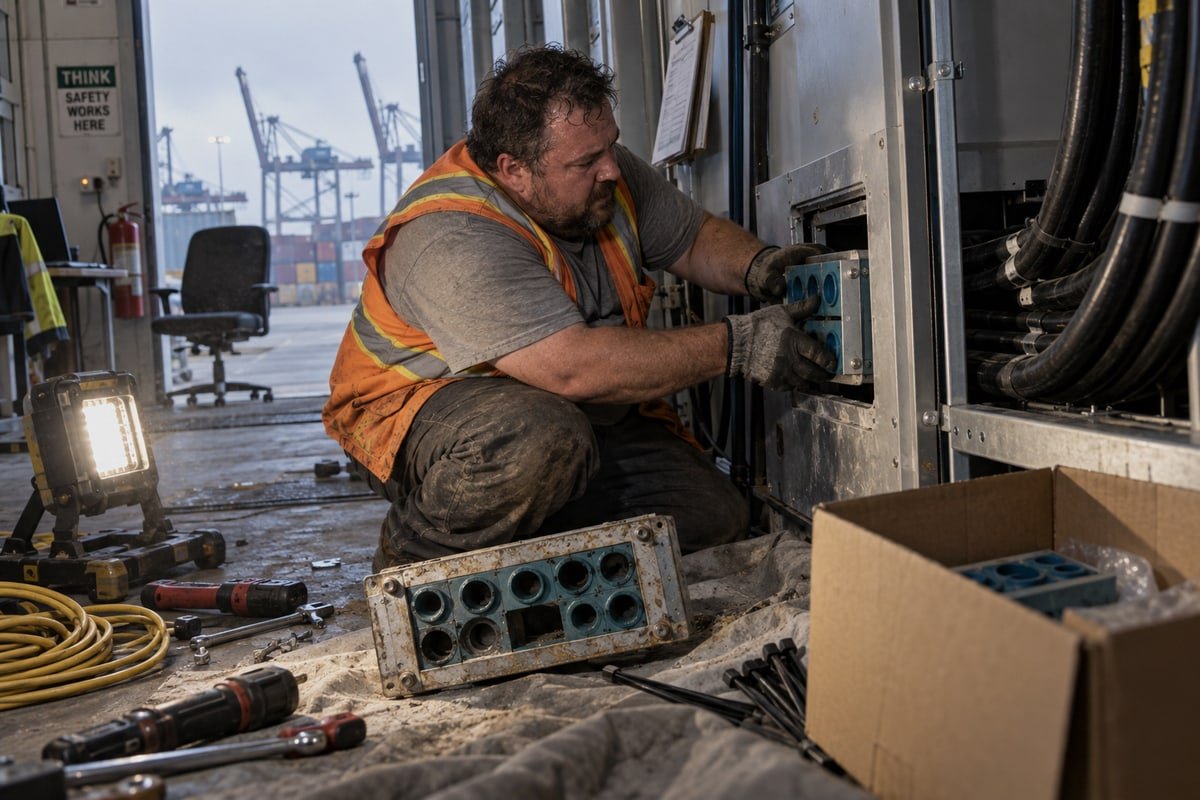
Lead time logistics decide whether a valid claim feels like good service or a disaster. The technical decision on a module defect 6 may take our engineers two days. The physical resolution can take weeks if nobody planned the freight side. That is why we treat logistics as part of the warranty, not something that happens after it.
Where the time actually goes
| Stage | Typical driver of delay | How to shorten it in the contract |
|---|---|---|
| Notice and evidence | Buyer gathers photos, batch codes, and cable data | Use the installation record from day one |
| Technical validation | Factory review, sometimes sample return | Allow validation from video first, sample later |
| Replacement sourcing | Waiting for the next production run | Commit spare module stock in the agreement |
| Outbound freight | Air versus sea, consolidation | Pre-agree air freight for warranty replacements |
| Customs clearance | Duty classification, missing documents | Ship with full export documentation and warranty declaration |
| Return of defective part | Nobody wants to pay return freight | Define who pays, or agree that samples may be destroyed after inspection |
Spare sealing modules are small and light. A frame is not. So our default advice is to keep replacement modules moving by air and to avoid returning steel frames at all unless the frame itself is the suspect part.
Transit damage is not a warranty issue
This is the point buyers most often misunderstand. Several supplier terms, including ours, state that damage in transit must be claimed against the carrier, not treated as a product defect. A crushed frame or a torn module bag at unpacking is a shipping claim. It needs a note on the delivery receipt and photos on the day of arrival. If the buyer signs clean and finds damage later, both the carrier and the factory will decline, and the buyer sits in the gap. The risk-allocation argument here is fair. Shipping damage, poor installation, and misuse are not manufacturing defects, and pushing them upstream slows down the claims that are.
A workflow that survives distance
- Buyer reports the failure with batch code, photos, and installation record within the agreed notice window.
- Supplier gives a written first response within the agreed days and requests any missing evidence.
- Supplier validates from evidence, or triggers third-party inspection for disputed cases.
- Replacement ships from committed spare stock by the pre-agreed method.
- Defective sample returns, or is destroyed on site with photo proof, per the agreement.
- Credit or reimbursement is issued once the defect is verified, with liability limited to repair, replacement, or purchase price as written.
Handled this way, warranty claims for multi cable transit parts sourced from overseas do not have to be slower than a local claim. They just have to be planned. Shipping and customs duties for warranty replacements should be named in the agreement, because the party that pays them will decide how fast they move.
Fazit
Warranty disputes drain more than money. Fix the process, not the passport: written RMA rules, batch evidence, clear freight terms, and a supplier that recovers factory defects fast.
Fußnoten
1. Reference for the technical definition and industrial application of multi-cable transit systems. ↩︎
2. Authoritative body for electrotechnical standards relevant to panel building and electrical components. ↩︎
3. International organization responsible for standards in rubber materials and manufacturing quality. ↩︎
4. Global authority on energy technology and battery storage system deployment. ↩︎
5. International organization dealing with the global rules of trade and market access between nations. ↩︎
6. Leading authority on quality management, providing standards for defect analysis and corrective actions. ↩︎


 English
  Español de México
  Deutsch
  Français
  العربية
  Русский