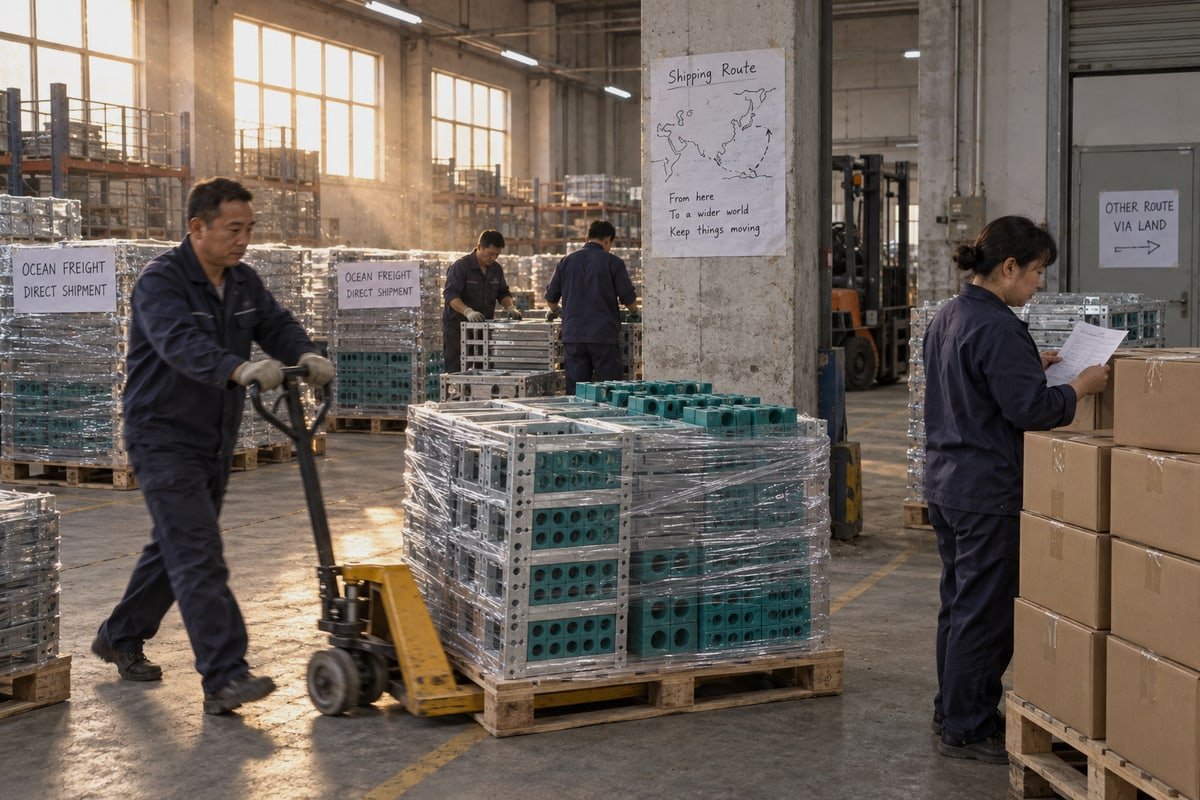
Sourcing multi cable transit for the US market once meant picking a Chinese factory. Now Section 301 tariffs and audit demands muddy that choice. Our export team untangles this dilemma weekly.
China remains the lowest-cost, highest-capacity source for multi cable transit for the US market, especially for spec-stable volume orders. Southeast Asia offers lower tariff and geopolitical exposure at a price premium. Most US buyers do best with a dual-source model: China for baseline volume, Southeast Asia for redundancy.
That short answer hides four real questions. Landed cost. Certification. Drop-in fit. Lead time. I will take each one in turn, using what we see on our own production line for modular cable sealing systems 1. You can then decide which lane fits your project, or whether you need both.
How do tariffs and trade policies affect my total landed cost when sourcing MCT systems from China versus Southeast Asia?
One trade-off I weigh on every quote to a US buyer: our ex-works price may be 40–60% under the incumbent, yet duties can eat part of that gap.
Section 301 tariffs add an extra duty layer on Chinese-origin MCT frames and sealing modules, narrowing China's ex-works price advantage. Southeast Asian origin avoids that layer but usually carries a higher factory price and freight. Compare full landed cost—price, freight, duty, testing, and delay risk—not the quote alone.
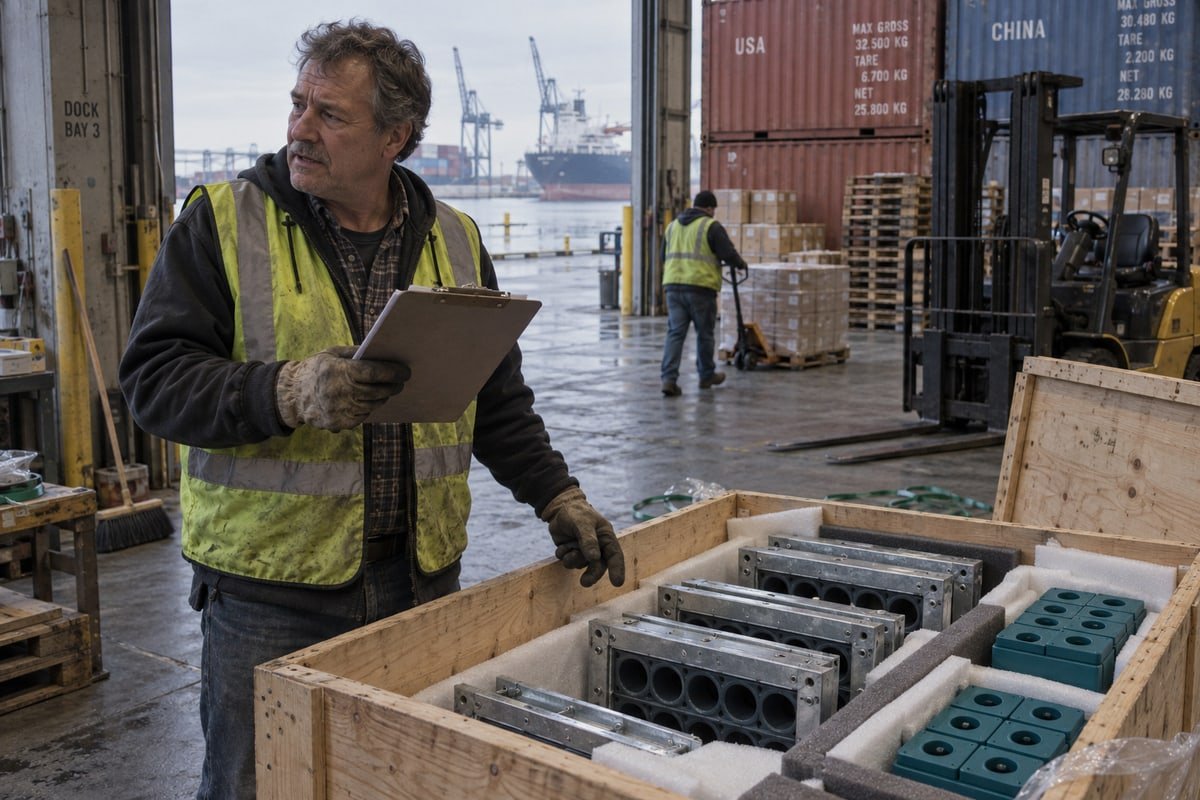
The factory quote is the loudest number in any sourcing decision. It is rarely the most important one. Here is how I break down import duties and logistics for a US-bound MCT order.
What actually goes into landed cost
| Cost layer | China origin | Southeast Asia origin | What I tell buyers to check |
|---|---|---|---|
| Ex-works unit price | Lowest; dense supplier competition | Usually higher; fewer independent factories | Compare like-for-like: frame, modules, stayplates, compression unit |
| Ocean freight to US ports | Mature lanes, frequent sailings | Good from Singapore, Vietnam, Malaysia; sometimes transshipped | Ask for FOB and CIF side by side |
| Standard HTS duty | Applies | Applies | Same HTS code either way |
| Section 301 tariffs | Applies to Chinese origin | Not applied | Confirm the current list and rate for your HTS code |
| Anti-dumping exposure on steel/aluminum frames | Higher | Acts as a hedge | Request mill certificates and origin paperwork |
| Compliance testing and submittals | Factory-dependent | Factory-dependent | Country of origin tells you nothing here |
| Delay and rework cost | Low with mature exporters | Varies by plant maturity | Ask for on-time delivery records |
The stakes are not small. One market estimate puts the US MCT market at about USD 1.2 billion in 2024, growing to roughly USD 2.0 billion by 2033. Certified offshore and marine-grade transit units can run anywhere from USD 200 to USD 2,000 each. So a duty percentage on a USD 1,500 unit is real money, not a rounding error.
Where the tariff math tips
Duty is applied to the declared value. That matters. A lower Chinese base price means a lower absolute duty amount, even when the rate is higher. When we build a cross-reference quote against an incumbent 120-frame brand, the buyer's own spreadsheet usually shows that a 40–60% factory-price gap survives the Section 301 layer, though the margin shrinks. I also remind buyers to check where the incumbent brand's product is actually made. Several premium European brands produce in Asia too, so the "safe" option may carry the same duty.
Country of origin is a customs rule, not a shipping label
US Customs applies a substantial transformation test 2. If frames are welded and EPDM modules are molded in China, then boxed in Vietnam, the origin is still China. A Southeast Asian address on the commercial invoice does not change that. Ask for a signed origin statement and factory-level production records.
Objection: "Southeast Asia always wins once tariffs are counted"
Not always. Fewer competing factories mean less price pressure. Smaller export volumes mean fewer sailings and sometimes transshipment through Singapore. For standard, repeatable specs at volume, China often still lands cheaper. For projects where tariff policy could shift mid-contract, Southeast Asia buys insurance. You are paying a premium for lower variance, and that can be the right call.
Can Southeast Asian manufacturers match China's certification standards like UL, ISO 9001, and IATF 16949 for cable transit systems?
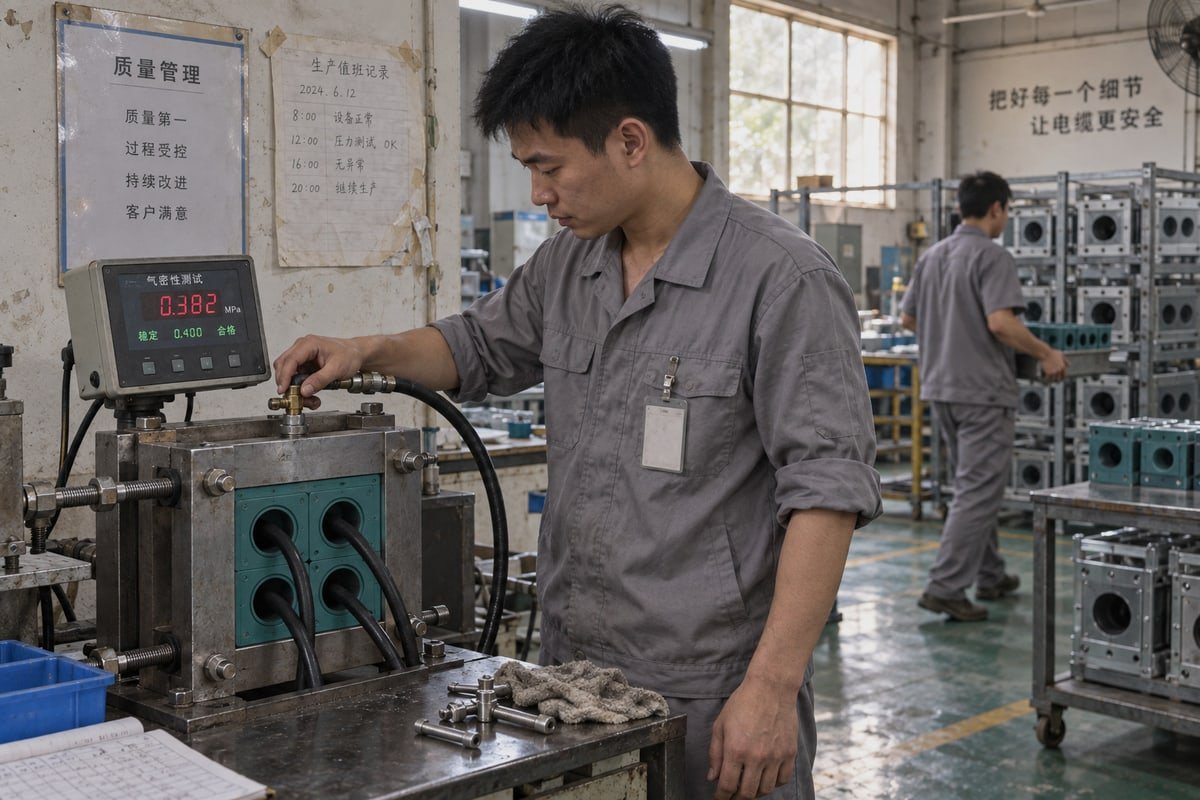
Before our last Bureau Veritas surveillance visit, our QC team pressure-tested a batch of TSC square modules at 0.4 MPa and logged every reading.
Yes, but only at the top tier. Leading factories in both China and Southeast Asia now hold ISO 9001 and IATF 16949, and some carry UL 1479 or ASTM E814 fire-test listings. The country does not certify the product; the individual factory does, so audit test documents supplier by supplier.

Certification is where the "cheapest country" debate falls apart. Neither China nor Southeast Asia has a national MCT standard. Each factory earns or fails its own approvals. The question is what each certificate proves, and whether the factory can show the paper.
Which certificate answers which question
| Certificate or test | What it actually proves | Who typically needs it |
|---|---|---|
| ISO 9001 3 | A working quality management system with traceability | Every B2B buyer, as a baseline |
| IATF 16949 4 | Automotive-grade process control, PPAP-style documentation, batch traceability | OEM integrators: BESS, modular data center, switchgear builders |
| Bureau Veritas factory approval | Class society has audited the plant and product for marine use | Offshore and marine industry, shipyards |
| A-0 / A-60 fire rating | SOLAS-style fire class division performance on bulkheads and decks | Marine, offshore, and industrial fire boundaries |
| UL 1479 / ASTM E814 | US building-code through-penetration firestop test, witnessed and listed | US commercial and industrial buildings, many EPC submittals |
| IP68 | Dust and continuous water immersion protection | Outdoor enclosures, containers, coastal sites |
| Watertight / gas-tight 0.01–0.4 MPa | Pressure sealing across a stated range | Pressurized rooms, gas-hazard zones |
I want to be precise about what our own paperwork covers. Our factory runs ISO 9001 and IATF 16949 systems and is BV-approved. Our modules test to A-0/A-60, IP68, and watertight/gas-tight sealing from 0.01 to 0.4 MPa. Those documents go out on request. UL 1479 certification 5 is a different path. It is a US building-code test with a UL-witnessed burn and ongoing follow-up service. If your project needs UL-listed firestop transit frames, ask any supplier, Chinese or Southeast Asian, for the UL file number. "UL-compliant" in a brochure is not a listing.
Elastomer consistency is where white-label fails
Frames are easy to inspect. Rubber is not. Our modules use halogen-free EPDM with a step-core design that adapts to a range of cable diameters within one module size. The performance depends on cure, hardness, and compression set staying inside tolerance batch after batch. That is what IATF 16949 traceability is for. In both regions, plants run by established European brands tend to hold consistency well. Unbranded white-label lines are the risk, and they exist in China, Vietnam, and Malaysia alike.
Objection: "Buy the cheapest first, validate later"
Some buyers do this. I understand why. But a failed submittal on a firestop boundary stops a project. A leaking module in a BESS container triggers a field replacement. Either one costs more than the price gap between two quotes. Validation samples are cheap. We send ours free for exactly this reason.
One more filter: friendshoring rules
Some US naval and federal projects now carry stricter country-of-origin requirements. No certificate overrides that. If your contract restricts Chinese origin, Southeast Asian or domestic supply is the only route, regardless of who has the better test file.
Which region offers better dimensional compatibility and drop-in replacement options for my existing 120-frame MCT installations?
A sourcing engineer once sent me a photo of a 120-frame cutout on a switchgear panel and asked whether our modules would fit without redrilling.
China currently offers the deeper pool of 120-frame-compatible drop-in suppliers, with cross-reference tables, CAD/STEP files, and in-house molds for custom sizes. Southeast Asian plants of established European brands offer original-spec parts, but few independent regional factories yet match China's second-source depth.

Drop-in replacement is a tolerance problem, not a marketing problem. The 120-frame standard is defined by its internal opening width, its bolt and weld geometry, and the module widths that stack inside it. If a second-source part misses any of those, the installer notices in the first ten minutes. Here is the qualification process I walk buyers through.
Five steps to qualify a second source
- Send the incumbent model numbers. We return a cross-reference table mapping each existing model to a DEWIN TSR or TSC equivalent.
- Request CAD/STEP files. Overlay them on your existing frame drawings before any hardware ships.
- Order free validation samples of the sealing modules and stayplates you use most.
- Fit-check in a real frame. Stack the modules, insert the stayplates, run the compression unit to full travel.
- Compare test documents. Confirm fire rating, IP68, and pressure range match or exceed the incumbent spec.
What "compatible" has to cover
| Element | Why it matters | Failure sign |
|---|---|---|
| Frame cutout and weld flange | Frame must drop into the existing opening | Redrilling or grinding on site |
| Module width increments | Modules must fill the opening with no gaps | Extra spacers or forced fit |
| Step-core diameter range | Cable OD must land inside a module's peel range | Wrong module size ordered for the cable |
| Stayplate thickness and slot fit | Stayplates separate rows and carry compression | Rows shift or rock under load |
| Compression unit travel | Must reach sealing pressure on the mixed stack | Loose seal or bottomed-out bolts |
| Spare part interchangeability | Mixed brands in one frame during maintenance | Field crews carry two parts lists |
Why China leads on second sourcing today
Supplier density is the reason. China has many factories molding to the 120 standard, and the competition forces them to publish cross-reference data and hold tight tolerances. Custom-engineered frames also ship faster from China, because in-house mold making and steel fabrication sit under one roof. We cut our own molds in Shaanxi for non-standard sizes, which is what lets us support private-label runs without a tooling partner.
Where Southeast Asia is catching up
Independent Southeast Asian factories are focusing on standardized modular systems for the oil and gas sector rather than broad cross-compatibility. Micro-factories in Malaysia and Thailand are using AI-driven CNC to prototype non-standard frames quickly. That is real value for a new design. It matters less for a drop-in, where the geometry is already fixed and the question is repeatable molding. One area where advanced Southeast Asian suppliers push ahead is data: some now bundle BIM objects and digital twin assets with their hardware, a growing requirement in US smart-building and modern shipyard contracts. We supply CAD/STEP as standard; if your project demands BIM-ready files, ask both regions early and treat it as a spec item.
How do lead times and supply chain reliability compare between Chinese and Southeast Asian MCT suppliers for US-bound shipments?
The lesson our planning team learned the hard way: transit days are the smallest part of a US-bound lead time. Molding slots, testing, and customs paperwork drive the calendar.
China typically delivers shorter manufacturing lead times for custom-engineered frames and spare sealing modules because of denser tooling and export infrastructure. Southeast Asia offers better continuity against tariff shocks and port disruption. Total lead time equals production scheduling plus testing, customs clearance, and ocean transit, so measure all four.
Buyers ask me for a lead time in days. I ask them what they are counting. A quoted "four weeks" can mean four weeks to the factory gate or four weeks to a US warehouse. Those are very different promises. Here is how the pieces compare by region.
Where the days actually go
| Lead-time component | China | Southeast Asia | What drives the difference |
|---|---|---|---|
| Production scheduling | Fast for standard modules; custom frames well supported | Fast for standardized oil and gas modules; custom tooling often outsourced | Mold density and in-house fabrication |
| Testing and documentation | Mature at certified plants | Mature at branded plants; variable elsewhere | Whether test rigs and QMS sit on site |
| Export paperwork and customs | Highly practiced export lanes | Growing but less uniform | Volume of US-bound industrial shipments |
| Ocean transit to US | Frequent direct sailings | Direct from Singapore; sometimes transshipped from Vietnam or Malaysia | Port size and carrier frequency |
| Policy and disruption exposure | Higher: tariffs, geopolitics, concentration | Lower: diversification benefit | Where your risk sits, not how fast the line runs |
Speed versus continuity
China wins the first four rows for most orders. The last row is where Southeast Asia earns its place. A China Plus One strategy is exactly that trade: accept a slightly longer or costlier second lane in exchange for continuity when the primary lane is disrupted. Large multinational cable makers already run plants in Singapore, Malaysia, and Vietnam for this reason. Supply chain diversification 6 has moved from a slide deck to a purchasing requirement.
I will be honest about our own footprint. We produce in Shaanxi, Shandong, and Hunan. That gives buyers redundancy against a single-plant stoppage and lets us ship spare sealing modules quickly. It does not hedge tariff exposure, because all three sites are Chinese origin. A buyer who wants both fast spares and origin diversity needs two suppliers, and I say so.
Capacity competition inside China
China's domestic MCT market is estimated at around USD 1.5 billion in 2024, growing toward USD 2.8 billion by 2033. Domestic offshore, data center, and BESS demand competes with export orders for the same molding capacity. Ask any Chinese supplier how they prioritize export slots when domestic projects surge.
The ESG question is arriving
Some US procurement teams now ask about renewable energy use in production to feed corporate ESG reporting. Certain Southeast Asian suppliers lead with this. Treat it as a data request, not a regional assumption. Ask both lanes for energy sourcing and be ready to see mixed answers everywhere.
Objection: "Pick one region and commit"
The pro-China view says scale and maturity are unbeatable. The pro-Southeast-Asia view says tariff and geopolitical exposure outweigh a small premium. Both are right for different line items. Split volume by application criticality. Run standard, high-volume, spec-stable modules through China. Route origin-sensitive or continuity-critical items through Southeast Asia. Qualify both with samples and documents before you need the backup.
Conclusion
Tariffs and audits make sourcing MCT harder than a price list. China wins on cost and depth; Southeast Asia wins on resilience. Build a certified supplier mix, not one bet.
Footnotes
1. Official ISO homepage, the global authority for industrial and quality management standards. ↩︎
2. Official US Customs and Border Protection site explaining trade regulations and origin determinations. ↩︎
3. Official landing page for the ISO 9001 quality management system standard. ↩︎
4. Official site for the international automotive quality management standard. ↩︎
5. Official website for UL Solutions, the primary authority for safety testing and certification. ↩︎
6. Official site for the World Trade Organization, covering global trade policy and diversification. ↩︎


 English
  Español de México
  Deutsch
  Français
  العربية
  Русский