
Mismatched cables land on our sample desk every week. Get the cable outer diameter range for multi cable transit wrong, and the seal leaks. Get it right, and it lasts.
To check the cable outer diameter range for multi cable transit, measure each cable’s finished jacket OD with a caliper at several points, confirm the value against the datasheet tolerance, then verify it falls inside the min–max window printed on the sealing module, ideally near the middle.
That is the short version. The long version has four steps. First, you measure correctly. Second, you understand what one module size can actually cover. Third, you map your existing frame to an equivalent model. Fourth, you prove the fit with a sample before you buy in volume. I will walk through each step below.
How do I measure my cable outer diameter accurately before selecting an MCT module?
Last quarter our QC bench flagged a set of sample cables because the stated 12 mm OD measured 12.9 mm across the jacket. That 0.9 mm changed the module choice.
Measure the finished outer jacket with a calibrated digital or vernier caliper at three or more points along a clean, uncrushed section, average the readings, compare with the datasheet nominal OD and tolerance, and use a pi-tape for oval cables.
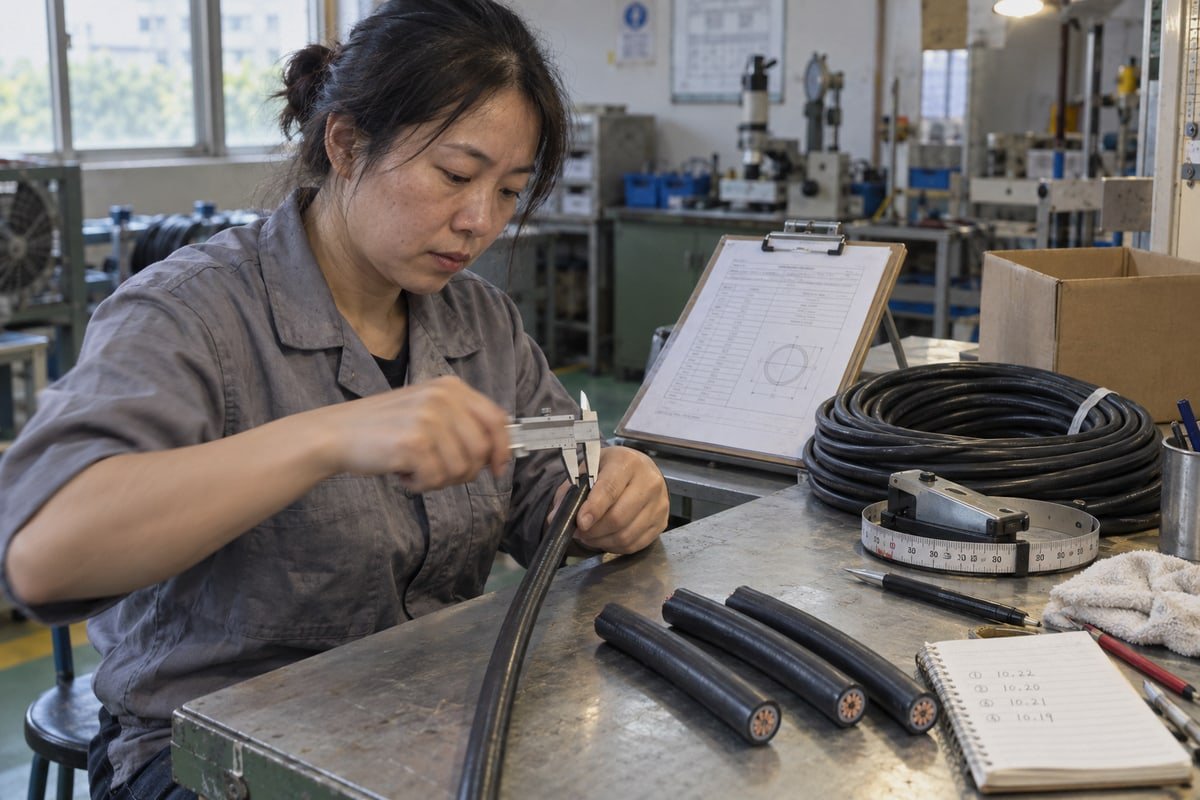
The most common mistake I see is simple. People read the conductor size or the nominal designation and call it the OD. It is not. The outer diameter is the diameter of the finished outer sheath. That is the surface the modular cable seal actually grips. Nothing else matters to the rubber.
Which surface do you measure?
For a plain PVC or LSZH cable, measure over the jacket. For an armored or shielded cable 1, measure over the outermost jacket too, unless your transit system asks for a measurement over the armor for bonding purposes. For a non-circular or triplex configuration 2, measure the maximum cross-sectional dimension. The module must clear the widest axis, not the average.
Then check the cable manufacturer's technical data sheet. Most sheets give a nominal OD 3 plus a cable tolerance range, often around ±0.5 mm. If your measured value sits outside that band, the cable itself is off spec. Stop and ask the cable supplier before you pick a module.
Which tool should you use?
| Tool | Best for | Watch out for |
|---|---|---|
| Digital caliper (calibrated) | Round cables, fast readings | Squeezing soft jackets; take light contact only |
| Vernier caliper | Workshop checks without batteries | Parallax reading error |
| Circumferential pi-tape | Oval cables from tight spooling, high-pressure seals | Needs a clean, straight section |
| 3D-scanning or vision apps | Estimating effective bundle diameter for many small cables | Treat as an estimate, not a sealing spec |
Two effects people forget
Cable jackets creep. Under long compression, some materials show cold flow, so the effective OD shrinks over years. Sitting near the module's maximum today can become a loose fit later. Also, LSZH jackets can expand in hot zones such as a BESS container in the Middle East. Both effects push me toward the same advice: aim for the middle of the module range, not the edge. In our own testing for IP68 ingress protection rating, the mid-range fits are the ones that pass without drama.
What OD range can DEWIN's step-core EPDM inserts cover within a single module size?
Wider adaptability per module versus tighter compression control is the trade-off we weigh every time we cut a new step-core mold in our own tool room.
DEWIN step-core EPDM inserts cover a printed min–max cable OD window per module size, matching the common 120-frame multi-diameter families; you peel layers until the marked window fits your measured OD. The exact range for each TSC size is stamped on the module and listed in the datasheet.

Here is how the step-core design works. Each half of the module has concentric rubber layers around the cable hole. You peel layers off one at a time. Each layer removed opens the hole to the next step. You stop when the cable sits in the hole with a small, even gap before compression. That gap closes when the compression wedge is tightened. One physical module size therefore serves many cable diameters.
How wide can one family go?
Adaptable systems on the market show what is achievable. The public figures below are useful reference points when you compare offers.
| Reference system | Published OD coverage | What it tells you |
|---|---|---|
| A common sealing system | 4 to 40 mm | One family can span a full order of magnitude |
| Roxtec Multidiameter approach | 4 to 99 mm across six module sizes | Six sizes cover most industrial cable schedules |
| icotek transit system | Up to 65 mm with connectors, 75 mm without | Connectorized cables need larger openings |
Because our TSC square modules and TSR round assemblies are dimensionally compatible with those common 120-frame module sizes 4, the same six-size logic applies to our range. The precise min–max window for each DEWIN size is printed on the module face. I always tell buyers to trust the printed window, not a general claim in a brochure. RDSO specifications say the same thing: visually check the printed dimensional range on the module and verify it against the cable dimensions.
The objection I hear most often
A purchasing engineer will ask: "If the range is so broad, why should I bother measuring exactly?" It is a fair question. A broad window reduces stock and simplifies planning. But it does not remove the need to verify the exact OD. Here is why. Compression is only correct within the window. A cable 0.5 mm above the maximum will not seal to the 0.01–0.4 MPa watertight and gas-tight levels we test to. A cable at the very minimum can loosen with cold flow over time. So the broad range is a stocking benefit, not a permission to skip the caliper.
Working near the limits
If your measured OD lands within about half a millimetre of a module boundary, I recommend one of two things. Either move to the neighbouring module size where the cable sits mid-range, or ask us for both sizes as validation samples and test both. Multi-diameter modules give you flexibility. Use it to sit in the middle, not at the edge.
How do I cross-reference my existing frame's diameter specs with DEWIN's model equivalents?
A sourcing engineer in Germany once sent us a frame drawing with only the cutout size and a competitor part number. That was enough to start a cross-reference.
Take the frame's internal cutout dimensions, module family size, stayplate count and compression unit type from your drawing or cable schedule, then match them line by line against the DEWIN cross-reference table, which maps each existing 120-frame model to the equivalent TSC or TSR part with the same OD window.

Cross-referencing is where second sourcing succeeds or fails. The cable OD is only one line item. The frame, the stayplates, the compression wedge and the packing arrangement all have to line up. When we build a cross-reference for a buyer, we go through the items below in order.
What we compare, and where you find it
| Item on your existing system | Where to find it | What DEWIN matches |
|---|---|---|
| Frame internal opening (W × H) | Frame drawing or nameplate | TSC frame series with identical cutout |
| Module family size (e.g., 15, 20, 30, 40, 60, 90 class) | Printed on module face | TSC module of same external block size |
| Printed OD window per module | Module face or datasheet | Equivalent step-core window, verified on sample |
| Number of stayplates per frame | Assembly drawing | Same count and thickness |
| Compression unit type | Assembly drawing | Matching wedge height and bolt pattern |
| Frame packing space | Cable schedule plus module count | Same fill plan, same spare modules for future cables |
A simple four-step routine
- Pull the cable schedule. List every cable, its measured OD, and its destination frame.
- Note the existing module part numbers against each cable. If the part numbers are missing, read the printed window off the module.
- Send us the frame drawing, the module list and the cable schedule. Our engineers return the cross-reference table with CAD or STEP files.
- Check the frame packing space. The sum of module heights plus stayplates plus the compression unit must fill the frame exactly. Blank modules take the rest.
The counter-argument, and my answer
Some buyers prefer a tightly sized system because each model is explicit and easy to verify against a marked range. I understand that. Explicit control is good. But a compatible multi-diameter module gives you the same explicit printed window, and it also drops into the frame you already own. You get the control without changing the steel. That is the whole point of a qualified second source at 40–60% lower cost. You do not re-engineer the firestop penetration. You swap the sealing modules, keep the A-0/A-60 fire rating and the IP68 rating, and keep the test documents on file.
Can I request a free validation sample to confirm cable fit before placing a bulk order?
Skipping the sample stage cost one project two weeks of rework, and we learned to insist on a fit check before any bulk order ships from our line.
Yes. DEWIN provides free validation samples of the selected sealing module size so you can test fit on your actual cables and frame before a bulk order; send us your measured ODs, cable schedule and frame model, and we ship the sample with datasheet and test documents on request.

I treat the validation sample as the last step of the OD check, not as a marketing gesture. A caliper reading and a cross-reference table are paper. The sample is proof. Here is how I recommend a sourcing team runs it.
What to send us before the sample ships
- The measured OD of each cable, with the number of measurement points and the tool used.
- The cable schedule, so we can see how many cables share each frame.
- The existing frame model or drawing, plus the current module part numbers if you have them.
- Any special condition: high ambient temperature, connectorized cables, or oval cables from long storage.
With that data, our engineers pick the module size and sometimes add the neighbouring size for borderline cables. Both go in the same box.
What to check when the sample arrives
| Check | Pass criterion | Why it matters |
|---|---|---|
| Cable sits in the peeled hole before compression | Small, even visual gap all round | Confirms the OD is inside the printed window |
| Gap between module halves after compression | Within the manufacturer's gap spec, e.g. 0.1–1.0 mm on some systems | Shows correct compression without crushing |
| Cable is centered, surfaces clean | No offset, no debris | Off-center cables leak on one side |
| Module drops into your frame with existing stayplates | No filing, no shimming | Proves dimensional compatibility |
| Test documents received | Fire rating, IP68, watertight/gas-tight reports | Supports your supplier qualification file |
After the sample passes
Once fit is confirmed, we lock the module size in your cross-reference table. Repeat orders and spare cable sealing modules 5 then ship against that record. If you need a non-standard size, our in-house mold making covers custom windows, and private-label marking is available. Export documentation is handled by us, which matters for EPC teams shipping to the Middle East and Asia-Pacific.
One honest note. A sample validates fit on the day of the test. It does not validate the cable manufacturer's future tolerance. If your cable supplier changes jacket compound, measure again.
Conclusion
Guessing the OD leads to leaks and rework. Measuring it, reading the printed window, cross-referencing the frame, and testing a free sample gives you a seal that lasts.
Footnotes
1. Technical definition of armored cables and their construction for industrial applications. ↩︎
2. Explains the triplex cable arrangement which requires specific cross-sectional measurement for sealing. ↩︎
3. NIST provides guidelines for dimensional metrology and standardized measurement of physical properties. ↩︎
4. The IEC provides international standards for electrical components and modular cable transit systems. ↩︎
5. Official EU resource for trade and customs regulations regarding industrial equipment and spare parts. ↩︎



 English
  Español de México
  Deutsch
  Français
  العربية
  Русский