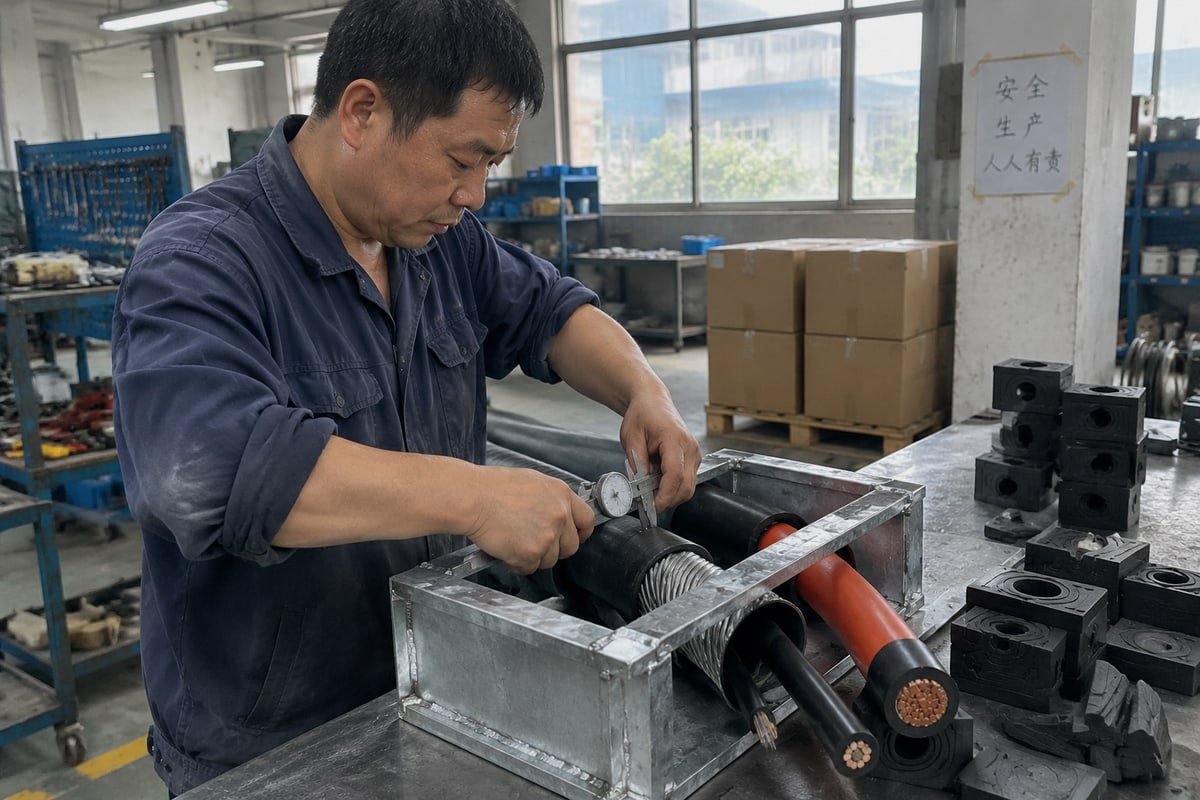
Multi cable transit modules for armored, fiber optic 1, and high-voltage cables look simple until one mixed bundle leaks. Our factory sees that costly rework often; correct sizing prevents it.
Choose multi cable transit modules by measured cable outer diameter, not nominal size, then confirm halogen-free EPDM compatibility with each jacket, earthing and bonding provisions for armor, low compression for fiber, verified A-60 and IP68 test data, and dimensional fit with your 120-frame cutouts.
Compatibility is more than a hole that fits. It is a fit-up decision, a sealing decision, a grounding decision, and a capacity decision. I will walk through each one in the order a specifier would use on a real project.
How do I verify that MCT modules will fit my existing 120-frame cutouts without redesigning the panel?
A sourcing engineer in Germany once sent us a frame drawing with one question: will your modules drop in? We answered with a cross-reference table and a sample.
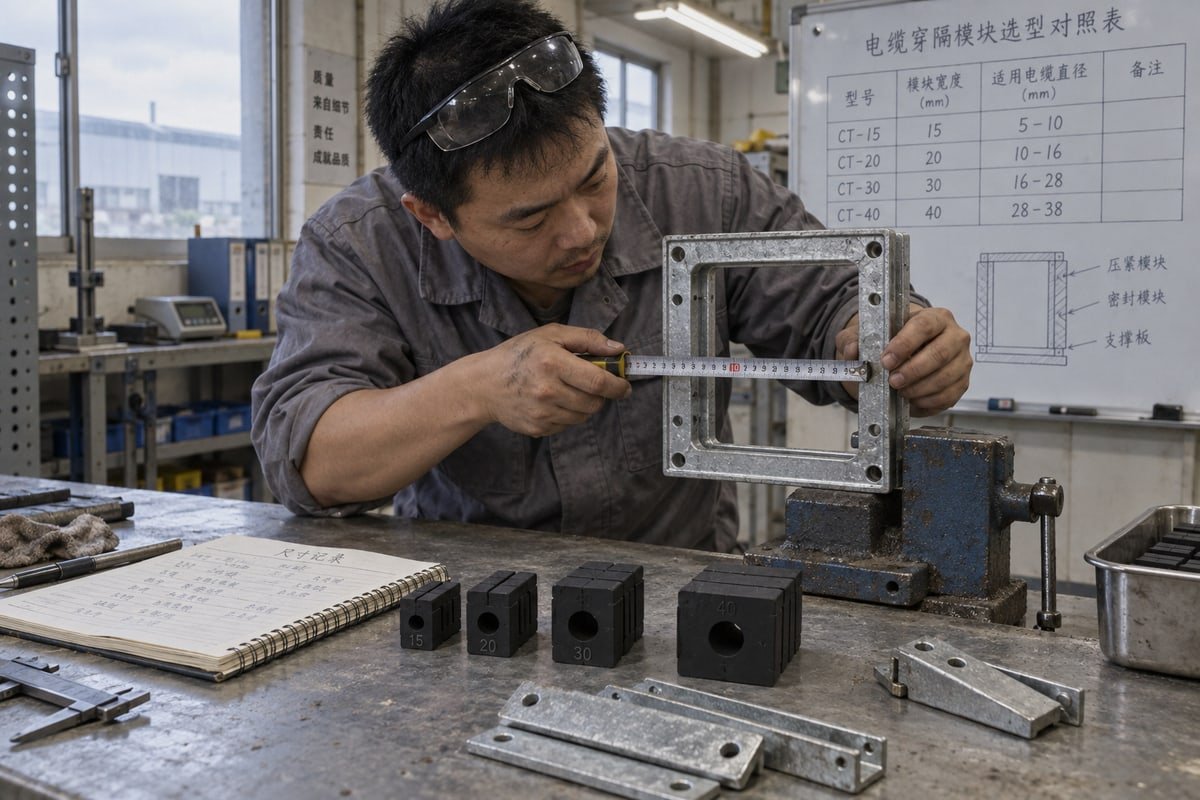
Verify fit by comparing the frame's internal opening width and depth to the module family dimensions, confirming that module heights sum to the frame height with stayplates and the compression wedge included, and testing a free validation sample in a spare cutout before ordering.
Why the 120-frame standard makes second sourcing possible
Most industrial transit frames 2 share one internal depth and one set of module widths. The common module family is 15, 20, 30, 40, 60, 90, and 120 mm. Each module is 120 mm deep, so it fills the frame from front to back. Module heights are designed so that stacked combinations fill the opening exactly. Our TSC square modules follow these same dimensions. That is why they can sit inside an existing cutout as a qualified second source. No panel redesign is needed.
The check itself is mechanical. I recommend measuring, not assuming. Here is what our engineers ask buyers to confirm before we ship a sample.
| Check point | What to measure | What confirms fit |
|---|---|---|
| Frame internal depth | Front-to-back clear depth | Matches the 120 mm module depth |
| Opening width | Inner clear width between frame walls | Equals a whole combination of module widths |
| Opening height | Inner clear height, top to bottom | Equals module stacks plus stayplates plus compression wedge |
| Stayplate slots | Slot spacing and plate thickness | Existing stayplates seat between module rows |
| Wedge travel | Free space above the top row | Compression wedge can expand fully and lock |
A three-step fit verification
- Overlay the drawings. Request native CAD or STEP files and place the module family into your frame model. Any interference shows on screen before metal is cut.
- Map the part numbers. Use a model cross-reference table that lists your existing model on one side and the equivalent DEWIN model on the other. This removes guesswork about which module replaces which.
- Fit a free validation sample. Install the sample in a spare cutout with your existing stayplates. Tighten the compression wedge to the documented torque. If the rows sit flush and the wedge locks, the fit is verified.
One warning from experience. A frame that has been welded on site may have pulled slightly out of square. Measure the actual opening, not the drawing. A few tenths of a millimeter matter when the wedge must compress every row evenly.
What certifications and test data should I request to confirm sealing performance for armored and high-voltage cables?
During a pressure test in our Shaanxi plant, we hold a sealed frame at pressure and watch for bubbles. That plain test tells more than a brochure.
Request fire-rated cable seal certificates for A-0 or A-60, an IP68 ingress protection rating report, watertight and gastight test data covering 0.01–0.4 MPa, halogen-free material declarations, earthing and bonding proof for armor, and ATEX or IECEx documentation where hazardous areas apply.
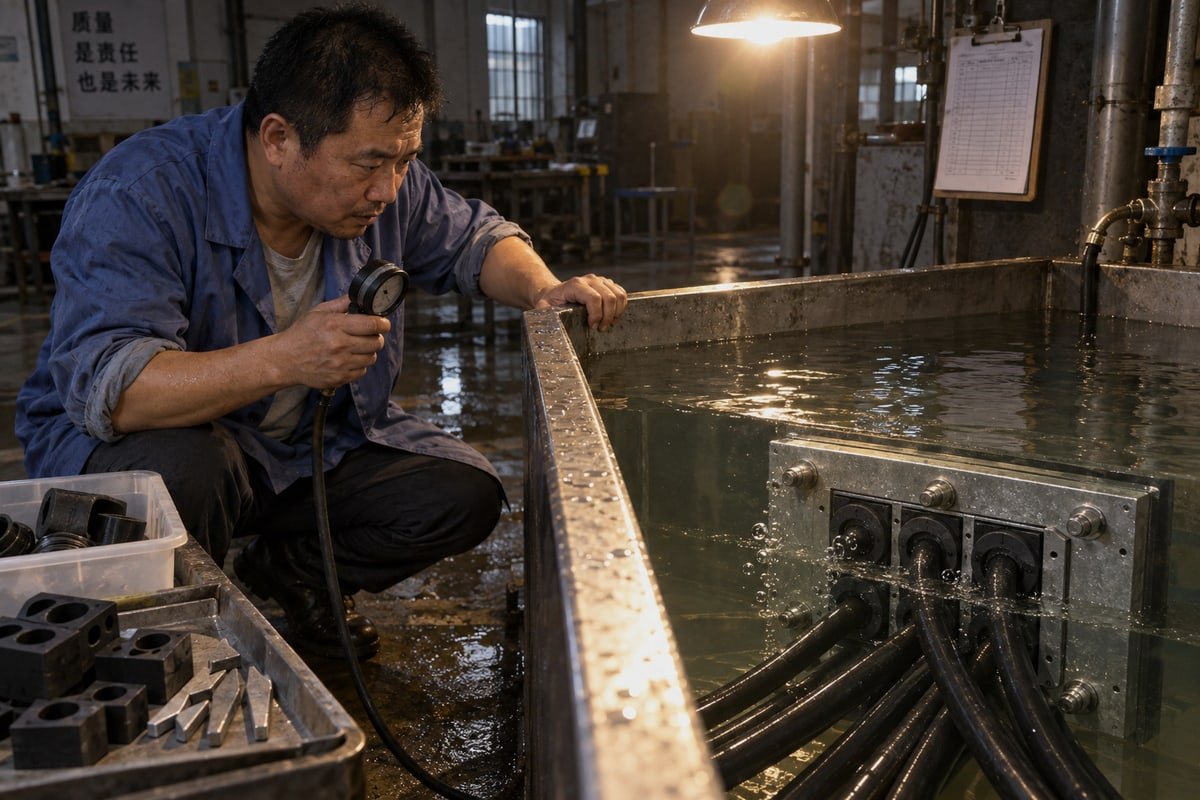
I always tell skeptical buyers the same thing. Ask for the document, then read the scope line. A certificate that covers a frame, module set, stayplates, and wedge as one tested assembly is worth far more than a certificate for a rubber block alone. The table below is the document set we prepare for European OEM audits.
| Document | What it proves | Why armored and HV cables need it |
|---|---|---|
| Fire test certificate, A-0 / A-60 | The assembly holds back fire and heat as fire-rated cable seals | HV cables carry high energy through fire barriers in BESS containers and switchgear rooms |
| IP68 report | Ingress protection rating against dust and immersion | Outdoor enclosures and containers face rain, washdown, and flooding |
| Pressure test report, 0.01–0.4 MPa | Watertight and gastight seals under pressure | Confirms the seal holds after compression around thick, stiff jackets |
| Material declaration | Halogen-free EPDM composition | Low smoke and no corrosive gas in a fire near live HV circuits |
| Quality system certificates | ISO 9001, IATF 16949, BV-approved factory | Shows repeatable production, not a one-time good sample |
| Explosion-proof certification | ATEX or IECEx scope for the assembly | Required in hazardous zones on offshore and petrochemical sites |
Armored cable: prove bonding and the right grip diameter
Armored cables raise two questions. First, does the project require continuity of the armor path through the transit? If yes, ask for a module or frame option with integrated conductive parts, such as tin-plated copper earthing straps, and ask for the earthing and bonding test that goes with it. Second, what diameter does the module actually grip? The armor or screen can change the effective cable outer diameter compared to the catalog value. We ask buyers to measure over the outer sheath at the transit location.
High-voltage cable: thermal load, separation, and EMC
High-voltage cables 3 have thick insulation build-up and larger diameters. They often need the 90 or 120 mm module, or several modules per frame. Ask two extra questions. What is the thermal behavior of the elastomer under continuous load? Heat trapped around the jacket can age insulation early. And does the project need EMC shielding? Some systems offer separate module options for shielding against radiated interference and for conducted disturbances. Request the EMC test report if that option is specified.
Industry pressure benchmarks often sit between 2.5 and 4 bar for water and gas tightness. Our test range of 0.01–0.4 MPa covers that band. Still, I would rather you read our test report than trust this sentence.
Can a single module size really accommodate fiber optic, armored, and high-voltage cable diameters without extra SKUs?
Every step-core module we mold balances two things: how wide a diameter range one block covers, and how much rubber remains to seal correctly at each step.
No single module size covers all three cable types, but a family of about seven step-core sizes, from 15 mm to 120 mm, spans roughly 3–99 mm cable outer diameter, so fiber, armored, and high-voltage cables share one frame with few SKUs.
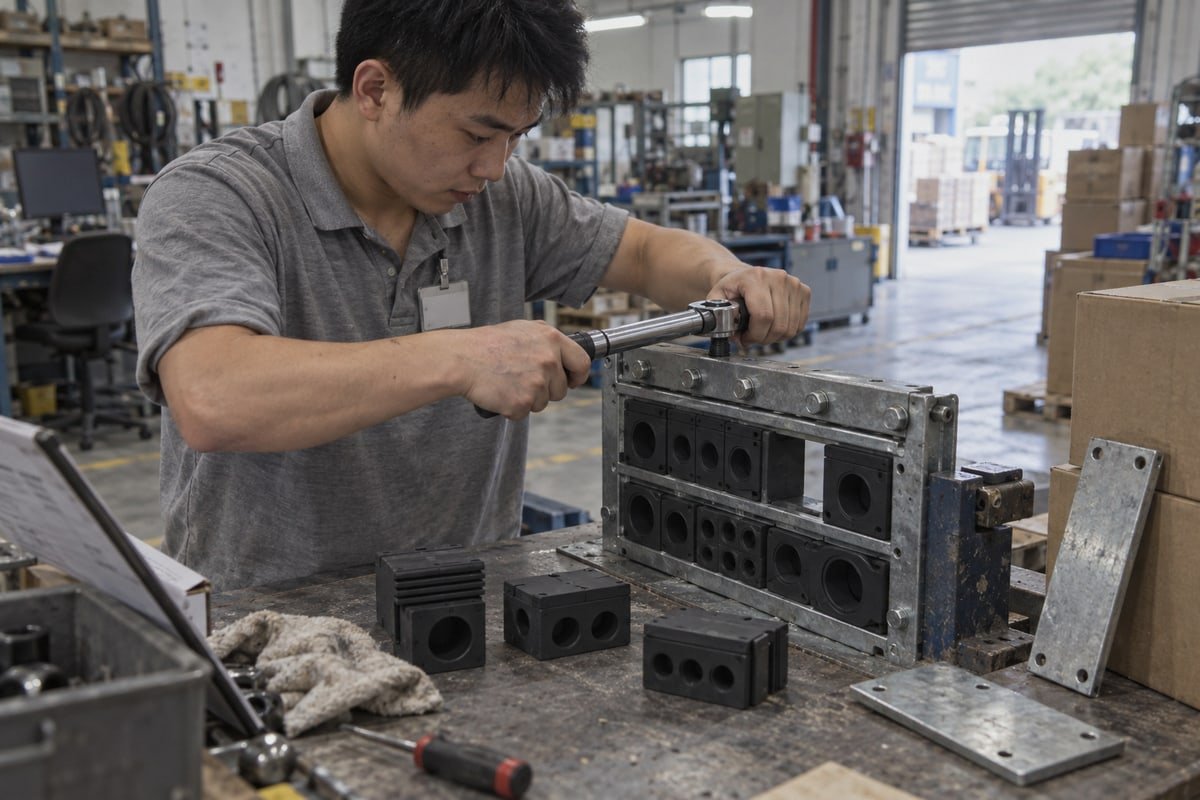
The honest answer is "one family, not one size." A multidiameter or step-core module has removable layers. The installer peels layers until the core matches the measured cable outer diameter. Some systems even direct you to pick an inside diameter one step smaller than the cable, so the rubber compresses properly. That design is why a small set of multi cable transit modules replaces dozens of gland sizes. Halogen-free materials in the core also keep the same fire behavior across every size.
How the sizing rule changes with cable type
| Cable type | Where to measure diameter | Compression target | Common pitfall |
|---|---|---|---|
| Fiber optic | Over the outer jacket, small-diameter service | Snug seal, low compression | Crushing the core or breaking bend radius |
| Armored | Over the sheath at the transit, including any screen | Firm seal with bonding provision | Using nominal size and under-gripping the armor |
| High-voltage | Over full insulation build-up | Full compression, often larger or multiple modules | Ignoring heat around thick jackets |
The fiber-first rule
Fiber cables are delicate. I group them into the gentlest compatible module, keep them away from oversized power modules where possible, and preserve pulling slack. Good modules also give mechanical retention and strain relief. That prevents micro-bending in fiber and supports the dead weight of heavy HV lines.
Why not just use cable glands?
Some engineers prefer glands for critical individual terminations. Glands are simple to understand and specific to one cable. That view has merit for a single cable. It falls apart at scale. One high-density transit cutout can carry up to 41 armored or non-armored cables. Forty-one glands mean forty-one holes, forty-one seals to inspect, and no organized layout. A transit reduces penetrations, saves panel space, and lets you add blank modules for future circuits. Size the frame for the cable count you will have in five years, not the count you have today.
What should I ask for—samples, CAD files, or cross-reference tables—before I qualify a new MCT supplier?
One lesson from a decade of exporting: buyers who ask for STEP files before price talks reach qualification faster, because fit questions get settled on screen first.
Ask for all three: a model cross-reference table mapping your existing part numbers, native CAD or STEP files to check the frame cutout, and free validation samples for a pressure test, plus certificates, elastomer compatibility statements, and a written spare-module lead time.

Qualification should be a short, evidence-based process. I have seen it drag for months when documents arrive one at a time. So we send a complete package up front. The table below is the checklist our European customers use, along with the red flags I would watch for from any supplier, including us.
| Item to request | Purpose | Red flag |
|---|---|---|
| Model cross-reference table | Maps existing model to DEWIN model for drop-in replacement | Vague "equivalent" claims with no part-number mapping |
| CAD or STEP files | Confirms 120-frame cutout fit before ordering | Only PDF drawings, no native files |
| Free validation samples | Lets you run your own fit and pressure test | Samples that differ from production material |
| Certificates and test reports | A-0/A-60, IP68, 0.01–0.4 MPa, ISO 9001, IATF 16949, BV factory approval | Certificates without scope or expired dates |
| Elastomer compatibility statement | Checks EPDM against special jackets | No answer on chemical compatibility |
| Spare-module lead time | Protects maintenance and future expansion | Long or undefined delivery for spares |
Check elastomer compatibility with special jackets
Offshore and energy projects often use mud-resistant NEK 606 4 or hydrocarbon-resistant jackets. Some jacket compounds can bond to or degrade a seal over time. Ask the supplier to cross-reference the module elastomer against your exact jacket material. A one-page compatibility statement avoids a seal failure years later.
Plan the lifecycle, not just the delivery
Frame materials should match the environment. Use 316L stainless steel 5 where corrosion is severe. Lighter polymer frames suit weight-sensitive enclosures. Some projects now add QR-coded frames linked to a digital twin. The code stores the cable schedule, inspection history, and spare capacity, so nobody opens the wedge just to count cables. Spare blank modules also allow later cable additions with minimal downtime.
On the supply side, real manufacturing depth matters. Our in-house mold making handles custom sizes. We run private-label production for integrators. Export documentation is handled with the shipment. And because we are factory-direct with plants in Shaanxi, Shandong, and Hunan, the same tested modules land at 40–60% lower cost than the incumbent brand. That is the trade a qualified second source should offer: lower cost, same evidence.
Conclusion
Leaks, rework, and stranded capacity start with wrong sizing. Match modules to measured diameter, cable type, and certified test data, and verify drop-in fit with samples first.
Footnotes
1. Authoritative overview of optical fiber technology and its industrial applications. ↩︎
2. DNV is a leading classification society that certifies industrial cable and pipe transit systems. ↩︎
3. Technical definition and standards for cables designed for high-voltage power transmission. ↩︎
4. Official website of the Norwegian Electrotechnical Committee (NEK) for the NEK 606 offshore cable standard. ↩︎
5. Authoritative resource on the properties and applications of 316L grade stainless steel. ↩︎



 English
  Español de México
  Deutsch
  Français
  العربية
  Русский