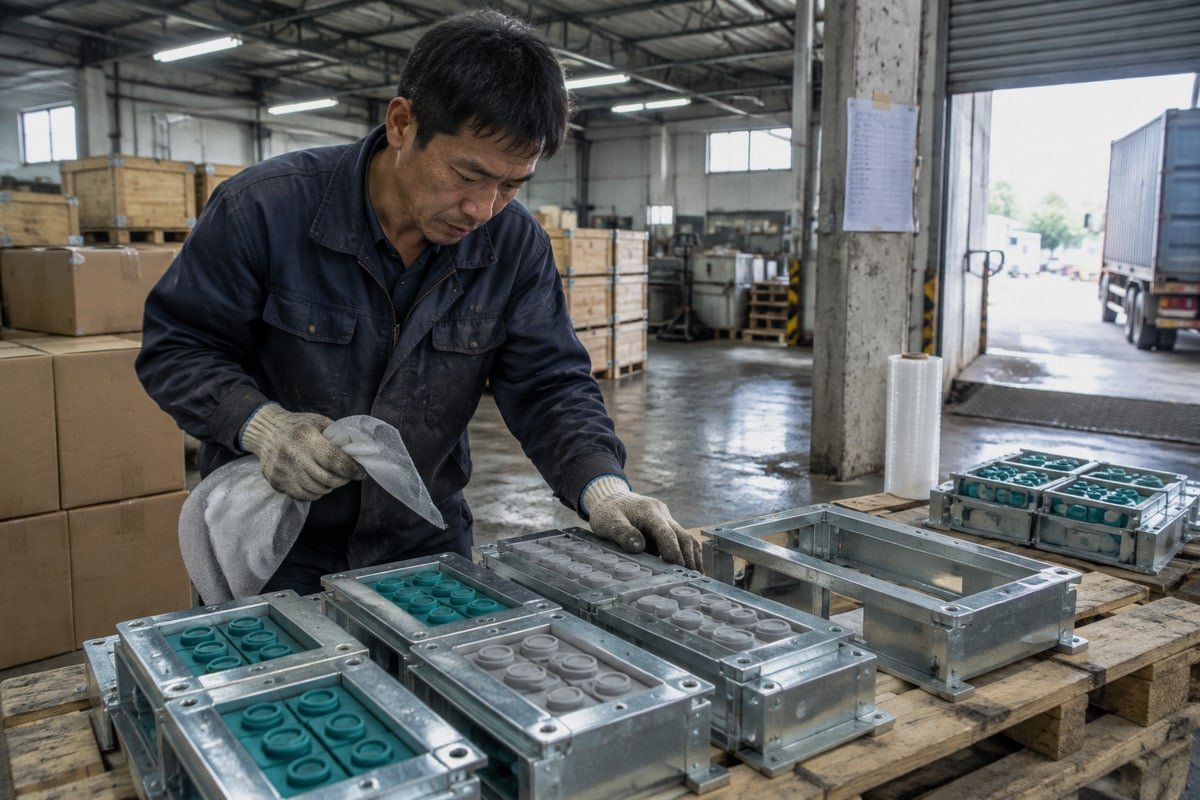
Unsealed transit openings let water in long before commissioning. Our factory sees the [corrosion](https://dewinmct.com/?p=1043) on frames sent back for rework. The right temporary sealing solution for multi cable transit openings prevents it.
Choose a temporary sealing solution for multi cable transit openings by matching the seal to transport risk: use IP66-rated modular EPDM modules for wet or marine routes, transit protection plugs for empty frames, and 120-frame-compatible modules that can stay in place as the permanent seal, with test reports.
That answer covers the decision in one sentence. The next four sections break it into the questions sourcing engineers actually send us. I will start with the ingress protection rating, because that is where most [transport damage begins](https://dewinmct.com/?p=791).
What IP rating do I need for a temporary MCT seal during shipping and storage?
Our QC team dunks compressed TSC modules in a water tank before release. Watching that test taught me that the IP question depends on route, not habit.
For a temporary MCT seal during shipping and storage, specify at least IP66 for open-deck or sea transport, IP67 where standing water is possible, and IP68-rated modules if the same seal will remain in service. Dust-only covers are enough only for short, dry, enclosed road transport.

The ingress protection rating has two digits. The first digit covers solids such as dust. The second covers water. For transport, the second digit does most of the work. IP66 means the seal resists powerful water jets, which is what driving rain and salt spray 1 look like on an open deck. IP67 means the seal survives temporary immersion under defined conditions. IP68 means it survives continuous immersion under conditions the supplier states. Our TSC square modules and TSR round assemblies are tested to IP68, because most of our customers build BESS containers and switchgear that may sit outdoors for months before anyone energizes them.
Matching the rating to the transport route
I do not push every buyer toward IP68. I ask about the route first. The table below shows how I sort the answer.
| Transport scenario | Main risk to the opening | Minimum rating I would specify | Practical note |
|---|---|---|---|
| Enclosed truck, under one week, dry climate | Dust, vibration | Blind modules or a fitted dust cover | A temporary cover is acceptable here |
| Open-deck land transport with rain exposure | Driving rain, road spray | IP66 | Compressed modules, not tape or foam |
| Sea transport, container stacked on deck | Salt spray, pooled water in the frame recess | IP66 plus IP67 | Sea transport protection also needs corrosion prevention on the frame |
| Port or site storage over one month | Standing water, UV, temperature cycling | IP67 or IP68 | Choose marine-grade materials for frame and modules |
| Air freight or high-altitude road pass | Pressure differential | IP66 with a compression-type seal | Compressed rubber tolerates pressure swings better than adhesive covers |
Why the low-cost view fails on wet routes
Some buyers tell me that temporary is good enough, so a plug or a strip of tape will do. For scenario one in the table, I agree. For every other row, I disagree, and the market agrees with me. One temporary cable entry product line on the market offers capacity for 4 to 32 cables and claims IP66/IP67 protection. Suppliers would not pay for those ratings on temporary products if buyers did not need them. A BESS container that arrives with salt water inside its cable penetration seals has lost its watertight integrity 2 before commissioning even starts. The rework cost dwarfs the price difference between a plug and a rated module.
Pressure, altitude, and blowouts
A solid step-core EPDM module 3 is compressed inside the frame. It is not glued. So a pressure differential does not peel it off the way it peels an adhesive cover. Our modules are tested watertight and gas-tight across 0.01 to 0.4 MPa, which covers the differentials seen in air freight and mountain transport. If the enclosure itself needs to breathe, that is a job for a vent membrane on the enclosure, not a weakness you should design into the transit.
How do I make sure the temporary seal stays compatible with my existing 120-frame cutouts?
A sourcing manager in Germany once sent me a frame drawing with one note: will your blocks actually fit? That question drives this section.
Confirm compatibility by checking three dimensions: the frame's inner packing space (120 mm in the standards that give the frame its name), the module stack height, and the compression unit travel. Request a model cross-reference table, CAD or STEP files, and free validation samples before ordering temporary seals.
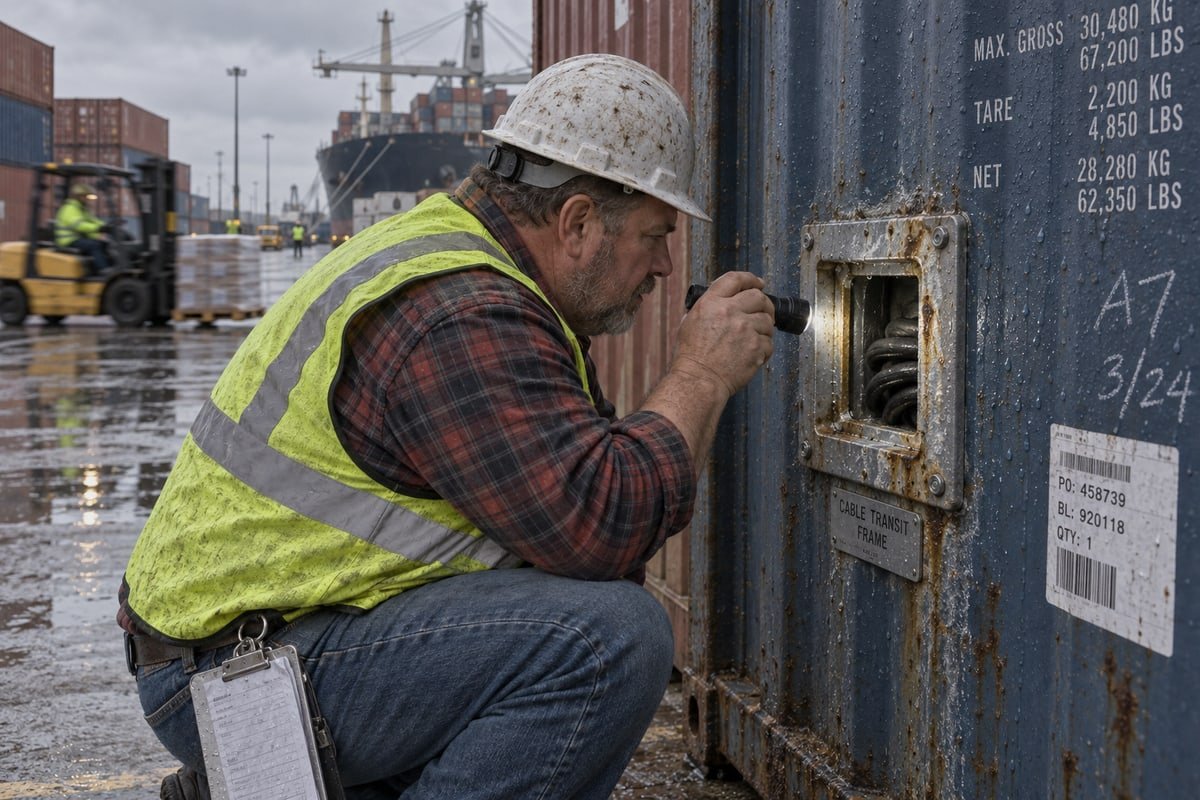
Cable transit frames built to common 120-frame standards share one key figure. The packing space inside the frame is 120 mm wide. Modules are sized so that a row of them fills that width, and rows stack until a compression unit at the top closes the remaining gap. Our TSC modules follow those module sizes, which is why they drop into existing cutouts as a qualified second source. But "drop-in" is a claim I expect buyers to verify, not accept. So here is how I ask them to verify it.
The five checks I run before I quote a second-source part
| Check point | Why it matters during transport | How to verify before ordering |
|---|---|---|
| Module footprint (width and height) | A wrong stack height leaves a gap or prevents the compression unit from closing | Compare the cross-reference table, then overlay our STEP file on your frame drawing |
| Compression unit travel and torque | Under-compressed modules shift under vibration and G-forces, causing insulation chafing | Request the compression spec and test it on a validation sample |
| Step-core diameter range | The cable jacket must sit in the correct step; over-peeling opens a leak path | Confirm each cable outer diameter against the module range |
| Stay plate position | Stay plates carry compression load across rows; wrong spacing lets rows tilt | Check plate thickness and slot position on the drawing |
| Frame material and finish | Mixed metals in a wet frame recess accelerate corrosion | Match galvanized or stainless finish to the existing frame |
A numbered process for qualifying the temporary seal
- Send us your existing module and frame model numbers. We return a cross-reference table listing the matching DEWIN model for each one.
- Download the CAD or STEP files for those models and overlay them on your cutout drawing.
- Request free validation samples for the sizes you use most.
- Fit-test the samples in one real frame with real cables. Compress to specification. Check that the stay plates sit flat and the compression unit closes within its travel.
- Approve the part numbers and add them to the drawing package for the transport phase.
This process usually takes one round of drawings and one sample shipment. It is the same qualification path our BESS and modular data center customers use, whether the seal is temporary or permanent.
Non-standard cables and the one-size-fits-all objection
Some buyers want a single universal temporary insert. Others want inserts designed around their exact cable density. Both are right for different frames. Step-core modules already cover a range of diameters within one size, which solves most cases. For very high-density or unusual configurations, the market offers 3D-printed custom inserts. Our answer is in-house mold making, so a custom size becomes a molded EPDM module rather than a printed part. I prefer that route because the molded part carries the same material data and test basis as the standard modules.
Can I reuse the same sealing modules for temporary transport and final installation?
Every step-core module we mold is a trade-off between wide diameter range and repeated compression cycles. That balance decides whether one module can serve both phases.
Yes. Step-core EPDM modules can be installed once for transport and left in place as the final seal, provided cable count and diameters do not change and the compression unit is re-torqued at commissioning. Only blind modules for empty slots need swapping when cables are added later.

The lifecycle view is now the market direction. Buyers want one modular sealing system for transport, commissioning, and operation instead of separate products for each phase. I support that view, but with conditions. The table below maps the three use cases I see most often.
Three transport scenarios and the module strategy for each
| Scenario | Recommended temporary solution | Can it stay as the final seal? |
|---|---|---|
| Short transport, low exposure | Transit protection plugs or blind modules in empty frames, plus a fitted cover | Blind modules yes; covers no |
| Transport plus commissioning delays | Full step-core module set, compressed at the factory before shipment | Yes, after re-torque at commissioning |
| High-risk transport or marine and offshore staging | Certified fire-rated and watertight module set in an approved frame | Yes, if the approval covers the final application |
Why step-core EPDM handles both phases
A step-core module has concentric layers. You peel layers until the core matches the cable diameter, insert the cable, and compress. Once compressed, the rubber holds its shape under vibration, which gives the mechanical stability that prevents cable shifting and jacket abrasion in transit. At commissioning, the installer checks the compression unit and re-torques it. The module itself does not need to come out. Our halogen-free EPDM does not rely on the plasticizers found in PVC-based fillers, so the risk of plasticizer migration into cable jackets during long, hot storage is lower. That matters for Middle East projects where a container may wait months at a port.
Disposable versus reusable, in cost terms
Disposable fillers look cheaper on the purchase order. Sealant-based transit systems, for example, use 20 mm sealant layers on each side of the conduit with filler sleeves occupying the spare space around cables. That approach seals well, but once cured it is cut out and replaced whenever cables change. A modular sealing system costs more per opening at first, yet it removes one full install-and-remove cycle and the waste that comes with it. Across a fleet of containers, that labor saving is where the real money sits. Where a project needs a log of environmental breaches, some buyers now add moisture indicators or passive RFID tags inside the enclosure; the transit itself stays passive and reusable.
When reuse does not work
I tell buyers plainly when the answer is no. If final cable diameters are not known at shipment, install blind modules and swap them later. If the frame will be cut and re-welded on site, order new modules for the final install. Reuse is a plan, not an assumption.
What test documents should I request to confirm temporary sealing performance before transit?
Our export team learned early that a certificate scan settles nothing. European buyers want the full test report behind it, and they read every page.
Request the IP ingress test report (IP66, IP67, or IP68), a watertight and gas-tight pressure test report stating the tested range, fire-rating certificates (A-0 or A-60) with the classification society approval, a halogen-free material declaration, and the factory's ISO 9001 or IATF 16949 certificate before transit.

A document package for a temporary seal should prove two separate things. First, the product performs. Second, the factory can repeat that performance batch after batch. Buyers often confuse the two. A quality system certificate proves process control. It does not prove that a specific module size passed a specific test. So I split the package as shown here.
Product test reports versus factory system certificates
| Document | What it proves | What to check on the page |
|---|---|---|
| IP ingress test report | The module resists dust and water at the stated code | The exact code, module sizes tested, test lab, date |
| Watertight and gas-tight pressure test report | Watertight integrity under pressure differential | The tested range, for example 0.01 to 0.4 MPa, test duration, pass criteria |
| Fire-rating certificate, A-0 or A-60 | Fire-rated seals for bulkheads and decks | Issuing classification society, frame configuration, insulation side |
| Halogen-free material declaration | Low smoke toxicity in cargo holds or rail tunnels | The standard referenced and the compound name |
| ISO 9001 and IATF 16949 certificates | Repeatable production and traceability | Scope wording, site address, validity date |
| Factory approval certificate | An independent body has audited the plant | Which society issued it and what it covers |
| EPDM material datasheet | Temperature range and aging behavior for storage | Hardness, service temperature, ozone and UV resistance |
Approvals and who issued them
In the marine market, temporary fire-safe sealing systems used during construction carry approvals from Bureau Veritas 5 and DNV. Those approvals exist because unfinished cable and pipe ducts spread fire during staging. Our own factory is BV-approved, and our modules carry A-0 and A-60 fire ratings. When a buyer asks for a temporary sealing solution for multi cable transit openings on an offshore module, I send the fire certificate together with the IP68 and pressure reports, and I state which body issued each one. For blast-related applications around cables and pipes, some cable entry products are ATEX-approved. Ask for that document separately if your route or site requires it.
Reading a pressure test report properly
A pressure figure without conditions is a marketing number. The report should state the module sizes, the frame used, the pressure steps, the hold time, and the leak criterion. Ours are tested from 0.01 to 0.4 MPa in both watertight and gas-tight configurations. If your frame size or cable combination is not on the report, ask for a test on a validation sample. We provide those samples free, and we provide the test documents on request, because a data-driven buyer should not have to trust a spec sheet alone.
Conclusion
Unsealed openings turn transport into rework. Match IP rating to route, verify 120-frame fit, reuse step-core modules, and demand test reports. Our free validation samples make that check easy.
Footnotes
1. Official NOAA resource explaining the environmental effects of salt spray on coastal and marine environments. ↩︎
2. Official site of the International Maritime Organization detailing global standards for ship watertight integrity. ↩︎
3. Technical overview of EPDM rubber properties and industrial applications. ↩︎
4. Industry authority providing information on standard shipping container specifications and logistics. ↩︎
5. Homepage of a leading international certification body for marine and industrial safety. ↩︎



 English
  Español de México
  Deutsch
  Français
  العربية
  Русский