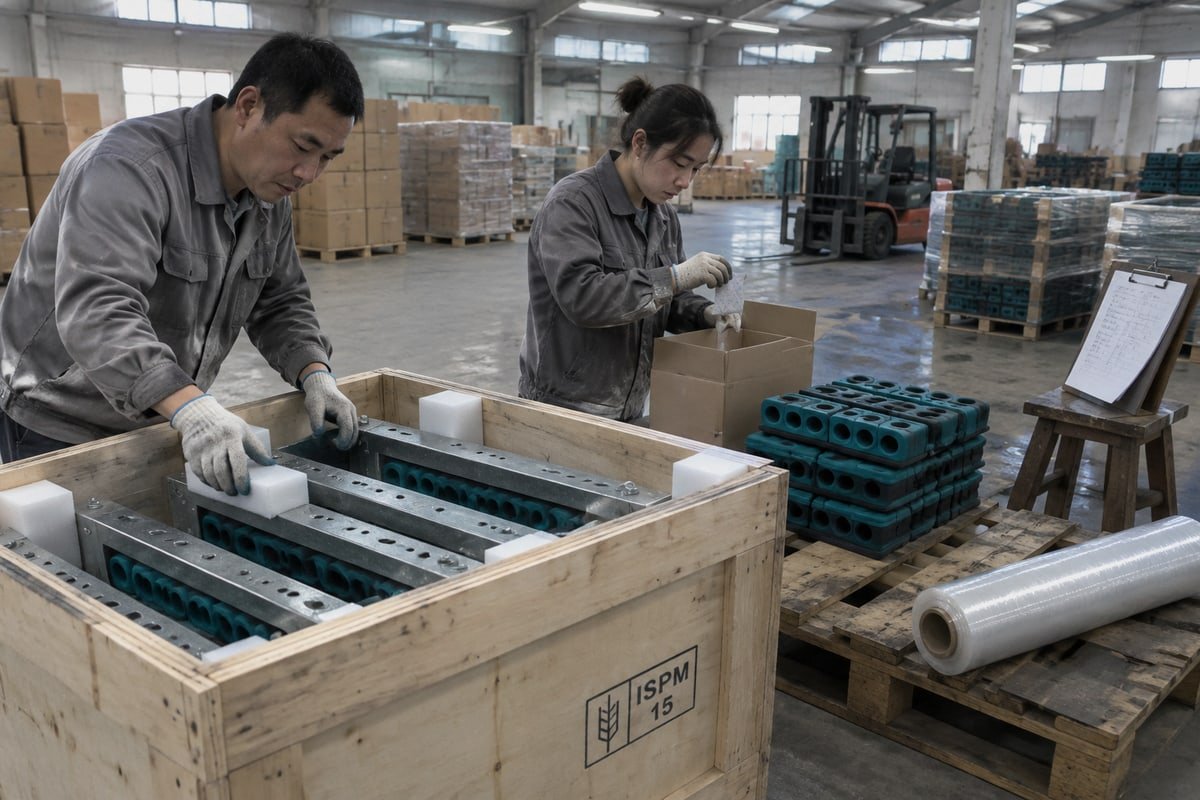
Our container loads of multi cable transit systems travel from Shaanxi to European sites for weeks. One damp crate can ruin EPDM modules before installation even starts.
Multi cable transit systems stay undamaged in transit when you ship EPDM modules uncompressed in sealed, desiccant-packed cartons, immobilize galvanized frames with foam dunnage inside heat-treated crates, strap crates to pallets, enforce stacking limits, and require photo-documented pre-shipment inspection from your supplier.
Below, I break this down into the three failure modes. Damp comes first. Deformation comes second. Crushing comes third. The last section covers the checks you should demand before you sign for the goods.
What causes moisture damage to MCT modules during long-distance shipping and how can I prevent it?
Last winter our Shandong plant unpacked a returned trial crate. The cartons inside were soft. The frames showed white zinc bloom. Nobody had added desiccant.
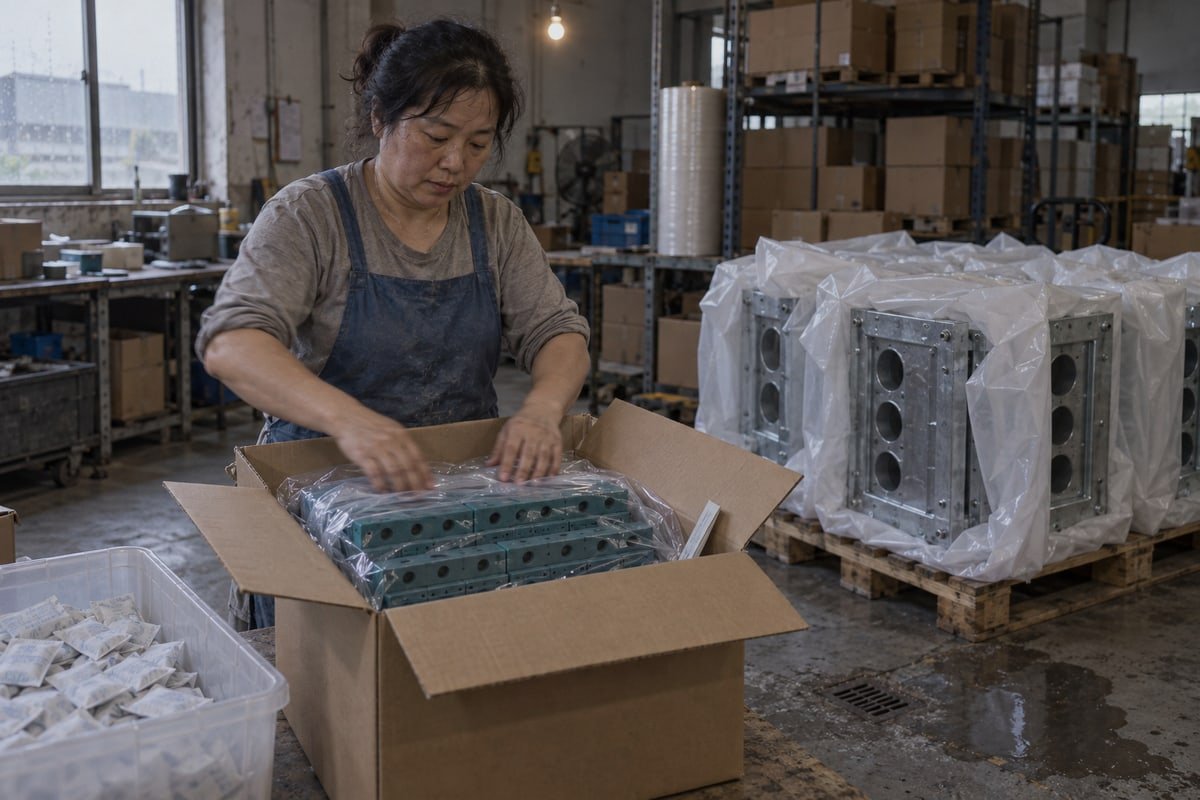
Moisture damage to MCT modules comes from condensation cycles inside sea containers, wet pallets, and unsealed cartons. Prevent it with sealed polyethylene liners, calculated desiccant units, VCI bags for galvanized frames, heat-treated crates, and pallet stretch-wrap that keeps humidity away from the EPDM.
Why EPDM and galvanized steel fail in different ways
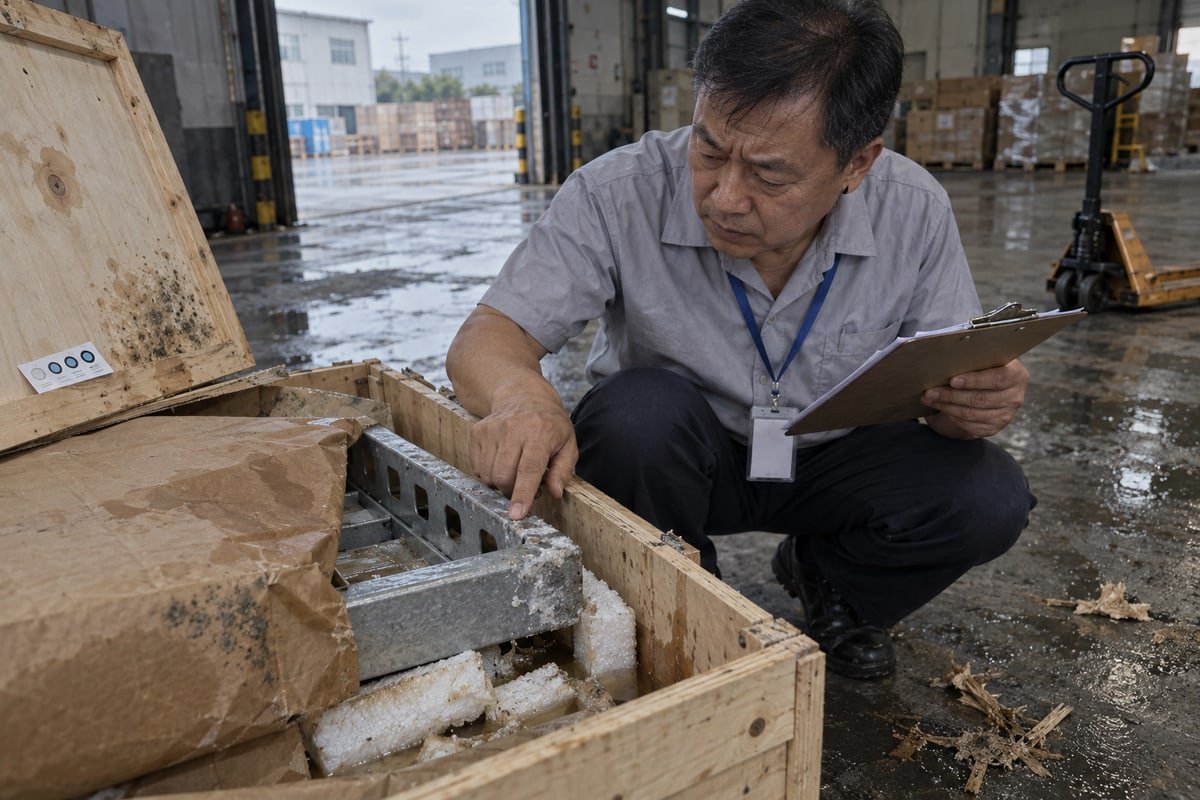
EPDM rubber properties help here. The polymer itself absorbs very little water. That is why our TSC and TSR cable sealing modules hold IP68 ingress protection 1 once they are compressed in the frame. But the rubber surface is not the weak point. The carton around it is. Wet corrugated board goes soft. It sheds fibers. Those fibers stick to the sealing faces. Cardboard also grows mold inside a warm container. Mold and paper dust on a step-core face leave a micro-gap when the module is compressed later on site. The metal side is worse. Galvanized frames and stay plates develop white zinc corrosion 2 when condensation sits on them for weeks. A rough zinc surface then scratches the module edge and holds dirt.
Where the water actually comes from
Sea containers breathe. The steel roof heats up in the day and cools at night. When the roof drops below the dew point of the air inside, water forms and rains down onto the cargo. Wet pallets add their own moisture load. So do cartons packed on a humid day. On our Shaanxi packing line we treat each of these as a separate source, because one barrier never covers all of them.
The barrier stack we ship for multi cable transit systems
| Layer | What it does | What to ask your supplier for |
|---|---|---|
| Sealed polyethylene liner | Keeps container rain off cartons | Heat-sealed seams, not folded and taped |
| Calculated desiccant units | Absorbs moisture trapped inside the liner | Quantity sized to carton volume and voyage length |
| VCI bags for metal parts | Stops zinc oxidation on frames, stay plates, and compression units | VCI film in direct contact with the metal |
| Heat-treated wooden crate | Structure plus first weather barrier | ISPM 15 stamp, lined lid, base raised off the floor |
| Pallet stretch-wrap | Secondary weather-tight seal | Full wrap including a top sheet |
| Humidity indicator card or logger | Proof of conditions on arrival | Reading recorded before the crate is opened |
For offshore yards that need marine grade cable seals 3, we can add a peel-off sacrificial polymer coating on the frames. It protects against abrasion and salt air until the day of installation. For long-haul routes, an IoT humidity and impact logger inside the crate gives you a time-stamped record instead of an argument.
After arrival, follow simple storage and handling guidelines. Keep cartons sealed. Store them off the floor. Keep them out of direct sunlight. UV and ozone attack rubber slowly, so material degradation prevention starts with the carton staying closed until the installer needs it.
Which packaging methods keep my EPDM sealing modules from deforming under pressure or heat in transit?
Denser packing saves freight per module. Pre-compressed stacks save carton volume. Our packing team weighs both against one fact: EPDM keeps a small permanent set after sustained compression.
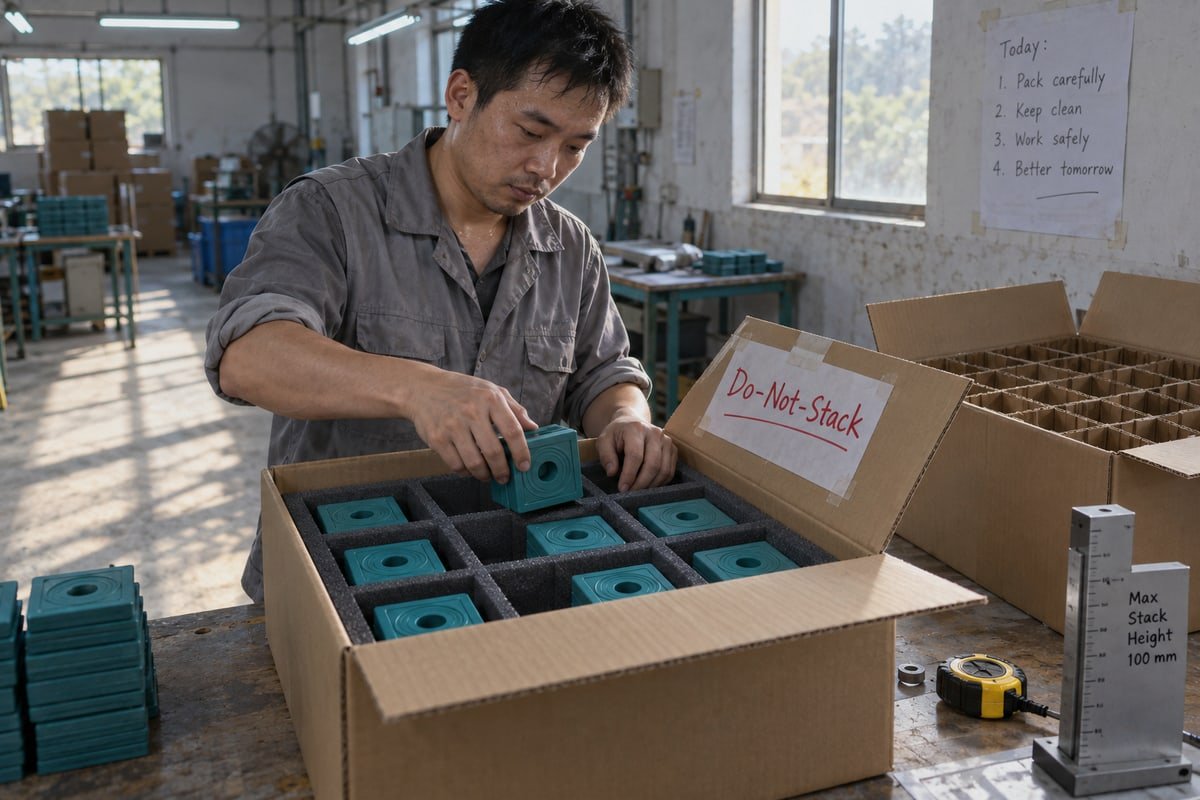
Keep EPDM sealing modules dimensionally stable by packing them loose, uncompressed, and single-layer in rigid cartons with custom-cut foam or honeycomb dividers, limiting stack height with Do-Not-Stack indicators, keeping cartons out of direct sun, and using phase-change materials or insulated liners on routes with extreme heat.
Compression set is a design fact, not a defect
Manufacturer service guides say it plainly. Rubber develops a small but lasting deformation after compression. Our step-core EPDM is designed around that. The installer compresses the module once, at the defined level, against a clean cable jacket. The set that forms is then even and predictable. Random compression inside a crate is different. A carton stacked five high in a container presses the modules at the bottom for weeks. The load is uneven. The set is uneven. The module still looks fine when you unbox it. Then it fails the visible-gap check after installation, and the site team blames the design.
Some buyers tell us rubber deforms anyway in service, so shipping pressure should not matter. It does matter, for one reason. The concentric step-core layers are what let one module size adapt to several cable diameters. Crush those layers unevenly and you lose part of that range. The module may then need a size you did not order.
Heat multiplies the pressure problem
Our Middle East shipments face the harshest case. A container roof in summer sun runs far hotter than the air outside. Warm EPDM softens and takes a set faster under the same load. Modules stored near the container roof take the most heat. So we place rubber cartons low in the load plan and put steel frames higher when the weight allows. For high-precision projects, insulated liners or phase-change materials hold the internal temperature steady.
Packing methods compared
| Method | Deformation risk | Our position |
|---|---|---|
| Modules pre-inserted and compressed in the frame | High | Never for shipment |
| Bulk-bagged modules loose in one carton | Medium to high | Only for very short domestic legs |
| Single-layer modules in foam-cut or honeycomb dividers | Low | Standard export packing |
| Cartons stacked beyond marked height | High | Do-Not-Stack cones and maximum stack height printed on every carton |
We ship spare cable sealing modules in the same carton spec as full systems. A replacement part that arrives deformed is not a spare.
How do I protect cable transit frames and compression units from crushing damage during freight handling?
A sourcing engineer in Rotterdam once sent us a photo of a frame from a previous supplier with a bent flange. The forklift tine had gone straight through the pallet side.
Protect cable transit frames and compression units by bolting them to heat-treated wooden crate bases, nesting frames flange-to-flange with plywood separators, boxing compression wedge kits and stay plates separately in foam-lined cartons, banding everything to the pallet with polyester strapping, and specifying forklift entry sides on the crate.
Why a bent frame is a failed frame
A frame does two jobs. It seals, and it supports. A cutout that is out of square by a few millimeters will not accept modules evenly. Compression then goes to one side. That gives you both a watertight cable penetration problem and a crushed cable on the tight side. For fire-rated cable transits, the A-0 and A-60 performance also depends on the frame sitting flat against the bulkhead. And a warped frame loses the dimensional compatibility with common 120-frame standards that makes drop-in second sourcing possible in the first place.
Why compression units matter more than they look
The compression wedge kit is small. It is also the one part that decides whether the whole transit reaches the defined compression state. A bent spindle or a dented wedge plate will bind before the modules close. The installer then over-tightens to compensate. That is the exact behavior every manufacturer guide warns against. Stay plates have the same issue. A kinked stay plate does not seat, and the row above it floats.
The crate build sequence we use
- Start with a heat-treated wooden base sized so the frames never overhang.
- Bolt or block the largest frame to the base first. Nothing should be able to slide.
- Nest further frames flange-to-flange with plywood separators. Weld seams never touch bare steel of the next frame.
- Pack compression units, wedges, and stay plates in a separate foam-lined carton. Fix that carton inside the crate, not loose on top.
- Fill remaining voids with honeycomb board or cut foam so nothing shifts under vibration.
- Close the crate and band it to the pallet with polyester strapping or steel banding.
- Mark the forklift entry sides, the center of gravity, and the stacking limit on the outside.
For repeat OEM orders with unusual frame geometries, we have run finite element simulations 4 on the crate layout to check how multi-axis vibration loads the flanges. That is extra work, but it is cheaper than a rejected shipment of multi cable transit systems at a BESS container line that is waiting to close panels.
What quality checks should I request from my supplier to confirm MCT systems arrive undamaged and ready for installation?
Early on, we learned a clean factory test report means little if a crate arrives with cracked modules. Now our QC ends at your unboxing, not our gate.
Request a pre-shipment inspection report with per-carton photos, module hardness and dimension checks against the drawing, frame flatness and cutout measurements to 120-frame dimensions, batch traceability to IP68 and A-60 test certificates, desiccant and humidity-indicator records, and a shock-indicator or data-logger readout on arrival.
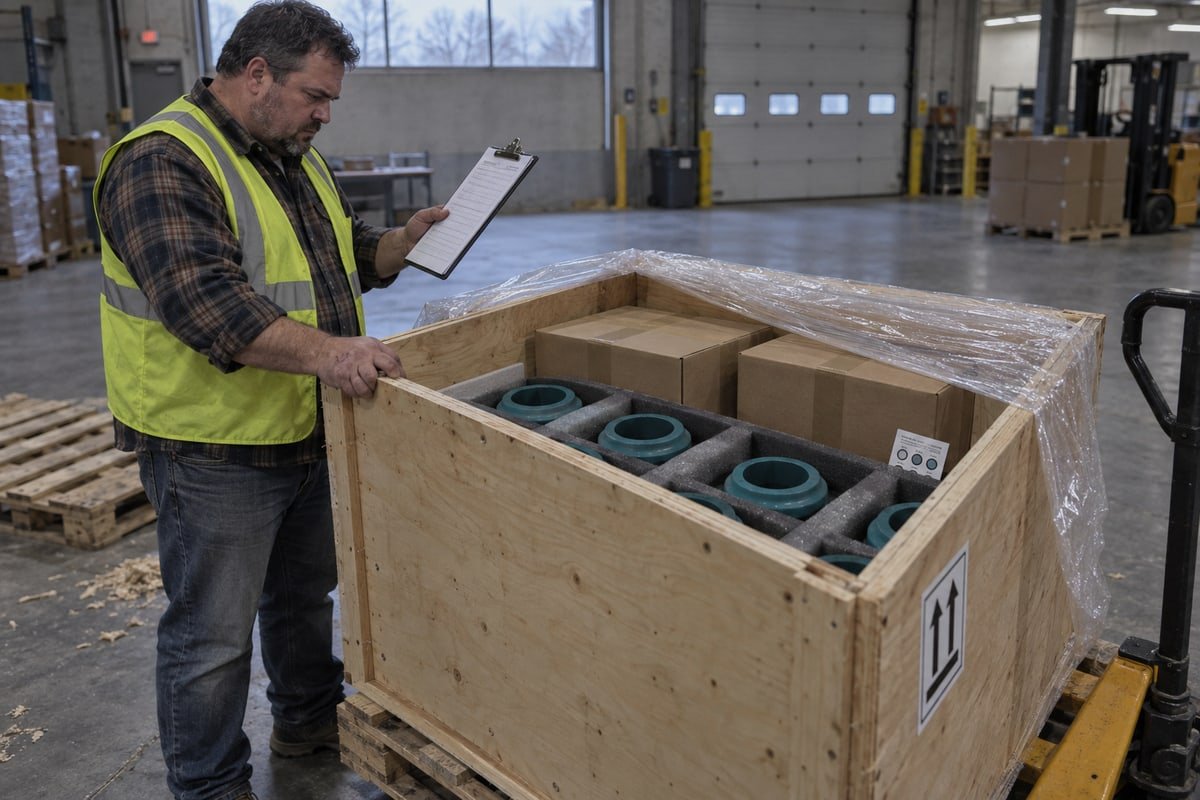
Split the checks into two moments
One set of checks belongs at the factory gate. The other belongs at your dock. Both need a written pass criterion. Some installers still work on a "tight enough" feeling. Manufacturer guidance rejects that and asks for a defined compression state with visual checks. I apply the same logic to inspection. A photo with a caliper in frame is evidence. A sentence saying "checked OK" is not.
| Check | When | What to ask for | Pass criterion |
|---|---|---|---|
| Module dimensions and hardness | Factory | Sample measurements per batch against the drawing | Within drawing tolerance, no cuts or voids |
| Frame flatness and cutout size | Factory | Measurement sheet with photos | Cutout matches 120-frame dimensions, frame flat on a surface plate |
| Certification traceability | Factory | Batch number linked to ISO 9001, IATF 16949, BV factory approval, IP68 and A-0/A-60 test documents | Documents supplied on request before shipment |
| Packing record | Factory | Photos of desiccant, VCI bags, dunnage, and strapping | Every carton photographed before the crate closes |
| Humidity and shock indicators | Arrival | Reading before the crate is opened | Indicator not tripped, humidity within the agreed limit |
| Dry-fit test | Arrival | One module compressed on a sample cable in one frame | No visible gap between cable and module after compression |
| Spare parts count | Arrival | Packing list with part numbers | Every compression unit and stay plate present |
The dry-fit test is the one that matters most
Take one frame, one compression unit, and a handful of modules. Insert them around a sample cable. Tighten to the defined level. Then look. Manufacturer checklists state there must be no visible gap between cable and module after compression. If that check passes on arrival, moisture, deformation, and crushing have all been ruled out at once. If it fails, you have a claim with evidence.
A common objection, and my answer
Some procurement teams ask whether a sealant-based system avoids all this shipping risk. Wet-applied products do not deform in a crate, so the question is fair. But they trade one problem for others. They have shelf life. They need cure time on site. They cannot be re-tightened. And when a BESS or data center integrator adds cables a year later, a cured sealant must be cut out. Mechanical multi cable transit systems can be opened, relubricated, and closed again. That is why we accept the tighter packing discipline. It is the price of a system that stays serviceable.
We make this easier for buyers who are qualifying us as a second source. Free validation samples ship in the same export packing as production. Cross-reference tables map your existing model to the matching DEWIN model. CAD and STEP files come with the quote. Watertight and gas-tight test results in the 0.01 to 0.4 MPa range are available on request. Check the sample crate the same way you would check a full order.
Conclusion
Damp, deformation, and crushing all start before installation. Ignore packaging and you inherit hidden seal failures. We specify barrier packing, uncompressed modules, crated frames, and documented inspection instead.
Footnotes
1. Official IEC page explaining the IP rating system for ingress protection. ↩︎
2. Technical explanation of the corrosion process affecting galvanized frames in humid conditions. ↩︎
3. IMO safety standards covering fire-rated divisions like A-60 mentioned for cable transits. ↩︎
4. Overview of the numerical method used to simulate structural stresses in packaging design. ↩︎


 English
  Español de México
  Deutsch
  Français
  العربية
  Русский