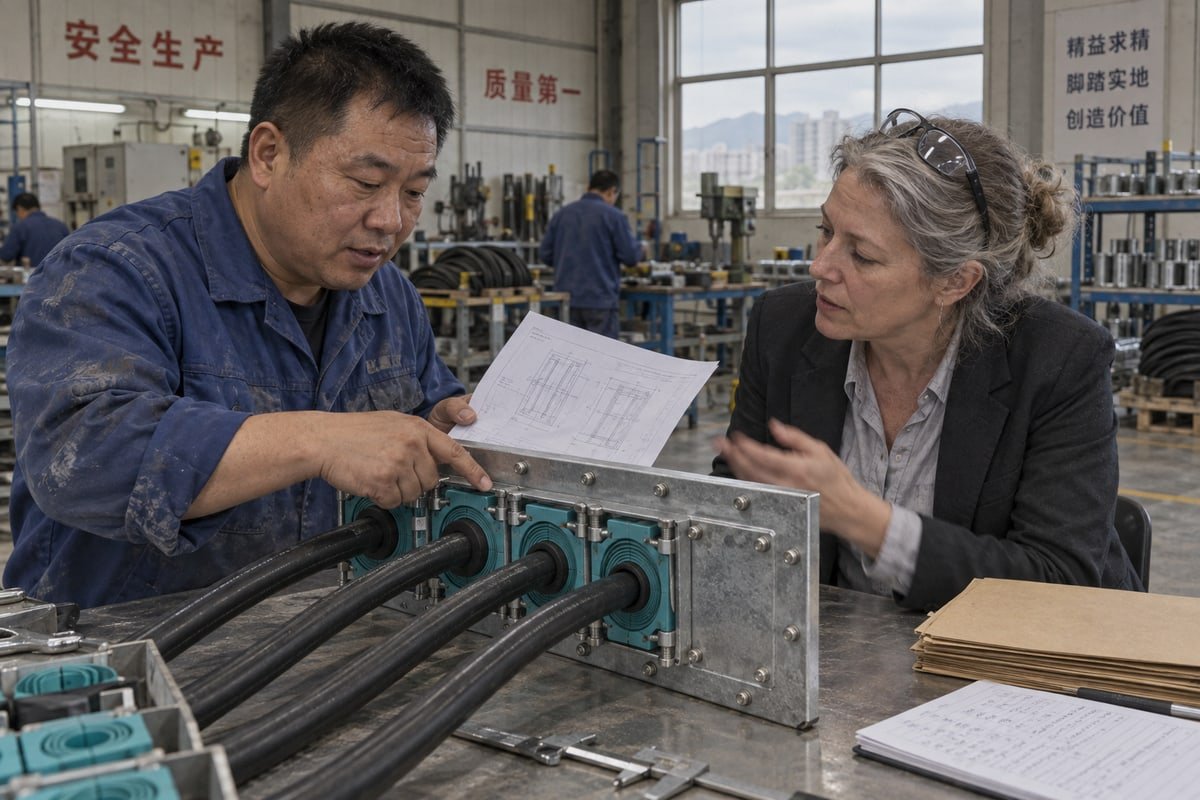
A frame that fits the cutout can still fail inspection. Our factory sees this whenever a multi cable transit is ordered without product selection and design training.
Request product selection and design training by writing it into the RFQ as a deliverable: ask the multi cable transit manufacturer for a pre-order cable schedule review, aperture sizing, module selection support, CAD/STEP files, named technical trainers, and free validation samples before you sign the purchase order.
That sounds simple. In practice, most buyers send a frame size and a target price, and nothing else. The four sections below walk through what to ask for, what to receive, who should deliver it, and how to prove it works on your own bench.
How do I request product selection guidance from an MCT manufacturer before I commit to an order?
Last quarter a BESS container builder sent us a frame drawing with no cable list. We sent back three questions before we quoted a single module.
Request product selection guidance by sending the manufacturer your cable schedule, aperture dimensions, environment, and required ratings, then asking for a written selection report, a module layout drawing, and a cross-reference to your existing models before the purchase order is issued.
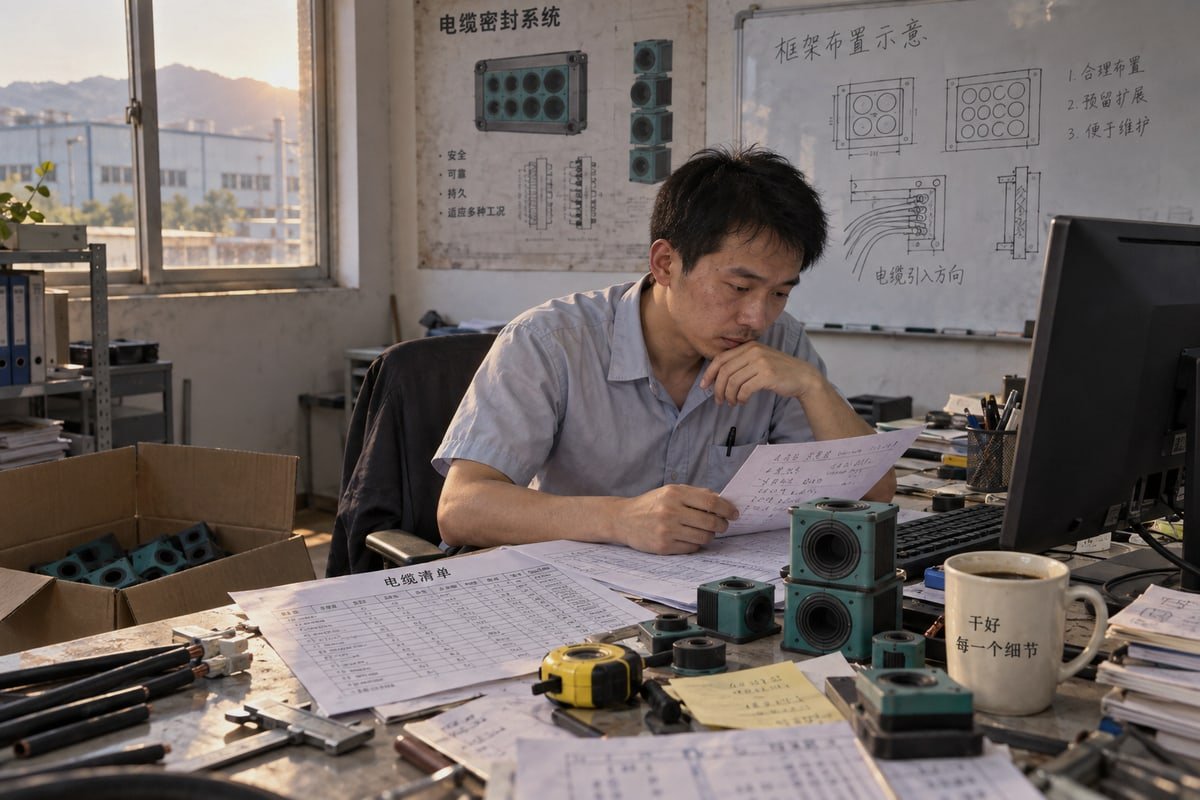
Selection for a cable sealing system starts with data, not with a catalogue. If the manufacturer cannot see your cables, it cannot size your modules. So the first thing I tell a purchasing engineer is this: give us the inputs, and we give you a report you can attach to the RFQ.
What to send before you ask for guidance
| Input you provide | Why the manufacturer needs it | Typical format |
|---|---|---|
| Cable schedule with outer diameters and counts | Drives sealing module selection and step-core sizing | Excel export from the cable schedule management tool |
| Aperture or existing frame dimensions | Confirms drop-in fit with 120-frame standards | 2D drawing or a photo with a tape measure |
| Mounting surface and wall thickness | Determines weld frame, bolt frame, or round TSR sleeve | Short note or section drawing |
| Environment and exposure | Selects halogen-free EPDM 1 grade and frame material (galvanized or stainless) | Checklist: indoor, outdoor, marine, hazardous area |
| Required ratings | Confirms fire safety certification (A-0/A-60), IP68, and gas-tight range 0.01–0.4 MPa | Project specification clause numbers |
| Spare capacity rule | Reserves space for future cables | Percentage or number of spare ways |
What the selection report should contain
The report should come back with four items. First, a module layout drawing showing every module position in the frame. Second, a bill of materials that lists modules, stay plates, filler blocks, and the compression unit. Third, a cross-reference table that maps your current supplier model to the equivalent DEWIN model. Fourth, a note on spare capacity. Some project specs require at least 50% spare for each cable outer diameter, and another common rule keeps instrument and electrical cables in separate frames. Ask the manufacturer to state which rule the layout follows.
If the vendor uses engineering design software or a calculation program, ask for the software output as part of the submittal. Many buyers now write this into the RFP so the bill of materials is generated, not guessed.
The objection I hear most often
"Any transit will do if the opening fits." I understand the logic, but fit is only the first check. A firestop penetration 2 also has to hold watertight integrity, resist gas migration, and keep cable segregation. A module that fits the cutout but uses the wrong rubber grade or the wrong compression will not pass the site inspector. That is why we ask for the environment and rating data before we quote.
What documentation and CAD/STEP files should I ask for during design training sessions?
Our drawing office keeps two versions of every TSC module STEP file: a simplified envelope for layout work and a full model for interference checks.
Ask for native STEP and 2D DWG files of frames, modules, stay plates, and compression units, plus installation drawings, the fire safety certification and IP68 test reports, material data sheets, a model cross-reference table, and a cable schedule template that records every module position.

Design training without documents is just a conversation. The value comes when your engineers leave the session with files they can load into the 3D model the same day. Here is how I structure the package for a European integrator.
The document package, in delivery order
- Product data sheets for the TSR round series and TSC square series, including module size ranges and the step-core diameter steps.
- STEP and DWG files for each frame type, module size, stay plate, and compression unit.
- Installation drawings with the compression sequence, torque guidance, and the required note that the onsite contractor must be trained on the approved design.
- Test evidence: fire test documents for A-0/A-60, IP68 ingress report 3, and the watertight/gas-tight test range of 0.01 to 0.4 MPa.
- Quality system certificates: ISO 9001 4, IATF 16949 5, and the BV factory approval.
- Material declarations confirming halogen-free EPDM and frame coating or stainless grade.
- Model cross-reference table from your existing supplier model to the DEWIN equivalent.
- A cable schedule template with one row per module position.
Reading the certifications correctly
A training session should spend time on what each document actually proves. Buyers often mix up a factory system certificate with a product test. The table below is the one we use in webinars.
| Document | What it proves | What it does not prove |
|---|---|---|
| ISO 9001 / IATF 16949 | The factory process is controlled and audited | The product passed a fire or pressure test |
| BV factory approval | A classification body has inspected production | Approval for a specific hazardous-area zone |
| A-0 / A-60 fire test report | The firestop penetration held for the tested duration and configuration | Performance in a different frame size or fill ratio |
| IP68 report | Ingress protection at the tested depth and time | Gas tightness at pressure |
| Gas-tight test 0.01–0.4 MPa | Sealed pressure range for the tested assembly | Blast rating or EMI shielding |
If your project sits under ATEX or UL requirements, ask the trainer to state plainly which parts of the package apply and which need a separate approval. That answer belongs in writing.
Keeping the physical transit and the model in sync
Modern sourcing teams ask about "digital twin" alignment. In plain terms, this means the cable schedule template is updated every time a cable is added on site, and the 3D model follows. We keep the template simple: frame ID, module position, module size, cable ID, cable OD, spare or occupied. Design training should include a short session on filling it in, because cable schedule management after handover is where most transits lose their spare capacity.
Who at the factory actually provides technical training, and how do I confirm their expertise?
Early on we let a sales engineer run a customer training call alone. The questions about compression torque went unanswered, and we changed the rule that week.
Technical training should come from the manufacturer's application or design engineers, not sales staff. Confirm expertise by asking for names, roles, years on the product, examples of aperture layouts they have approved, and by requesting a short live session that answers your project-specific questions.
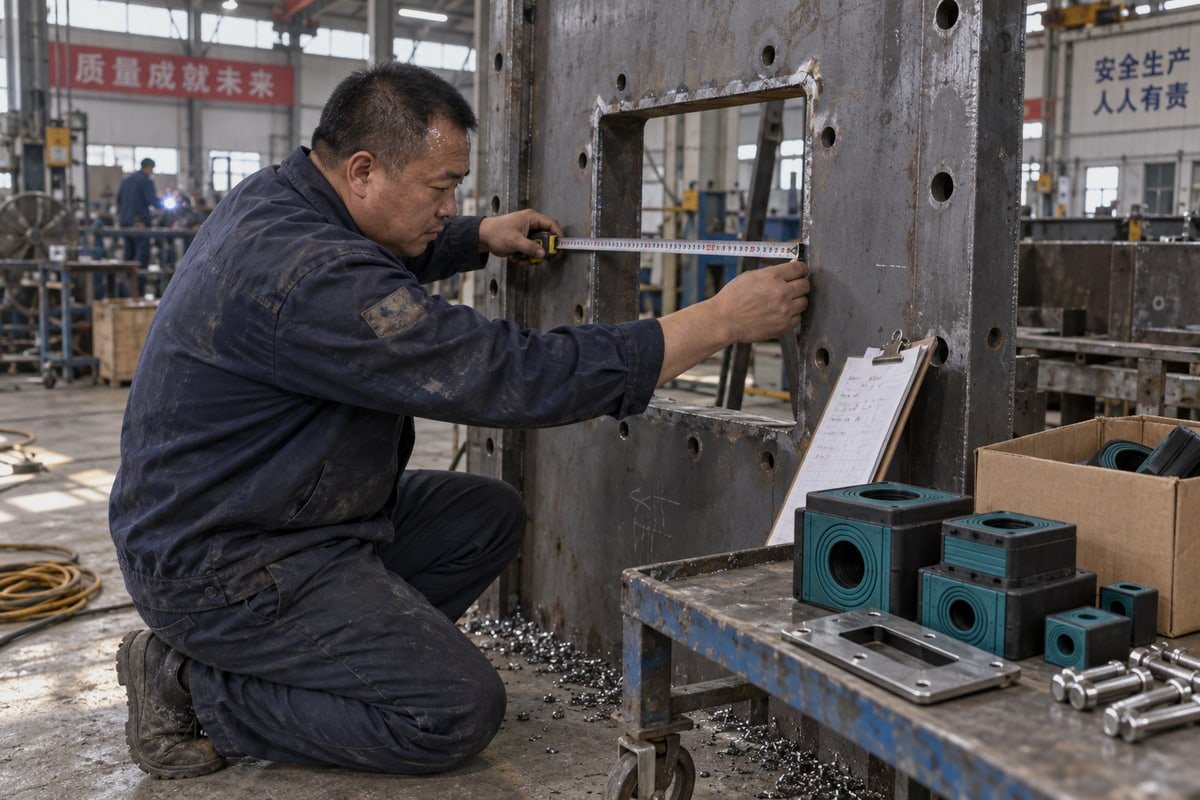
The person who trains you shapes how your installers work for the life of the project. So it is fair to ask who they are. At our plants in Shaanxi, Shandong, and Hunan, training requests are routed through the application engineering group, with QC and mold-making staff joining when the topic needs them.
Who teaches what
| Role at the factory | What they should teach | How you can verify |
|---|---|---|
| Application engineer | Sealing module selection, aperture sizing, spare capacity rules | Ask for two anonymised layout drawings they produced and the logic behind each |
| Design engineer | Frame variants, custom sizes, in-house mold options, CAD/STEP structure | Ask them to explain a step-core module drawing line by line |
| QC or test engineer | Compression checks, IP68 and gas-tight test method, installation quality control | Ask for the inspection checklist they use on the production line |
| Sales engineer | Commercial terms, lead time, export documentation | Not a substitute for the three roles above |
Formats that work, and when to use each
Vendors now offer blended training: onsite workshops, live webinars, and recorded video modules. Each has a place. An onsite workshop suits transit frame installation crews before mobilisation. A webinar suits a design team onboarding a new product line or a second-source model. Video modules suit refresher training when a project runs for years and new employees join. For long programmes, a "train-the-trainer" clause in the contract lets you build an internal expert and reduce reliance on the vendor.
Two objections, answered
"The installer already knows cable glands and seals." Glands and modular sealing solutions are not the same skill. An MCT needs module stacking, stay plate placement, compression order, and adherence to the approved drawing. Get that wrong and the seal looks fine but leaks under pressure.
"Training increases cost." It does add a line to the quote. But an untrained crew produces rework, failed inspections, and unplanned cable additions that eat the spare ways. In our experience the training line is small next to a frame that has to be cut out and reinstalled.
One last check: ask the trainer a question they cannot know from a brochure, such as how to handle a cable OD that sits between two step-core layers. A real application engineer will answer with a drawing, not a slogan.
How can I use free validation samples to test what I learn during design training?
Shipping a free sample costs us freight and a module set. We still do it, because a sample failing on your bench beats a frame failing on site.
Use free validation samples to rehearse the trained procedure: fit the modules into your existing 120-frame cutout, strip step-core layers to your actual cable diameters, compress the unit, then run a water or air test and compare results against the manufacturer's installation drawing and inspection checklist.

A validation sample is a training exercise with a pass or fail at the end. That is why I ask buyers to run it right after the design session, while the procedure is fresh. Here is the sequence we recommend to purchasing engineers qualifying us as a second source.
The bench procedure, step by step
- Request a sample set that matches one real frame position from your layout: the modules, filler blocks, one stay plate, and a compression unit.
- Check dimensions against the cross-reference table. The modules should drop into your existing 120-frame cutout without shims.
- Take three cables from your actual cable schedule, one at the low end, one mid-range, one at the high end of the module size.
- Strip the step-core EPDM layers to each cable OD, following the training instruction on how many layers to remove.
- Stack modules and stay plates in the order shown on the installation drawing. Fit the compression unit and tighten in the trained sequence.
- Run a simple water test for watertight integrity, or an air test at a pressure inside the 0.01–0.4 MPa range if your bench allows it.
- Record results on the inspection checklist. Photograph the stack before and after compression.
- Send the completed checklist back. We review it and confirm whether the technique matches the approved design.
What each check proves
| Bench check | Pass criterion | What it validates |
|---|---|---|
| Drop-in fit | No shim, no grinding, bolts align | Dimensional compatibility for drop-in second sourcing |
| Layer stripping | Cable sits snug with no visible gap at the module face | Sealing module selection and trained stripping method |
| Compression | Unit closes to the drawing dimension without over-torque | Installation quality control procedure |
| Water or air test | No leak over the hold time you set | Watertight integrity and, if pressurised, gas tightness |
| Checklist completion | Every field filled, photos attached | Cable schedule management discipline for site |
Why this matters for future changes
The sample also tests future-proofing. Try adding a fourth cable into a spare position without disturbing the sealed ones. If the trained procedure allows it, your spare capacity rule is real. If not, revisit the layout before you order frames for the whole container fleet.
Conclusion
Cheap unit price is not the cheapest transit. Write product selection and design training into the RFQ, verify the trainers, and prove the lesson with a free sample.
Footnotes
1. Technical reference for EPDM rubber, detailing its properties as a durable sealing material for industrial applications. ↩︎
2. Authoritative Wikipedia entry explaining the function and importance of firestop penetrations in building safety. ↩︎
3. Official IEC page defining Ingress Protection ratings, specifically the IP68 standard for dust and water resistance. ↩︎
4. Official ISO page for the 9001 standard, the global benchmark for quality management systems. ↩︎
5. Official site for the IATF 16949 standard, essential for quality management in the automotive supply chain. ↩︎



 English
  Español de México
  Deutsch
  Français
  العربية
  Русский