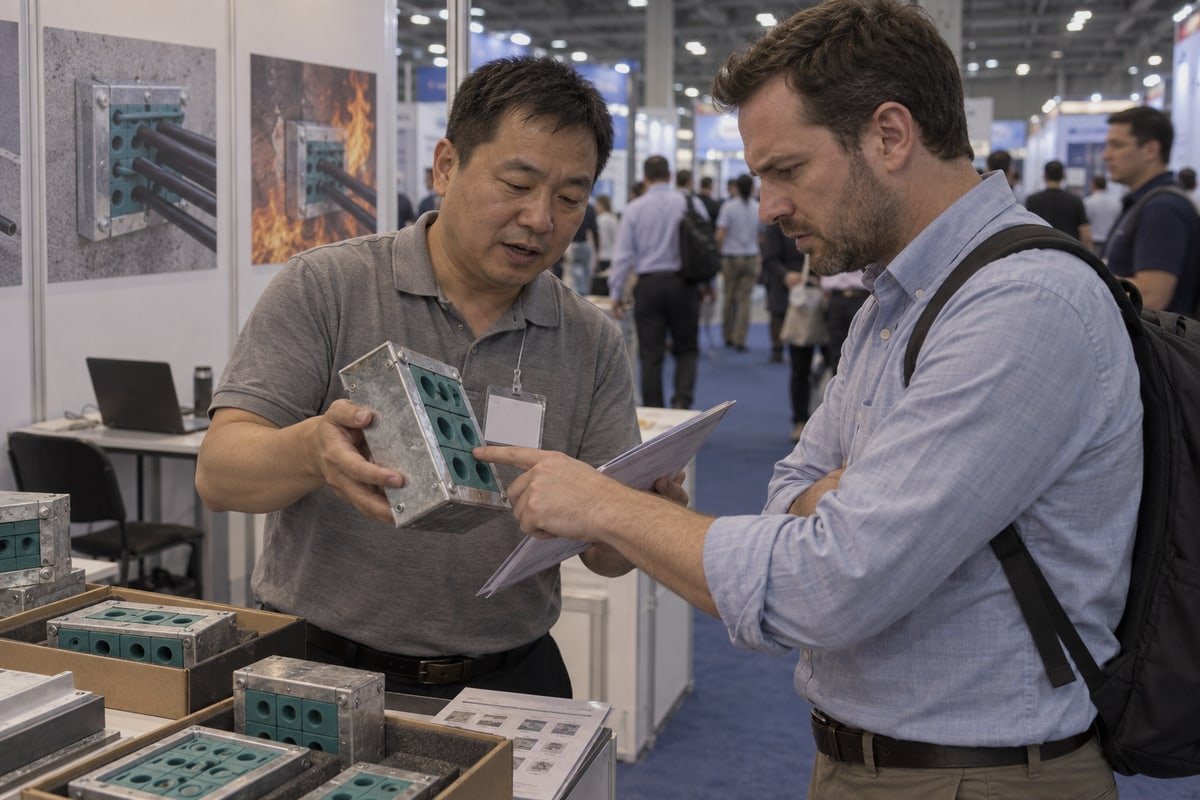
Screening Chinese multi cable transit suppliers looks easy until three identical Alibaba listings quote three different fire ratings. Our production line has fielded that exact confusion from buyers since 2013.
To screen Chinese multi cable transit suppliers, use B2B platforms for breadth and trade shows for verification. Filter listings by verified manufacturer status, request certification documents and CAD files online, then confirm rubber quality, weld finish, and engineering depth in person. Validate with free samples before any purchase order.
The two channels fail in different ways. Platforms hide who actually owns the factory. Trade shows hide how a supplier behaves after the booth comes down. Below, I walk through four questions that European purchasing engineers ask us most often, and I show how to answer each one using both channels together.
How can I verify a Chinese MCT supplier's certifications before trusting an Alibaba listing or trade show claim?
During our last BV surveillance audit 1, the surveyor pulled batch records for a TSC module run and traced the EPDM compound back to the incoming inspection log. That is what a real certificate costs.
Verify a Chinese MCT supplier's certifications by requesting the certificate number, issuing body, scope, and expiry date, then checking them on the certifier's public database. Match the legal entity name on the certificate to the business license, the platform profile, and the trade show booth.
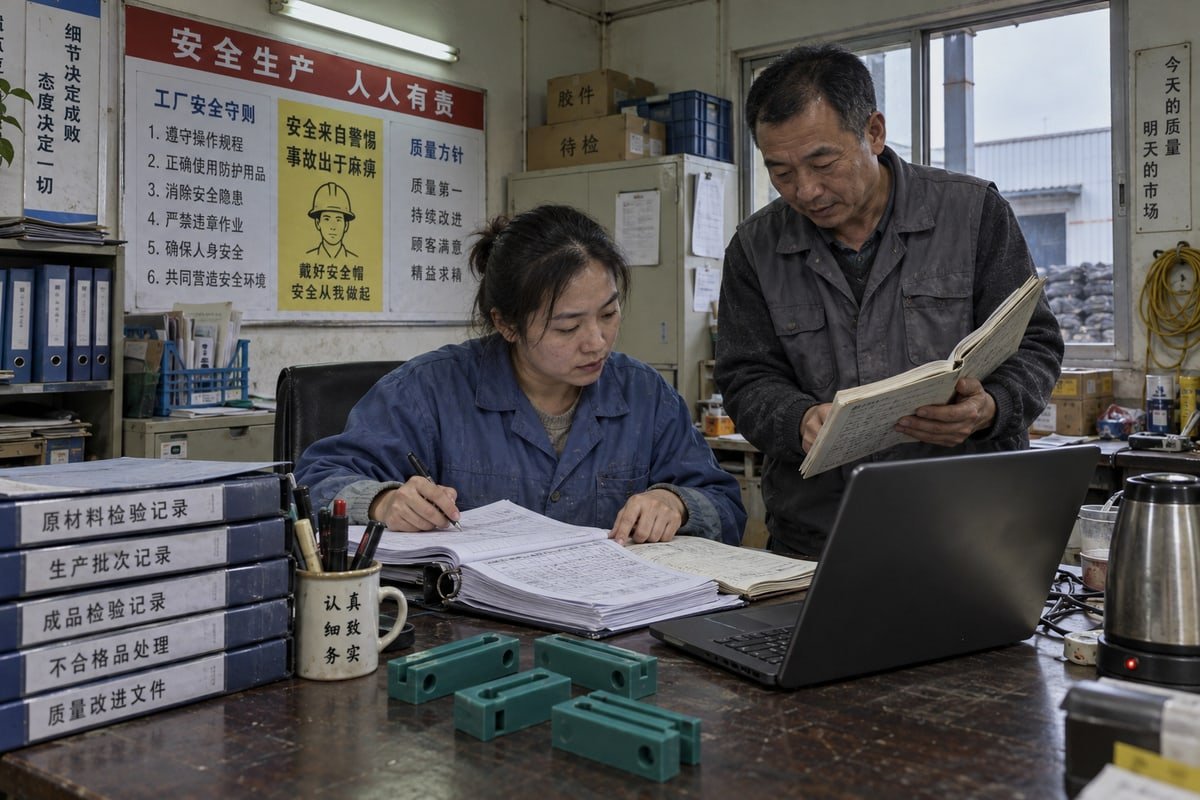
A certificate is only useful if you can trace it to a named company, a defined scope, and a live registry entry. Many buyers stop at the PDF. That is where the supplier verification process usually breaks down. A trading company can display a factory's ISO 9001 certificate on its Alibaba page. A booth at the Canton Fair 2 can show a laminated fire test report that belongs to a competitor's module. Neither situation is rare.
Which certifications matter for multi cable transit systems?
The list depends on your end market. Marine cable transit systems and offshore engineering standards 3 demand class society approval. Land-based switchgear, BESS containers, and modular data centers usually need a quality management system plus product test evidence for fire and ingress protection.
| Certification or test | What it proves | How to verify it |
|---|---|---|
| ISO 9001 | A working quality management system | Check the certificate number on the certifier's database; confirm the site address |
| IATF 16949 | Automotive-grade process control, useful for OEM integrators | Same registry check; ask for the latest audit nonconformity summary |
| BV, DNV GL certification, Lloyd's Register approval, ABS | Type approval for marine and offshore penetrations | Search the class society's public approval finder by company name and product |
| Fire rating A-0 / A-60 | Fire-rated cable seals hold a bulkhead or deck rating | Ask for the full test report, not the summary page; check the lab name and test date |
| IP68 | Watertight penetration seals under sustained immersion | Ask for the test standard reference and sample configuration tested |
| Pressure test 0.01–0.4 MPa | Watertight and gas-tight performance across a range | Ask which module size and cable diameter were tested |
What do platform badges and booth claims actually cover?
Alibaba Trade Assurance protects the transaction. It refunds you if goods do not ship or do not match the order description. It does not confirm that a fire test was ever performed. Verified Supplier or Gold Plus badges confirm that a third party visited a premises. They do not confirm that the premises makes the product you are buying. At our Shaanxi plant, we run in-house mold making and rubber compounding, so we can show the badge and the machinery. A reseller can only show the badge.
Trade show claims have the same weakness. A polished booth is a sales front. The test is whether the person at the booth can tell you which module size was mounted in the fire test furnace. If they cannot, request the report and verify it later.
When should you pay for a third-party audit?
For any order above a trial quantity, commission factory inspection services 4 from SGS, Intertek, or BV. Ask the auditor to photograph the molding presses, the compression test rig, and the incoming material inspection area. This step costs a few hundred dollars. It is cheaper than a failed seal in a live BESS container.
What should I ask for online versus in person to confirm dimensional compatibility with my existing 120-frame system?
We weigh a real trade-off every time a drawing request arrives. Share full tolerances too early and risk copying. Hold them back and lose a skeptical European engineer who reads spec sheets first.
Online, ask for 2D drawings with tolerances, a model cross-reference table, and STEP files for the frame cutout and module stack. In person, bring a spare 120-frame or a gauge block and physically insert the supplier's modules, checking stack height, compression travel, and stay plate fit.
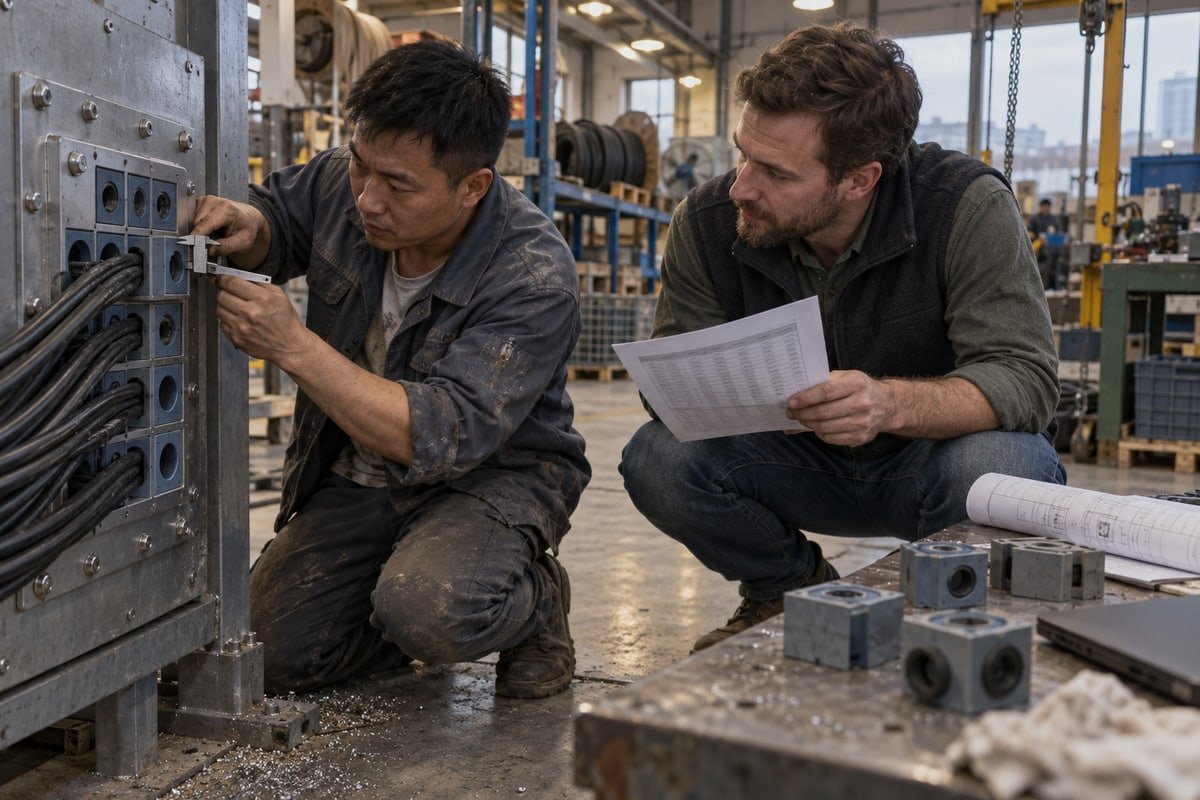
Dimensional compatibility is the whole point of second sourcing. If a module is one millimeter tall, the compression unit bottoms out before the seal reaches rated pressure. If a module is one millimeter short, the stack rattles and the gas-tight claim is gone. So the question is not whether a supplier says "compatible." It is whether you can prove it before the PO.
Online checks: documents that reveal compatibility
Platform messaging is good for one thing. It creates a written record. Use it to collect the documents below and compare them against your incumbent supplier's drawings.
| Document to request online | What to compare | Red flag |
|---|---|---|
| 2D module drawing with tolerances | Width, height, depth, and step-core diameter range | Drawing has nominal values only, no tolerance band |
| Frame cutout drawing | Inner opening, bolt pattern, flange thickness | Supplier asks you to send your frame drawing first with no reference of their own |
| Model cross-reference table | Existing model → supplier model, one row per size | Table lists only a few sizes or skips compression units and stay plates |
| STEP or IGES files | Full assembly of frame, modules, stay plate, compression unit | Only a rendered image is offered; native files are "available after order" |
| Material datasheet | Halogen-free EPDM, hardness, temperature range | Compound is unnamed or described only as "rubber" |
Our own TSC series cross-reference table lists each common 120-frame module size against the DEWIN model. We send it with the STEP files on the first request. A supplier who cannot do this either does not have the tooling or does not understand what you are asking.
In-person checks: what your hands find that a PDF hides
At a fair, the digital record stops and physical inspection starts. This is the point raised in most sourcing guides. Rubber block elasticity and frame weld quality are hard to judge on a screen. Here is what I recommend you do at a booth.
- Press a module core with your thumb. Step-core EPDM should return shape immediately. Slow recovery signals a cheap filler blend.
- Peel one step layer. It should separate cleanly without tearing the layer below.
- Run a finger along the frame weld. A ground, continuous weld seals; a spatter-covered weld does not.
- Stack the supplier's modules in your own frame or gauge block. Count the modules that fill the opening. Compare the count to your incumbent system.
- Ask the booth engineer to name the compression travel in millimeters. Then tighten the unit and watch.
The trade show visit works best after the online document review. You arrive knowing which tolerance to check. You leave with a physical sample that matches or contradicts the drawing.
How do I use free validation samples to compare suppliers found through B2B platforms and trade shows fairly?
A sourcing manager at a BESS container builder once asked us for six modules and a compression unit, then admitted the same request had gone to four other suppliers.
Compare validation samples fairly by issuing one written sample specification to every supplier, logging receipt dates, and running identical tests: dimensional check against your frame, compression fit, water tightness, and material hardness. Score results on the same sheet regardless of whether the supplier came from Alibaba or a fair.
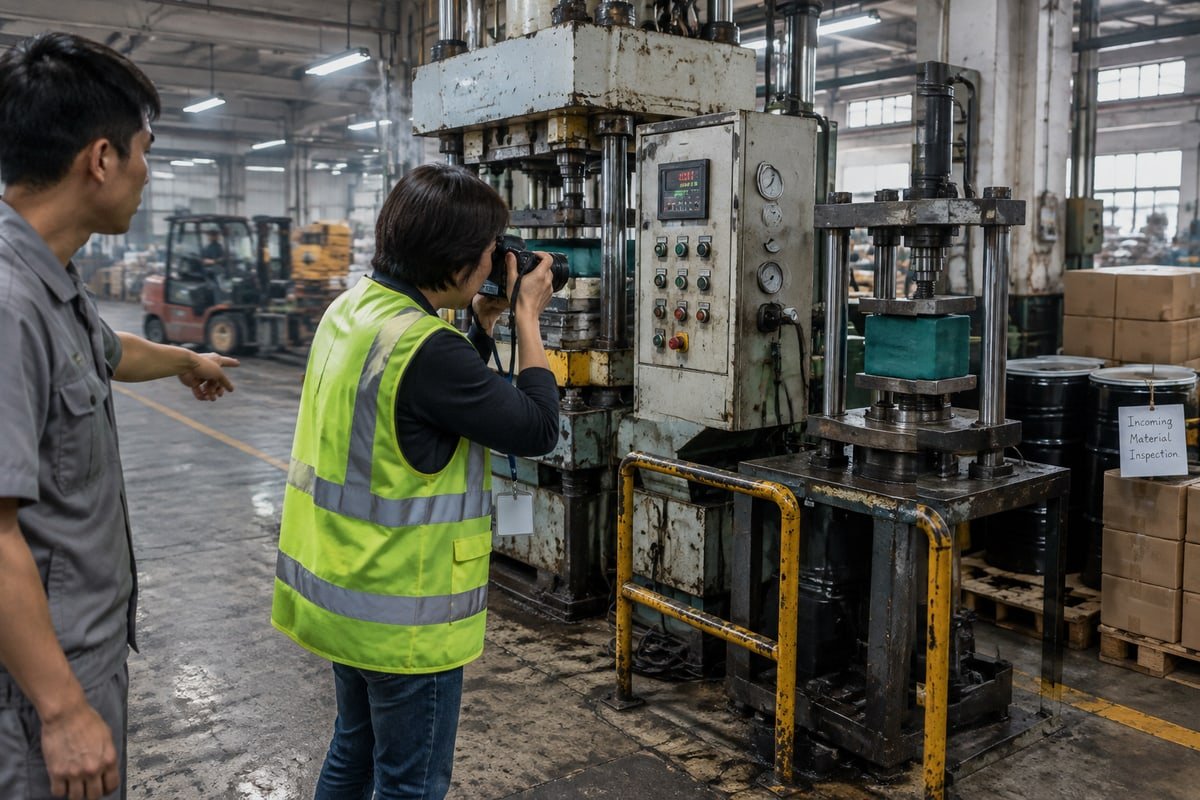
That buyer did the right thing. Free samples are the cheapest qualification tool you have. Yet most buyers waste them. They accept whatever the supplier chooses to send. They test the Alibaba sample on a bench and the trade show sample by eye. Then they compare notes that were never comparable.
Why samples from the two channels fail differently
Trade show samples are show pieces. The supplier selected them from the best batch, and a sales engineer carried them by hand. They tell you the supplier's ceiling. Platform samples usually ship from stock, packed by a warehouse worker, and travel by courier. They tell you the supplier's floor. Both facts are useful. Neither is the average.
So write the sample request yourself. Specify the module size, the cable diameter range you will seal, the frame type, and the quantity. Ask for one compression unit and one stay plate with every module set. Ask that the samples come from a production batch, with the batch number stamped or labeled. We label every module we ship this way, because a batch number is the only link back to our incoming EPDM inspection record.
A scoring sheet that treats both channels equally
| Test | Method | Pass criterion | Peso |
|---|---|---|---|
| Dimensional fit | Insert modules into your 120-frame; measure stack height | Within tolerance band on the supplier's own drawing | 25% |
| Compression fit | Tighten compression unit to full travel | Even face pressure, no module extrusion | 20% |
| Water tightness | Pressurize the assembled frame with water | No leakage at the rated pressure you specify, within 0.01–0.4 MPa | 25% |
| Material check | Shore hardness, halogen-free confirmation from datasheet | Hardness matches datasheet; LSZH or halogen-free statement present | 15% |
| Documentation | Batch label, drawing revision, packing list | All three present and consistent | 15% |
Apply this sheet to every supplier. Add a column for the sourcing channel, but do not let the channel change the score. Our quality control protocols use a similar sheet for final inspection, so a buyer who runs this test is essentially repeating our own release check. If the numbers match, the supplier is telling the truth. If they do not, you have saved yourself an audit fee.
One more fairness rule
Log the date you sent the request and the date the sample arrived. Lead time on a free sample predicts lead time on spare sealing modules later. A supplier who takes five weeks to ship six modules will not rescue you when a container is stuck at commissioning.
Which sourcing channel gives me more reliable access to CAD files, technical support, and stable lead times after the initial contact?
The hardest lesson we learned exporting to Europe was that a fast quote means nothing if the STEP file arrives three weeks later.
Neither channel guarantees post-contact support; the supplier's internal structure does. Trade shows let you meet the engineer who owns the CAD library, while platforms give a written, timestamped record of response speed. Test both by requesting a STEP file and a lead-time schedule within seven days.
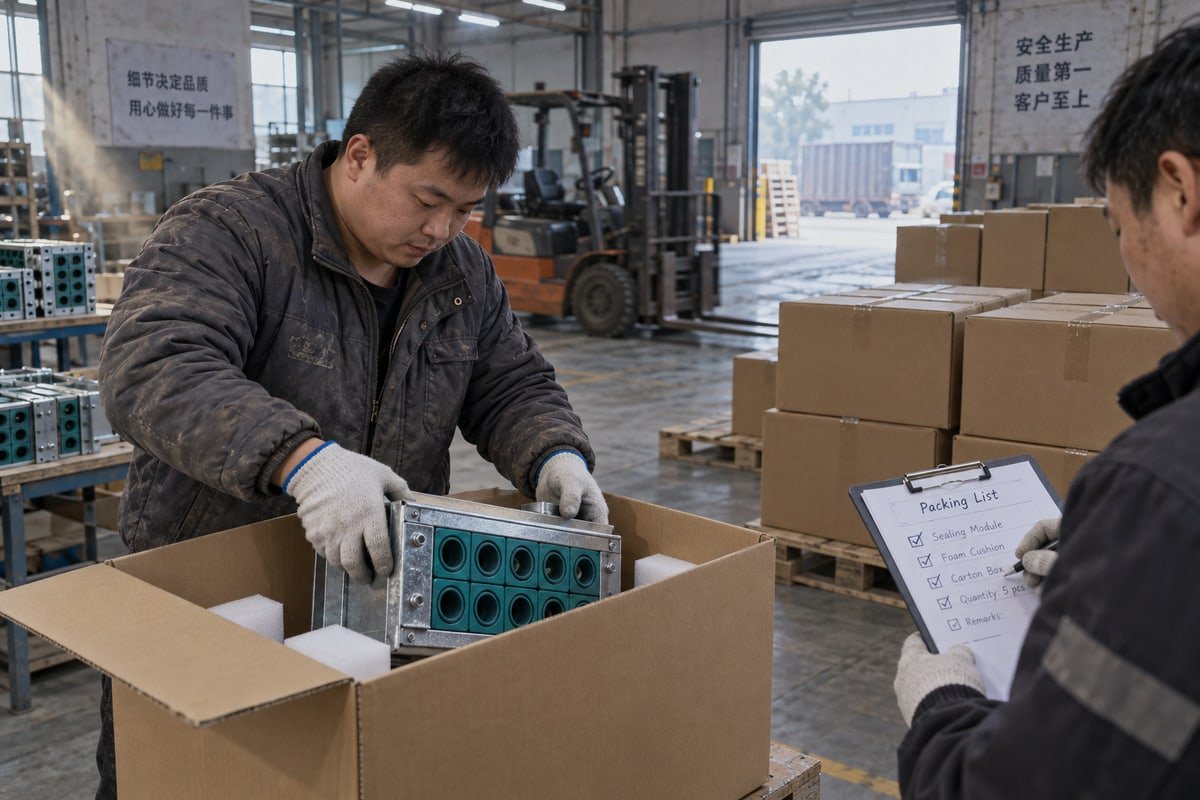
The channel you used to find a supplier does not run their engineering department. A factory with in-house designers will send CAD files whether you met them at the Canton Fair or on Made-in-China. A trading company will stall in both cases, because it has to ask its factory. So the real question is how each channel helps you detect which type you are talking to.
Channel comparison for after-contact support
| Factor | B2B platform | Trade show | Which channel reveals more |
|---|---|---|---|
| CAD and STEP files | Request through chat; delay is timestamped | Ask the booth engineer to open the file on a laptop | Trade show, if an engineer is present |
| BIM and 3D models | Rarely visible on listings | Often shown for modular data center and shipyard clients | Trade show |
| English technical support | Chat quality is visible over weeks | One conversation, often with sales, not engineering | Platform, over time |
| Lead-time stability | Transaction history and reviews hint at it | Direct question on capacity and second production sites | Both, in combination |
| Installation training | Video links sometimes in listings | Live demo of compression sequence at the booth | Trade show |
| Relationship for custom tooling | Hard to build through chat alone | Face-to-face discussion of mold cost and MOQ | Trade show |
The objections buyers raise, and how I answer them
Some purchasing engineers tell me platforms are enough. They point out that Alibaba, Made-in-China, and Global Sources remain the core China sourcing tools 5 in 2026, and that travel to Guangzhou costs a week and several thousand euros. That is fair for discovery. It is not fair for engineering depth. A chat window cannot show you whether a supplier's engineer can calculate module selection for a mixed bundle of 12 mm control cables and 45 mm power cables.
Other buyers tell me trade shows are the only trustworthy route. They argue that fairs expose fake factories. Yet a booth can also be rented by a reseller with a good brochure. Global Sources has run for over 50 years and launched its online platform in 1995, and it now links its Hong Kong fairs to online exhibitor search. That pairing exists because organizers know a booth alone does not prove competence.
So I resolve both objections the same way. Use the platform to send a written request for a STEP file, a drawing revision, and a lead-time schedule. Note the reply time. Then use the fair to meet the person who answered and ask them a follow-up question they could not have rehearsed. If the same engineer answers consistently in both settings, you have found a real factory.
What lead-time stability looks like from the inside
Our modules are molded across three sites in Shaanxi, Shandong, and Hunan. That redundancy is why we can promise fast delivery on spare sealing modules. When you ask a supplier about lead times, ask about their second production site, their mold inventory, and their EPDM stock policy. A supplier with one press and outsourced rubber cannot give a stable answer, no matter which channel you found them on.
Also ask about digital deliverables that newer projects demand. Modular data center and shipyard clients increasingly request BIM objects for modular cable management 6 layouts. Some ask for video-based installation training, because improper compression is the leading cause of seal failure on site. Green-certified projects may ask about recyclability of frames and ESG reporting. A supplier who has already prepared these materials is a supplier with real engineering staff behind the booth or the listing.
Conclusion
Similar-looking listings hide real quality gaps. A wrong module fails at commissioning. Screen Chinese multi cable transit suppliers with platforms for breadth, fairs for proof, and samples as the judge.
Footnotes
1. Bureau Veritas provides essential surveillance audits and certification services to ensure manufacturing compliance and quality. ↩︎
2. The Canton Fair is China’s premier trade event, serving as a critical venue for physical supplier verification. ↩︎
3. DNV provides the primary technical standards and classification services for the offshore engineering and maritime industries. ↩︎
4. SGS is a global leader in providing factory inspection and quality verification services for international trade. ↩︎
5. Global Sources is a leading B2B platform that provides verified sourcing tools and supplier information for global buyers. ↩︎
6. Uptime Institute is the global authority on data center infrastructure standards, including modular and prefabricated designs. ↩︎

 English
  Español de México
  Deutsch
  Français
  العربية
  Русский