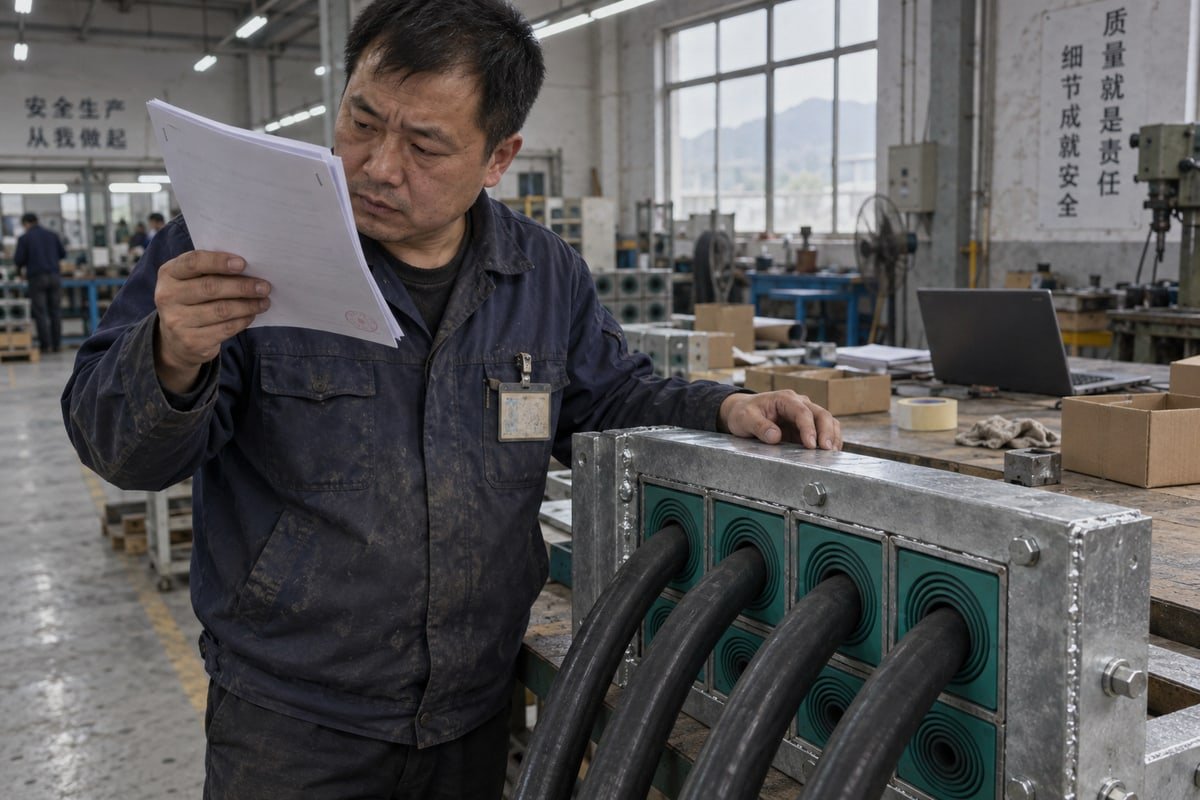
Brochures reach our Shaanxi factory claiming “fire rated” without proof, so verifying fire rating compliance for multi cable transit products matters. One failed inspection stalls a project; evidence prevents it.
Verify fire rating compliance for multi cable transit products by requesting the exact type approval certificate or test report, confirming the standard (EN 1366-3, IMO FTP Code, UL 1479), checking the A-0/A-60 class, and matching substrate, orientation, cable fill, and size range to your application before ordering.
That answer sounds simple. In practice, each step hides a detail that can void a rating. The four sections below walk through the documents, the classifications, the standards, and the sample process in the order a purchasing engineer would actually use them.
What certification documents should I request to confirm an MCT supplier's fire rating claims?
A sourcing engineer in Germany once asked us for "the fire certificate". We sent five documents. Only one answered his actual question, and that lesson shaped this checklist.
Request the type approval certificate, the full third-party test report with tested assembly drawings, the scope statement listing substrates and fill limits, the installation manual, factory quality certificates such as ISO 9001, and a cross-reference table proving the delivered model matches the tested one.

The word "certificate" covers many things. A one-page manufacturer declaration is a certificate. So is a forty-page type approval issued by a classification society. They do not carry the same weight. The table below shows what I ask buyers to collect before they compare suppliers.
The six documents that actually prove a fire rating
| Document | What it proves | Red flag if missing |
|---|---|---|
| Type approval certificate | A classification society or notified body reviewed the test and issued a listing with a certificate number | The supplier offers only a brochure "summary" |
| Full third-party test report | The exact tested assembly, furnace curve, thermocouple data, and pass/fail against integrity and insulation ratings | The report is withheld as "confidential" |
| Scope statement or performance matrix | Permitted substrates, orientation, size range, maximum cable fill, and approved accessories | Vague "suitable for all walls" wording |
| Installation manual and cut sheets | Compression depth, stay plate intervals, and torque values; the rating is void if these are not followed | A generic one-page drawing |
| Factory quality certificates | ISO 9001 and IATF 16949 systems 1, plus any third-party factory approval | A trading company with no factory address |
| Model cross-reference table | The part number on your purchase order matches the designation on the certificate | Invoice part numbers differ from certificate part numbers |
Check the certificate against the listing directory
Type approval certificates are only as good as their listing status. Third-party verification agencies keep public directories. For UL, look up the FHIT system number and confirm the whole assembly, not just a module, is listed. For FM Global approval, check the FM Approvals guide. Intertek keeps a similar directory. For marine and offshore classifications, the certificate should come from DNV, ABS, Lloyd's Register 2, or Bureau Veritas under the IMO FTP Code. Confirm the listing is active. Expired listings are a common problem with older product families.
Manufacturer-issued or independent? Resolving the objection
Some project teams accept a manufacturer-issued certificate to save time. I understand the pressure. But passive fire protection is a life-safety function. A manufacturer certificate is a declaration. An independent certificate is a verification. Our own approach reflects this. We run ISO 9001 and IATF 16949 systems, our factory is BV-approved, and we release the underlying test documents on request rather than a marketing summary. If a supplier cannot do the same, treat the fire claim as unverified.
How do I interpret A-0 and A-60 fire rating classifications when comparing cable transit systems?
During a furnace witness test on our TSC modules, the unexposed-face thermocouples told the whole story. The A-60 line is about temperature, not just flame.
A-0 and A-60 are IMO A-class divisions tested under the IMO FTP Code and A.754(18). Both require 60 minutes of integrity against flame and smoke; A-60 additionally limits temperature rise on the unexposed side for 60 minutes, while A-0 has no insulation requirement.
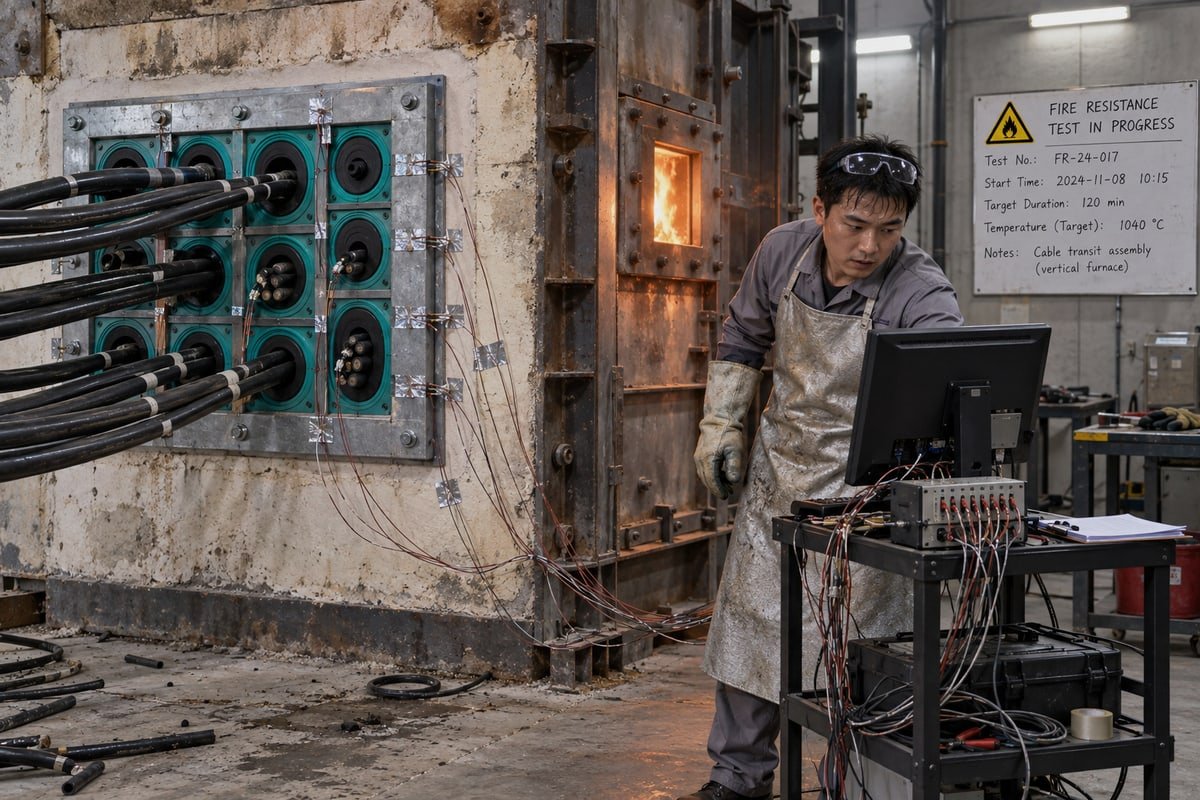
The quickest way to read these classes is to separate the two questions they answer. Does fire and smoke get through? That is integrity. Does heat get through? That is insulation. The table compares the classes buyers meet most often.
| Class | Integrity | Insulation | Standard | Typical application |
|---|---|---|---|---|
| A-0 | 60 min | 0 min | IMO FTP Code / A.754(18) | Steel bulkheads where insulation is not required |
| A-30 | 60 min | 30 min | IMO FTP Code / A.754(18) | Intermediate marine divisions |
| A-60 | 60 min | 60 min | IMO FTP Code / A.754(18) | Engine room boundaries, offshore modules |
| H-60 / H-120 | 60 / 120 min, hydrocarbon curve | 60 / 120 min | Hydrocarbon fire test regimes | Offshore process areas |
| EI 60 / EI 120 | 60 / 120 min | 60 / 120 min | EN 1366-3 with EN 13501-2 | Buildings, BESS and data center enclosures under EN rules |
What "insulation" means at the thermocouple
Under the IMO criteria, the average temperature rise on the unexposed face must stay within 140 °C above the initial temperature, and no single point may rise more than 180 °C. EN 1366-3 uses comparable limits for its I classification. This matters for cable penetration seals in a specific way. Copper conductors carry heat straight through the seal. So a fuller cable bundle, or larger conductor sizes, can push the cold-side thermocouples over the limit even when the rubber holds. That is why the certificate lists maximum cable fill and cable types.
The rating belongs to the assembly, not the block
A single EPDM module has no fire class on its own. The rating covers the frame, the modules, the stay plates, the compression unit, the substrate, and often a layer of structural fire insulation on one side. Our step-core, halogen-free EPDM modules 3 reach A-0 or A-60 depending on which assembly they sit in. A quotation that says "A-60" should tell you which side is insulated, the insulation thickness, the frame model, and the tested fill. If it does not, ask.
Orientation and spacing change the answer
Technical guidance notes that cable penetrations may need to be tested both vertically and horizontally for general approval. A bulkhead result does not automatically cover a deck. IMO guidance also indicates that adjacent transits in a division need at least 200 mm separation during testing, unless the system was designed and tested as multi-transits for adjacent placement. A tightly packed row of frames in a BESS container wall can fall outside the tested scope for this reason alone.
Which international test standards should I check to ensure fire rating compliance is genuine?
The trade-off we weigh on every export quote is scope versus breadth: a certificate that covers many standards, or one tied tightly to a single tested assembly.
Check EN 1366-3 with EN 13501-2 classification for European buildings, IMO FTP Code and IMO A.754(18) for marine and offshore, UL 1479 or ASTM E814 for U.S. firestop, UL 2196 for circuit integrity, and ISO 22899-1 where jet fire exposure is part of the risk profile.

Genuine fire rating compliance starts with matching the standard to the jurisdiction, the insurer, and the project owner. Different standards ask different questions of the same product. Here is the plain-English comparison I share with EPC procurement teams.
| Standard | Sector | What it measures | Result format | Not interchangeable with |
|---|---|---|---|---|
| EN 1366-3 + EN 13501-2 | European buildings | Integrity (E) and insulation (I) of service penetrations | EI 60, EI 120, up to 240 minutes | UL 1479 |
| IMO FTP Code / A.754(18) | Marine and offshore | A-class and B-class divisions, plus H-class regimes | A-0, A-60, H-120 | EN 1366-3 |
| UL 1479 / ASTM E814 | U.S. firestop | F rating, T rating, and hose stream after fire | Hours, up to 4 | EN or IMO |
| UL 2196 | Fire-resistive cable systems | Whether the circuit keeps operating during fire | 1 or 2 hours | Any firestop rating |
| ISO 22899-1 | Hydrocarbon jet fire | Resistance to a high-velocity jet flame | 60 or 120 minutes, variant-specific | Furnace tests |
Why the standards are not interchangeable
The furnace curves differ. UL 1479 certification adds a hose stream test 4 after the fire, which stresses the seal mechanically. ASTM E814 testing standards produce separate F and T ratings 5 for flame and temperature. EN 1366-3 compliance produces E and I values with its own thermocouple placement. IMO tests use a steel plate specimen that reflects a real bulkhead. UL 2196 asks a different question entirely: it checks that the cable circuit still carries power, not that the wall stays sealed. A product marketed with "up to 4 hours" under an EN or UL regime may hold a shorter A-class or H-class approval offshore. Read the standard next to the number, never the number alone.
Broad or narrow? Resolving the objection
Some buyers want one multi-standard certificate for procurement simplicity. Others argue a narrower certificate tied exactly to the installation is easier to defend during inspection. Both points are fair. My recommendation is to buy on the narrow scope that matches your assembly and treat multi-standard coverage as a bonus, not a substitute. A BESS container builder shipping to Europe and the Middle East should confirm which standard each destination authority accepts, then check the supplier's certificate library for that exact standard and configuration.
Performance that travels with the seal
Fire is not the only pass-through requirement. Many projects also need watertight and gas-tight sealing, blast resistance, or an IP rating. Our modules are tested for watertight and gas-tight performance between 0.01 and 0.4 MPa, and for IP68 ingress protection. Jet fire classification is a good example of scope sensitivity: one manufacturer's public certificate shows that the jet fire class can depend on product length and application-specific critical conditions. Always confirm the exact variant on the certificate matches the variant on your order.
Can I request free validation samples to verify fire rating performance before I commit to a bulk order?
We learned early that a sample in a buyer's hand settles more arguments than a PDF. That is why free validation samples became part of our qualification process.
Yes. Reputable MCT manufacturers provide free validation samples so you can check dimensional fit in existing 120-frame cutouts, material and marking, and compression behavior. Samples cannot replace a furnace test, so pair them with the certificate and test report for the exact configuration.
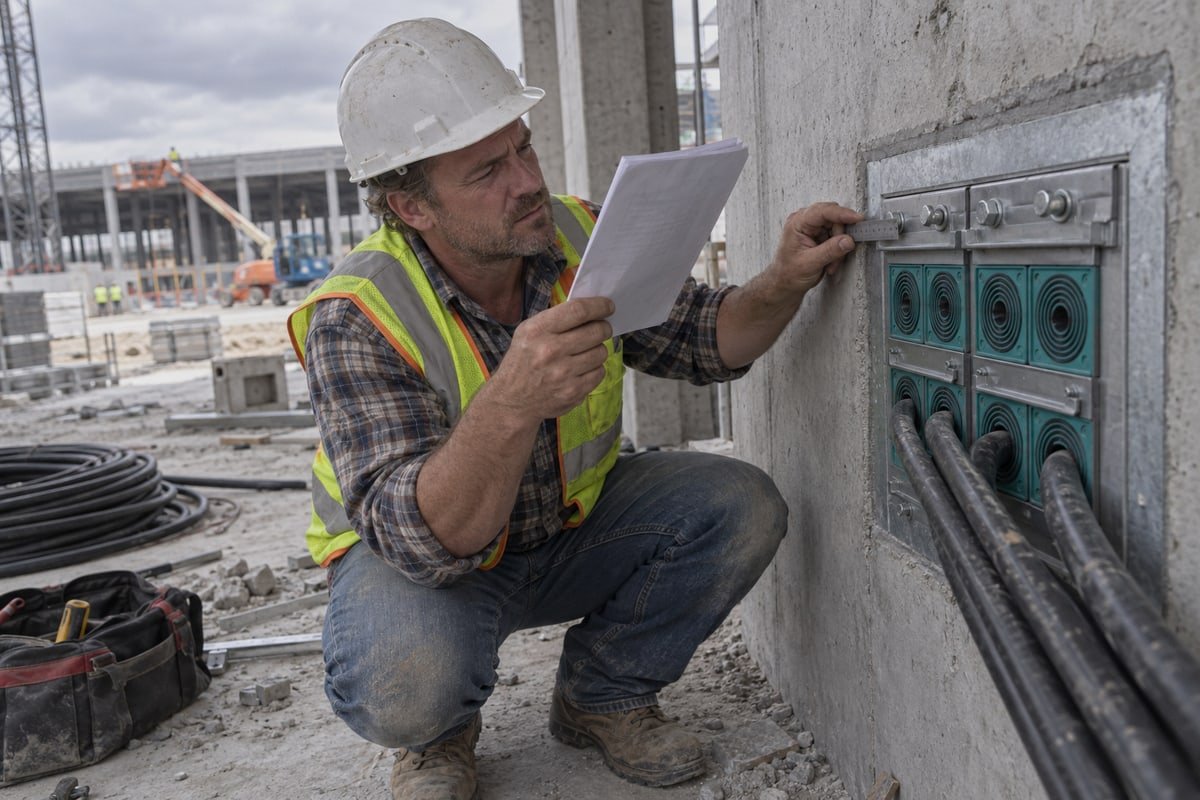
A sample answers physical questions. A certificate answers fire questions. Buyers get into trouble when they expect one to do the job of the other. The process below is what our purchasing contacts in Europe and Asia-Pacific follow when they qualify us as a second source.
A five-step sample validation routine
- Send your current module and frame model numbers. We return a cross-reference table mapping each existing model to the matching DEWIN model, together with CAD and STEP files for your drawing review.
- Receive TSR round or TSC square modules and stay plates. Measure them against your existing frame cutout, since our parts are dimensionally compatible with common 120-frame standards.
- Inspect the material. Confirm halogen-free EPDM and peel the step-core layers to the cable diameters used in your project.
- Run a trial compression using the stay plate intervals and compression depth from the installation manual. Check that the compression unit reaches the specified travel without over-stressing the modules.
- Compare the sample against the certificate scope. Confirm the module size, cable fill, and frame type fall inside the tested range before you release a bulk order.
What a sample can and cannot verify
| Question | Sample proves it | Documents prove it |
|---|---|---|
| Drop-in fit in the existing frame | Yes | Cross-reference table |
| Material type and hardness | Yes | Material data sheet |
| Compression and stay plate behavior | Yes | Installation manual |
| Fire integrity and insulation ratings | No | Type approval certificate and test report |
| Watertight, gas-tight, IP68 performance | Partially, if you have a pressure rig | Test documents on request |
| Long-term aging over a 25-to-30-year window | No | Aging test data from the supplier |
Traceability and aging data
Ask for batch traceability on the modules. Serialized or batch markings let your QA team confirm that delivered parts come from the same production lot as the certified product, which also guards against counterfeit substitution. Ask, too, for long-term aging data on the elastomer. Intumescent and EPDM materials must keep their sealing properties for decades, and a supplier should be able to explain how that was assessed.
A digital check before the physical one
If your engineering team works in BIM, compare the planned cable density and arrangement against the manufacturer's as-tested arrangement before the samples ship. This catches fill and spacing problems early, when they cost nothing to fix. The cost case for second sourcing is strong, typically 40–60% below incumbent pricing, but it only holds if the sample and the certificate line up.
Conclusion
Marketing claims cannot survive an inspection; certificates, standards, and tested scope can. Verify each before ordering, then request our validation samples and test documents to confirm the fit.
Footnotes
1. Authoritative source for the ISO 9001 quality management standard mentioned in the text. ↩︎
2. DNV is a leading classification society providing type approval for marine and offshore components. ↩︎
3. Technical overview of EPDM rubber properties, the primary material used in MCT modules. ↩︎
4. Official UL Solutions page describing fire resistance testing and standards like UL 1479. ↩︎
5. Official ASTM International page for the E814 standard used for fire tests of penetration firestop systems. ↩︎



 English
  Español de México
  Deutsch
  Français
  العربية
  Русский