
USCG-approved documentation for MCTs, not the product itself, is what stalls US-flagged projects IATF 16949 1. One missing test report held a shipyard order from our factory for weeks. Here is the fix.
USCG-approved documentation for MCTs on A/B/H-class bulkheads includes a Coast Guard Certificate of Approval or Type Approval Certificate, a fire test report to the IMO 2010 FTP Code from an accepted laboratory, evidence of follow-up factory inspection, installation drawings, and boundary-specific test evidence for A-60, B-15, or H-class ratings.
That is the short answer. The long answer is where most buyers get stuck. A bulkhead has a class. A transit has an approval. These are two different things, and the Coast Guard checks both. Below I walk through each document, what it proves, and where a second-source supplier fits in.
What certificates or type approvals must I request from my MCT supplier to confirm USCG compliance for A/B/H-Class bulkheads?
A sourcing manager in Rotterdam once asked me for "the USCG certificate" for our TSC modules. Singular. That question showed me how much confusion sits around this topic.
Request a USCG Certificate of Approval or Type Approval Certificate under approval series 164.138, the underlying fire test report to IMO 2010 FTP Code Part 3, proof of a third-party follow-up service program, and, for MRA products, the Wheelmark certificate showing the matching USCG approval number.

There is no single sheet of paper that settles the question. The Coast Guard is documentation-driven, not brand-driven. A product sold as "marine approved" means nothing to a plan reviewer at the Marine Safety Center 2 unless the package behind it proves the exact configuration. So I tell buyers to think in layers.
The four core documents and what each one proves
| Document | What it proves | Who issues it |
|---|---|---|
| USCG Certificate of Approval (COA) or Type Approval Certificate | The product design is accepted under 46 CFR Part 164, commonly listed under approval series 164.138 for penetration seals | US Coast Guard, via the Marine Safety Center |
| Fire test report to IMO 2010 FTP Code 3 Part 3 | The transit was actually burned in a furnace and held the boundary rating | USCG-accepted or recognized independent laboratory |
| Follow-Up Service (FUS) evidence | Production units still match the tested prototype | Third-party certifier auditing the factory |
| Installation drawings and instructions | The as-installed transit matches the tested assembly | The MCT manufacturer |
The first row is what most people mean by "the certificate." The other three rows are what the reviewer actually reads.
Where the MRA and ACP routes fit
Two shortcuts exist, and both come with conditions. Under NVIC 02-19 and the US–EU/UK Mutual Recognition Agreement, a cable penetration seal carrying the Wheelmark or Red Ensign mark can be accepted, but only when it also carries a corresponding USCG approval number. A Wheelmark alone is not enough. Second, vessels enrolled in the Alternate Compliance Program may accept a Type Approval Certificate from a Recognized Organization such as ABS or DNV, provided that certificate references the US Supplement. If the vessel is not in the ACP, that route closes.
Two subchapters, one transit
Buyers also forget that an MCT sits on two regulatory tracks at once. Its electrical role falls under 46 CFR Subchapter J. Its material and fire approval falls under Subchapter Q. Ask your supplier to state which documents cover which subchapter. In our own export files, we keep the A-0 and A-60 fire test documents from our BV-approved factory in one folder and the ISO 9001 4 and IATF 16949 system certificates in another, so a reviewer can trace each claim to a source. For a US-flagged hull, I then tell the buyer plainly which USCG-side items they still need to request or arrange, rather than letting them assume a class-society paper covers everything.
How do fire rating requirements differ between A-Class, B-Class, and H-Class penetrations, and what documents prove each classification?
Every time we plan a fire test on our EPDM modules, we weigh the same trade-off: test one worst-case configuration, or test the range buyers actually install.
A-Class penetrations must block smoke and flame for 60 minutes under the standard cellulosic curve, with A-60 to A-0 insulation limits. B-Class must resist flame for 30 minutes at B-15 or B-0. H-Class uses the hotter hydrocarbon curve. Each needs its own fire test report.
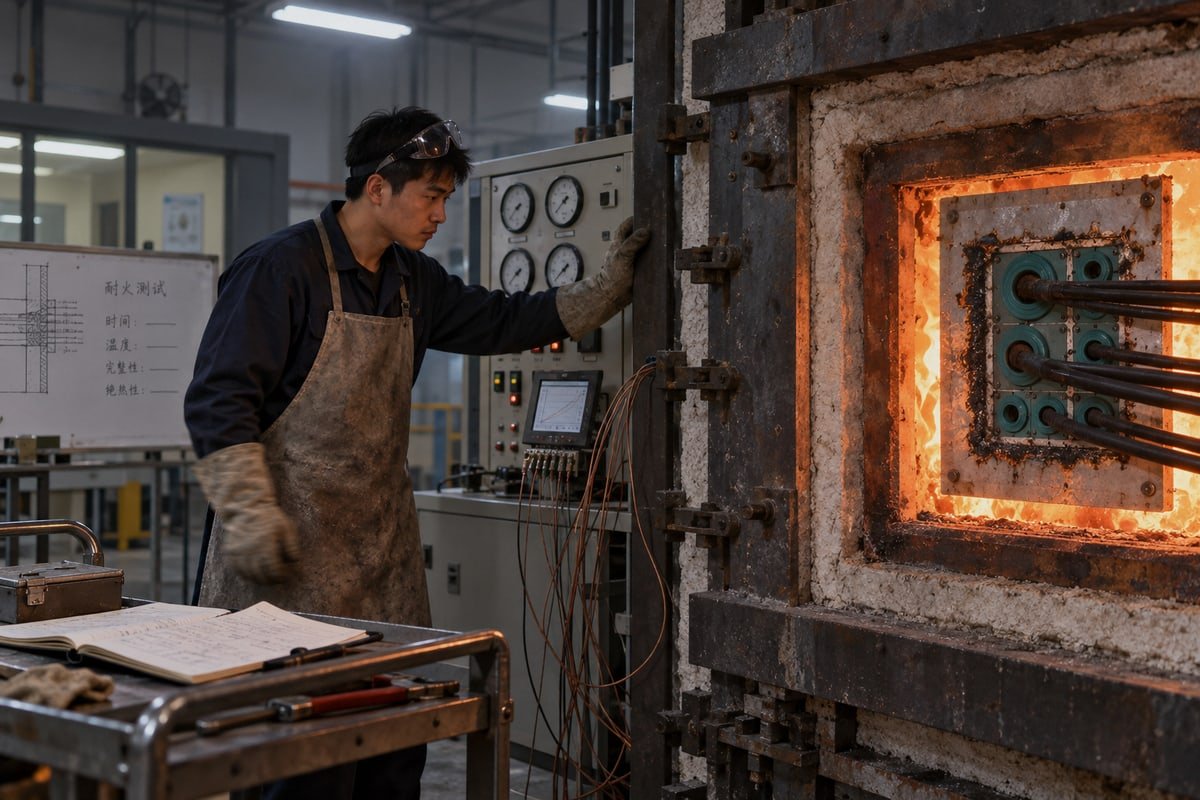
The fastest way to see the difference is side by side.
| Class | Base requirement | Sub-ratings | Time-temperature curve | Typical location |
|---|---|---|---|---|
| A-Class | Steel or equivalent, stops smoke and flame for 1 hour | A-60, A-30, A-15, A-0 (minutes of insulation) | Standard cellulosic curve, IMO FTP Code Part 3 | Main vertical zones, machinery space boundaries |
| B-Class | Noncombustible, stops flame for 30 minutes | B-15, B-0 | Standard cellulosic curve, IMO FTP Code Part 3 | Accommodation and corridor bulkheads |
| H-Class | Resists a hydrocarbon pool fire | H-60, H-120 by project spec | Hydrocarbon curve, steeper and hotter | Offshore platforms, FPSOs, tanker process areas |
Boundary rating versus penetration rating
This is the point I repeat most often. An A-60 fire rating on the steel bulkhead does not transfer to the hole you cut in it. SOLAS Chapter II-2 and the US structural fire protection rules both require that the penetration preserve the boundary. So the transit must be tested in an A-60 assembly to claim A-60. The temperature rise on the unexposed side is measured on the seal itself. If the seal was tested in a B-15 panel, it proves B-15 and nothing higher.
Why H-Class is not a longer A-Class test
Some buyers assume H-Class is just A-Class with more insulation. It is not. The hydrocarbon curve climbs much faster and peaks hotter than the cellulosic curve. A sealing compound that survives 60 minutes in a cellulosic furnace can fail early under hydrocarbon exposure. That is why offshore asset owners ask for a separate H-Class Fire Test Report. Our own modules are tested to A-0 and A-60. If a project calls for H-Class, I say so openly and point the buyer to a hydrocarbon-tested option rather than stretching a certificate.
The documents that prove each class
For A-Class and B-Class, collect the Fire Test Report referencing the 2010 FTP Code, the Type Approval Certificate that quotes the tested rating, and the installation drawing that shows insulation continuity across the transit. For H-Class, collect the same items plus explicit reference to the hydrocarbon curve. Then cross-check the vessel's Fire Control Plan. It must state the rating of every transit location, and the certificate you hold must meet or exceed that number.
What test reports should I collect to verify watertight and IP68 sealing performance before installation on a US-flagged vessel?
During a routine QC run on our pressure bench, one TSC module held 0.4 MPa only after we re-torqued the compression unit. Torque now sits beside pressure on every sheet.
Collect a hydrostatic or pneumatic pressure test report showing the tested range, for example 0.01–0.4 MPa, an IP68 ingress protection report stating immersion depth and duration, a gas-tightness test, and an EPDM material data sheet. Each report should name the exact frame, module, and cable configuration tested.

Fire gets the attention, but water closes ships. On a US-flagged vessel, a transit through a watertight subdivision bulkhead has to hold the flooding head the bulkhead is designed for. So I ask buyers to build a second document set that runs parallel to the fire set.
The four reports and what to read in each
| Report | What it measures | What to check before accepting it |
|---|---|---|
| Pressure test (hydrostatic or pneumatic) | Leak-free sealing across a pressure range, e.g. 0.01–0.4 MPa | Direction of pressure, hold time, compression torque used |
| IP68 ingress protection 5 report | Dust-tight and continuous immersion | Immersion depth and duration stated as numbers, not just "IP68" |
| Gas-tightness test | No gas migration across the seal | Test medium and detection method named |
| EPDM material data sheet | Halogen-free composition, hardness, temperature range | Batch traceability and aging data |
Reading an IP68 report properly
IP68 is a code, not a number. The "8" only means the item survived immersion under conditions agreed between manufacturer and user. If the report does not state depth and time, you cannot compare it with anything. Our own IP68 documents state those conditions, and I recommend rejecting any sheet that leaves them blank.
Why configuration matters as much as the result
A step-core EPDM module seals a range of cable diameters in one module size. That is convenient, but it also means the test must show which diameters were used. A report on a fully packed frame proves little about a half-empty frame with spare blank modules. Ask for the cable layout drawing that goes with each report. Then compare it to your own as-built transit. For our TSR round assemblies and TSC square modules, we keep the tested cable layout attached to the pressure sheet so the two travel together.
How these reports enter the USCG package
Watertight reports do not usually go under 46 CFR Part 164. They support the vessel's subdivision and stability review instead. Still, plan reviewers cross-read files. A watertight report that contradicts the fire drawing, for instance a different frame size, will raise a question you do not want to answer late in the build.
If I switch to a second-source MCT supplier, what documentation do I need to confirm drop-in compatibility without re-certifying the bulkhead penetration?
The hardest lesson from our early second-source deals: dimensional fit is easy to prove, but keeping the penetration's fire approval valid takes a different set of papers.
You need a model cross-reference table, dimensional drawings or STEP files proving 120-frame compatibility, the second supplier's own fire test report and Type Approval Certificate for the same boundary class, matching IP68 and pressure reports, and a written statement that the tested configuration mirrors your as-installed transit.

Let me raise the objection I hear most. "The bulkhead was approved with brand X inside it. If I change the module, the whole penetration has to be re-certified." That is half right, and the half that is wrong costs money.
What does not need re-certification
The steel bulkhead itself does not change. Its A-Class construction, its stiffening, and its insulation schedule stay as approved. The frame cutout does not change either, as long as the second-source module is dimensionally compatible with the common 120-frame standard. What changes is the cable penetration seal inside the frame. That seal must carry its own approval for the same boundary class. So you are not re-certifying the bulkhead. You are substituting one approved seal for another and documenting the substitution.
A five-step substitution process
- Obtain the cross-reference table from the second source. It should map your existing model number to the replacement model, one line per size.
- Request STEP or CAD files and check the module width, height, and compression stroke against the installed frame. Free validation samples make this step physical, not theoretical. We send them for exactly this reason.
- Collect the second source's Fire Test Report and Type Approval Certificate. Match the rating to the Fire Control Plan entry for that location. A-60 needs A-60. No rounding.
- Collect the IP68, pressure, and gas-tightness reports and confirm the tested cable layout matches yours.
- Update the vessel's transit records and the Fire Control Plan. Emerging digital as-built registries track every module and every later cable change, which keeps the original certification defensible at the next inspection.
The specialty cable trap
One item catches integrators moving from data center or BESS projects to marine work. The 2023 Subchapter J update requires documentation of fire stops used with specialty cables, such as coaxial runs, that may not pass standard flammability tests. If your second-source transit carries those cables, log them separately. A generic catalog cut-sheet will not cover it.
Why this makes second sourcing realistic
Buyers come to us for 40–60% lower module cost. They stay because the documentation set travels with the module. Cross-reference table, STEP files, A-0 and A-60 test documents, IP68 and 0.01–0.4 MPa pressure reports, all available on request. That set is what lets a purchasing engineer qualify a second source without reopening the structural fire protection review.
Conclusion
Missing USCG-approved documentation, not bad hardware, sinks MCT submittals. Gather the certificate, fire test report, factory inspection evidence, and drawings first, and the plan review moves.
Footnotes
1. Global automotive quality standard often used by manufacturers to demonstrate high-level production control. ↩︎
2. The primary USCG office responsible for reviewing and approving vessel design and equipment documentation. ↩︎
3. International standards for fire test procedures required for marine bulkhead penetration approvals. ↩︎
4. The international standard for quality management systems used to verify factory production consistency. ↩︎
5. International standard for defining levels of sealing effectiveness against moisture and foreign bodies. ↩︎



 English
  Español de México
  Deutsch
  Français
  العربية
  Русский