
A quote arrives 40% below your incumbent. Then freight, duties, and brokerage shrink the gap. Our export team helps buyers model landed cost for multi cable transit procurement before that happens.
Landed cost for multi cable transit procurement equals the supplier’s ex-works price plus freight, insurance, import duties and taxes, customs brokerage, handling, and inspection, divided by the units received. Allocate shared costs by weight, volume, or customs value, then compare the per-module figure against local supplier pricing.
That formula looks simple. The hard part is filling in each line with real numbers. Below, I walk through each cost bucket, the hidden items most buyers miss, how Incoterms and HS codes 1 change the result, and how a free sample lets you check your math before you commit.
How do I break down landed cost components for MCT procurement from a Chinese factory?
A sourcing engineer in Germany once sent us his spreadsheet with only two lines: unit price and sea freight. Our export team added six more rows before he signed anything.
Break MCT landed cost into seven buckets: ex-works product price, international and inland freight, cargo insurance, import duties and taxes based on HS code, customs clearance and brokerage fees, port and document handling, and receiving inspection. Add certification fees and currency conversion as separate lines, then total everything.
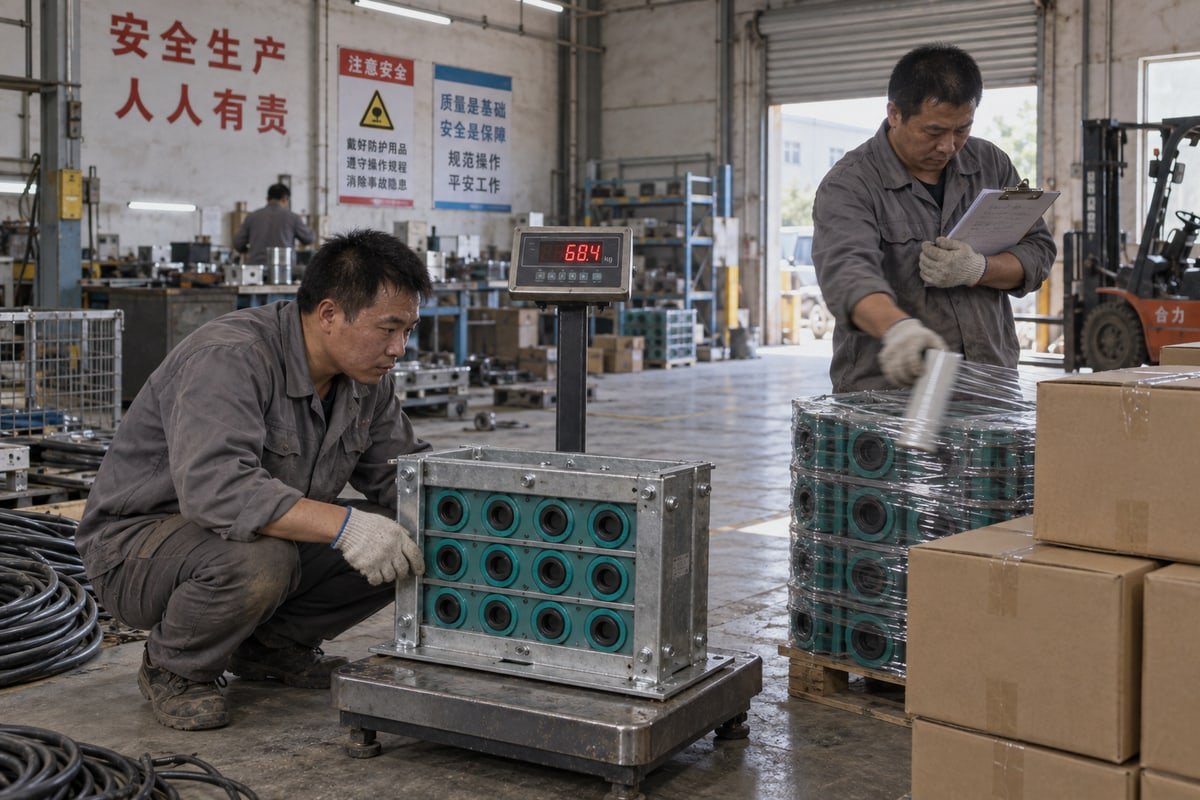
Each bucket behaves differently. Some attach to a single line item. Others belong to the whole shipment and must be spread across every SKU in the container. If you skip that step, your frame looks cheap and your spare seals look expensive, or the other way around. Neither number is true.
Start with the Bill of Materials, not the invoice
An MCT order is rarely one part. A typical package from our line includes a galvanized or stainless frame, TSC square sealing modules in several sizes, TSR round assemblies for pipes, a compression unit, stay plates, and a bag of spare sealing parts. Each of these has a different weight, volume, and duty treatment. So I always tell buyers to list the Bill of Materials first, then attach costs to it. The invoice alone hides that structure.
The seven cost buckets
| Cost bucket | What it includes | Direct or shared? | Usual allocation basis |
|---|---|---|---|
| Product price | Frames, modules, compression units, stay plates, spares at EXW or FOB | Direct per line | Invoice value |
| Freight | Ocean or air carriage, drayage, terminal handling, inland last-mile | Shared | Weight or volume |
| Insurance | Cargo cover for the voyage | Shared | Customs value 2 |
| Import duties and taxes | Duty by HS code, VAT or GST, anti-dumping where applicable | Shared, but rate differs by line | Customs value per line |
| Customs clearance fees | Broker fee, entry filing, document processing | Shared | Unit count or value |
| Port and handling | Container release, demurrage risk, pallet handling | Shared | Weight or volume |
| Receiving and QC | Unpacking, dimensional check, storage, any rework | Shared or direct | Unit count |
Freight forwarding charges deserve special attention. Forwarders often quote a headline ocean rate and then add origin handling, destination terminal fees, and documentation as separate lines. I ask buyers to request the all-in door-to-door figure, so nothing appears after the container lands.
A worked example
Take a package of four identical MCT assemblies quoted at 12,000. Freight and drayage add 1,600. Cargo insurance adds 120. Duty and brokerage add 900. Port, handling, and documents add 280. Receiving inspection adds 300. Total landed cost is 15,200, or 3,800 per assembly. That is roughly 27% above the quoted price. The savings against a European incumbent usually remain, but only the 3,800 figure belongs in your bid.
Some buyers push back here. They say a quick "price plus freight plus customs plus a risk margin" is good enough for a first pass. I agree, for a first pass. But when you present a supplier switch to your finance team, they will want line-level allocation. Do the full model once. It is easier than defending a rough number later.
We weigh one trade-off constantly when quoting: ship a full frame set with spare seals now, or let the buyer air-freight two modules later at a painful premium.
Hidden costs include customs brokerage and terminal fees, currency exchange movements during long lead times, third-party certification for ATEX or marine class, a 5–10% spare module buffer, CBAM levies on steel frames, and internal receiving and qualification time. Local suppliers hide costs too, mainly in lead time and spare pricing.

A fair comparison uses Total Cost of Ownership, not the first-year purchase price. Modular cable seals live inside switchgear, BESS containers, and offshore modules for decades. The frame stays. The modules get swapped when cables change. So the price and availability of spare seals matter as much as the initial package.
Hidden costs on both sides of the table
| Hidden cost | Import from our factory | Local European supplier |
|---|---|---|
| Customs brokerage and terminal fees | Yes, per shipment | No |
| Currency exchange rates | Exposure during 4–8 week production plus transit | Minimal |
| Certification fees (ATEX, ABS, Lloyd's Register) | Included where we hold approvals; project-specific witness tests are extra | Often quoted separately too |
| Spare module buffer | Ship 5–10% extra with the main order | Buy on demand, often at list price |
| CBAM levy on steel | Applies to imported steel frames into the EU | Not applicable to domestic steel |
| Supplier qualification time | Engineering hours to validate a second source | Already qualified |
| Emergency freight | Air-freight if spares are short | Courier from regional stock |
| Lead time risk | Ocean transit adds weeks | Shorter, but not always faster if backordered |
Three items buyers most often forget
First, currency exchange rates. Our production lead time for a custom frame with in-house molds can run several weeks, and ocean transit adds more. If you are paying in USD and reporting in EUR, a swing over that window changes your landed cost. Lock the rate, or add a documented buffer.
Second, project-specific certification. Our modules carry A-0/A-60 fire ratings, IP68 ingress protection, and watertight and gas-tight test records at 0.01–0.4 MPa, and our factory is BV-approved. That covers most switchgear and data center projects. But marine and offshore logistics projects sometimes require a class witness test or an ATEX file review for a specific installation. Treat that fee as a direct procurement cost on the project, not general overhead.
Third, the contingency buffer. Installers cut seals wrong. Cable schedules change on site. A 5–10% spare module allowance shipped in the original container costs a fraction of one emergency air shipment. I have watched buyers save that money on the PO and lose it three times over at the port.
Where the comparison still favors a second source
Qualification time is the biggest hidden cost against us, and I will not pretend otherwise. We reduce it with model cross-reference tables that map an existing 120-frame module code to our TSC or TSR equivalent, plus CAD/STEP files and test documents on request. That turns days of engineering review into hours. Once qualified, the 40–60% component saving repeats on every reorder and every spare.
How do customs duties and freight terms affect my total landed cost for cable transit modules?
One lesson from years of shipping to Rotterdam and Jebel Ali: the Incoterm on the proforma decides more of your final number than the unit price does.
Freight terms under Incoterms 2020 decide which costs sit inside the quote and which you pay later; EXW leaves everything to you, DDP bundles all of it. Duties depend on HS code classification, with steel frames and EPDM modules often classified differently, and customs value may include freight and insurance.

Two quotes for the same frame can differ by thousands simply because one is EXW Xi'an and the other is DAP Hamburg. Neither is wrong. They just move the same costs to different columns. Your job is to map who owns each cost before you compare anything.
What each Incoterm leaves on your side
| Incoterm 2020 | Seller pays up to | Buyer still pays | Landed cost effort for buyer |
|---|---|---|---|
| EXW | Goods packed at our factory gate | Export clearance, all freight, insurance, duties, taxes, brokerage, delivery | Highest, but full cost visibility |
| FOB | Goods loaded on vessel at Chinese port | Ocean freight, insurance, import duties and taxes, destination handling, delivery | High |
| CIF | Ocean freight and insurance to destination port | Import duties and taxes, brokerage, terminal fees, inland delivery | Medium |
| DAP | Delivery to named place, not unloaded, not cleared for import duties | Import duties and taxes, brokerage | Faible |
| DDP | Everything including duties and taxes | Unloading only | Lowest, but least transparent pricing |
We quote most European integrators FOB or CIF, and we handle the export documentation on our side. DDP sounds easiest, but it hides the duty and freight split inside one number. If you want to benchmark suppliers honestly, ask for FOB and build the rest yourself.
HS Code classification and the customs base
An MCT system is not one tariff line. The galvanized or stainless frame, compression unit, and stay plates fall under steel article 3 headings. The halogen-free EPDM sealing modules fall under vulcanized rubber articles. Duty rates differ, and customs authorities 4 want them declared separately. Ask your supplier for the HS code per line on the commercial invoice 5. We provide this by default because misclassification triggers delays, and delays trigger demurrage.
Note also that in many jurisdictions, including the EU, the customs value is the CIF value, not the FOB invoice. Freight and insurance become part of the duty base. A buyer who applies the duty rate to the invoice alone will understate the tax.
Weight, volume, or value?
Buyers often ask whether to allocate freight by weight or by value. Value-based allocation is right for ad valorem duty and insurance. But it distorts freight economics for MCT. A steel frame is heavy and compact. A box of polymer sealing blocks is light and bulky. Freight follows chargeable weight 6, which is the greater of actual and volumetric weight. So allocate freight by weight or volume, and duty by customs value. Then divide each line by its real driver. For a full frame set, I recommend expressing the result as cost per cable opening. It lets an engineer compare a densely packed frame against a spread-out one on equal terms, and it rewards packing frames and modules together to maximize container density.
Can free validation samples help me verify landed cost accuracy before placing a bulk order?
Before a sample leaves our Shaanxi plant, our QC team weighs it, measures the box, and logs both on the shipping label. That data becomes your first landed cost input.
Yes. A free validation sample gives you actual weight, packed dimensions, HS code, and a real courier invoice, so you can test your freight, duty, and brokerage assumptions on one unit. It also confirms 120-frame fit and seal performance, which removes rework and requalification risk from the bulk landed cost.

Most landed cost models fail on estimates, not formulas. Buyers guess the weight. They guess the HS code. They guess the broker fee. A sample replaces three guesses with three facts before any money moves.
Un processus de vérification en cinq étapes
- Request the sample with a cross-reference. Send us your existing module code. We match it to the DEWIN TSC or TSR equivalent using our cross-reference table and ship it free.
- Record the physical data. Log the sample's net weight, gross weight, and packed dimensions. Scale those figures to your full Bill of Materials. This gives you a chargeable weight for the bulk shipment.
- Check the customs treatment. The sample clears customs under the same HS codes as the bulk order. Your broker's entry shows the duty rate applied and the fees charged. Both numbers go straight into your model.
- Validate fit and performance. Drop the module into your existing frame cutout. Confirm the step-core EPDM adapts to your cable diameter range. Review our A-0/A-60, IP68, and pressure test documents against your specification. Any gap here would mean rework cost in bulk.
- Reconcile estimated and actual. Compare your original spreadsheet estimate with the sample's real cost trail. Adjust the buffer where they diverge.
What the sample proves and what it does not
| Assumption in your model | Verified by a sample? | How |
|---|---|---|
| Unit weight and volume | Oui | Scale label data |
| HS code and duty rate | Oui | Broker's customs entry |
| Brokerage and handling fees | Partly | Courier fees differ from container fees |
| Dimensional compatibility | Oui | Physical fit test in your frame |
| Seal performance | Oui | Test documents plus your own check |
| Ocean freight rate | No | Requires forwarder quote for full volume |
| Currency exposure | No | Depends on payment timing |
Spreadsheet or ERP?
Some finance teams insist landed cost must live in the ERP. Others prefer a spreadsheet. Both are right at different stages. Use the spreadsheet with sample data to make the sourcing decision. Then let the ERP post estimated landed cost at PO receipt and true it up when the forwarder and broker invoices arrive. The sample makes your estimate close enough that the true-up is small.
Conclusion
Landed cost decides whether a low MCT quote is real savings or a paperwork trap. Build all seven buckets, allocate them correctly, and verify with a free sample.
Notes de bas de page
1. Official WCO resource explaining the Harmonized System used to classify traded products worldwide. ↩︎
2. The WTO’s official guide on the international agreement for determining customs valuation of goods. ↩︎
3. Authoritative source for information on steel production, properties, and industrial applications. ↩︎
4. Global organization responsible for international customs standards and cooperation between customs authorities. ↩︎
5. Updated to the current live Trade.gov page for commercial invoice requirements. ↩︎
6. Explains the logistics concept of chargeable weight based on actual versus volumetric measurements. ↩︎



 English
 Español de México
 Deutsch
 Français
 العربية
 Русский