
Every month our export desk fields the same worry: a buyer holds certification for multi cable transits, yet the flag state maritime authority questions it. That gap sinks schedules.
To confirm flag state recognition of certification for multi cable transits, check the flag’s Recognized Organizations list, confirm the Type Approval Certificate cites the IMO FTP Code and SOLAS Chapter II-2, match its scope to your model and division, and request written acceptance from the flag or its RO.
That answer sounds short. In practice it has four separate checks, and each one can fail on its own. I will walk through them in order. I will also show you which documents to ask your supplier for, how to map test reports to the rules, and what to do when a flag asks for more.
A sourcing manager in Rotterdam once sent me our BV factory approval and asked if it covered his vessel's flag. My honest answer: not by itself.
Verify acceptance by checking the flag administration's published list of Recognized Organizations, confirming the issuing Classification Society holds delegated authority for that registry, and matching the certificate's scope, model number, and fire division to your installation. If the flag runs its own approval scheme, request its acceptance letter directly.

What flag state recognition means in practice
Recognition means the flag administration accepts a certificate as proof of statutory compliance under SOLAS. Most flags do not test products themselves. They delegate that work to Recognized Organizations 1, and those are usually the major Classification Societies. Each flag publishes its own RO list. The list also shows which functions are delegated. Some flags delegate hull and machinery surveys but keep equipment approval in their own hands. So the first check is simple. Open the flag's RO list. Find the society that issued the Type Approval Certificate. Confirm that it holds delegation for that registry and for that function.
Three approval routes and where each is accepted
| Approval route | Who issues it | Where it is normally accepted | Watch-out |
|---|---|---|---|
| Classification Society approval (Type Approval Certificate) | IACS member society | Flags that list that society as an RO | Some flags still require their own endorsement for cable penetration seals |
| Marine Equipment Directive / Wheelmark certification | EU notified body under Directive 2014/90/EU | All EU and EEA flags | Only valid for the MED item covering A-class penetrations; check the item number |
| Flag-issued acceptance letter or circular | The flag administration itself | That flag only | Rarely transferable to another registry |
| Mutual-recognition arrangement (for example EU–US marine equipment MRA) | Notified body in one party, accepted by the other | Both parties to the agreement | Scope is limited to listed equipment categories |
The objection we hear most: class approval is enough
Many operators tell us that Classification Society approval settles the question. Often it does. But not always. A few flags require their own acceptance letter for cable transits. EU flags expect Wheelmark certification for ships built under the Marine Equipment Directive. And a factory approval is a different thing again. Our BV-approved factory status proves that our production system in Shaanxi is surveyed. It does not replace a product certificate matched to the flag. We say this openly to buyers because a surprise at survey costs far more than a frank answer at quotation.
What happens when the vessel changes flag?
Start the check again. Wheelmark certification travels across EU flags. A class Type Approval Certificate may need the new flag's endorsement. Keep the full compliance package on board so the change-of-flag survey does not stall.
What documentation should I request from my MCT supplier to prove flag state and class society approval?
Years ago we shipped a batch of TSC modules with a factory certificate only. The shipyard's surveyor wanted the full package. We learned to send it up front.
Request the Type Approval Certificate with its Limitations and Approved Drawings, the fire test report referencing the IMO FTP Code, watertight and IP68 test reports, the factory's Classification Society approval, installation instructions, product marking details, and any Marine Equipment Directive or flag-specific acceptance letters.

Treat it as a compliance package, not a single certificate
Surveyors now read approval certificates, test reports, installation manuals, and service records as one linked set. If one item is missing, the whole set loses weight. Here is the order I recommend when you write to a supplier:
- Type Approval Certificate, including the Limitations page and the Approved Drawings.
- Fire test report for the exact module family, naming the test method in the IMO FTP Code 2.
- Watertight and gas-tight pressure test report with the tested pressure range.
- IP68 ingress test report with immersion depth and duration.
- Factory approval and quality system certificates.
- Installation instructions, including frame types, packing, compression torque, and spacing between transits.
- Nameplate and module marking details so the surveyor can trace the product on board.
- Any MED certificate, flag acceptance letter, or mutual-recognition reference.
| Document | What it proves | What to check before you file it |
|---|---|---|
| Type Approval Certificate | The model is approved by a Classification Society | Model numbers, expiry date, fire division, cable range, and every line under Limitations |
| Fire test report | Fire integrity of the sealed penetration | A-0 or A-60 fire rating, orientation (bulkhead or deck), cable fill, and frame type |
| Pressure and IP68 reports | Watertight integrity and ingress protection | Tested pressure, direction of pressure, and whether the tested assembly matches yours |
| Factory approval and ISO 9001 / IATF 16949 | Consistent production | Audit dates and scope; ask whether the RO conducts periodical surveys of the plant |
| Installation manual | Approved installation method | Version date matches the certificate revision |
Read the Limitations section line by line
This is where most rejections start. A certificate may approve a module only in a specific frame, only with a certain packing material, or only up to a stated cable density. It may approve a bulkhead position but not a deck position. Compare each limit against your drawing before the modules ship.
Production surveillance and the transit register
Ask whether the manufacturer's production facility is surveyed on a periodic basis. A certificate stays valid for new installations only while surveillance continues. Also ask for data formatted for the Cable Transit Seal Systems Register that IACS Unified Requirements 3 Z23 and Z28 introduced. That register lists each transit, its location, its approval reference, and its inspection status. We supply model cross-reference tables, CAD and STEP files, and free validation samples with every qualification request, so a purchasing engineer can fill that register without chasing us later.
Can I cross-reference DEWIN's test certificates with IMO and SOLAS requirements before submitting for flag state review?
Every fire test we run costs weeks of furnace time and modules we cannot sell. We weigh that against one thing: whether the report will survive a surveyor's desk.
Yes. Map each DEWIN test document to its governing rule: the A-0/A-60 fire report to IMO FTP Code Part 3 and SOLAS Chapter II-2 Regulation 9, the watertight and gas-tight report to SOLAS Chapter II-1 integrity rules, and the IP68 report to IEC 60529. Then list gaps before review.

Build the cross-reference table first
I tell buyers to make a three-column sheet before they send anything to a flag. Column one is our document. Column two is the rule it supports. Column three is the specific point a surveyor will look for.
| DEWIN document | Governing requirement | What the reviewer checks |
|---|---|---|
| A-0/A-60 fire test report for TSC and TSR modules | IMO FTP Code Part 3; SOLAS Chapter II-2, Regulation 9.3.1 on penetrations in A-class divisions | Test method named, orientation tested, insulation side, cable fill, frame material |
| Watertight and gas-tight test, 0.01–0.4 MPa | SOLAS Chapter II-1 watertight subdivision rules and class rules for penetrations | Pressure direction, hold time, no leakage past the modules or frame weld |
| IP68 ingress report | IEC 60529 | Depth, duration, and the assembly tested |
| Halogen-free EPDM material data | SOLAS Chapter II-2 low-smoke and toxicity expectations; class material rules | Halogen-free declaration, hardness, ageing data |
| BV factory approval, ISO 9001, IATF 16949 | Production consistency behind the Type Approval Certificate | Audit scope and validity dates |
Fire integrity: A-60 fire rating and the FTP Code
An A-60 fire rating only means something when the test follows the IMO FTP Code method for A-class divisions. SOLAS Chapter II-2 requires that cable penetrations do not weaken the division they pass through. So the surveyor will compare the tested configuration with the drawing. Our step-core EPDM modules adapt to a range of cable diameters inside one module size. That is convenient on site. It also means you must confirm that the cable fill on your drawing sits inside the fill that was tested.
Watertight integrity and pressure direction
Our pressure test range runs from 0.01 to 0.4 MPa. Ask which side the pressure was applied from. A deck transit sees water from above. A bulkhead transit may see it from either side. If the flag's rules or the ship's damage-stability case need a higher head, say so early and we can run a witnessed test.
Read the flag's National Annex before you submit
Some flags add local requirements above the international conventions. Their Marine Notices may demand extra evidence for passive fire protection or specific marking. We have also seen surveyors ask about chemical compatibility between EPDM modules and LSZH or SHF2 cable jackets. Long-term integrity matters as much as the fire rating, so we provide material data for that check on request.
Last year our QC team re-ran an IP68 immersion check on a spare TSR assembly because a surveyor asked for a dated report, not a catalogue line.
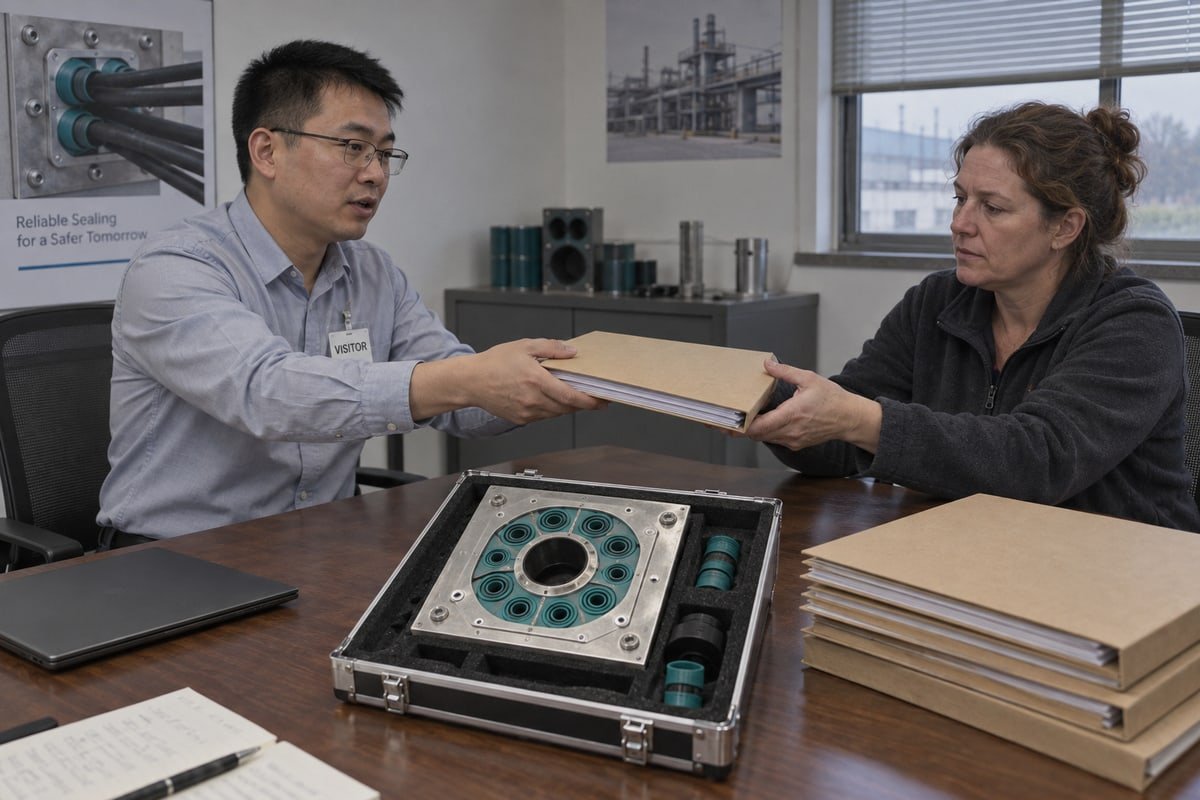
Ask the flag in writing which test, standard, and division it needs. Then request the matching dated test report from the supplier, confirm the tested configuration equals your installed one, obtain a Classification Society witness or re-test if required, and submit through the vessel's Recognized Organization with installation records.
A five-step response that keeps the schedule
- Get the request in writing. Ask the flag or its RO to name the rule, the division type, and the evidence format it wants. Vague requests lead to vague answers and a second round.
- Pull the exact report. For fire, that is the FTP Code test on the same module family, frame, and orientation. For ingress, that is the IP68 report to IEC 60529. We keep test documents available on request, so this step should take days, not weeks.
- Compare configuration. Frame type, packing material, compression torque, and cable fill must match the report. If your installation sits outside the tested configuration, no amount of paperwork fixes it.
- Arrange a witnessed test when needed. If the flag wants evidence beyond the existing report, a Classification Society surveyor can witness a re-test at our plant. Our in-house mold making means we can build the exact tested assembly quickly.
- Submit as one package through the RO, with the register entry, installation photos, and the surveyor's installation report.
| Typical flag request | Evidence that closes it | Who provides it |
|---|---|---|
| Proof of A-60 in deck orientation | FTP Code test report for deck position, or a witnessed re-test | Supplier plus class surveyor |
| Watertight integrity at a higher head | Pressure test to the required MPa, pressure applied from the correct side | Supplier |
| IP68 for exposed deck transits | Dated IEC 60529 report naming depth and duration | Supplier |
| Installation quality | Torque records, spacing check, photos, surveyor's report | Shipyard or service supplier |
Installation evidence weighs as much as the certificate
Port State Control officers do not stop at paperwork. PSC reports have recorded improper installation of multi cable transit systems as a deficiency, even when the product was certified. Class and flag guidance on cable transit seal systems also stresses manufacturer authorization and qualified inspectors. So keep the installer's qualification with the package. Watch the concentrated inspection campaigns on fire safety as well. When the Paris and Tokyo MoU 4 regimes focus on passive fire protection, flags tighten what they ask for almost at once.
Newer requests: digital records and cyber zones
Some owners now load transit data into a 3D asset model or digital twin. That gives a surveyor a live compliance map and supports remote audits. One more point for switchgear and BESS integrators: if a transit carries integrated monitoring sensors into a cyber-secure zone, IACS UR E26 and E27, in force for newbuild contracts from 1 July 2024, may bring additional cybersecurity evidence into scope. Plain passive modules like ours do not, but the question will come up.
Conclusion
One certificate rarely satisfies every flag. Unverified paperwork stalls surveys and deliveries. Verify the RO, match the scope, assemble the package, and ask us for the test documents.
Footnotes
1. IACS provides the framework for Recognized Organizations that perform statutory certification on behalf of flag states. ↩︎
2. IMO’s safety page explaining the Fire Test Procedures Code required for SOLAS-compliant fire protection materials. ↩︎
3. Official IACS landing page for Unified Requirements, moved from /publications/ to /resolutions/. ↩︎
4. The official site for the Paris MoU, which coordinates port state control inspections across major maritime regions. ↩︎



 English
  Español de México
  Deutsch
  Français
  العربية
  Русский