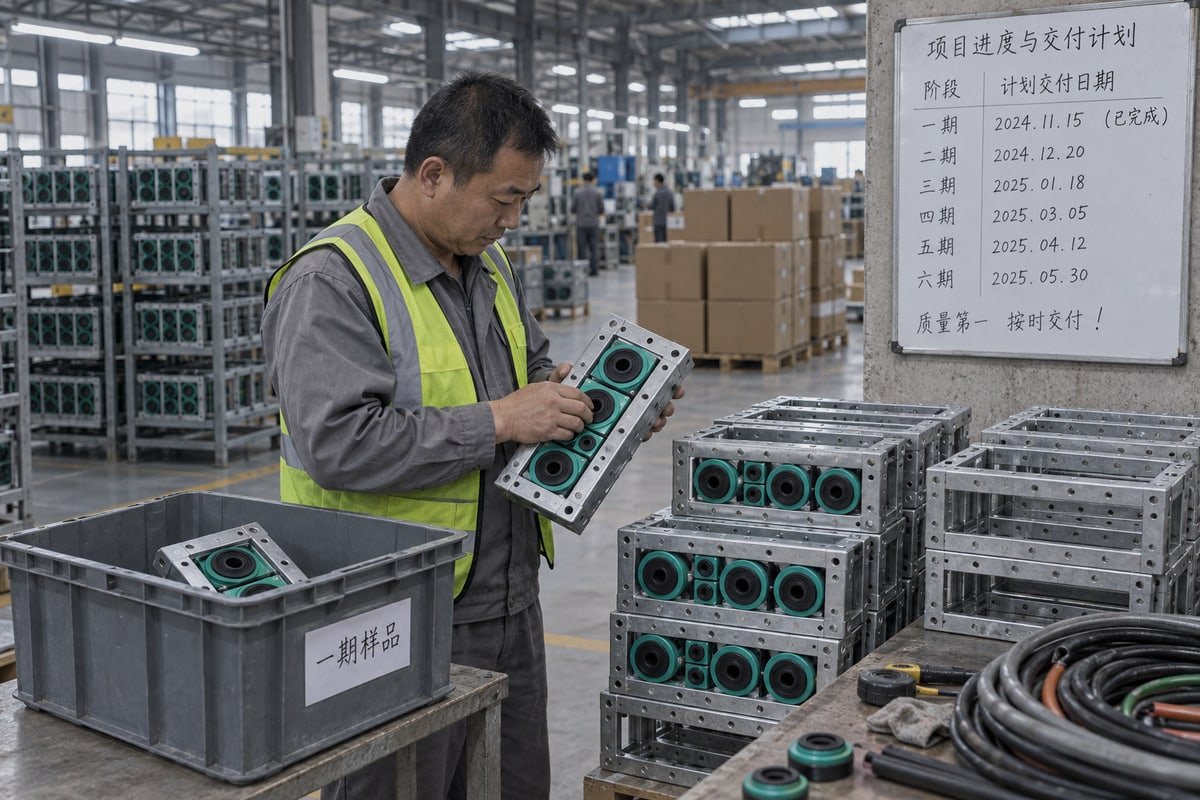
Our factory ships modular cable seals into data center cable transit projects where one wrong procurement call can stall a phase for months. Re-tender or single-source? I weigh both here.
Phase-by-phase re-tendering of data center cable transit risks specification drift, recertification, mismatched frames, and schedule gaps against 12–18-month lead times. A single supplier risks vendor lock-in, pricing power, and concentration risk. The safest path locks the technical standard early and qualifies a dimensionally compatible second source under controlled rules.
Below, I break the decision into four questions. Each one comes straight from conversations with sourcing teams on phased builds. I will keep the language plain and the evidence concrete.
How do I compare the risks of re-tendering cable transit suppliers phase-by-phase versus staying with a single vendor for my data center project?
Every quote we prepare for a phased campus forces one trade-off: the buyer wants competition, the installed frames want consistency. The question is which risk you can actually control.
Compare both models across six risk categories: schedule, firestop compliance, compatibility, cost, accountability, and flexibility. Re-tendering scores worse on schedule, compatibility, and accountability; single sourcing scores worse on cost leverage, lock-in, and concentration. Score each against your campus maturity, then decide which risks your governance can absorb.

Here is the comparison I put in front of sourcing managers before we talk about price at all.
| Risk category | Phase-by-phase re-tendering | Single supplier |
|---|---|---|
| Schedule | Each tender adds bidding, review, and onboarding time; gaps can miss 12–18-month lead times for specialized transit components | One order book and one forecast, but one vendor delay stalls every phase |
| Firestop compliance | A new supplier may trigger fresh testing and inspection sign-off | One tested assembly across phases; still needs re-verification if the design changes |
| Compatibility | Specification drift in frame geometry, module sizes, and seals | Native interoperability; risk appears only if the catalog changes |
| Cost | Better price discovery; but smaller lots, repeated mobilization, later-phase premiums | Volume leverage early; pricing power shifts to the vendor after lock-in |
| Accountability | Finger-pointing at interfaces if a fire seal breaches during audit | Single point of responsibility for design, supply, and warranty |
| Flexibility | Can adapt to new needs such as high-density AI cabling | Limited if the standard product line does not fit the new design |
Why cable transit is not a normal line item
A cable transit is a small share of capex. But every penetration through a fire-rated wall 1 or raised floor is a compliance item. It carries the fire rating of the wall, the airtightness integrity of the cold aisle, and the water seal of the plant room. If it slips, operational uptime is what pays.
That is why I treat this as a project-risk decision, not a sourcing decision. The failure mode is rarely the module itself. The failure mode is rework: an opening that no longer matches, a warranty that no longer covers the interface, or a BIM record that no longer describes what is in the wall.
The objection I hear most often
Buyers tell me that competition each phase keeps prices honest. I agree, but only for the commercial terms. Once you re-tender the technical standard itself, you also re-tender the warranty structure, the submittal package, and the maintenance schedule. Managing three transit brands in one facility means three sets of spare parts, three technical files, and three points of contact when the fire inspector asks a question. The administrative burden is real, and it lands on the operations team, not on procurement.
Where each model fits
Greenfield builds usually benefit from standardization of infrastructure around one approved system. Expansions and retrofits can tolerate phased competition, but only if the base specification is locked and the second source is proven to fit the first-phase frames.
Can I qualify a second supplier without disrupting dimensional compatibility with my existing 120-frame cable transit system?
A sourcing manager in Europe sent me a photo of a Phase 1 frame and asked one question: will your modules fit this cutout? That is the right first question.
Yes. A second supplier can be qualified without disruption if its modules are dimensionally compatible with the 120-frame standard, verified through a model cross-reference table, free validation samples fitted in the actual cutout, and CAD/STEP files checked against as-built frame drawings before any purchase order is placed.

Qualification does not have to be a science project. This is the sequence we run with integrators, and it works because the frame stays where it is.
- Send us the as-built drawing or a clear photo of the installed frame with the nameplate visible.
- We return a cross-reference table mapping each existing module code to the equivalent DEWIN size.
- We ship free validation samples for the two or three most common sizes on the cable schedule.
- Your installer fits the samples into a live frame and torques the compression unit to the existing procedure.
- You check the result against the CAD/STEP files we provide, and against the original compression height.
- Only then do you place a pilot order for one room or one row.
What compatibility actually means
Compatibility is not just a matching outer footprint. The full stack must close.
| Checkpoint | What to verify | Why it matters |
|---|---|---|
| Frame internal opening | Matches the 120-frame standard on the as-built drawing | Modules and stay plates must fill the aperture with no voids |
| Module footprint | Width, depth, and height of each modular cable seal size | Mixed heights leave gaps and break the compression stack |
| Compression unit | Travel range and bolt torque against the existing frame | Under-compression fails airtightness integrity; over-compression damages rubber |
| Stay plates and end packing | Thickness and count per row | Rows must stack to the same total height as Phase 1 |
| Cable diameter range | Step-core range per module | Confirms the current cable schedule fits without re-coring |
| Material | Halogen-free EPDM declaration | Keeps fire and smoke behaviour consistent across brands |
Step-core rubber and hybrid builds
Our modules use step-core, halogen-free EPDM. One module size covers a range of cable diameters, so the installer peels layers to fit rather than stocking a dozen sizes. This matters most on hybrid projects that mix modular units 2 with traditional shell-and-core construction. Tolerances there are tight, and a module family that adapts on site reduces the chance of a mismatch. Interoperability, in practice, is the sample fitting the frame with the original torque and the original height. If it does, the second source is real.
What certification and test documentation should I request before switching or adding a cable transit supplier mid-project?
Our QC team ties each module batch to a traceable lot record before it leaves Shaanxi. That record links to the test file an auditor will ask for.
Request the fire test report for the rated assembly (A-0/A-60 class), IP68 ingress test data, watertight and gas-tight pressure results (0.01–0.4 MPa), halogen-free material declarations, ISO 9001 and IATF 16949 certificates, third-party factory approval such as BV, and a model cross-reference table tied to the installed frame.

Mid-project is the worst time to discover a missing document. So I advise buyers to request the full package before the first sample ships, and to read it against the frame that is already in the wall.
| Document | What it must show | Red flag |
|---|---|---|
| Fire test report | The tested assembly, its rating class (A-0 or A-60), and the module family used | A certificate for the frame that does not name the module |
| IP68 ingress test | Test conditions and result for the compressed module stack | A rating claimed for a single module, not the assembly |
| Pressure test | Watertight and gas-tight performance across 0.01–0.4 MPa | No pressure range stated |
| Material declaration | Halogen-free EPDM, compound identity, hardness | Generic rubber with no compound reference |
| Quality system | ISO 9001 and IATF 16949 certificates, in date | Certificates issued to a trading company, not the factory |
| Third-party approval | Factory approval from a recognized body such as BV | Approval that cannot be verified with the issuer |
| Cross-reference table | Existing model to replacement model, with dimensions | Sizes listed without frame reference |
Firestop compliance is an assembly question
An inspector does not approve a rubber block. The inspector approves a penetration: wall, frame, modules, stay plates, and compression unit together. So the fire report must describe the assembly as installed. If you add a second brand, the documentation must show the modules perform inside the existing frame type. This is why we keep test documents available on request rather than as a marketing summary. The engineer on the other side needs the test conditions, not a badge.
Protecting the digital thread
Every document should also feed your life cycle management records. Operators increasingly want BIM metadata that survives supplier changes, so ask the new supplier for CAD/STEP files that carry the same naming convention as Phase 1. Some owners now request material and embodied-carbon data for a facility-level material passport. A second source that can supply compound data and origin information keeps that record unified instead of splitting it by brand.
What I would refuse to accept
I would not accept a test summary without the underlying report. I would not accept a factory approval that names a different site than the one producing my order. And I would not accept a lead time promise without a written spare-module supply commitment.
How do I balance potential cost savings from re-tendering against lead-time and supply continuity risks across multiple data center build phases?
The hardest lesson I learned running export orders is that a cheap module that arrives late costs more than an expensive one that arrives on time. Phased builds punish lateness.
Balance them by pricing risk, not just parts. Model total cost of ownership across phases, including mobilization, requalification, rework, and delay exposure. Then capture savings through a pre-qualified second source with a frozen specification, framework pricing, and buffer stock, rather than through re-tendering that resets lead times each phase.
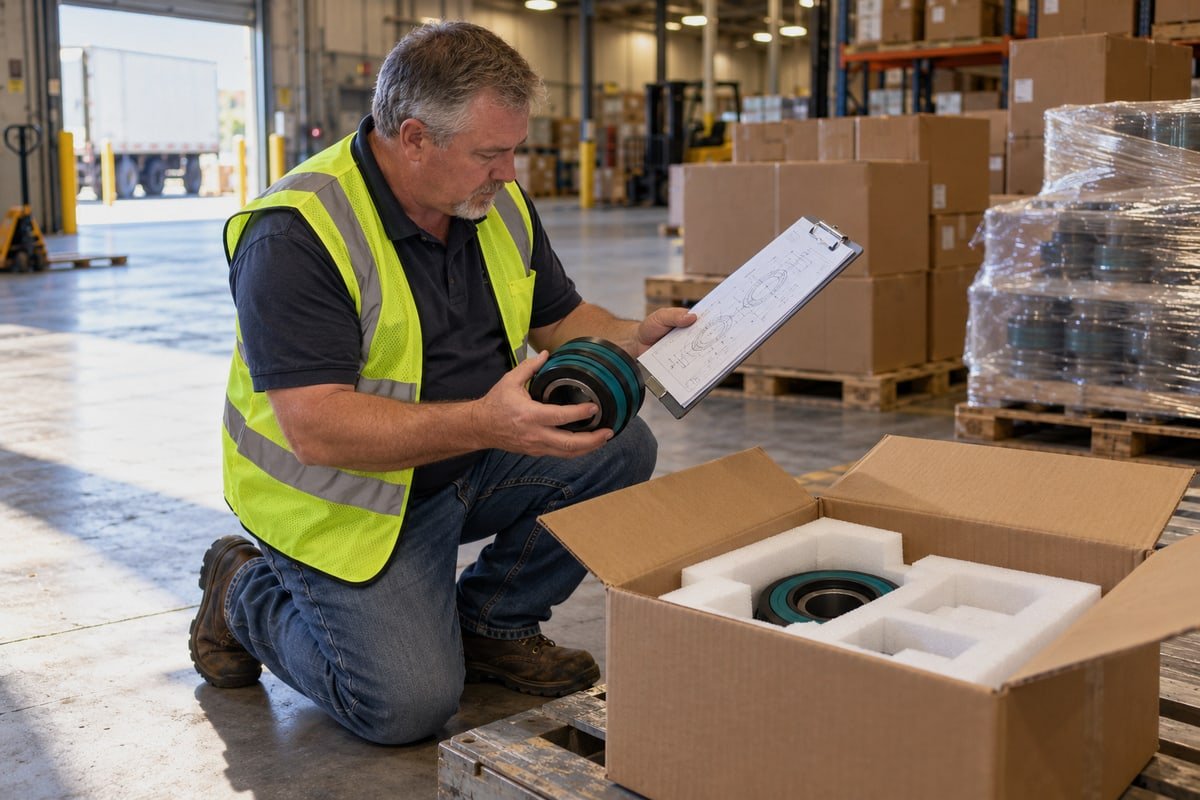
Price is easy to compare. Risk is not. So I ask buyers to write both on the same sheet.
Lead-time arithmetic
Market commentary on specialized transit components cites lead times of 12 to 18 months for some parts. Broader data center supply chains show the same pressure, with fiber lead times reported near 20 weeks for large buyers and up to a year for smaller ones. If a tender cycle takes three months and the commissioning date is fixed, a re-tender at each phase can open a gap that no amount of bid saving closes. Narrow vendor bases make this worse. When allocation tightens, a buyer with no priority status waits.
Putting savings and risk on one sheet
| Cost or risk item | Open re-tendering each phase | Single supplier only | Frozen spec plus qualified second source |
|---|---|---|---|
| Unit price | Lowest on paper | Rises after lock-in | 40–60% lower on the second-source share |
| Tender and onboarding cost | Repeated every phase | Once | Once, then framework pricing 3 |
| Requalification and testing | Likely | None unless design changes | Done once at qualification |
| Rework and interface risk | High | Low | Low, if sample fit is verified |
| Lead-time exposure | Reset every phase | Concentrated on one vendor | Split, with buffer stock |
| Supply chain resilience | Fragmented | Single point of failure | Two qualified sources |
The hybrid model in practice
This is the approach I recommend, and it is how our own customers use us. Lock the technical standard in Phase 1: frame type, module family, compression procedure, and test documentation. Then compete only the commercial terms. Qualify a second source that fits the same frames, agree framework pricing across all phases, and hold a small stock of spare sealing modules on site. In-house mold making lets us cover custom sizes when a later phase brings denser cabling, which is a practical form of future-proofing without a redesign.
Decide by campus maturity
For a greenfield hyperscale build, standardize hard and qualify the alternate source early. For an expansion of a mature campus, the base spec is already locked, so a controlled second source can carry more volume. In both cases, avoid re-tendering anything that could force redesign or recertification. The savings live in the commercial terms, not in the wall.
Conclusion
Re-tendering saves on paper but fragments a system that depends on consistency. Lock the specification early, qualify a compatible second source, and keep competition where it cannot break the wall.
Footnotes
1. Standard for high-challenge fire walls and protective openings in commercial and industrial buildings. ↩︎
2. Technical guidelines for modular construction and infrastructure interoperability in complex engineering projects. ↩︎
3. Best practices and definitions for framework agreements in large-scale institutional procurement. ↩︎



 English
  Español de México
  Deutsch
  Français
  العربية
  Русский