
Our order desk sees the same failure: a PO says “Class 1” for multi cable transit room class ratings, the wrong module ships, and site work stalls. Explicit standards fix it.
To avoid incorrect shipments from confusing multi cable transit room class ratings, name the governing standard on every PO, separate room class from fire, IP, and gas-tight ratings, order by exact variant code, cross-reference the model, and confirm fit with a free validation sample before releasing the full order.
Most wrong shipments are not product defects. They are translation errors between a room class, a wall or deck rating, and a product certificate. This article shows you how to translate correctly, step by step, and how to stop a bad order before it leaves the dock.
What exactly do MCT room class ratings mean, and how do I identify which one my project needs?
A sourcing manager in Germany once sent us a spec that read “Class 2 room, A-class wall.” Two different systems, one line. We had to ask which was which.
MCT room class ratings refer to ISO 14644-1 cleanroom particle classes (ISO 1 to ISO 9), but the same word “class” also covers A-, H-, and J-class fire ratings, IP codes, and UL Types. Identify the governing standard first, then match the product certificate to it.
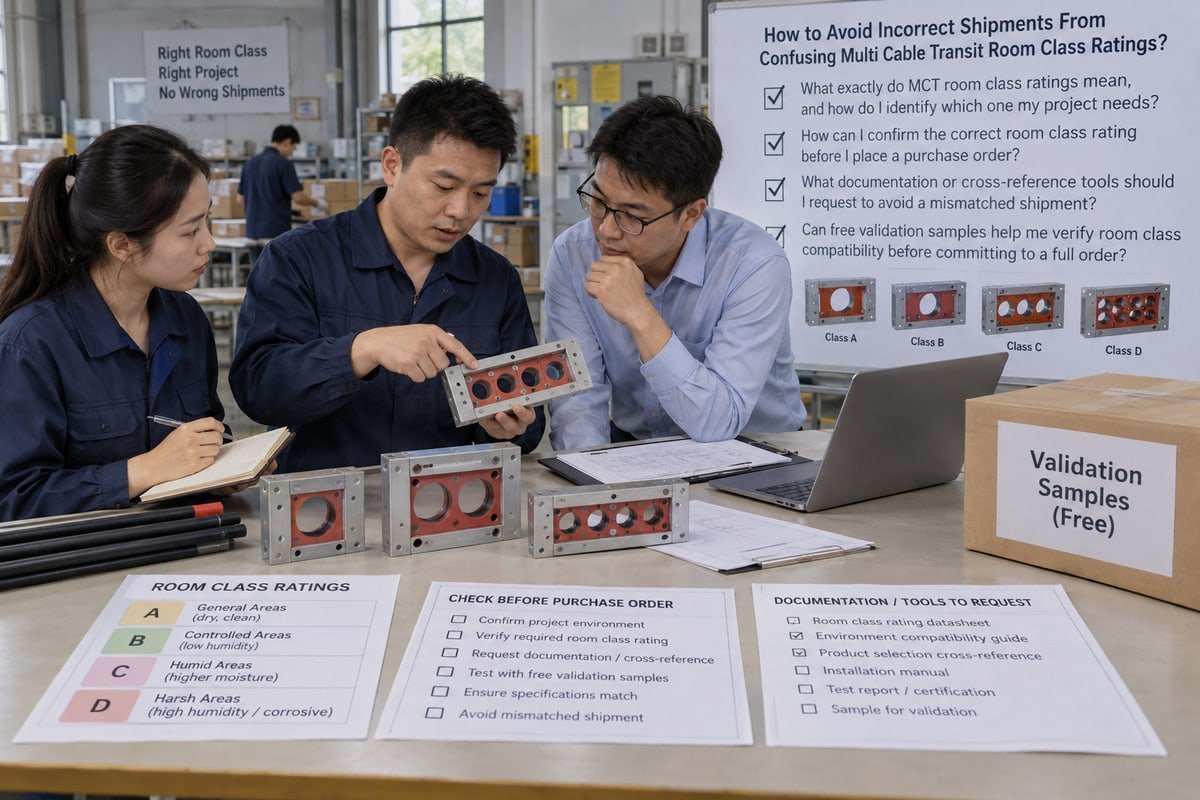
The word “class” is the root of the problem. In one project file it can mean five different things. Each one is measured by a different test, by a different body, and for a different reason. If your team does not name which system applies, someone downstream will guess.
The rating systems that get mixed up
| Term on the spec | What it actually measures | Governing reference | Applies to |
|---|---|---|---|
| ISO Class 1–9 | Airborne particles per cubic meter | ISO 14644-1 | The whole cleanroom |
| A-class (A-0, A-30, A-60) | Cellulosic fire, steel bulkhead | SOLAS / IMO FTP Code 1 | Bulkhead and deck transits |
| H-class (up to H-120) | Hydrocarbon fire | Offshore fire test standards | Offshore modules, process areas |
| J-class | Jet fire | Jet fire test protocols | High-pressure gas areas |
| E / I time | Integrity / Insulation, in minutes | EN or national fire test | Building penetrations, decks |
| IP66 / IP68 | Dust and water ingress | IEC 60529 | The seal itself |
| UL Type 4X 2 / Type 12 | Enclosure environment | UL 50E | Panels and enclosures |
| 2-hour FRR | Fire-resistance rating | Local building code | Utility and building walls |
Notice the last column. A cleanroom is classified as a whole room. A cable penetration seal is only one component inside it. One well-known cleanroom technical paper states this directly: tightness requirements are defined for the whole cleanroom, not for individual components like cable penetration seals. So a “Class 1” cable entry with a particle-emission test report 3 is not proof that the room is Class 1. It is proof that the component does not add particles. These are not the same document, and buyers mix them up constantly.
How to find the rating your project actually needs
I tell buyers to work backwards from the surface, not forwards from the catalog. Ask three questions in order.
- What is the surface? A steel bulkhead, a concrete wall, a container panel, or a cleanroom partition.
- What does the safety plan say about that surface? An A-60 fire rating, a 2-hour FRR, a 60-minute EI, or a particle class.
- What extra performance does the room add? Gas-tightness, water-tightness, EMC grounding, or pressure hold.
For our own modular sealing systems, the honest answer is that we test to A-0/A-60 fire, IP68 ingress, and watertight/gas-tight sealing from 0.01 to 0.4 MPa. We do not claim H-class fire protection 4, because that is a different test with hydrocarbon fire curves. If your deck needs H-120, the right question is not “which DEWIN part,” it is “which test report.” That distinction is where a good spec starts.
How can I confirm the correct room class rating before I place a purchase order?
We learned this after a rushed frame order years ago: the buyer wanted stainless frames for a coastal deck, but the PO said only “standard.” Primed mild steel shipped.
Confirm the room class rating before ordering with five checks: pull the governing standard from the room safety plan, confirm the wall or deck fire rating (E and I times), state pressure requirements (gas-tight or watertight), calculate cable diameters and fill ratio, and lock the frame material and variant code.
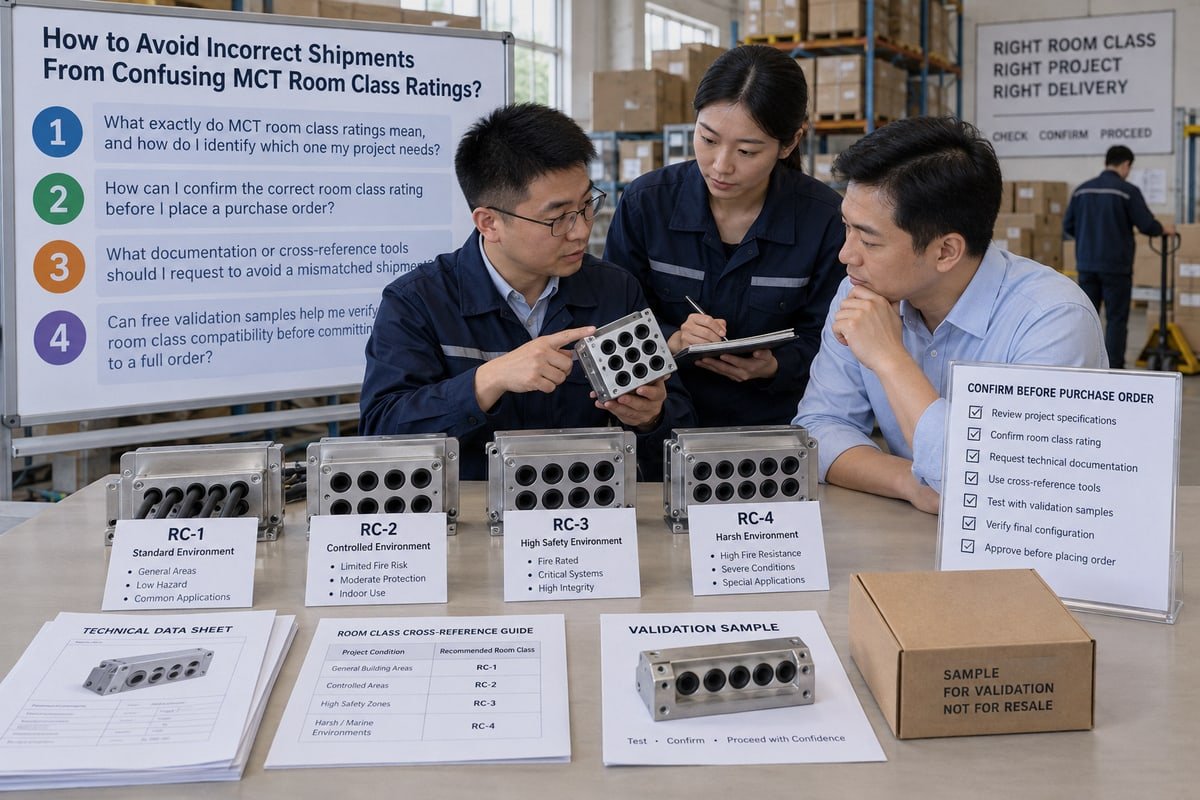
A purchase order is a translation document. Its job is to carry the engineer’s intent to a warehouse picker who has never seen the drawing. If the PO only says “class,” the translation fails. Here is the process we ask our EPC and OEM customers to follow before they release an order to us.
The five-step pre-order check
- Name the standard, not the family. Write “A-60 per SOLAS / IMO FTP Code” or “EI 120 per EN 1366-3 5,” not “fire-rated transit.” The standard number is what the picker can match against the certificate.
- Split fire, pressure, and ingress into separate lines. An A-60 fire line does not cover gas-tightness. If the room is a BESS container or a switchgear cell that must hold pressure, add a line for gas-tight cable seals with a stated value. We test our modules from 0.01 to 0.4 MPa, so the PO should state which end of that range the room needs.
- Calculate density with sizing software, not by eye. List every cable outside diameter and the count. Our step-core EPDM modules adapt to a range of diameters within one size, but the frame cutout and the total fill still need arithmetic. Undersized cable penetration frames are one of the top causes of return shipments.
- Audit spare capacity. Future cables must not push the frame past its certified fill ratio. Reserve spare modules on the PO now, so the certified configuration is not broken later on site.
- Lock material and variant code. Stainless versus primed mild steel, single-side versus split frame, and the exact suffix. A product name is not a variant.
Good versus bad specification language
| Bad line on a PO | Why it ships wrong | Better line |
|---|---|---|
| “Class 1 transit” | No standard named; could be ISO, fire, or IP | “Particle-emission tested for ISO 14644-1 Class 1, report attached” |
| “Fire-rated, 60 min” | A-60, H-60, and EI 60 are different tests | “A-60 fire rating per IMO FTP Code, cert no. on packing list” |
| “Sealed to required rating” | Outcome only; supplier must guess the test | “Gas-tight to 0.2 MPa, water pressure test report required” |
| “Frame, 120 type” | Material and drawing not fixed | “120-frame, stainless 316L, drawing DW-xxxx, split design” |
Some engineers push back here. They prefer outcome-based specs: “just seal it to the rating and let the factory choose.” I understand the appeal. It is fast to write. But in our export experience, outcome language is exactly where overlapping standards collide, because the factory picks the cheapest matching interpretation. Standard-driven procurement costs more discipline up front from sales and logistics. It costs far less than a rejected container in Rotterdam. The balanced answer is to keep the standard explicit and give the buyer a plain-language checklist like the one above.
What documentation or cross-reference tools should I request to avoid a mismatched shipment?
On our packing line in Shaanxi, every crate gets a checklist pass: the packing list must repeat the standard, the variant code, and the frame drawing number before it leaves.
Request a technical specification sheet with test method numbers, Type Approval or factory approval certificates, fire and water pressure test reports, a model cross-reference table (existing model to replacement model), CAD/STEP drawings, and a packing list that repeats the standard and variant code line by line.
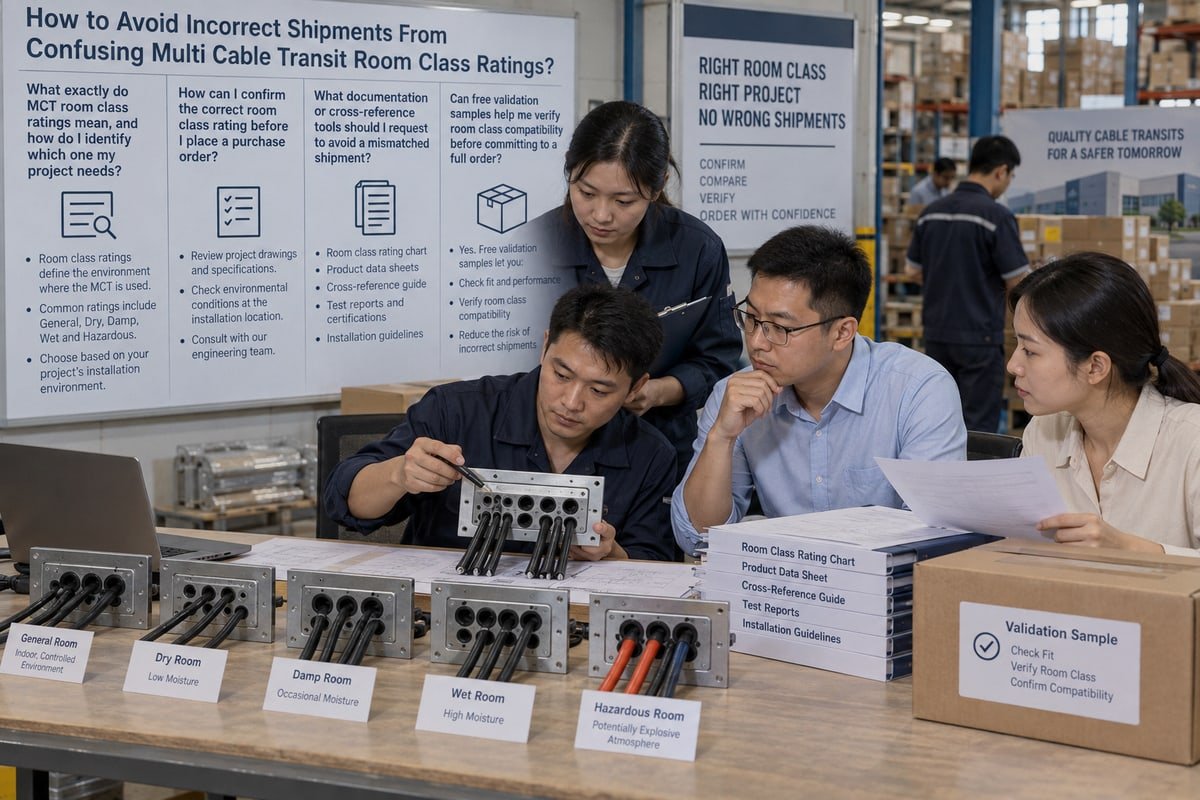
Documents are the only thing that connects a rubber block in a crate to a rating on a drawing. If the paperwork does not travel with the part, the rating does not travel either. The list below is what we hand to a European purchasing engineer during supplier qualification. I suggest you ask any second source for the same set.
The document pack to demand
| Document | What to check inside it | Why it prevents a wrong shipment |
|---|---|---|
| Technical specification sheet | Test method numbers next to every claim (IP68 per IEC 60529, A-60 per FTP Code) | Lets the warehouse match a claim to a code, not a slogan |
| Fire test report | Curve type (cellulosic or hydrocarbon), E and I times, tested frame size | Stops A-class being shipped for an H-class deck |
| Water pressure testing report | Test pressure in MPa, duration, pass criteria | Proves the gas-tight or watertight line on the PO |
| Type Approval Certificate | Issuing body (DNV, ABS, Lloyd’s Register, BV), scope, expiry | Required for SOLAS certification chains on ships and offshore |
| Factory approval and QMS certs | ISO 9001, IATF 16949, BV factory approval | Shows the process behind the part, not just one sample |
| Model cross-reference table | Existing model → replacement model, with dimensions | Confirms drop-in fit into existing 120-frame cutouts |
| CAD/STEP files | Frame cutout, bolt pattern, module stack height | Lets your drafter verify fit before any metal is cut |
| Packing list with codes | Standard, variant suffix, drawing number, quantity | The last check before the crate is sealed |
Two tools that close the gap between paper and part
The first is the cross-reference table. Buyers who move from an incumbent brand to our TSR round assemblies or TSC square modules ask for it before anything else. It maps their current part number to ours, with the dimensions side by side. That way the picker does not compare names. The picker compares numbers.
The second is a scan-to-spec link on the frame. Several of our data center and BESS customers now ask for a QR code on the frame nameplate. At receiving, the code opens the drawing, the room-class requirement, and the installation manual. The warehouse checks the physical frame against the digital spec in seconds. This is a small addition, and it catches suffix errors that a human eye misses on a busy dock.
One more request for global supply chains: ask the supplier to map UL Type ratings to IMO or IEC equivalents in writing. A UL Type 4X claim and an IP66 claim 6 overlap, but they are not identical tests. When a U.S. drawing meets a European or Middle East site, that written mapping saves a round of RFIs.
Can free validation samples help me verify room class compatibility before committing to a full order?
There is a trade-off we weigh on every sample request: a free module costs us mold time and freight, but a wrong 500-frame shipment costs everyone far more.
Yes. A free validation sample lets you check the frame cutout fit, the module step-core range against real cable diameters, and the compression unit torque, and lets your QA team compare the sample’s test documents against the room’s governing standard before a purchase order is issued.
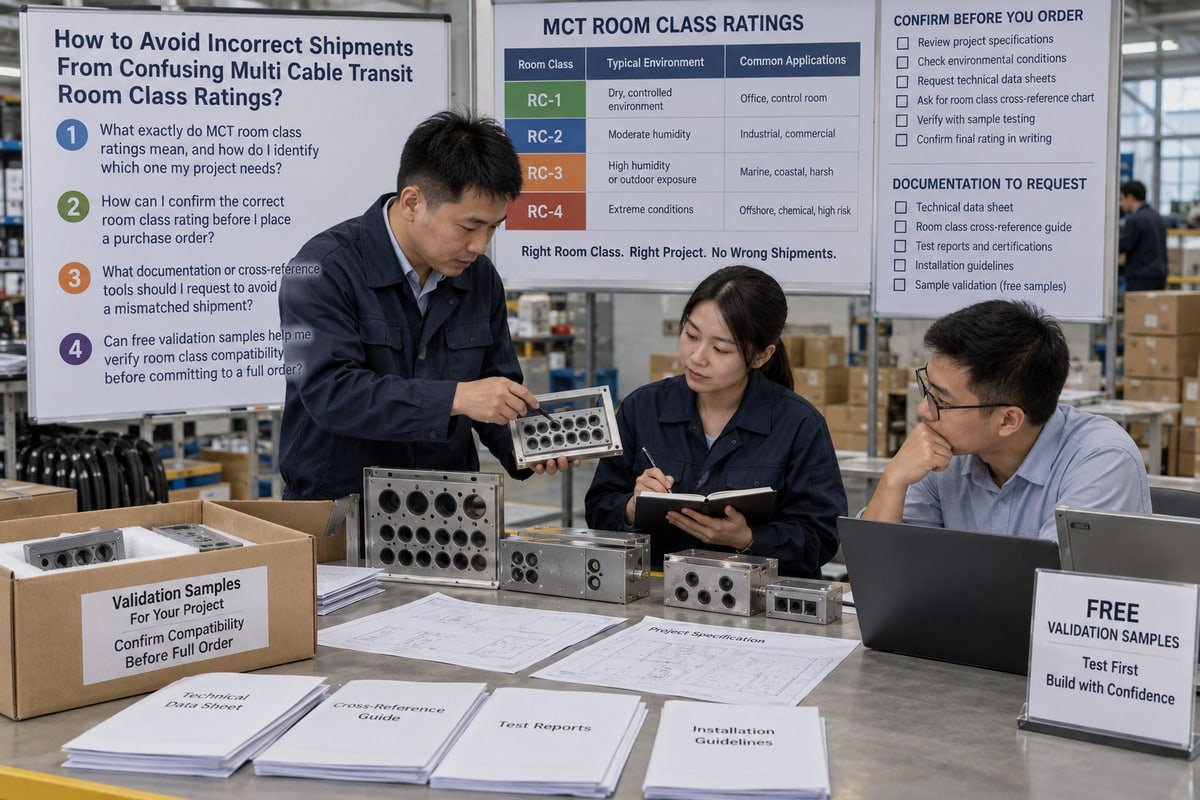
A sample answers physical questions. It does not answer room questions. I want to be direct about that, because buyers sometimes expect a sample to “prove Class 1.” It cannot. No single component can certify a room. What a sample can do is remove the three most common causes of a mismatched shipment: wrong dimensions, wrong variant, and wrong paperwork.
What a validation sample can and cannot confirm
It can confirm:
- The module drops into your existing 120-frame cutout with no rework.
- The step-core layers peel to match your actual cable outside diameters, including pre-terminated cables with connectors.
- The MCT wedge kit or compression unit reaches the stated compression with your torque tools.
- The stay plates and frame drawing match the CAD/STEP files you were sent.
- The test documents shipped with the sample match the standard on your drawing, line by line.
It cannot confirm:
- The cleanroom’s ISO class. That is a room measurement.
- Fire performance of your specific wall or deck. That comes from the test report and the certified configuration.
- Anything about a different variant. A sample of one suffix proves only that suffix.
A simple sample-to-order workflow
- Send us the cable list, frame drawing, and the governing standard. We return a cross-reference proposal.
- We ship a free validation sample: one module set, or a small frame with compression unit, with the technical specification sheet and test reports.
- Your drafter checks fit against the CAD file. Your QA checks the report numbers against the room safety plan.
- You approve the exact variant code in writing. That code goes onto the PO, the packing list, and the QR label.
- Only then does the full order release from our line in Shaanxi, Shandong, or Hunan.
This workflow is how a second source earns qualification without risk. The sample is free. The lesson it teaches is not: it forces every party to agree on the standard before the first pallet moves. In our experience, buyers who run the sample step see near-zero variant mix-ups on the full order, because the variant was frozen on paper before it was ever picked.
Conclusion
Wrong MCT shipments start as translation errors between room class, fire class, and product certificate. Name the standard, order by variant code, and validate a sample first.
Footnotes
1. The International Code for Application of Fire Test Procedures (FTP Code) governs fire safety on ships. ↩︎
2. UL 50E provides the safety standards for electrical enclosures, including environmental protection ratings like Type 4X. ↩︎
3. ISO 14644-14 provides the standard for testing particle emission from equipment used in cleanrooms. ↩︎
4. H-class ratings involve hydrocarbon fire tests, which are more intense than standard cellulosic fire tests. ↩︎
5. CEN develops European standards like EN 1366-3 for fire resistance testing of penetration seals. ↩︎
6. The IEC 60529 standard defines the IP ratings used to measure protection against dust and water. ↩︎



 English
  Español de México
  Deutsch
  Français
  العربية
  Русский