IP66, IP67, and IP68 ratings for multi cable transits confuse buyers who visit our factory. Over-specify and you overpay; under-specify and one flooded entry sinks the enclosure. Here’s our method.
IP66, IP67, and IP68 ratings for multi cable transits differ only in water exposure: all are dust-tight. IP66 resists powerful water jets, IP67 survives 1 m immersion for 30 minutes, and IP68 withstands continuous immersion at a manufacturer-defined depth and time. Choose by real flooding risk.
That is the short answer. The long answer matters more, because the label on the datasheet is only part of the story. Below, I break down what each rating really tests, which one your BESS container or switchgear needs, what the upgrade costs, and how to check a supplier’s proof before you sign off.
What's the real technical difference between IP66, IP67, and IP68 sealing performance in an MCT module?
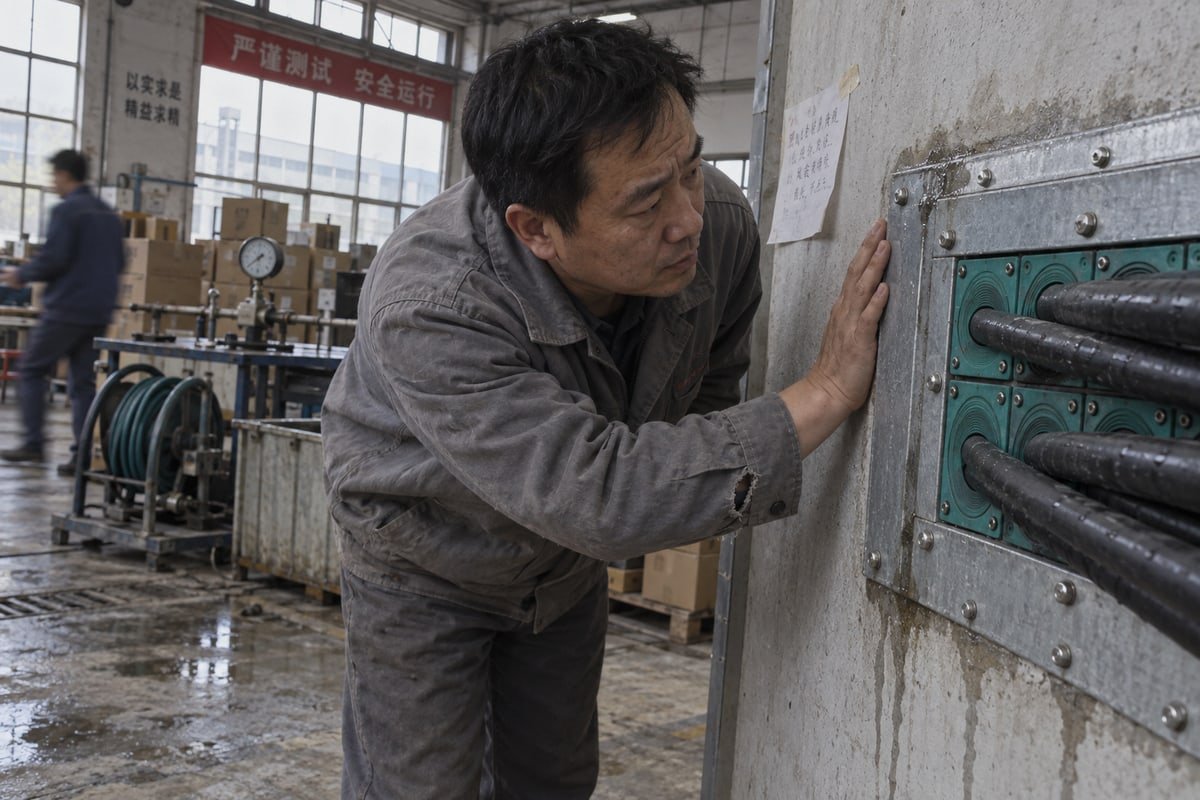
During a hydrostatic pressure test 1 on our line, one TSC module wept at the frame edge. The rubber was fine. The compression torque was not. That lesson shapes this section.
Under the IEC 60529 standard, IP66, IP67, and IP68 share the same dust-tight first digit. The difference is water: IP66 means water jet resistance, IP67 means temporary immersion (1 m, 30 minutes), and IP68 means continuous immersion at a depth and duration the manufacturer defines and tests.

The Ingress Protection code 2 has two digits. The first digit covers solids. The second digit covers water. For the three ratings in this article, the first digit is always 6. That means dust-tight. So IP66, IP67, and IP68 are identical in how they block fine dust and debris. Every difference sits in the second digit.
The three water tests in plain English
| Rating | Solids digit | Water digit | What IEC 60529 actually tests | Practical meaning for a cable transit |
|---|---|---|---|---|
| IP66 | 6, dust-tight | 6 | Powerful water jets from any direction | Survives hose washdown, driving rain, wind-driven spray |
| IP67 | 6, dust-tight | 7 | Immersion at 1 m depth for 30 minutes | Survives a brief flood or a submerged trench during a storm |
| IP68 | 6, dust-tight | 8 | Immersion deeper than 1 m, longer than 30 minutes, at conditions the manufacturer specifies | Survives long-term submersion, but only to the tested depth and time |
Notice the last row. IP68 is not one fixed condition. One published data sheet I have seen defines IP68 as 300 kPa for 16 hours, which equals about 30 metres of water depth. Another supplier might test at 2 metres for 24 hours. Both can print "IP68." So when we quote IP68 for our TSR and TSC modules, we attach the pressure and duration. Without those two numbers, the rating tells you very little.
Why IP68 does not automatically include IP66
This is the point most specifiers miss. A water jet applies focused mechanical force on one spot. Static immersion applies even pressure everywhere. A seal can pass one and fail the other. An IP68 module that was never jet-tested is not automatically IP66. Some manufacturers list both, for example "IP66/IP68," to show they ran both tests. If you need washdown resistance and flood resistance, ask for both.
What actually changes inside the modular sealing blocks
Here is the part that matters for multi cable transits specifically. A single cable gland seals one cable. A transit seals many cables of mixed diameters through one opening. The IP rating then depends on three physical factors:
- Compression precision. The stay plates and compression unit must squeeze every module evenly. Uneven torque leaves a path along one cable. Our step-core EPDM blocks are designed so the peeled layers close tightly around the cable jacket when the frame is compressed to the specified height.
- Cable cold flow. Cable jackets creep over years. Diameters shrink slightly. A rubber compound without high elastic memory will not follow that shrinkage, and the original seal opens. This is why halogen-free EPDM 3 with good recovery matters more than the rating printed on the box.
- Differential thermal expansion. A galvanized steel frame and a rubber block expand at different rates. In extreme climates, that mismatch can open micro-gaps during temperature swings. Some designs now move to composite frames to remove galvanic corrosion 4 at the seal-to-frame interface as well.
Next-generation transits are also adding built-in compression indicators 5 or sensors. They give real-time proof that the seal still holds the pressure its rating requires. I think that trend is healthy, because it moves the conversation from a label to a measurable state.
Which IP rating do I actually need for my BESS container or outdoor switchgear application?
A sourcing engineer in Europe once asked us for IP68 on every cable entry of a BESS container. Half of those entries sat high on the wall under a roof.
Most BESS containers and outdoor switchgear need IP66 at minimum for rain and washdown. Specify IP67 where floor-level entries face flood-prone sites or standing water. Specify IP68 only for entries below grade, in sumps, or where continuous immersion is credible. Match the rating to the exposure, not the brochure.
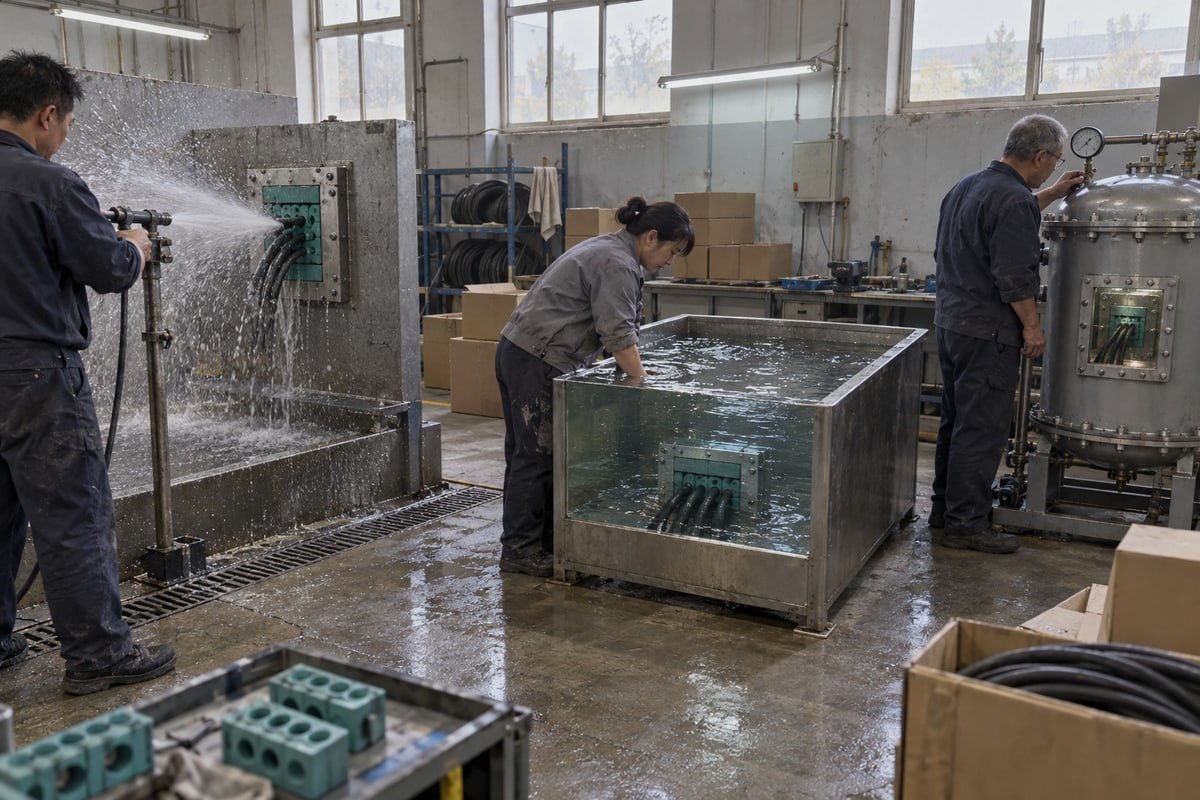
The right rating is a system-level decision. If one watertight cable entry 6 fails, water does not stop at that cable. It reaches the busbar, the BMS, or the battery racks. So I start every specification review by mapping each transit position against its worst credible water exposure. This table is the decision framework we use with integrators.
| Transit location | Worst credible exposure | Recommended minimum | Add-on requirements |
|---|---|---|---|
| BESS container side wall, under canopy | Driving rain, pressure washing | IP66 | UV-stable EPDM, fire rating if wall is a fire boundary |
| BESS container base or plinth level | Ponding, flash flood for minutes to hours | IP67 | Gas-tight sealing for thermal-runaway gases |
| Below-grade cable pit, trench, or sump | Standing water for hours or days | IP68 at a stated depth and time | Corrosion-resistant frame |
| Outdoor switchgear, side or roof entry | Rain, hose washdown, blowing dust | IP66 | NEMA 4X where salt or chemicals are present |
| Quayside or coastal switchgear | Salt spray, wave overtopping | IP67 or IP68 | Stainless or composite frame |
| Indoor control panel, conditioned room | Dust, condensation, cleaning | IP54 baseline, IP66 if washed down | Halogen-free materials |
Standard MCT designs from most vendors reach at least IP54. Higher-performing variants reach IP66 and IP67, and many are now offered at IP68 within the same product family. So the question is rarely "can I get IP68?" The question is "do I need it here?"
The over-specification objection, and how I resolve it
Some engineers argue that projects over-specify IP68 when IP66 or IP67 would perform fine. They point to added cost, tighter installation tolerances, and extra maintenance checks. That argument is fair for a wall entry under a canopy. The opposing view says IP68 is cheap insurance against downtime, corrosion, and cable replacement in flood-prone sites. That argument is also fair for a trench entry.
My resolution is simple. Specify the rating each position needs. But choose a modular platform whose sealing blocks are already tested to IP68. Our TSC and TSR modules are the same blocks whether the project calls for IP66 or IP68. You do not pay a premium for the higher rating. You just get the test document that proves it. That way the debate about over-specification becomes a paperwork question, not a cost question.
NEMA rating comparison for enclosure protection levels
European buyers often ask how IP maps to NEMA. A quick NEMA rating comparison: NEMA 4X is close to IP66 but also requires corrosion resistance. Type 12 is roughly indoor dust and drip protection. Type 3R covers outdoor rain but not jets. IP codes say nothing about corrosion, ice, or UV. So if a switchgear panel must be NEMA 4X, the frame material matters as much as the rubber.
Beyond water: total system compliance
The market is moving toward "total system compliance" rather than a single number. A BESS container wall may be a fire boundary, so the transit may need an A-0 or A-60 fire rating. Battery off-gassing means gas-tight sealing matters, which is why we test watertight and gas-tight performance across 0.01–0.4 MPa. Environmental sealing is therefore three questions at once: water, fire, and gas. Ask all three before you fix the IP rating.
Does upgrading to IP68 sealing increase my cost or lead time compared to IP66 or IP67 modules?
When we tooled our TSC line, we weighed a trade-off: one EPDM compound and one mold set for all ratings, or separate variants. We chose one. Here is why.
Not necessarily. When IP66, IP67, and IP68 come from one modular platform with the same EPDM blocks and frames, the material cost is nearly identical. Cost and lead time rise only when IP68 requires custom frame sizes, extra hydrostatic testing, or third-party witness reports. Ask for those items separately.

A notable market trend supports this. Leading transit systems now list IP65, IP66, IP67, and IP68 together for the same product family. The mechanical architecture is the same. The sealing outcome depends on configuration and testing, not on a different rubber. That changes how you should read a quote. If a supplier charges a large premium for "the IP68 version," ask what physically differs. Often the honest answer is: nothing except the test report.
Where the real cost drivers sit
| Cost or lead-time driver | Effect on price | Effect on lead time | How to keep it under control |
|---|---|---|---|
| Sealing block compound and geometry | None, if the same block serves IP66 to IP68 | None | Confirm the block part number is identical across ratings |
| Frame material (galvanized, stainless, composite) | Moderate | Small | Choose frame by corrosion exposure, not by IP rating |
| Custom frame cut-out or non-standard size | Moderate, driven by tooling | Days to weeks, depending on mold capacity | Prefer 120-frame compatible sizes; use a supplier with in-house molds |
| Batch hydrostatic and gas-tight testing | Low | Small | Ask whether it is already part of routine QC |
| Third-party witnessed type test | Higher, but one-time | Weeks | Reuse existing type approvals rather than repeating tests |
| Compression verification (torque records, indicators) | Low | None | Request the compression spec with every delivery |
The pattern is clear. The rubber does not drive the IP68 premium. Tooling and paperwork do.
The second-source angle
This is where IP66, IP67, and IP68 ratings for multi cable transits intersect with procurement. Many of our European customers already run an incumbent brand of transit. Their frames use common 120-frame dimensions. Our modules are dimensionally compatible with those cutouts, so the IP68-tested block drops straight into the existing frame. We provide a cross-reference table from the existing model to the DEWIN model, plus free validation samples, so qualification does not require a redesign. On that basis, integrators typically land at 40–60% lower component cost against the incumbent, while keeping the same or higher ingress rating. So the practical answer to "does IP68 cost more?" is often the reverse: a qualified second source at IP68 costs less than the incumbent at IP66.
Lead time and spare modules
Lead time risk usually comes from spares, not from the initial order. A container builder needs replacement modules when a cable diameter changes on site. Because we mold our own blocks in Shaanxi, Shandong, and Hunan, we keep spare sealing modules moving without waiting on a third-party molder. Custom sizes go through our in-house mold shop as well. That keeps the IP68 configuration from becoming a schedule problem.
How can I verify IP68 watertight and gas-tight performance with test reports before I approve a supplier?
We learned the hard way that an IP68 logo on a datasheet is not a test report. One early export order taught us to attach hydrostatic reports to every quote.
Ask for the actual test report, not the datasheet. Verify a hydrostatic pressure test at a stated pressure and duration, a gas-tight test across a stated range such as 0.01–0.4 MPa, the test-body identity, module and frame part numbers, and the date. Then confirm with a free validation sample.
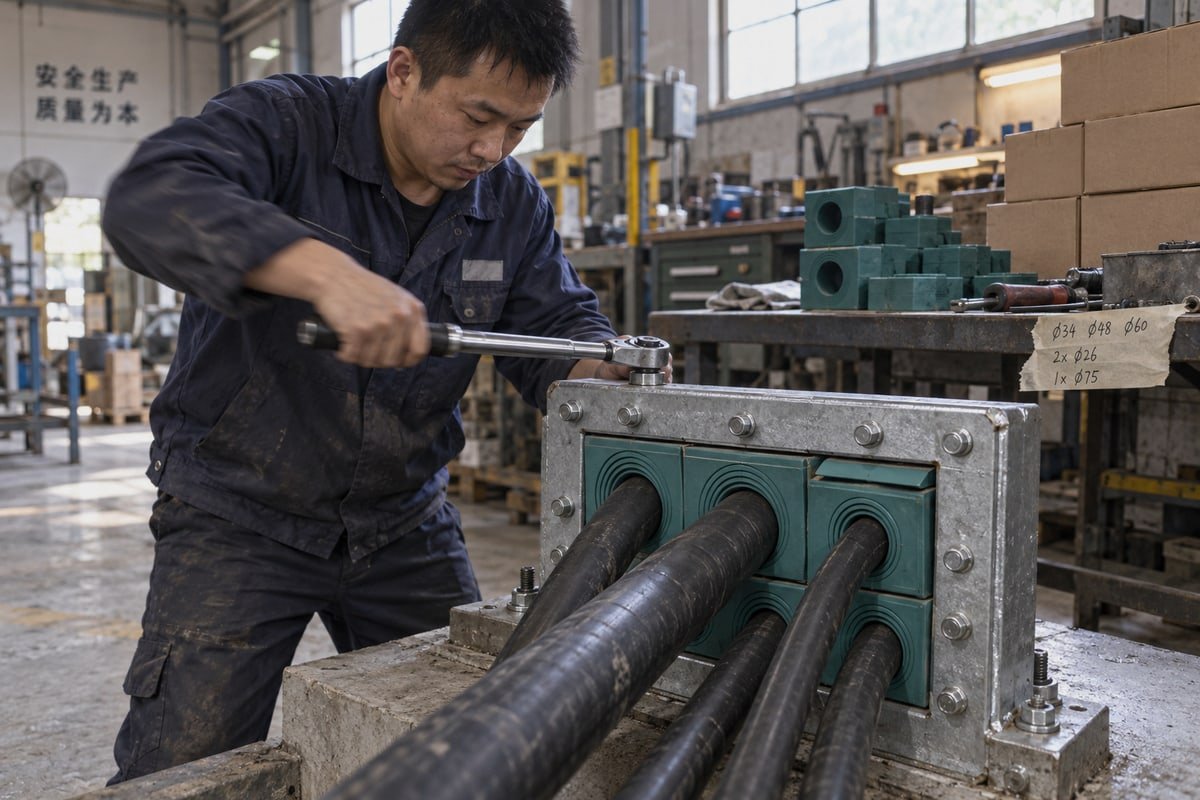
Skeptical purchasing engineers are right to be skeptical here. A rating claim is cheap to print and expensive to prove. So I recommend a fixed verification process. We follow the same steps ourselves when we audit a rubber compound supplier.
A six-step supplier verification process
- Request type test reports, not brochures. A report has a test number, a date, a sample description, and a signature. A brochure has a logo.
- Read the hydrostatic pressure test parameters. The report must state the pressure, the duration, and the medium. "IP68" alone is not a parameter. "300 kPa for 16 hours" is.
- Check the sample configuration. The tested assembly should include the frame, the compression unit, the stay plates, and modular sealing blocks fitted with cables at both the minimum and maximum diameter of the block range. A block tested empty proves nothing about a loaded transit.
- Confirm the gas-tight test. For BESS and switchgear, ask for the pressure range and the leak criterion. We test watertight and gas-tight performance from 0.01 to 0.4 MPa and share those documents on request.
- Identify the test body. In-house testing under an ISO 9001 and IATF 16949 quality system is acceptable for routine batches. For type approval, look for a recognized third party. Our factory is BV-approved, and that approval covers the factory process, not just one sample.
- Run a free validation sample in your own frame. Fit our module in your existing 120-frame cutout, compress it to the stated height, and pressure test it on your bench. Then compare the CAD/STEP file to the physical part.
What a credible report must contain
| Report element | Why it matters | Red flag if missing |
|---|---|---|
| Pressure and duration | Defines what IP68 means for this product | Rating stated with no numbers |
| Sample part numbers | Links the test to the exact block and frame you will buy | Generic "MCT system" with no model codes |
| Cable sizes used in test | Proves the seal works across the block's diameter range | Test done without cables |
| Compression height or torque | Lets you reproduce the seal on site | No installation reference |
| Fire test reference (A-0 or A-60) | Confirms the same assembly passed fire and water | Fire and IP tested on different assemblies |
| Issuing body and date | Establishes traceability and validity | Undated or unsigned document |
One more point. Test reports describe a new module. Ask the supplier how the seal behaves after years of cable cold flow and thermal cycling. A serious supplier will talk about elastic memory and re-torque intervals. A trading company will change the subject. Documents, drawings, and a sample on your bench remove most of the guesswork.
Conclusion
Guessing an IP rating risks either wasted budget or a flooded enclosure. Match IP66, IP67, or IP68 to real exposure, then demand test reports and a validation sample before approval.
Footnotes
1. Technical explanation of the pressure testing method used to verify seal integrity. ↩︎
2. Official international standards body that defines the Ingress Protection (IP) rating system. ↩︎
3. Authoritative source detailing the chemical properties and applications of EPDM synthetic rubber. ↩︎
4. Technical background on the electrochemical process affecting metal frames in cable transits. ↩︎
5. Authoritative engineering source for monitoring and sensor technologies in electrical infrastructure. ↩︎
6. Global energy authority providing context on infrastructure safety for battery storage systems. ↩︎


 English
  Español de México
  Deutsch
  Français
  العربية
  Русский