
Export and customs documents for multi cable transit once held our container at a European port for days. One invoice line just said “rubber parts”. Product fine, paperwork not.
Sourcing multi cable transit from China requires a Commercial Invoice, Packing List, sales contract, Customs Declaration, and Bill of Lading or Air Waybill. Add a Certificate of Origin, RoHS/REACH declarations, MSDS for lubricants, and test certificates when the destination or project requires them.
That list looks short. It is short. The problem is not the number of documents. The problem is whether they agree with each other. Below I walk through what we prepare, what you should verify, and where the real delay risks sit.
What documents does DewinMCT provide to help me clear customs without delays?
A sourcing manager in Germany recently asked us for the full document pack before placing his first purchase order. He wanted to see it, not hear about it.
DewinMCT provides the Commercial Invoice, Packing List, sales contract, export Customs Declaration copy, Bill of Lading or Air Waybill, and Certificate of Origin on request. We also supply Technical data sheets, HS Code classification notes, RoHS/REACH declarations, and MSDS for lubricants so every document matches.

Chinese customs law requires the exporter to make a truthful declaration and to submit any required licensing documents for examination. Export formalities are completed at the customs office of departure. Customs guidance lists the supporting attachments as contract, invoice, packing list, manifest, bill of lading 1 or waybill, and the broker authorization. That is the legal frame we work inside on every shipment.
Standard documents versus conditional documents
| Document | Always or conditional | Who prepares it | What you should check |
|---|---|---|---|
| Commercial Invoice | Always | Our export desk | Unit price, total value, Incoterms, HS code, description matching your PO |
| Packing List | Always | Our warehouse | Frames and modules counted separately, gross/net weight, carton dimensions |
| Sales contract | Always in China export practice | Both parties | Value and terms match the PO |
| Export Customs Declaration | Always | Our licensed broker under our authorization | Copy shared after customs release |
| Bill of Lading or Air Waybill | Always | Freight forwarder | Consignee, notify party, cargo description |
| Certificate of Origin | Conditional | Issued on our application | Correct form for the destination trade agreement; attestation for some Middle East ports |
| RoHS/REACH declaration | Conditional | Our QA team | Covers the halogen-free EPDM modules |
| MSDS | Conditional | Our QA team | Only when a sealing lubricant ships in the kit |
| Export License | Rare | Not required for standard MCT hardware | Confirm only for unusual alloys or restricted destinations |
HS Code classification: frames and modules are not the same line
An MCT system is two products in one box. The transit frame, compression unit, and stay plates are steel articles. The sealing modules are vulcanised EPDM rubber. They fall under different HS Code classification headings. We declare them as separate lines with separate weights. This is not extra work for its own sake. A single line reading "cable transit set" invites a customs query, and a query at the departure port pushes your delivery date.
Incoterms decide who files what
Incoterms set the split of responsibility. Under FOB, CIF, or DAP, we handle the Chinese export Customs Declaration through our broker. Under EXW, your forwarder takes over export clearance. For a first order I would not recommend EXW. A forwarder who has never seen our product may describe it in a way that does not match our Technical data sheet.
Is an Export License really required?
Some sourcing pages say a supplier needs an "export license" from GACC for every shipment. That mixes two things. Every Chinese exporter must hold a customs registration record. A product-specific Export License applies only to controlled goods or restricted destinations. export controls 2 Standard MCT frames and EPDM modules are not controlled goods. We hold the registration. The license is not part of the pack for normal orders.
One more objection I hear: "Invoice, Packing List, and Bill of Lading are enough." They are enough when nothing goes wrong. The contract, broker authorization, and origin support are what protect you when a customs officer opens the file.
How do I verify certification paperwork like ISO 9001, IATF 16949, and BV approval before I sign a purchase order?
We learned early that a scanned certificate in an email proves very little. Buyers now check certificate numbers against registrar databases, and we prefer it that way.
Verify ISO 9001, IATF 16949, and BV approval by requesting certificate copies with numbers, checking each number in the issuing body's online database, confirming the certified site address matches the factory shipping your goods, and checking the scope and expiry date before signing the purchase order.

A certificate is a claim about a specific site, a specific scope, and a specific date range. Read all three. A certificate for a trading office in one city does not cover a plant in another. A scope that lists "trading of industrial parts" does not cover mold making or rubber vulcanisation.
The verification table we send with our certificates
| Certificate | Issued by | What to check | Where to check |
|---|---|---|---|
| ISO 9001 | Accredited certification body | Certificate number, site address, scope, expiry | The certification body's public register or the IAF CertSearch database |
| IATF 16949 | IATF-recognized certification body | Certificate number, manufacturing site, scope | The IATF global database of certified sites |
| BV approval | Bureau Veritas | Approval number, product range, validity | Bureau Veritas certificate check service |
| Business license | Chinese market regulator | Registered capital, registered address, business scope | National Enterprise Credit Information Publicity System |
Why the site address matters for us in particular
Our headquarters is in Shaanxi. We also run production in Shandong and Hunan. When a buyer asks which site will produce his order, we tell him, and we send the certificate that covers that site. If a supplier cannot answer the site question quickly, that is a signal.
Factory or trading company?
This is the second thing to verify, and it links to the first. Our business license shows RMB 50M registered capital and a manufacturing scope. Our patent record shows 38 or more granted patents. Both can be checked in public Chinese registers. A trading company can forward a certificate. It cannot forward a mold shop.
What IATF 16949 does and does not tell you
IATF 16949 is a quality management system 3 standard. It tells you our processes are controlled and audited, including traceability and change management. It does not tell you a module passed a fire test. That comes from product test reports, which I cover in the next section. Treat the two as separate questions, because they are.
If time allows before the purchase order, ask for a live video walk of the module press line and the mold shop. It costs an hour. It removes most doubt.
What test reports and compliance certificates should I request to confirm fire rating and IP68 sealing performance?
Our test bench for compression units checks sealing pressure between 0.01 and 0.4 MPa. The report from that bench is the document I would ask for first.
Request the A-0/A-60 fire test report, an IP68 ingress protection test report to IEC 60529, watertight and gas-tight pressure test records from 0.01 to 0.4 MPa, the BV factory approval, RoHS/REACH declarations for halogen-free EPDM, and any Marine type approval the project specifies.
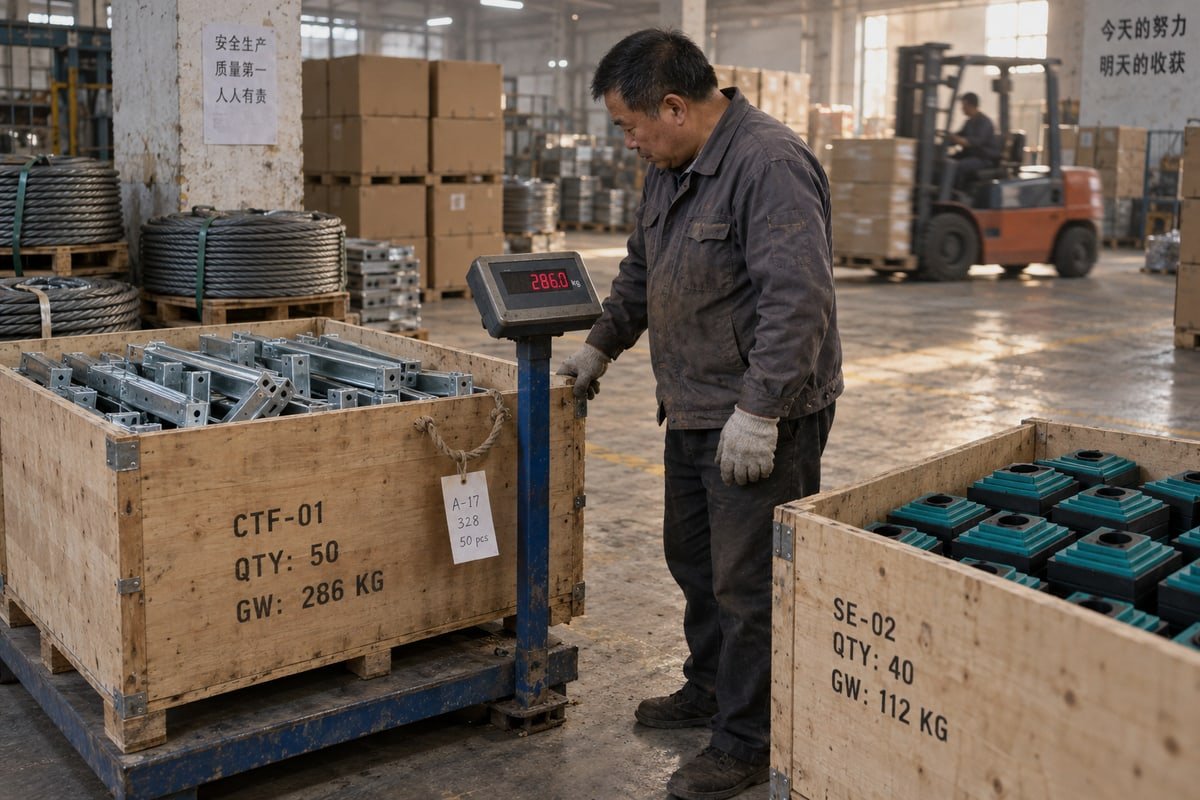
Here is the objection I want to resolve first. Some buyers treat multi cable transit as a low-risk commodity that needs no compliance review. The frame is steel. The module is rubber. What could go wrong? The answer is that a BESS container or a switchgear cabinet is only as fire-safe and as watertight as its cable entry. The test reports are not customs documents in the strict sense. They are the documents your own engineering sign-off depends on.
Match each performance claim to a document
| Performance claim | Document to request | Reference | What to look for |
|---|---|---|---|
| Fire rating A-0 / A-60 | Fire test report on the transit assembly | IMO FTP Code A-class division testing | Frame size and module type tested, test duration, laboratory name |
| IP68 | Ingress protection test report | IEC 60529 | Water depth and duration, module and frame combination tested |
| Watertight and gas-tight | Pressure test record | Factory test, 0.01–0.4 MPa | Pressure held, hold time, leakage criterion |
| Halogen-free EPDM | RoHS and REACH declarations, halogen content report | RoHS, REACH, halogen test method | Compound reference matching the module part number |
| Marine or offshore use | Marine type approval | BV, DNV, ABS, or MED as the project specifies | Approval scope covers the exact model, not just the brand |
| North American projects | Reports referencing UL fire safety standards | Project specification | Confirm whether the end product or the transit needs the listing |
Type test versus batch test
A type test is done once on a representative assembly. A batch test is done on the goods in your order. For fire rating and IP68, you will get type test reports. For sealing pressure, we can provide the factory test record for compression units in the shipment. Ask which one you are receiving. Both are valid. They answer different questions.
Make the report point at the module you bought
Our step-core modules are dimensionally compatible with common 120-frame standards. Our cross-reference table maps an existing model to a DEWIN model. When you read a test report, check that the tested model number is the one on your PO, or is covered by the same family in the report scope. A report for a round TSR assembly does not automatically cover a square TSC module.
What about CE Certification?
Passive sealing modules are not always inside a CE directive 4 by themselves. Your finished cabinet or container may be. Ask your compliance team which case applies. We supply the Technical data sheet and material declarations that feed your own technical file, so you are not blocked later.
Can DewinMCT help me manage export documentation for private-label or custom-molded MCT orders?
Cutting a custom mold takes weeks. Getting the paperwork wrong for that custom part can cost even longer. We weigh both timelines together on every private-label order.
Yes. DewinMCT handles export documentation for private-label and custom-molded MCT orders: we declare your brand name consistently on the Commercial Invoice, Packing List, and Bill of Lading, file the Customs Declaration with the correct HS Code, obtain the Certificate of Origin, and keep trademark authorization on record.
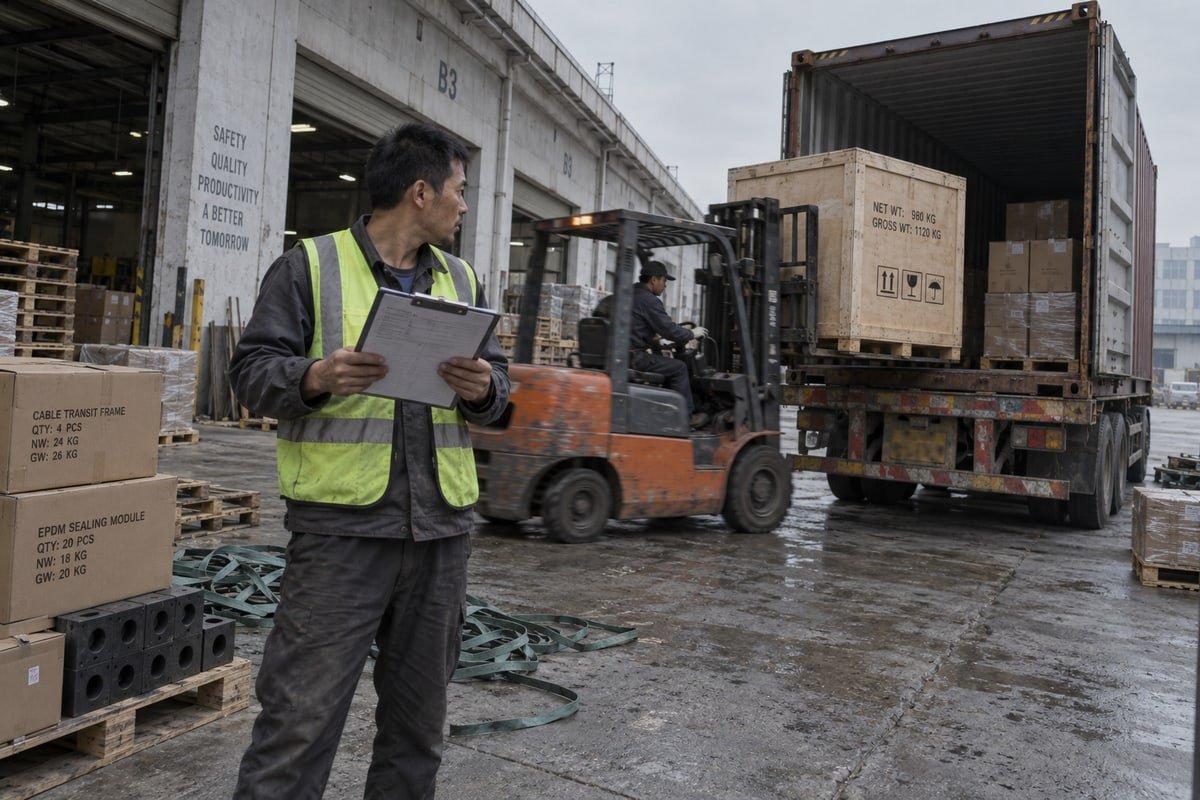
Private-label and custom-molded orders add two risks to an otherwise normal export file. The first is a brand mark that is not ours. The second is a part number that does not exist on any public catalogue. Both are easy to handle. Both cause delays when nobody handles them.
Our six-step process for a private-label export file
- We agree the declared description and HS Code classification for each custom part before the mold is cut, not after the goods are packed.
- You send a trademark authorization letter allowing us to apply your mark and export goods carrying it. We keep it on file with our broker.
- We create the Technical data sheet and drawing for the custom module, including CAD/STEP files, so the customs description has a source document behind it.
- Our export desk drafts the Commercial Invoice and Packing List using your part numbers and your brand, with our factory as shipper. You approve them before filing.
- Our broker files the Customs Declaration. The Bill of Lading is issued with the same description. We apply for the Certificate of Origin if your destination needs it.
- We send you the full pack as a single set before payment release, so your import broker can pre-clear.
Why the trademark letter is not optional
China customs runs intellectual property 5 checks on export cargo. Goods carrying a registered mark can be held if the exporter cannot show authority to use it. Your letter closes that gap. It should name the mark, the goods, and our company. One page is enough.
Custom sizes and the test report question
A custom-molded module changes the geometry. It does not always change the compound or the compression principle. When the custom part sits inside the same tested family, we say so and reference the family report. When it does not, we tell you what additional testing you would need before you rely on the A-0/A-60 or IP68 claim. Honest scope beats a report that quietly covers a different part.
Who controls the file?
One party should own the document set. On our orders that is our export desk, with your approval at step four. Split ownership between supplier, forwarder, and buyer is where the mismatches start. Spare module re-orders follow the same file, so a repeat shipment is faster than the first.
Conclusion
Document mismatches, not product complexity, delay multi cable transit shipments from China. Match every line, verify every certificate, and let one party own the file. We do that daily.
Footnotes
1. A Bill of Lading is a critical legal document in international trade acting as a title of goods. ↩︎
2. Replaces 404 with the current authoritative U.S. government page for export control regulations. ↩︎
3. IATF 16949 is the global technical specification and quality management standard for the automotive industry. ↩︎
4. The European Commission explains the scope of CE marking and relevant directives for products in the EU. ↩︎
5. Customs authorities perform intellectual property inspections to prevent the export of counterfeit or unauthorized branded goods. ↩︎


 English
  Español de México
  Deutsch
  Français
  العربية
  Русский