Every week our sales engineers field the same question: standard vs custom multi cable transit 1 for procurement? Choose wrong and you pay in rework, or in a twelve-month wait.
اختر نظام عبور كابلات متعدد قياسيًا عندما يستخدم اختراقك فتحات إطار 120 شائعة، وأقطار كابلات مختلطة ضمن نطاقات الوحدات، وتصنيفات A-60 أو IP68 معتمدة. اختر المخصص فقط عندما تجعل الهندسة، أو التعرض الكيميائي الشديد، أو معايير المالك وحدة الكتالوج حلاً وسطًا.
That answer sounds simple. In practice, the decision hides inside four smaller questions. Does the module fit? What does custom really cost? Which documents prove the claims? And when should you test a sample first? I will take each one in turn.
كيف أعرف إذا كانت وحدة MCT قياسية ستتناسب بالفعل مع الفتحات الموجودة لديّ ذات الـ 120 إطارًا؟
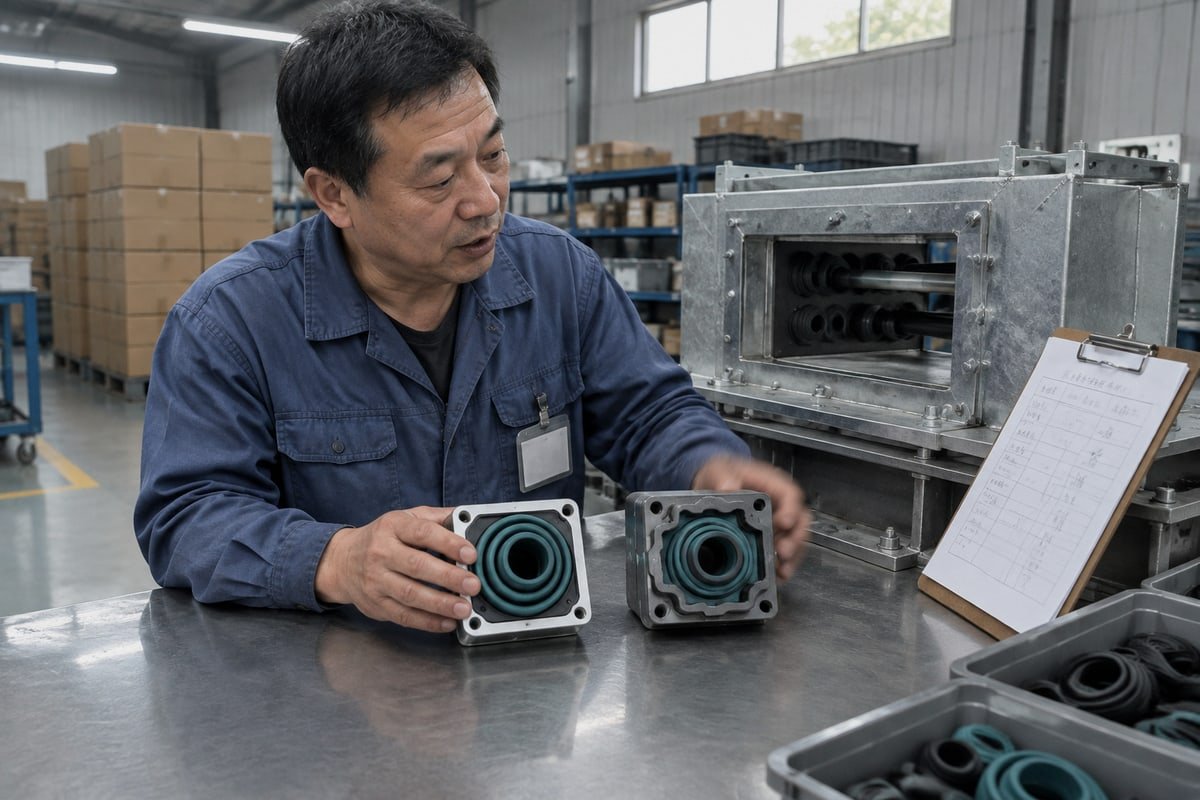
Last quarter our QC bench measured a European integrator's frame sample against our TSC modules with calipers. Fit was confirmed before any commercial talk began.
وحدة MCT قياسية تناسب الفتحة الموجودة لديك بإطار 120 عندما يتطابق عرضها الاسمي وارتفاعها وعمقها مع الفتحة الداخلية للإطار، وتترك وحدة الإسفين الضاغط مساحة تعبئة صحيحة، ويقوم جدول مرجعي بربط نموذجك الحالي بالبديل. تحقق باستخدام عينة مادية.

What the 120 in 120-frame actually tells you
The number describes a frame family, not one product. Frames in this family share a nominal depth and a module grid. Modules come in set widths. Combinations of those widths fill the opening row by row. If your cutout was made for this family, a compatible module from another factory should slide into the same slot. The key word is "should". Weld distortion, paint thickness 2, and stay plate thickness all eat into the packing space. That is why we publish our TSC and TSR dimensions with tolerances, not only nominal values. The same logic applies to round sealing assemblies. A TSR unit must match the pipe sleeve inner diameter, and the sleeve wall must be within the range the rubber can load against.
A fit checklist you can run before ordering
| Check | What to measure | Why it matters |
|---|---|---|
| Frame internal width | Inside face to inside face, after paint | Modules must fill the row with only the wedge allowance left over |
| Frame depth | Front edge to rear edge | Module depth must sit flush so the compression wedge unit loads evenly |
| Stay plate thickness | Each plate, with coating | Thick plates reduce usable module height |
| Wedge travel | Compressed and uncompressed height | Too little travel means low sealing pressure and a failed IP68 test |
| Cable outer diameter | Minimum and maximum from the cable schedule | Each cable must fall inside the step-core range of its module |
Step-core modules and mixed cable diameters
Our modules use step-core, halogen-free EPDM. Each core has peelable layers. The installer removes layers until the bore matches the cable. One module size then covers a range of diameters. This is the modular adaptability that lets standard modular sealing systems 3 handle retrofit installation requirements, where the cable list changed after the frame was welded. It also supports space-saving cable management, because you do not need one module size per cable size.
Cross-reference tables as procurement evidence
A cross-reference table maps the model you have today to the model we ship. It lists width, height, depth, cable range, and material side by side. It turns a sourcing decision into a document trail. We pair it with CAD and STEP files. Your engineer can drop the model into the assembly and check clearances before the sample even leaves our warehouse.
ما هي مفاضلات التكلفة والمهلة التي يجب أن أتوقعها عند تحديد تصميم عبور كابل مخصص؟
Tooling cost against schedule risk is the trade-off our mold shop weighs every time an EPC asks for a non-catalog module size.
توقع تصميمًا مخصصًا لعبور الكابلات ليضيف رسوم قوالب أو أدوات، وساعات هندسية، ووقت تسليم أطول، من بضعة أسابيع إضافية لوحدة مهيأة إلى أكثر من اثني عشر شهرًا للإطارات المصممة بالكامل حسب الطلب. الوحدات القياسية الجاهزة للشحن من المخزون، بنسبة 40-60% أقل من أسعار العلامات التجارية المنافسة.

Custom does not always mean bespoke. In our order book, "custom" splits into three tiers. Each tier carries a very different cost and schedule profile.
| Tier | Real example | Tooling cost | Engineering effort | Lead time | Supply risk |
|---|---|---|---|---|---|
| Catalog standard | TSC or TSR module in a 120-frame size | None | None | From stock | Low, multi-plant stock |
| Configured modular | Standard frame with a non-catalog bore, private-label marking, or a special stay plate count | Low, in-house mold adjustment | Days | Weeks | Low to moderate |
| Fully bespoke | New frame geometry for a curved bulkhead or a proprietary equipment interface | High, new mold and fixtures | Weeks | Months; some engineered frames are reported at over 12 months | High, single-source parts |
Where the money actually goes
The mold is only the first line. A custom design also needs drawings, first-article inspection, and often a separate test campaign because the tested configuration no longer matches the product. Those engineering hours land on your invoice one way or another. On a configured module we absorb most of that, because our mold making is in-house and the base EPDM compound and step-core geometry stay unchanged.
Total cost of ownership, not unit price
Purchase price is the smallest part of the total cost of ownership. Installation labor, spare parts, inspection, and future expansion decide the rest. Standard modules win on all four. Stocked spare sealing modules ship fast. Spare capacity planning is easy, because a blank module block in the frame can be swapped for a cored module later without breaking the seal. A bespoke design ties every future spare to one mold. If that mold is retired, replacement becomes a project in itself.
The pro-custom objection, and where it holds
Buyers sometimes tell me a custom transit lowers long-term risk. They are right in one case. When a standard product forces a workaround, such as stacking two frames over an odd cutout, you inherit a hidden compliance cost. So the honest rule is a hybrid one. Use standard modular frames for around 90% of penetrations. Reserve custom engineering for non-standard structural geometry or extreme chemical exposure. Demand pressure from deepwater and LNG projects is pushing average selling prices up because of higher specifications, and the wider multi cable transit market 4 is growing at roughly 5.2%. That growth makes specialized elastomer supply tighter, not looser. A standardized second source spread across our Shaanxi, Shandong, and Hunan plants is how we keep continuity for our buyers.
أي شهادة ووثائق اختبار أحتاج إليها لمقارنة أنظمة الإغلاق القياسية مقابل المخصصة؟
A sourcing manager in Rotterdam once replied to our quote with a single line: send the test reports, then we talk price.
قارن تقارير اختبار الحريق إلى EN 1366-3 أو UL 1479 مع تصنيفات A-0 أو A-60 أو H-120، تقارير دخول IP68 إلى IEC 60529، شهادات الضغط المقاومة للماء والغاز، موافقات ATEX أو IECEx للمناطق الخطرة، بالإضافة إلى موافقات المصانع من ISO 9001 و IATF 16949 وهيئات التصنيف مثل Bureau Veritas.

The document set, and what each one proves
| Document | Standard or body | What it proves | Standard vs custom note |
|---|---|---|---|
| Fire test 5 report | EN 1366-3, UL 1479; A60 and H120 ratings on the marine side | Fire-rated cable penetrations keep integrity for the rated time | Custom frame geometry can fall outside the tested configuration |
| Ingress protection report | IEC 60529, IP68 | Dust-tight and immersion-tight seal | Module-level result; valid in any frame that achieves correct compression |
| Pressure test certificate | Watertight and gastight seals tested across 0.01–0.4 MPa | Seal holds a pressure differential | A new frame usually needs a repeat test |
| Hazardous area certifications | ATEX, IECEx | Fitness for explosive atmospheres | Gating for offshore and marine applications and LNG plants |
| Quality system | ISO 9001, IATF 16949 | Process consistency and traceability | Same weight for both routes |
| Class-society factory approval | Bureau Veritas and peers | Marine acceptance of the production site | Frame-specific type approvals are separate |
Product certificate versus system certificate
This distinction trips up many buyers. An IP68 report on a module says the rubber, the peelable cores, and the compression method work. A fire rating is a system result. It covers a specific frame, module layout, packing density, and wall type. When you compare standard versus custom sealing systems, ask which level each document covers. Our A-0 and A-60 reports, IP68 report, and pressure test documents are available on request, and we state the tested configuration on each one.
Why custom designs reopen the test question
A fully bespoke frame changes the tested system. That can mean a project-specific fire test, which adds weeks and cost. A configured module inside a standard frame usually stays within the tested envelope. This is the strongest technical argument for the standard-first approach, ahead of price. If a project needs ATEX compliant seals, confirm that the exact product family carries the approval, not only the brand.
Inspection after installation
Standard transits follow simple inspection protocols. A visual check of the compression wedges and a look at the module faces tell the inspector whether the seal is loaded. Bespoke designs often need custom inspection procedures, and in some cases non-destructive testing, to verify integrity over time. That recurring cost belongs in your comparison sheet.
متى يكون من المنطقي طلب عينات التحقق المجانية قبل الالتزام بالأدوات المخصصة؟
One lesson from a decade of exporting: a sample that fails on a customer's bench costs far less than a mold that fails in the field.
اطلب عينات تحقق مجانية قبل أي أدوات مخصصة عندما يكون لديك فتحات إطار 120 قائمة، أو أقطار كابلات مختلطة، أو تأهيل مصدر ثانٍ لتشغيله. غالبًا ما يزيل اختبار الملاءمة الفيزيائي، وفحص الضغط، واختبار IP68 الفوري على وحدة قياسية الحاجة إلى قوالب مخصصة بالكامل.

A five-step sample validation process
- Send us the frame drawing and cable schedule. We return a cross-reference table, a proposed module layout, and STEP files. Manufacturer design tools generate the bill of materials at this stage, which cuts ordering errors that plague custom specifications.
- Receive the free sample set. We ship the exact TSC or TSR modules from the layout, plus a compression wedge unit if your frame needs one.
- Run the fit test in your real frame. Check row fill, wedge travel, and stay plate clearance. Record the compressed height.
- Run a compression and seal check. Peel the cores to the cable diameters on your schedule. Load the wedge. Apply a water or air pressure check at your own bench pressure.
- Decide the route. Use the outcome table below.
What each outcome should trigger
| Sample outcome | Meaning | Next procurement step |
|---|---|---|
| Fits, seals, cable range covered | Standard route is proven | Issue a catalog purchase order and add spare capacity blocks |
| Fits, but one cable falls outside the core range | Configured route | Request a modified core bore from our in-house mold shop |
| Frame opening does not match any grid | Geometry exception | Scope a custom frame, and keep standard modules inside it |
| Chemical or temperature exposure exceeds EPDM data | Material exception | Discuss compound options and a retest plan before tooling |
When samples say no
Samples do not always support the standard route. A curved hull section, a proprietary switchgear enclosure, or a hazardous area with unusual media can push you to custom tooling. Even then, the sample stage is not wasted. It tells you which parts of the system can stay standard. In most of these cases the frame is custom and the modules are not. That hybrid keeps the tested seal, the stocked spares, and the simple inspection routine.
Second-source qualification without the drama
For BESS container builders and modular data center integrators, the sample step is usually a qualification exercise rather than a design exercise. The buyer already owns a frame standard. The question is whether a lower-cost module family passes the same acceptance tests. A free sample, a cross-reference table, and the test documents from the previous section answer that in a few weeks, and at zero tooling cost.
Conclusion
The wrong transit choice costs rework or a year of waiting. Default to certified standard modules, validate with free samples, and reserve custom tooling for genuine exceptions.
Footnotes
1. ISO provides international standards for the design and safety of industrial components like cable transits. ↩︎
2. Paint thickness is a critical measurement in industrial coatings that affects the fit of modular components. ↩︎
3. The IEC sets international standards for electrical technologies, including ingress protection and modular sealing. ↩︎
4. Statista provides market data and growth projections for industrial sectors including the cable transit market. ↩︎
5. UL is the global authority for fire safety testing and certification of building and marine materials. ↩︎


 English
  Español de México
  Deutsch
  Français
  العربية
  Русский