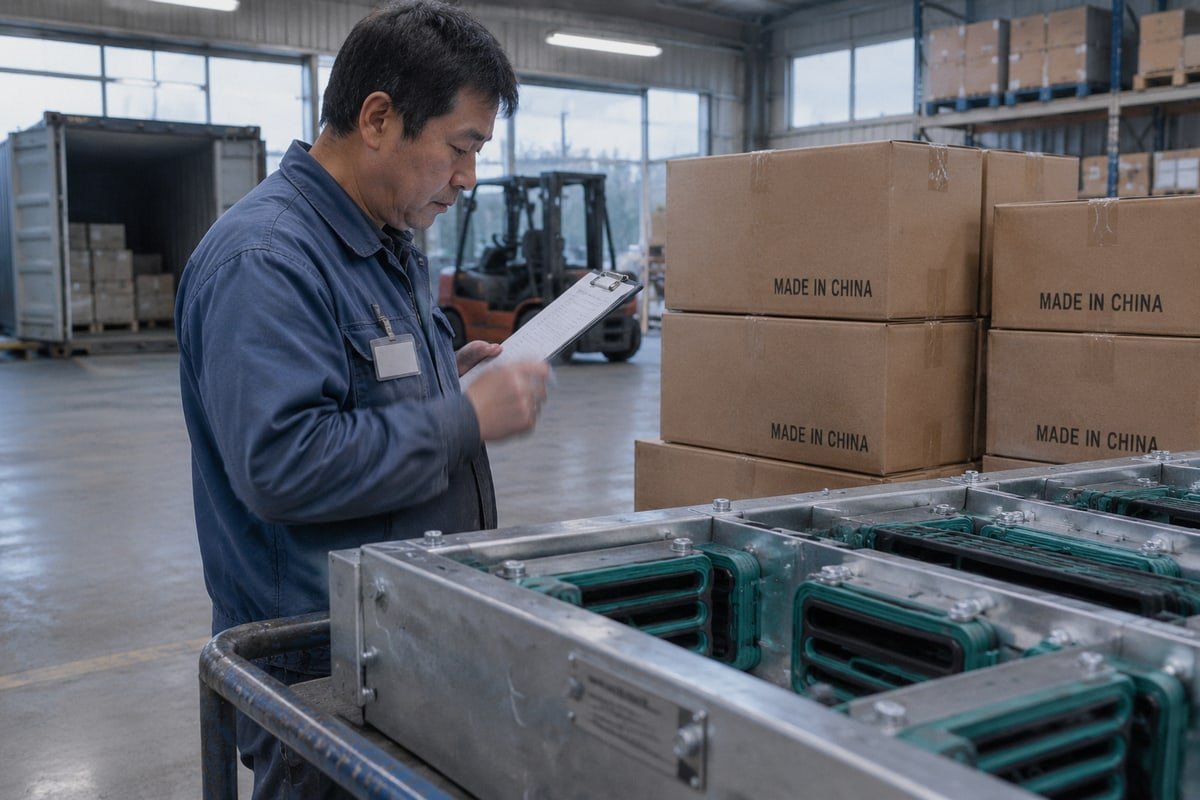
Country-of-origin marking for multi cable transit products from China trips up more shipments than sealing failures do IATF 16949 1. One wrong label on our frames, and your container waits at the port.
Label country-of-origin marking for multi cable transit products from China with the exact English words Made in China, placed permanently on the frame nameplate and molded into sealing modules, repeated on the immediate carton, and matched word-for-word on the commercial invoice, packing list, and Certificate of Origin.
That is the short answer. The longer answer depends on how customs treats a modular cable sealing system, which part counts as the article, and where the shipment is going. I will walk through each of those points below, using the frames and modules we build every day as the working example.
What Country-of-Origin Marking Requirements Apply to MCT Products I Import from China?
A container of our TSC modules once waited at a European port because the carton read Made in PRC while the invoice said China. We standardized every label afterward.
MCT products imported from China must carry a conspicuous, legible, permanent and indelible marking showing the English country name, typically Made in China. Origin follows the substantial transformation rule, the importer of record holds legal liability, and product, carton, and documents must state the same origin.
The starting point is not the label. It is the customs decision about where the goods come from. Only after that decision do you pick the wording and the location.
How origin is decided for a cable transit system
China's customs framework ties origin to one of two tests. Either the goods are wholly obtained in China, or China is the place where the last substantial transformation happened. The same decree defines origin marking as the words or figures placed on the goods or their packaging to show that origin.
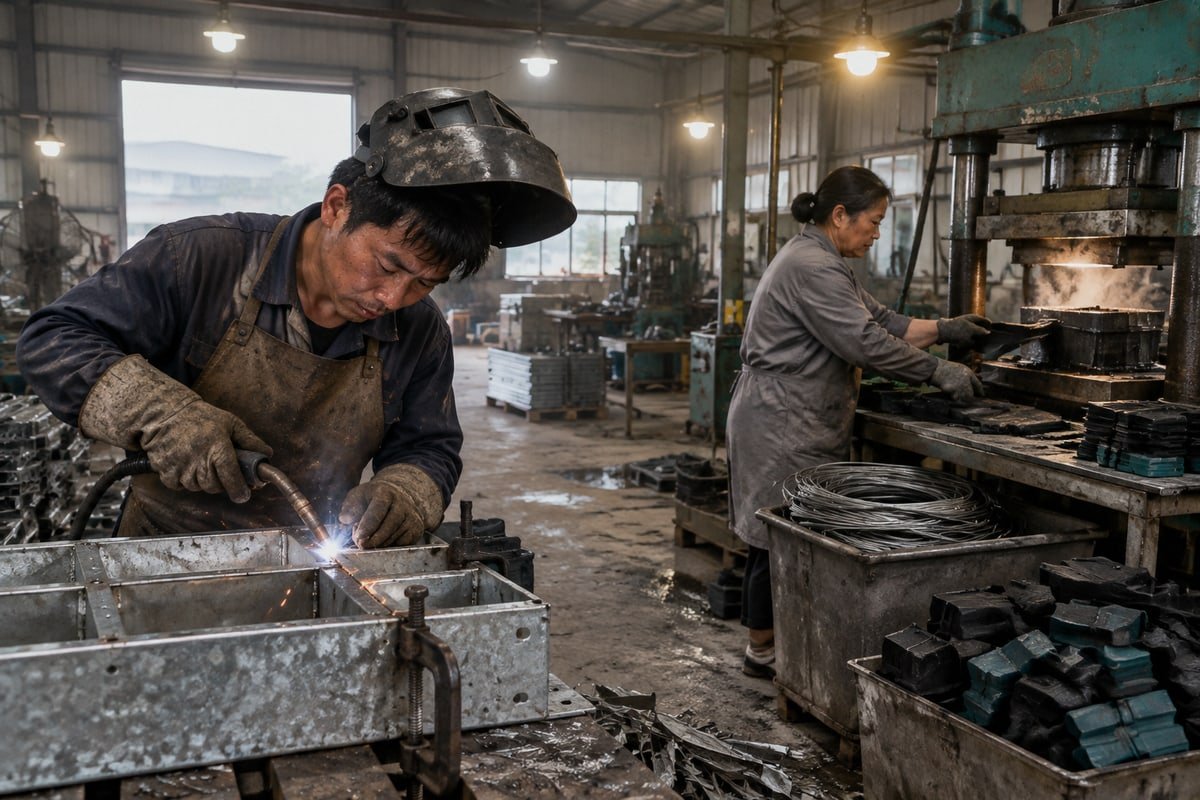
For our products the answer is simple. The frames are cut and welded in our Shandong plant from Chinese steel. The step-core, halogen-free EPDM modules are molded in Shaanxi from compound we source domestically. Both tests point to China. Even if a supplier imports a bolt or a raw rubber compound, welding a frame or molding a module is a substantial transformation. So the finished article is still Chinese origin. Importers sometimes assume the opposite, and that assumption is a common source of trouble.
What the marking itself must satisfy
The strictest published rules come from US Customs and Border Protection 2 under 19 CFR 134. Even if you sell into Europe or the Gulf, these rules are a useful benchmark because they are explicit.
| Requirement | What it means for an MCT frame or module |
|---|---|
| Conspicuous | An inspector or installer can read it without removing bolts, cables, or modules |
| Legible | Clear letters at a size that survives paint, dust, and grease |
| Permanent and indelible marking | Stamped, engraved, or molded in; not a paper sticker that peels |
| English country name | Made in China; bilingual labels allowed if English is equally prominent |
| Accepted wording | China, People's Republic of China, or The People's Republic of China |
| Risky wording | Made in PRC; CBP has rejected the abbreviation for industrial hardware |
| Liability | The importer of record, not the Chinese supplier, faces a 10% marking duty and detention |
Origin also drives duty. Your Harmonized System codes 3 set the base rate, and the origin decides whether Section 301 tariffs apply on top. A wrong origin statement is therefore a duty error, not just a labeling error. That is why I treat import compliance regulations as the first filter and branding as the second.
Where Should the "Made in China" Label Be Placed on Cable Transit Frames and Sealing Modules?
Every nameplate we design forces a trade-off. A larger origin stamp is easier for inspectors to read, but it competes with your private-label branding and the A-60 fire rating data.
Place Made in China on the frame nameplate between the compression bolts, mold it into each EPDM sealing module, and print it on the immediate carton. Small parts like stay plates and lubricant may rely on the container marking exception if their end-user box is clearly labeled.
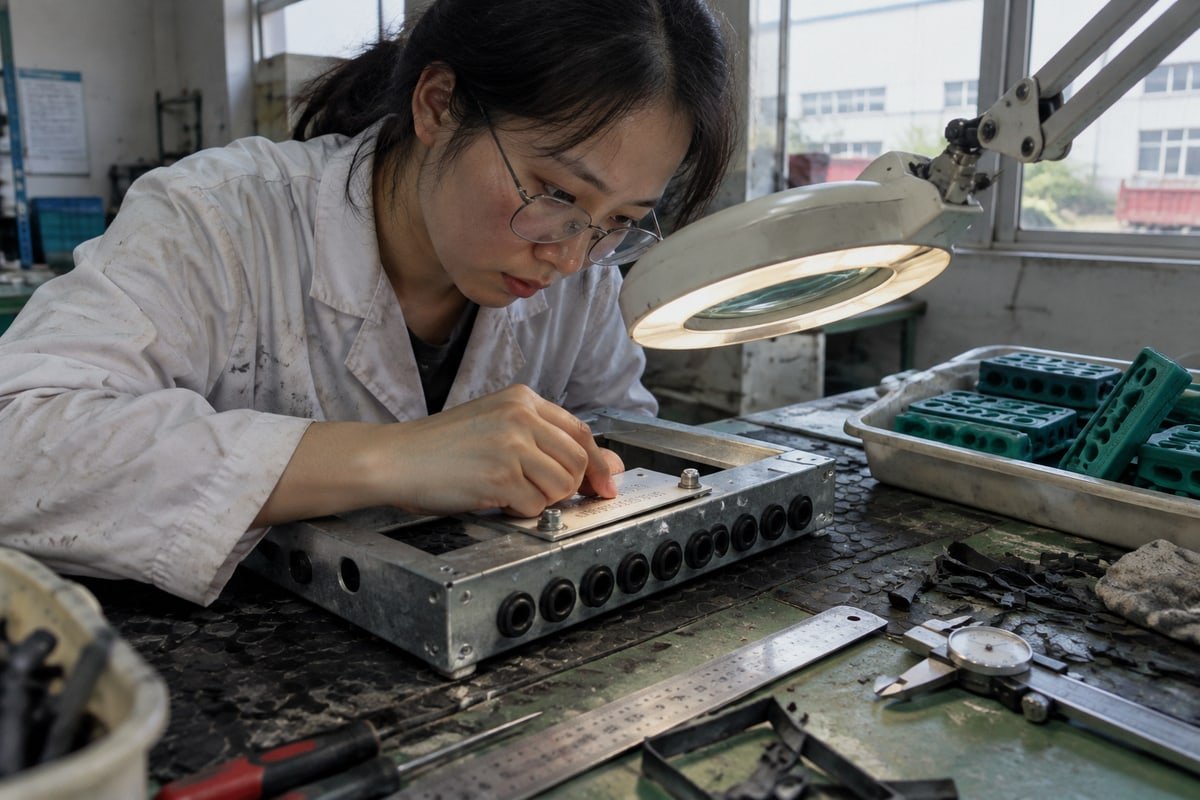
Buyers often push back here. They tell me the carton already says Made in China, so why mark the frame? I understand the logic. Direct marking costs tooling time. But the carton is thrown away on site. The frame stays in a bulkhead for twenty years, and the module gets replaced as a spare part. Customs looks at what reaches the ultimate purchaser. For a frame, that is the frame itself.
Component-by-component placement
In a modular cable sealing system the frame is legally the article. The modules, stay plates, and compression unit are components when shipped inside a complete kit. The picture changes when the same modules ship as spares.
| Component | Marking method | Location | Notes |
|---|---|---|---|
| Galvanized frame | Die-stamped or laser-engraved nameplate | Between the two compression bolts, facing outward | Readable after cables are installed |
| EPDM sealing module | Molded-in lettering from the mold cavity | Flat outer face, beside the concentric grommet rings | Survives compression and heat cycling |
| Compression unit | Stamped on the steel body | Top face | Visible when the frame is closed |
| Stay plates | Container marking exception | Immediate box | Box must reach the end user labeled |
| Lubricant tubes | Printed on tube and on box | Both | Low cost, so mark both |
| Spare modules sold separately | Molded-in mark plus labeled bag or box | Product and packaging | Include batch number |
Why the method matters as much as the place
Ink does not last on hot-dip galvanized steel. We tested printed marks on frames destined for offshore switchgear rooms, and salt-spray exposure lifted them. That fails the indelible test in 19 CFR 134. So we stamp. For rubber, we cut the lettering into the mold. Because we make molds in-house, adding Made in China and a batch cavity to a custom module size costs almost nothing extra. That batch number also helps you. During a customs audit you can link a physical module to a specific entry, duty payment, or Section 301 exclusion claim.
Branding versus compliance
Private-label customers want their logo on the nameplate. That is fine. Your brand can sit at the top, the fire rating and IP68 data in the middle, and Made in China at the bottom. Origin is a customs fact. Branding is a design choice. Both fit on one plate if you plan the layout early and review the artwork before we cut the die.
What Origin Documentation Should I Request from My MCT Supplier for Customs Clearance?
A sourcing manager in Germany recently asked me for three things before his first order: the Certificate of Origin format, a sample commercial invoice, and our BV factory approval.
Request a chamber-issued Certificate of Origin, a commercial invoice stating Made in China per line item with Harmonized System codes, a matching packing list, a signed supplier origin declaration, and photos of the actual product and shipping container marking before the goods leave the factory.
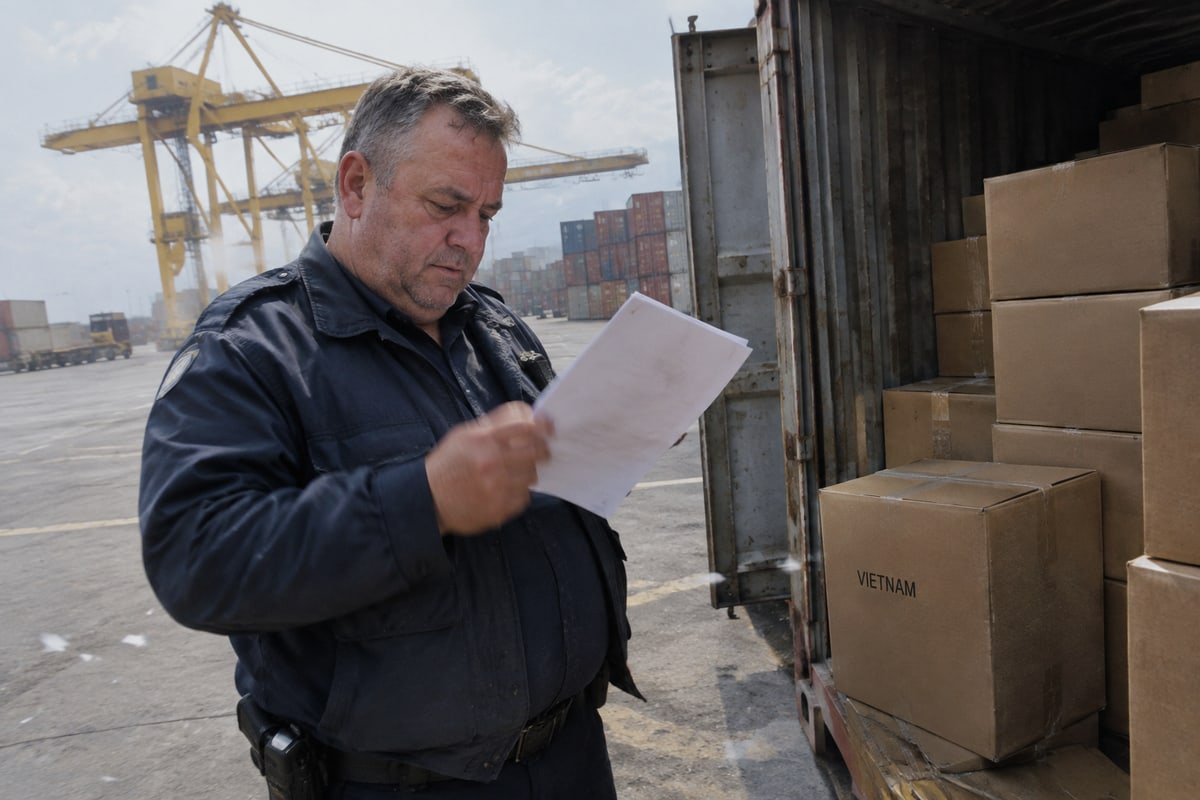
Documents fail for one reason more than any other: they do not agree with each other or with the goods. A broker compares the invoice, the packing list, the Certificate of Origin, and the carton. If one says PRC, one says China, and one says nothing, the entry stops. Here is the order in which I recommend you request the paperwork.
A five-step documentation sequence
- Before order confirmation: ask for a signed supplier declaration of origin. It should name the factory address where transformation occurs. Ours lists Shaanxi for molded modules and Shandong or Hunan for frames.
- At artwork approval: request nameplate drawings and carton label proofs. Confirm the wording is Made in China on every item.
- Before shipment: request the draft commercial invoice and packing list. Check that each line carries the same origin statement and the same HS code.
- At loading: request photos of the marked frames, molded modules, inner boxes, and outer cartons. These are your evidence if the shipment is inspected.
- After shipment: receive the original Certificate of Origin. For Gulf destinations, confirm chamber attestation and any embassy legalization your customer requires.
Which document does what
| Document | Issued by | Purpose | Common error |
|---|---|---|---|
| Certificate of Origin | China Council for the Promotion of International Trade or China Customs | Formal proof of non-preferential or preferential origin | Consignee name does not match the invoice |
| Commercial invoice | Supplier | Value, description, HS code, origin per line | Origin stated once in the footer only |
| Packing list | Supplier | Carton count, weights, shipping marks | Carton marks missing origin |
| Supplier origin declaration | Supplier | Confirms where substantial transformation occurred | Signed by a trading company, not the factory |
| Marking photos | Supplier QC | Proves physical marking before export | Photos of samples, not the production lot |
Commercial invoice requirements deserve one more note. Customs wants the origin on each line, not just at the bottom. If you ever bundle our Chinese modules with frames from another country, the carton and the invoice must itemize Contents Made in each country. A single Made in China on a mixed kit is a commingling problem.
Finally, keep origin papers separate from performance papers. Our ISO 9001 4 and IATF 16949 certificates, the BV factory approval, and the A-0/A-60, IP68, and 0.01–0.4 MPa test reports prove quality. They do not prove origin. Buyers who file them as origin evidence get asked for the Certificate of Origin anyway. Request both sets, but know which question each one answers.
Do Country-of-Origin Marking Rules Differ Between the EU, Middle East, and Asia-Pacific Markets?
Shipping the same TSR assemblies to Rotterdam, Dubai, and Singapore taught us one lesson: the origin is identical, but the label rules and paperwork around it are not.
Yes. The EU has no general mandatory origin mark for industrial goods but forbids misleading claims; Middle East markets often demand legalized Certificates of Origin and Arabic-English labels; Asia-Pacific rules vary by country. A permanent English Made in China mark satisfies all three baselines.
The good news is that a correctly marked frame from our line does not need to change between markets. What changes is the paperwork, the language on the carton, and how strictly the authority polices misleading claims.
| Market | Physical origin mark on industrial goods | Documentation emphasis | Watch out for |
|---|---|---|---|
| European Union | Not mandatory for most industrial goods; misleading origin claims prohibited | Non-preferential origin under the Union Customs Code; Certificate of Origin on request | Buyers or end customers requiring marking by contract |
| Middle East (GCC) | Expected by most buyers and inspectors | Chamber-attested and often embassy-legalized Certificate of Origin | Arabic alongside English on cartons and labels |
| Asia-Pacific | Varies by country; misleading marks prohibited under consumer and trade law | Preferential certificates under regional trade agreements where applicable | Different HS interpretations for firestop transit systems |
| United States (reference) | Mandatory, permanent, English | CBP entry documents; FTC labeling guidelines police secondary claims | 10% marking duty; Section 301 tariffs |
European Union
The EU has debated a mandatory origin mark for industrial goods for years. The proposals share one idea: where a mark is required, it must be legible, indelible, visible in normal handling, and not misleading. Today, for a cable transit frame, no horizontal EU law 5 forces the Made in China mark. But two things still make it wise. First, a false or vague origin claim can breach unfair commercial practice rules. Second, most of our European OEM customers write the marking into their purchase specification because their own end customers ask for it. One more point: CE marking is a conformity mark, not an origin mark. It says nothing about where the frame was made.
Middle East
Gulf projects are document-heavy. Our EPC customers in the region routinely ask for the Certificate of Origin to be attested by the chamber and then legalized by the destination embassy in China. Cartons often need Arabic and English. The physical mark on the frame stays Made in China in English, and we add the Arabic line on the shipping container marking and inner labels rather than on the nameplate, so the English country name remains prominent.
Asia-Pacific
Here the rules are the least uniform. Australia treats a misleading origin claim as a consumer-law issue. Several Southeast Asian countries accept preferential Certificates of Origin under regional agreements, which can lower duty on modular cable sealing systems. Classification also shifts; some authorities treat a full MCT kit as an electrical fitting, others as an article of the frame material. Confirm the Harmonized System codes with your broker before we print the invoice.
One label, many markets
My practical rule is to mark for the strictest market and document for the destination market. A stamped English Made in China on the frame and molded lettering on the module satisfy the US, the EU, the Gulf, and Asia-Pacific alike. Then we adjust the paperwork and carton language for the port of entry.
Fazit
Wrong origin labels stall shipments and invite marking duties. Mark Made in China permanently, match every document, and ask us for validation samples and origin paperwork before you order.
Fußnoten
1. Official portal for the IATF 16949 standard, ensuring quality in the automotive supply chain. ↩︎
2. Official US government resource for trade rules and country of origin marking requirements. ↩︎
3. Official World Customs Organization page for the Harmonized System used to classify traded products. ↩︎
4. Official site for the ISO 9001 standard, governing international quality management systems. ↩︎
5. Official European Commission site for customs regulations and trade policy within the European Union. ↩︎

 English
  Español de México
  Deutsch
  Français
  العربية
  Русский