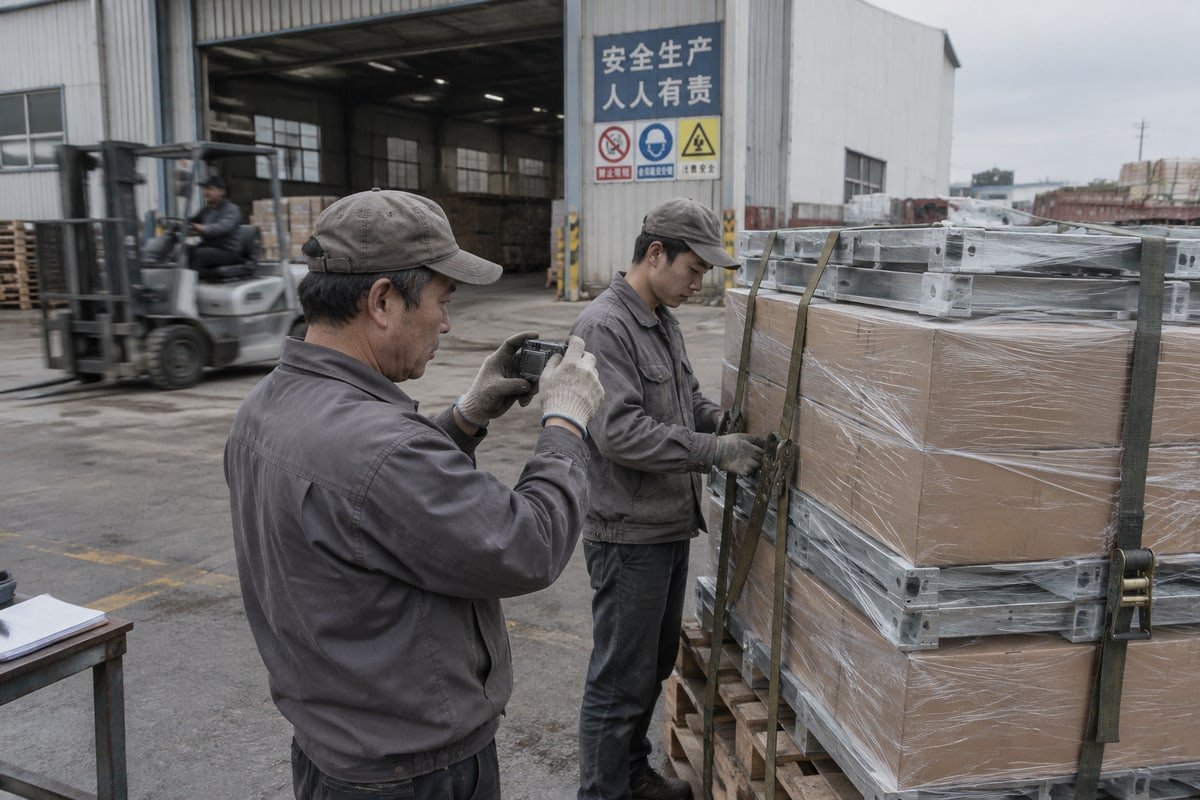
One of our TSC module pallets once arrived with a crushed corner, and the claim stalled for weeks. That taught us how to insure a multi cable transit shipment properly.
To insure a multi cable transit shipment, buy all-risk cargo insurance for the full invoice value before pickup, photograph packing at loading, inspect on delivery, note damage on the proof of delivery, notify the carrier within 48 hours, and file with bill of lading, invoice, packing list, and photos.
That is the short version. The rest of this guide walks through each step in order. I will cover which policy to choose, how to document damage, what packaging to demand from your supplier, and which papers your factory must hand over so the insurer actually pays.
What insurance coverage should I choose when shipping MCT sealing modules internationally?
A sourcing manager in Germany once asked us whether carrier liability 1 alone was enough for two pallets of TSC modules. We ran the numbers with her before quoting.
Choose an all-risk marine cargo insurance policy covering the full commercial invoice value of the MCT sealing modules, door to door, valid for the entire transit window. Carrier liability is capped per kilogram and rarely covers replacement cost, custom molds, or project delay exposure.

The choice comes down to one question. If the shipment is lost or crushed, who pays, and how much? Carrier liability and a cargo insurance policy answer that question very differently.
Carrier liability versus a cargo insurance policy
| Factor | Carrier liability | All-risk cargo insurance |
|---|---|---|
| Payout basis | Weight-based cap set by the carrier or convention | Full commercial invoice value you declare |
| Cover for a frame set with modules and compression units | A fraction of the steel and EPDM replacement cost | Replacement cost, often plus freight and duty |
| Burden of proof | You must show the carrier was at fault | You show the loss happened during insured transit |
| Who arranges it | Automatic with the freight contract | Shipper, consignee, forwarder, or broker |
| Deductible | None, but recovery is small | Often applies; one LTL shipper policy lists a $500 minimum |
Some buyers tell us carrier liability is enough. For a single carton of spare EPDM sealing modules 2, that is a fair position. The goods are cheap to replace and we can ship spares fast. But a full multi cable transit shipment for a BESS container line is different. The frames have project-specific cutouts. The delivery date is tied to a container build slot. A weight-based payout will not cover a re-run of the order, let alone the delay. In that case, all-risk cover is the cleaner path.
Who buys the cover under your Incoterms
Incoterms decide who carries the transit risk, and that decides who should insure. Under FCA or FOB, risk passes to you at pickup or at the port, so you arrange cover. Under CIF, we as seller must insure, but only to a minimum clause level. Under CIP, Incoterms 2020 3 raised the required cover to the all-risk level. Under DAP or DDP, we carry the risk to your door, so we insure. Check the term on the pro forma before you assume anyone has bought a policy.
Broker, platform, or direct
Digital shipping platforms let you add insurance at order creation, and that works well for repeat parcels of modular cable seals. Two rules apply. The insured amount must equal the full declared amount, and multi-package shipments may need each package insured on its own. For mixed pallets of frames, stay plates, and modules, a broker or forwarder usually tailors the policy better and supports the claim later. Whichever route you take, confirm the policy period covers the actual transit window, including any dwell time in a bonded warehouse.
How do I properly document cable transit frame damage before filing a claim?
Our QC team photographs every compression unit and stay plate before the crate lid goes on. That habit started after a claim died for lack of before pictures.
Document cable transit frame damage by photographing the sealed container or trailer before unloading, then the crate, then each frame in place. Note every defect on the proof of delivery before signing, keep damaged frames separate, and report concealed damage within 3 to 15 days.

Most claims are won or lost in the first hour at the receiving dock. The insurer wants proof that the damage existed at handover, not after your team moved the goods. Follow this sequence and keep the evidence chain unbroken.
The six-step delivery inspection
- Inspect before you unload. Photograph the container seal, door condition, and any water marks or shifted load while everything is still in place.
- Do a joint inspection with the driver. Walk the pallets together. A clean proof of delivery is very hard to argue against later.
- Write exceptions on the POD. State the number of damaged items and the type of damage. "Two frames bent, crate wet" is enough. Never sign "received in good order" if you have doubts.
- Stop and preserve. Leave damaged crates where they are until photos are done. Keep the packaging, the desiccant bags, and any wet cardboard.
- Separate and mitigate. Move damaged frames away from sound stock. Get a repair or replacement quotation early. Insurers can deny claims when the policyholder lets the loss grow.
- Issue an inspection report. One page, dated, signed, with photo references. This becomes the storekeeper's report the insurer will request.
Damage you cannot see from the outside
Cable transit frames and compression units carry certified performance, not just shape. On our TSC frames, even minor warping changes how the EPDM modules compress, and that can void the A-0/A-60 fire rating and the IP68 seal we test against. Firestop transit systems that arrive out of square should be claimed as loss of certified performance, not as cosmetic damage. Ask for a functional torque check on compression bolts and wedge units during assessment. Internal fractures in these parts are often invisible but break the pressure-tight seal. Also count individual sealing modules per diameter rather than trusting pallet weight. Losing one box of a specific step-core size can stall a whole switchgear panel run.
Reporting windows you must not miss
| Event | Typical window | Why it matters |
|---|---|---|
| Notify the carrier of visible damage | Within 48 hours of delivery | Late notice weakens the presumption that damage occurred in transit |
| Concealed damage claim | 3 to 15 days after receipt | After this, the carrier argues the damage happened in your warehouse |
| Formal written claim, domestic road freight | Up to 9 months | Statutory limit in many jurisdictions |
| Formal written claim, international sea freight | Shorter, often measured in days to a few months | Convention-based limits are stricter |
| Any claim under the policy | Within the policy period | Claims outside the policy period will not be considered |
What packaging standards should I request from my MCT supplier to reduce transit risk?
Every extra millimetre of crate timber costs freight volume, yet every skipped stay plate separator risks a warped frame. We weigh that trade-off on each export order.
Request export-grade plywood crates or heat-treated pallets, frames strapped flat with corner protection, EPDM modules boxed in sealed polyethylene with desiccant, compression units and bolts bagged and counted per frame, a packing list by item, and dated loading photos from the factory floor.

Insurers are blunt about this. Suitable packaging is a condition of cover, and a claim can be cut or refused if the goods were not packed for the journey. So packaging is part of transit risk management, not a cost line to squeeze. Below is what we recommend buyers write into the purchase order, and why each item matters for MCT components specifically.
Packaging specification by component
| Component | Main transit risk | What to request |
|---|---|---|
| Galvanized transit frames (TSC, 120-frame compatible) | Bending, weld seam impact, scratched zinc layer | Strapped flat on a rigid base, corner protectors, no stacking of loose frames |
| Round sealing assemblies (TSR series) | Crushing, thread damage | Individual cartons, threads capped, cartons nested in a crate |
| EPDM step-core modules | Moisture, ozone, oil contamination, deformation under weight | Sealed polyethylene liner, desiccant, boxes never bottom-loaded under steel |
| Compression units, wedges, bolts | Loss, mixing between frame sets | Bagged and labelled per frame, count stated on packing list |
| Stay plates and spares | Bent edges | Bundled with edge boards inside the frame crate |
| Nameplates and test documents | Separation from goods | Document pouch fixed inside the crate lid, plus digital copy by email |
Standards to name in the order
Ask for ISPM 15 heat-treated timber 4 so the crate is not held or destroyed at customs. Ask for a packing list that lists each module size and quantity, not just gross weight. Ask for humidity indicator cards in any crate that moves by sea. And ask for photos of the open crate, the closed crate, and the loaded container, all with a visible date. Our export desk sends this photo set with the shipping advice as standard practice, because those images are the "before" evidence in every claim.
Where the trade-off lands
Heavier crating raises volumetric freight cost. Lighter crating raises claim risk. Our rule of thumb is simple. Steel frames and compression units get a rigid crate. Spare modular cable seals shipped alone can travel in double-wall cartons on a pallet. If your order mixes both, put the frames in the crate and stack the module cartons beside them, never underneath. That single layout choice removes most of the crushing damage we have seen on inbound claims.
Which documents does my factory need to provide for a successful freight damage claim?
We learned the hard way that a claim bill without a matching packing list goes nowhere. Now our export desk prepares the full freight claim documentation set in advance.
Your factory should provide the commercial invoice, itemized packing list, original bill of lading or air waybill, certificate of origin, pre-shipment loading photos, test and certification documents proving pre-transit condition, a repair or replacement quotation, and an authorization letter if it claims on your behalf.

Most insurers will not open a file until every required document is on the table. Incomplete paperwork does not just slow payment. It can push the claim past the reporting window and kill it. The list below splits the burden between the factory, the consignee, and the carrier so nothing falls between the chairs.
Who provides what
| Document | Provided by | Purpose in the claim |
|---|---|---|
| Commercial invoice | Factory | Establishes insured value per line |
| Itemized packing list | Factory | Proves quantity per module size and frame type |
| Bill of lading, air waybill, or CMR note | Carrier via factory or forwarder | Proves the goods entered transit and under what terms |
| Pre-shipment loading photos | Factory | Proves condition before handover |
| Test certificates and factory QC record | Factory | Proves the frame met A-0/A-60, IP68, and 0.01–0.4 MPa seal performance before shipping |
| Repair or replacement quotation | Factory | Quantifies the loss and shows mitigation |
| Authorization letter | Factory or consignee | Needed when a supplier acts on the consignee's behalf |
| Proof of delivery with exceptions | Consignee | Proves damage was noted at handover |
| Inspection or storekeeper's report | Consignee | Formal record of the damage found |
| Formal complaint letter to carrier | Consignee | Preserves recourse rights against the responsible party |
| Claim bill and insurer claim form | Consignee | Opens the file and states the amount claimed |
| Delivery order or delivery list | Carrier or terminal | Confirms release from the port |
Marine and offshore projects need one more step
For vessel and offshore deliveries, replacement parts must be traceable. The IACS unified requirement UR Z28 calls for a Cable Transit Seal Systems Register on board. When a damaged frame or module set is replaced under a claim, log the replacement part numbers, batch, and certificates into that register and into the construction file. Otherwise the next class survey finds hardware that does not match the record. We supply the certificates and drawings for this on request, because a paid claim is worthless if the installed system fails an audit later.
Why claims still fail with all the documents present
Three reasons come up again and again. First, the values on the invoice, packing list, and claim bill do not match, usually because a partial shipment was invoiced differently. Second, the photos have no date or no packaging in frame, so the insurer cannot tie them to the shipment. Third, the claim arrived after the policy period ended. Fix all three before you submit. We keep a single shared folder per multi cable transit shipment with every document above, so the consignee can download the set on the day the damage is found.
Conclusion
Transit damage to modular cable seals is cheap to prevent and expensive to argue about. Insure for full value, photograph everything, note the POD, and file complete papers fast.
Footnotes
1. U.S. government resource explaining cargo insurance requirements and carrier liability for transported goods. ↩︎
2. Technical overview of EPDM rubber, the primary material used in high-performance cable transit sealing modules. ↩︎
3. Official ICC rules defining the responsibilities of buyers and sellers in international trade. ↩︎
4. International standard for wood packaging to prevent the spread of pests during global shipping. ↩︎



 English
  Español de México
  Deutsch
  Français
  العربية
  Русский