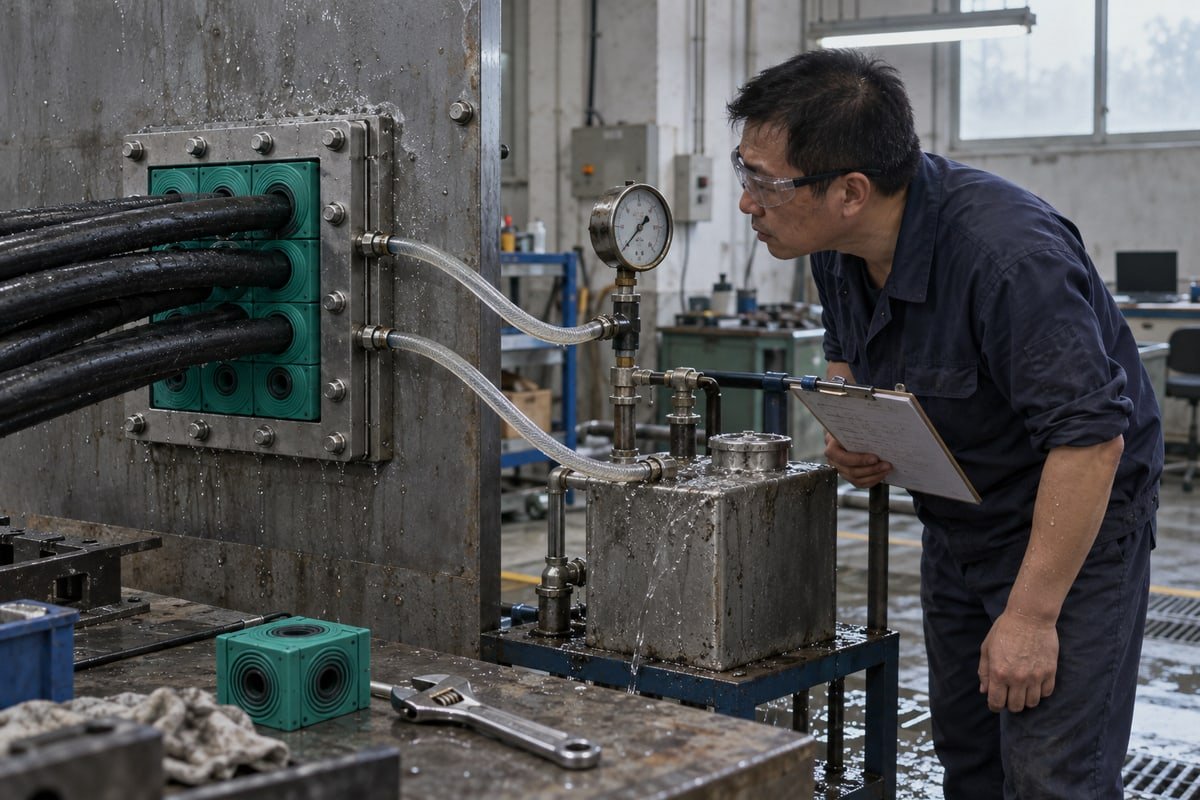
A multi cable transit’s rated water and air pressure sealing looks simple on paper IATF 16949 1. Then a flooded BESS container proves otherwise. Our Shaanxi test bench exists to prevent that.
Verify a multi cable transit’s rated water and air pressure sealing by requesting the type approval certificate and independent test report, confirming the tested configuration matches your installed frame, cable fill, and wall thickness, then running a hydrostatic and pneumatic decay test on a validation sample.
That answer has three parts. Documents first. Configuration match second. A physical test third. I will walk through each one below, and I will show you the exact questions we get asked by European sourcing teams, because those questions are usually the right ones.
How can I confirm a supplier's MPa rating actually matches independent test lab results?
A sourcing engineer in Germany once emailed me our 0.4 MPa figure with a single question: tested by whom, at what fill? Fair question. Here is how I answered.
Confirm an MPa rating by matching the supplier's number to the pressure, medium, hold time, and assembly listed on the independent test report. If the report's frame size, module set, and cable fill differ from your build, the rating does not transfer, whatever the brochure says.

The first thing I told that engineer is that "rated" is not a generic word. A modular cable seal is a system. The frame, the modules, the stay plates 2, the compression unit, and the cable fill all decide the result together. Change one part and you have a different assembly. So the verification question is not "does the brochure say 3 bar?" It is "was my exact assembly tested to 3 bar under my conditions?"
Convert the units before you compare anything
Our test documents state watertight and gas-tight sealing from 0.01 to 0.4 MPa. A European datasheet may quote the same physics in bar. A US spec may use psi. I always convert first, because a bar pressure rating and an MPa figure can look very different when they are actually close.
| MPa | bar | psi (approx.) | Where you typically see this level |
|---|---|---|---|
| 0.01 | 0.1 | 1.45 | Low-pressure air leak check on a finished install |
| 0.10 | 1 | 14.5 | Common gas-tightness level on many MCT certificates |
| 0.25 | 2.5 | 36 | Frequent water-tightness claim for standard frames |
| 0.30 | 3 | 43.5 | Gas-tight level quoted for some offshore systems |
| 0.40 | 4 | 58 | Upper end of our tested watertight and gas-tight range |
| 0.60 | 6 | 87 | Highest hydrostatic figures I have seen in type tests |
Across the industry, published water ratings run from about 2.5 bar up to 6 bar, and gas ratings from 1 bar to 3 bar. Some offshore systems quote 4.5 bar water and 3 bar gas. That spread tells you something important. "Multi cable transit" is a family of products with different design limits, not one standard pressure level.
Water and gas are two separate lines on the report
A hydrostatic pressure test pushes water against the seal. A pneumatic test pushes air or nitrogen. Air finds paths that water cannot, because the molecules are smaller and the viscosity is lower. In practice, gas-tightness certification 3 is the harder exam. So when a supplier gives you one number, ask which medium it applies to. If the report only shows water, you do not have a gas rating. You have an assumption.
The five details that must match
Here is the checklist I send back with every test report request:
- Frame type and depth, including whether it was a welded or bolted frame.
- Module set and fill pattern, including any spare or blank modules.
- Cable diameter range, and whether cables were solid-jacketed or armoured.
- Wall or bulkhead thickness the frame was fixed into.
- Test conditions: medium, hold time, submerged versus static setup, and whether the test was repeated after aging or after at least one year installed.
Some buyers push back here. They tell me the published rating should be enough, and that checking test scope is overkill for a rubber block. I understand the time pressure. But a certified rating is only valid for the tested geometry and method. A field build with two more cables, a missing filler piece, or a different frame depth is no longer the tested assembly. The certificate cannot cover what it never saw.
What test documents should I request before trusting an MCT's IP68 or watertight claims?
During an internal audit, our QC lead traced a TSC module batch record back to the test report it referenced. That traceability is exactly what you should demand.
Request five documents: a type approval certificate or type-examination certificate, an independent test report for water and gas tightness, an installation handbook showing the tested build-up, a pressure test declaration stating pressure, medium, and duration, and a configuration limits sheet covering cable range and frame depth.

I keep a standard document pack for each of our TSC square modules and TSR round seals. When a buyer asks for "the certificate", I send the pack and I explain what each item does and does not prove. That explanation matters more than the PDF count.
What each document actually proves
| Document | What it proves | What I would check first |
|---|---|---|
| Type approval certificate (DNV, Lloyd's Register, ABS, or BV) | A class body reviewed the design against its rules, often aligned with DNV GL standards for marine and offshore use | Product series named, expiry date, and the configuration scope line |
| Independent test report | Actual hydrostatic and pneumatic results from a lab | Pressure, hold time, medium, pass criteria, and whether the lab is accredited |
| Installation handbook | The build-up that was tested | Torque values, fill pattern, stay plate spacing, curing or settling time |
| Pressure test declaration | The supplier's own statement of the test envelope | It should say MPa or bar, medium, and duration, not just "watertight" |
| Configuration limits sheet | The boundaries of the rating | Cable diameter range per module, maximum cable count, frame depth |
| IP68 ingress protection report | Dust-tight and continuous immersion performance | The immersion depth and duration, because IP68 conditions are manufacturer-defined |
IP68 is not the same thing as a bar rating
This confuses a lot of good engineers. IP68 ingress protection means dust-tight plus continuous immersion under conditions the manufacturer specifies. It is a standardised exposure test. A bar or MPa rating describes resistance to a pressure differential across the seal. Both can be true for the same transit. Our modules carry IP68 and a separate 0.01 to 0.4 MPa watertight and gas-tight range. But an IP66 splash rating on its own tells you nothing about sustained pressure. A submerged claim is stronger than a hose-down claim. Read which one you are being shown.
Quality system certificates prove process, not pressure
I want to be honest about our own paperwork. Our ISO 9001 4 and IATF 16949 systems and our BV factory approval prove that we make the same product the same way every batch. They do not prove that any batch holds 4 bar. Only a product-level test report does that. Some suppliers wave a factory approval as if it were a product certificate. Ask for both, and read the scope line on each.
Can I validate sealing performance myself using free samples before committing to an order?
Free validation samples cost us money on every qualification. We still send them, because a sample tested on your bench settles arguments that a PDF never can.
Yes. Fit the free sample into a test frame with your real cable sizes, torque the compression unit to spec, wait 48 hours for the modules to settle, then run a hydrostatic pressure test to your required bar and a pneumatic decay test with calibrated gauges.

The most useful qualification I have seen a customer run was also the simplest. They took our cross-reference table, picked the DEWIN model that matched their existing part number, dropped it into their existing 120-frame cutout, and tested it beside the incumbent module on the same bench. Same frame, same cables, same gauge. That is a fair comparison, and it is the reason we make our modules dimensionally compatible with common 120-frame standards in the first place.
A seven-step bench procedure
- Pull the CAD or STEP file and confirm the module footprint matches your frame cutout before you cut anything.
- Peel the step-core layers of each module to match the cable diameter. Check that no layer is left half-peeled.
- Load the frame in the fill pattern shown in the handbook. Fill empty positions with blank modules. Never leave a gap.
- Fit the compression wedge system and tighten to the torque value or visual indicator the handbook gives. Uneven torque means uneven expansion.
- Inspect the face. Look for visible gaps or "smile" deformations between modules where a cable is oversized for its layer.
- Leave the assembly for 48 hours. EPDM modules keep settling after compression, and a test at hour one can pass while a test at hour 48 fails, or the reverse.
- Run the water test first, then the air test, and record both.
Which leak test method fits your case
| Method | Medium | What it catches | Limitation |
|---|---|---|---|
| Hydrostatic pressure test | Water | Watertight integrity at rated bar | Wets the frame; not sensitive to micro-leaks |
| Pneumatic decay test | Air or nitrogen | Pressure loss over a set time on calibrated gauges | Needs a sealed chamber on one side |
| Bubble emission | Air plus soap solution | Visible leak location | Misses very small paths |
| Ultrasonic leak detection | Air | High-frequency signatures of microscopic bypasses | Needs a trained operator and a quiet room |
| Vacuum decay | Vacuum | Seal integrity without stressing internals | Lower differential than a full pressure test |
One more thing I ask buyers to build into their bench plan. Cable jackets creep. XLPE and PVC contract during temperature cycling, and a seal that passed at room temperature can loosen after a cold-hot cycle. If your container will see wide swings, cycle the sample before the final test, and plan a secondary compression check in your installation inspection checklist. Some vendors now talk about IoT smart modules with embedded humidity and pressure sensors. I find the idea interesting for monitoring, but I would not let it replace the bench test.
Why do fire rating and gas-tight certification matter alongside pressure sealing specs?
Early in our export work, I learned that a transit passing 4 bar of water can still leak smoke. Fire, gas, and pressure are three different exams.
Fire rating and gas-tightness certification matter because they cover failure modes a water test cannot. A-0 and A-60 prove the seal holds back flame for 60 minutes, A-60 also limiting heat transfer, while gas-tightness proves it blocks smoke, fumes, and pressurised air through paths water never finds.
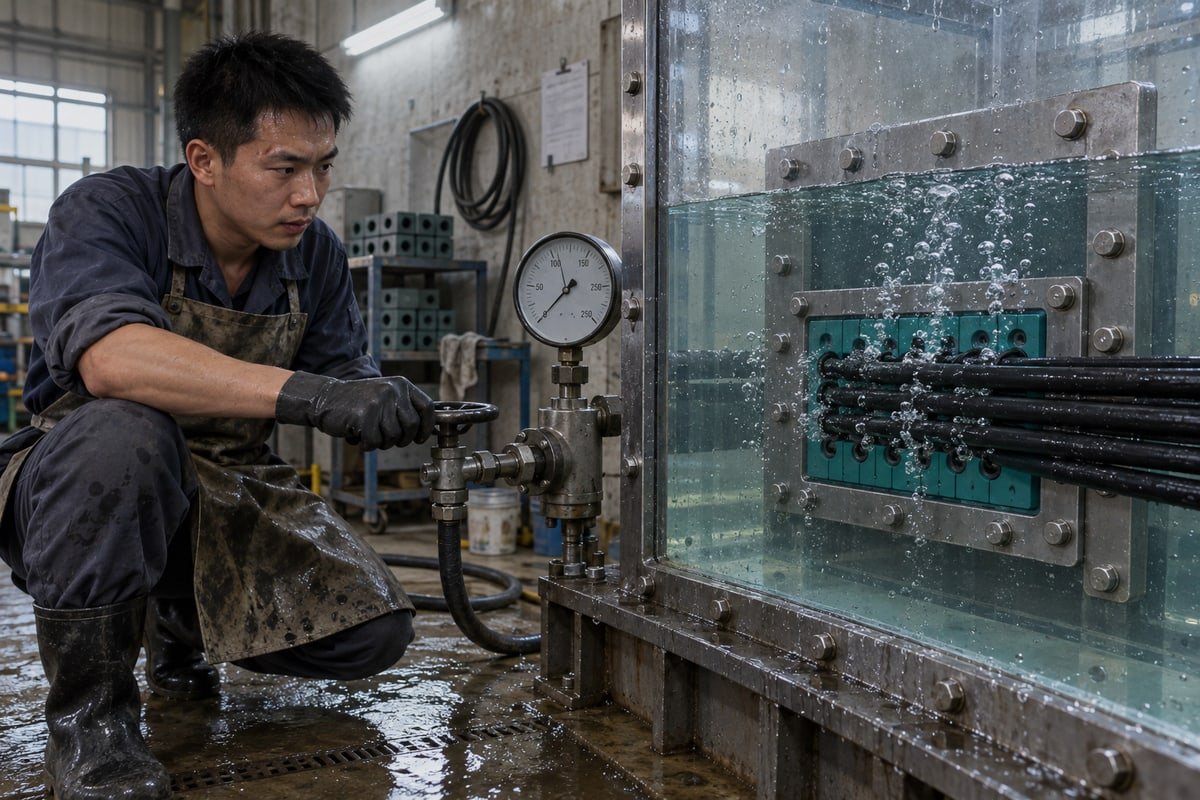
Most of the buyers I talk to now build battery energy storage containers 5, modular data centres, or switchgear enclosures. None of those are ships. Yet the same three questions apply to every one of them, and they are often decided by the same rubber block.
Three ratings, three failure modes
| Rating | What is tested | Failure mode it covers | Typical evidence |
|---|---|---|---|
| Fire rating A-0 / A-60 | Furnace exposure on one side, integrity for 60 minutes; A-60 also limits temperature rise on the cold side | Flame and heat passing between compartments | Fire test report and type approval certificate |
| Gas-tightness certification | Static air or nitrogen pressure held for a set time | Smoke, thermal runaway off-gas, pressurised air leaking through the transit | Pneumatic decay report stating bar and duration |
| Water pressure rating | Hydrostatic load on one side | Flooding, rain ingress, wash-down | Hydrostatic test report stating bar and duration |
| IP68 ingress protection | Dust chamber plus immersion at stated depth and time | Dust and water ingress under standard exposure | IP test report with immersion conditions |
Why one rating does not imply another
A fire test measures whether flame and hot gas cross the seal while the furnace runs. It does not measure whether the seal holds ambient air pressure on a normal day. Some fire-stop materials swell only when heated, so at room temperature they may not be gas-tight at all. The reverse is also true. A perfectly gas-tight EPDM module with no fire rating will soften and open a path under fire load.
This is why we test our modules for all three and issue the results together. Our TSC and TSR modules are halogen-free EPDM, which matters in a fire because halogenated rubber releases corrosive acid gases when it burns. In a data centre or switchgear room, that gas can do more damage than the flame.
What this means for your specification
For a BESS container, I would write the spec as one line covering all three: A-60 fire rating 6, gas-tight to a stated bar, and watertight to a stated bar, all on the same module series and all on the same tested build-up. If a thermal runaway event pressurises a compartment, the transit has to hold gas and heat at the same time. A supplier who can only show one of the three has not proven the product for that job. And if the evidence sits on three different product variants, you do not have a certified system. You have three brochures.
Conclusion
Ratings without matching test evidence are guesses. Guesses flood containers. Ask for the certificate, match the configuration, test the sample, and we will supply the documents.
Footnotes
1. International quality standard specifically for the automotive industry supply chain and manufacturing. ↩︎
2. Technical component of multi-cable transits used to maintain structural integrity and pressure sealing. ↩︎
3. Official verification process for sealing systems to prevent the passage of air or hazardous gases. ↩︎
4. Global standard for quality management systems ensuring consistent product manufacturing and quality. ↩︎
5. Industrial enclosures requiring specialized sealing for safety and environmental protection in energy grids. ↩︎
6. Standardized fire resistance classification for marine and offshore structural components. ↩︎


 English
  Español de México
  Deutsch
  Français
  العربية
  Русский