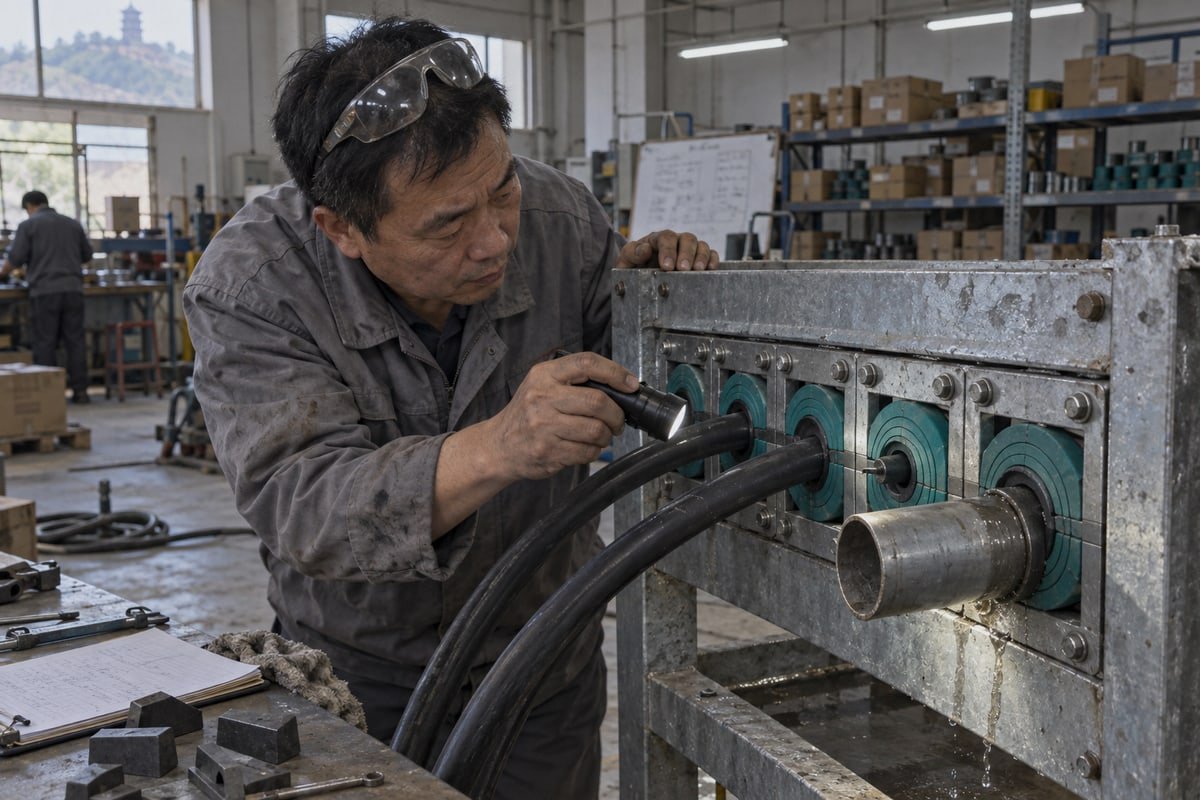
Los sistemas de tránsito multicable parecen idénticos en papel para cables y tuberías. Esa suposición está detrás de muchos sellos fallidos que diagnostican nuestros ingenieros de Shaanxi. Comprender la diferencia lo soluciona.
Los sistemas de tránsito de múltiples cables utilizan los mismos marcos, bloques de sellado modular y cuña de compresión para ambos servicios, pero las penetraciones de cable priorizan la densidad, la reentrada y la conexión a tierra EMC, mientras que las penetraciones de tubería deben manejar la expansión térmica, el peso de la tubería, diámetros rígidos más grandes y la certificación dedicada de fuego y presión.
A continuación, explico las cuatro preguntas que nuestros contactos de compras hacen con más frecuencia. Cubro la física del sellado, el hardware compartido, las brechas de certificación y un método de selección práctico para penetraciones mixtas. Cada sección termina con lo que se debe solicitar a cualquier proveedor, incluyéndonos a nosotros.
¿Cómo difiere el rendimiento de sellado entre las penetraciones de cable y tubería en los sistemas MCT?
Durante las pruebas de presión en nuestra planta de Shandong, un módulo TSC que soportaba 0,4 MPa alrededor de cables goteó alrededor de una tubería de acero del mismo diámetro. Mismo bloque, diferente trabajo.
Los sellos de cables comprimen las cubiertas flexibles, por lo que la pequeña variación de diámetro es absorbida y la integridad hermética al gas se logra fácilmente. Los sellos de tuberías presionan contra metal rígido, caliente o vibrante, por lo que la estanqueidad al agua depende de una coincidencia exacta del diámetro exterior, la tolerancia de movimiento y, para tuberías termoplásticas, módulos intumescentes que cierran el vacío en caso de incendio.
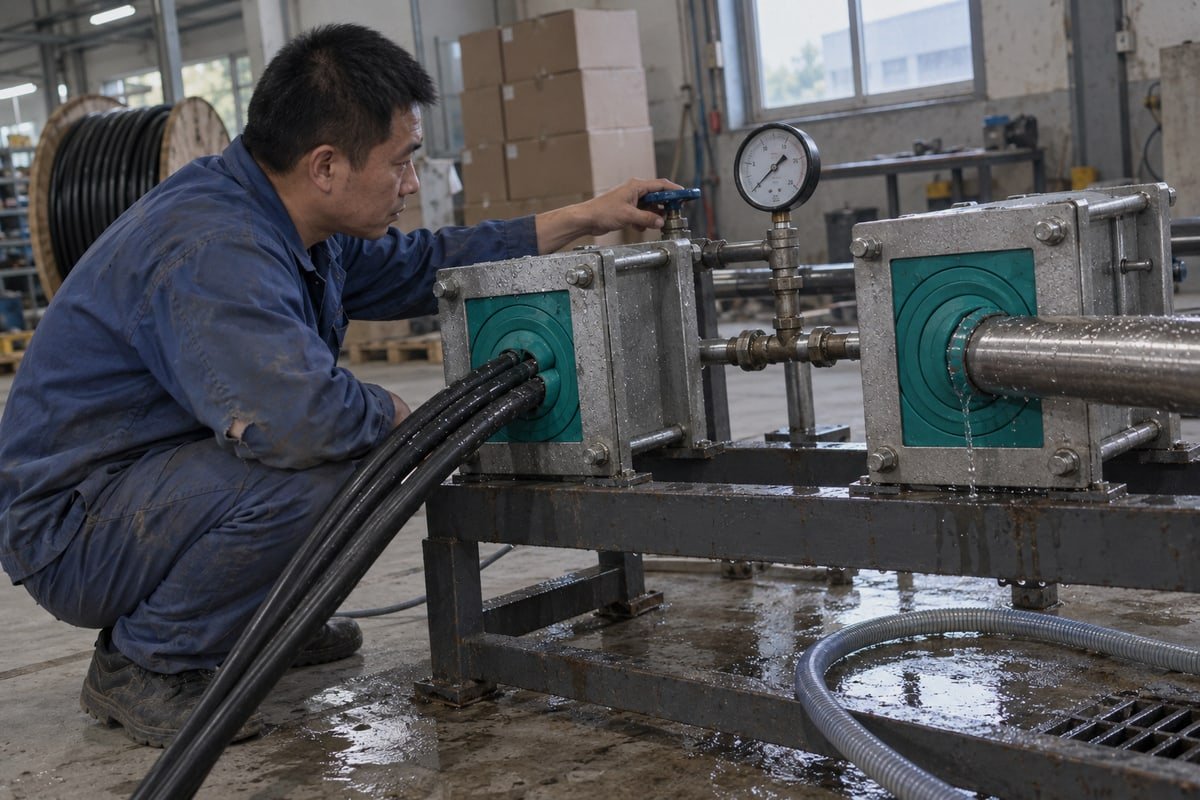
La lección de ese banco de pruebas fue simple. La goma estaba bien. La física cambió. Así es como se lo explico a los ingenieros de abastecimiento que leen las hojas de especificaciones antes de respondernos.
Contra qué presiona realmente el sello
Un cable tiene una cubierta de polímero flexible. Cuando la cuña de compresión se aprieta, nuestro módulo de EPDM libre de halógenos se deforma, y la cubierta también se deforma un poco. Dos superficies se mueven una hacia la otra. Por eso, un bloque TSC de núcleo escalonado cubre un rango de diámetros de cable dentro de un único tamaño de módulo. Se pelan capas para acercarse, y la compresión hace el resto.
Una tubería no coopera. Las paredes de acero, cobre e inoxidable son rígidas. Toda la deformación debe provenir de la goma. Si el paso de pelado deja un pequeño espacio, la goma tiene que llenarlo por completo. Por lo tanto, los bloques para tuberías necesitan una tolerancia de diámetro exterior más ajustada. En nuestra fábrica, a menudo cortamos un orificio dedicado con un molde interno en lugar de depender de capas pelables.
Movimiento, calor y peso
Tubería expansión térmica 1 es la segunda diferencia. Una línea de refrigerante o de agua caliente se expande y contrae a lo largo de su eje en cada ciclo. Los cables apenas se mueven. El sello debe mantener integridad hermética al gas 2 mientras la tubería se desliza a través de él. Eso es un problema de fricción y fatiga, no solo un problema de presión estática.
Las tuberías también soportan peso. Los cables suelen colgar de bandejas externas, por lo que el tránsito no soporta casi nada. Un tránsito de tuberías a menudo se convierte en un soporte secundario para la tubería y su fluido. Esa carga viaja a través de los módulos, las placas de sujeción y la soldadura del marco.
Comportamiento ante el fuego
Para sellos con clasificación contra incendios, una tubería de acero conduce el calor directamente a través de la barrera, por lo que una prueba de clasificación contra incendios A-0 o A60 monitorea la temperatura en el lado frío. Una tubería termoplástica 3 hace lo contrario. Se ablanda y desaparece. Ese caso necesita un módulo intumescente que se expanda, aplaste la tubería y selle el orificio que deja.
| Factor de sellado | Penetración de cable | Penetración de tubería |
|---|---|---|
| Superficie sobre la que presiona el módulo | Cubierta flexible, comparte la deformación | Pared rígida, la goma absorbe toda la deformación |
| Tolerancia de diámetro | Las capas de núcleo escalonado absorben la variación | Se necesita un orificio exacto o un paso de pelado ajustado |
| Movimiento axial | Despreciable | Expansión térmica en cada ciclo |
| Carga en el tránsito | Baja, cables en bandejas | Peso de la tubería y del fluido, vibración |
| Modo de fuego | La cubierta se quema, el módulo resiste | Conducción de calor (metal) o colapso (plástico) |
| Prueba de agua/gas | 0,01–0,4 MPa, IP68 en nuestros módulos | Mismo rango, pero debe repetirse con la tubería |
Penetraciones estancas en mamparos 4 para cualquiera de los servicios pueden alcanzar los mismos números. La diferencia es lo difícil que es llegar allí y cómo envejece el sello después.
¿Puedo usar el mismo marco y diseño de módulo para tránsitos tanto de cable como de tubería?
Un fabricante de contenedores BESS en Alemania nos preguntó el año pasado si un recorte de marco de 120 podría transportar tanto cables de alimentación como una línea de refrigerante. La respuesta honesta es sí, con condiciones.
Sí. El marco, las placas de retención y la cuña de compresión son hardware compartido, y los módulos compatibles con marcos de 120 se adaptan a cualquiera de los servicios. Lo que cambia es la selección de módulos: bloques de núcleo escalonado de EPDM para cables, bloques de perforación exacta o intumescentes para tuberías, además de un anclaje de marco reforzado cuando la tubería transfiere peso o movimiento térmico.
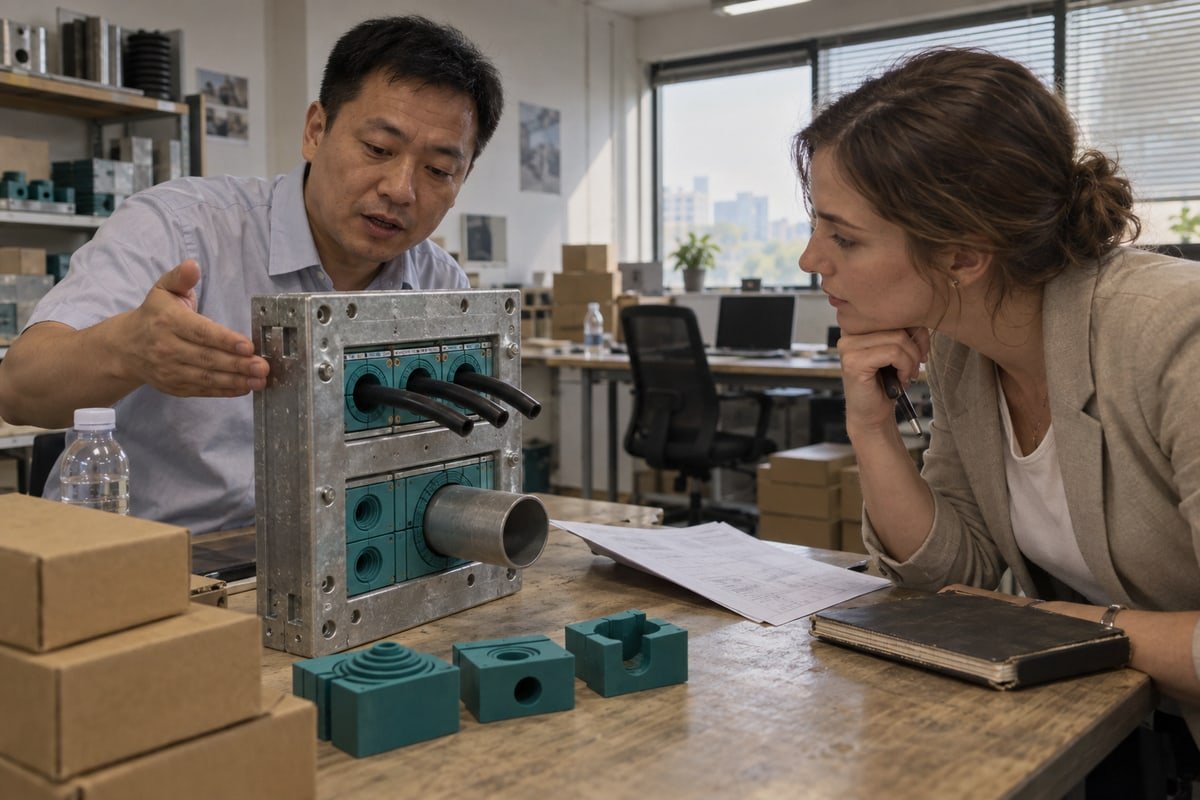
Esa consulta alemana se convirtió en un ejercicio interno útil. Colocamos la lista de cables y la lista de tuberías una al lado de la otra y preguntamos qué partes realmente cambiaron. Menos de lo que esperaba. Aquí está el proceso que seguimos ahora cuando un cliente hace la misma pregunta.
How we specify a shared frame
- Confirm the cutout standard. Our frames are dimensionally compatible with common 120-frame standards. If your existing frame is already in the wall or bulkhead, our modules drop into the same cutout. We supply a cross-reference table from your current model to the DEWIN model so qualification is a paperwork step, not a redesign.
- Choose the mounting method by the barrier, not the service. Welded frames suit steel bulkheads and decks. Bolted frames suit concrete walls, panel enclosures, and container skins where welding is not allowed. Marine and offshore safety rules often decide this for you.
- Split the frame into zones. Cables go in one zone with TSC square modules packed for density. Pipes go in their own row with dedicated bores. Stay plates separate the rows and carry compression evenly.
- Check anchorage against pipe load. If the pipe leans on the transit, the frame weld or bolt pattern must carry it. Cables never trigger this check. Pipes often do.
- Reserve spare capacity. Leave blank modules in the cable zone. Adding a cable later then means peeling a block, not cutting a new hole.
Where the design genuinely diverges
| Componente | Cable transit | Pipe transit | Shared? |
|---|---|---|---|
| Marco de tránsito | Welded or bolted | Welded or bolted, heavier anchorage check | Sí |
| Placas de retención | Estándar | Standard, sometimes thicker for load | Sí |
| Compression wedge | Estándar | Estándar | Sí |
| Módulo de sellado | TSC step-core EPDM | Exact-bore, TSR round, or intumescent | No |
| Entry geometry | Cables at 90° to the frame face | Pipe axis fixed by pipework, transit adapts | Partly |
| Spare capacity | High priority | Rarely needed | No |
The 90° entry rule matters more than people think. A cable that enters at an angle side-loads the module and opens a leak path. Pipes arrive wherever the pipework puts them, so the frame position must be set from the pipe routing, not the other way around.
One more point for skeptical buyers. Multi cable transit systems seal immediately once the compression wedge is torqued. Compound or mastic methods need curing time. Some suppliers quote installation savings of up to 30% versus single-module approaches. I cannot verify their number, but the mechanism is real, and it applies equally to pipes and cables.
¿Qué certificaciones debería verificar para aplicaciones de sellado de cable versus tubería?
Every test report we issue forces one trade-off: a broader certificate costs more test hours, but a narrow one leaves your pipe penetration without valid approval.
Para cables, verifique la clasificación de incendio A-0 o A-60, la protección de ingreso IP68, la presión de prueba estanca al agua y a los gases, los datos de material libre de halógenos y las afirmaciones de puesta a tierra EMC. Para tuberías, confirme que la prueba de incendio utilizó el material y diámetro reales de la tubería, además de las tolerancias de movimiento y carga, porque las aprobaciones de cables no se transfieren automáticamente.
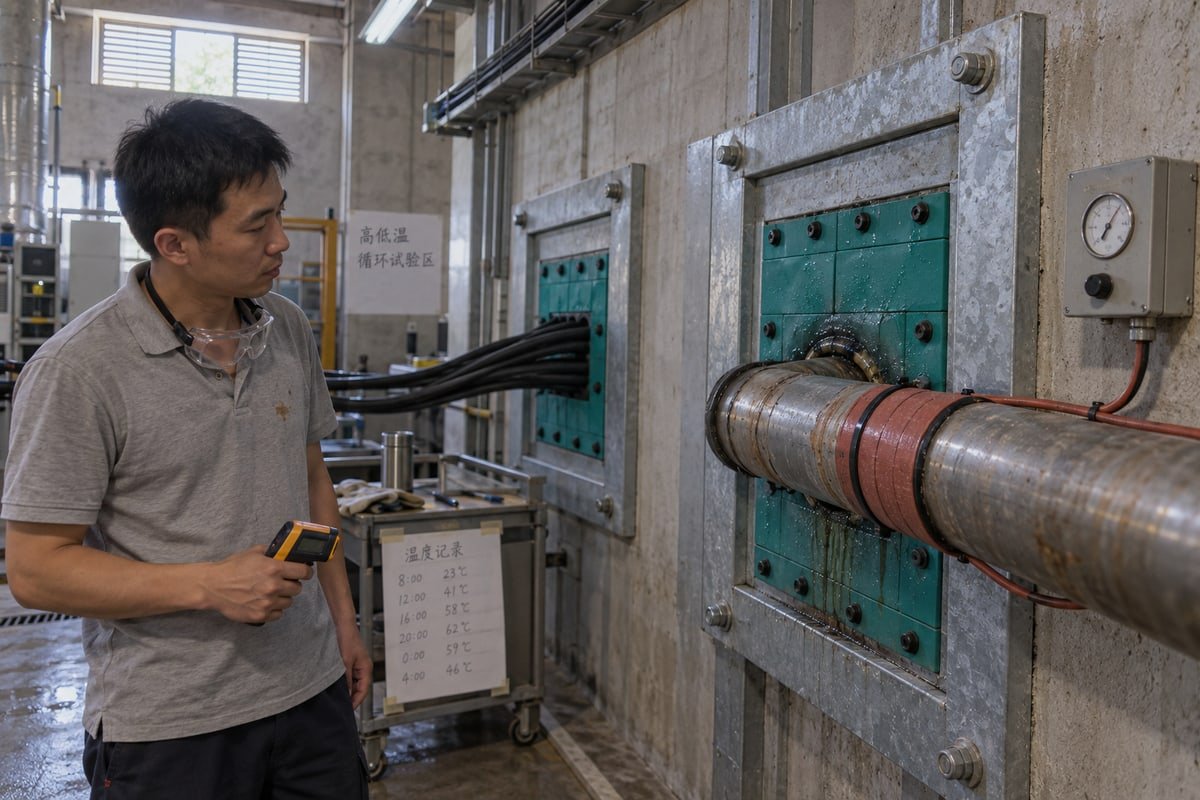
I want to address a fair objection before the checklist. Several buyers have told me that the loudest marketing claims are always tied to one narrow test configuration. They are right. That is exactly why the configuration in the report must match your penetration. The fix is not to distrust certificates. The fix is to read the test setup page, not just the cover page.
Why a cable certificate does not cover a pipe
A fire test with cables measures the seal while the jackets burn away and the module holds. A fire test with a steel pipe measures heat conduction through the pipe wall to the unexposed side. A test with a thermoplastic pipe checks whether the intumescent module closes the void as the pipe collapses. Three different failure modes. Three different reports. Product literature from established brands says the same thing: A-0 cable transits and pipe penetrations need dedicated testing.
Marine and offshore safety versus building projects
Marine and offshore projects usually stack requirements: A-class fire rating plus watertight bulkhead penetrations plus gas-tight integrity, sometimes plus jet fire resistance for process areas. Our factory is BV-approved and our modules carry A-0/A-60 fire ratings 5, IP68, and watertight/gas-tight sealing from 0.01 to 0.4 MPa. We do not claim jet fire performance, and I would advise you to ask any supplier the same direct question rather than assume it.
Building and container projects lean on the quality system behind the certificate. We run ISO 9001 and IATF 16949, which matters to switchgear and modular data center integrators because the same audit discipline applies to every batch of spare sealing modules.
The document request list
| Documento | Cable application | Pipe application |
|---|---|---|
| Informe de prueba de fuego | A-0 / A60 fire rating with cable types listed | Same rating, with pipe material and OD listed |
| Protección de ingreso | IP68 on the sealed module | IP68 with pipe movement noted, if tested |
| Prueba de presión | Watertight and gas-tight, 0.01–0.4 MPa | Same, on the pipe configuration |
| Material data | Halogen-free EPDM declaration | Plus intumescent data for plastic pipes |
| EMC / grounding | Conductive layer and grounding and bonding method | Usually not applicable |
| Aprobación de fábrica | BV-approved factory, ISO 9001, IATF 16949 | Same |
| Load and movement | Not required | Axial and lateral movement allowance |
We hold test documents for our configurations and release them on request. If a pipe case sits outside what we have tested, I will say so and quote the test rather than stretch a cable report to cover it.
¿Cómo elijo el tipo de módulo correcto cuando mi proyecto involucra penetraciones mixtas de cables y tuberías?
One lesson from a decade of cutting molds: mixed penetrations tend to fail at the boundary between the cable zone and the pipe zone, not inside either one.
Utilice módulos de núcleo escalonado cuadrado TSC para el haz de cables, dimensione un conjunto redondo TSR separado o un bloque de orificio exacto para cada tubería, y mantenga las tuberías en su propia fila de marco o marco. Luego, haga coincidir todo el marco con el requisito más estricto presente, generalmente el caso de fuego, carga y movimiento de la tubería.
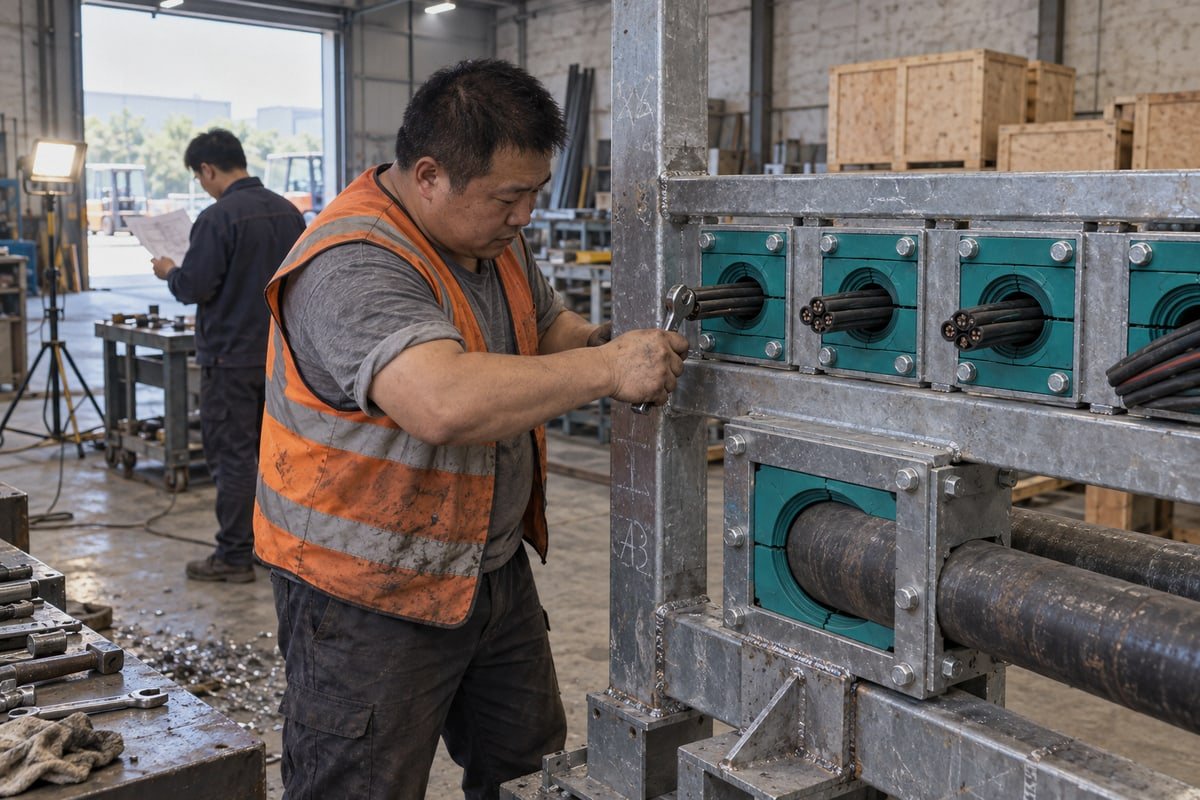
The boundary fails because two different compression behaviours meet at one stay plate. Soft cable blocks keep compressing. A rigid pipe block stops early. The wedge load then goes where it is easiest, and the cable side over-compresses while the pipe side stays loose. Keeping the services in separate rows, or separate frames, removes that problem. Here is the selection method I give to EPC procurement teams.
A five-step selection method
- List every service with OD, material, and temperature. Cables need OD and armour type. Pipes need OD, wall material, fluid, and operating temperature. Digital transit management platforms now track this pipe metadata for compliance reporting, so record it from day one.
- Sort by failure mode. Flexible jacket, rigid metal, or thermoplastic. Each gets its own module family.
- Flag EMC and grounding needs. Armoured cables entering sensitive equipment rooms may need modules with a conductive layer for blindaje electromagnético 6 (EMC) and grounding and bonding. Pipes never need this.
- Set the governing requirement. If one pipe needs A60 and movement allowance, the whole frame is specified to that level.
- Reserve spare capacity in the cable zone only. Pipes rarely change. Cables always do.
Module selection matrix
| Service type | Module family | Key feature | Notas |
|---|---|---|---|
| Power and control cables, mixed OD | TSC square step-core | Peelable halogen-free EPDM, density packing | Leave blank modules for future cables |
| Armoured cables into EMC rooms | TSC with conductive layer | Grounding and bonding path | Confirm bonding method with frame |
| Small metal pipes and conduits | TSR round assembly | Exact bore, immediate seal | Check thermal movement |
| Large steel pipe through bulkhead | Exact-bore block, reinforced frame | Load path through stay plates | Verify anchorage |
| Thermoplastic pipe | Intumescent module | Expands and closes void in fire | Dedicated fire report required |
The cost objection, answered honestly
Some project teams still favour cast-in sleeves or compound fills because the first-cost line looks lower. I understand the instinct. The lifecycle answer is different. A compound seal has to be broken and re-cured every time a cable is added. A modular transit is opened, peeled, and re-torqued. Our drop-in modules also arrive at 40–60% lower cost than the incumbent brands while fitting the same 120-frame cutouts, which usually closes the first-cost gap on its own.
To make qualification easy, we provide free validation samples, CAD and STEP files for every frame and module, and English technical support that answers spec questions rather than sales questions. For custom pipe bores, our in-house mold making covers sizes that catalogue peel steps cannot reach, and spare sealing modules ship fast because we make them ourselves across three plants.
Conclusión
Treating cable and pipe penetrations as identical costs certification and re-work later. Specify the shared frame once, choose modules per service, and demand the matching test documents before ordering.
Notas al pie
1. Scientific principle explaining how materials change volume in response to temperature fluctuations. ↩︎
2. IEC standard defining protection levels against gas and moisture ingress for technical enclosures. ↩︎
3. Industry authority providing technical data on thermoplastic materials used in industrial piping systems. ↩︎
4. Bureau Veritas provides classification and certification for watertight sealing systems in marine vessels. ↩︎
5. Official IMO standards for fire protection levels in marine and offshore environments. ↩︎
6. Technical explanation of methods used to protect sensitive electronics from electromagnetic interference. ↩︎



 English
 Español de México
 Deutsch
 Français
 العربية
 Русский