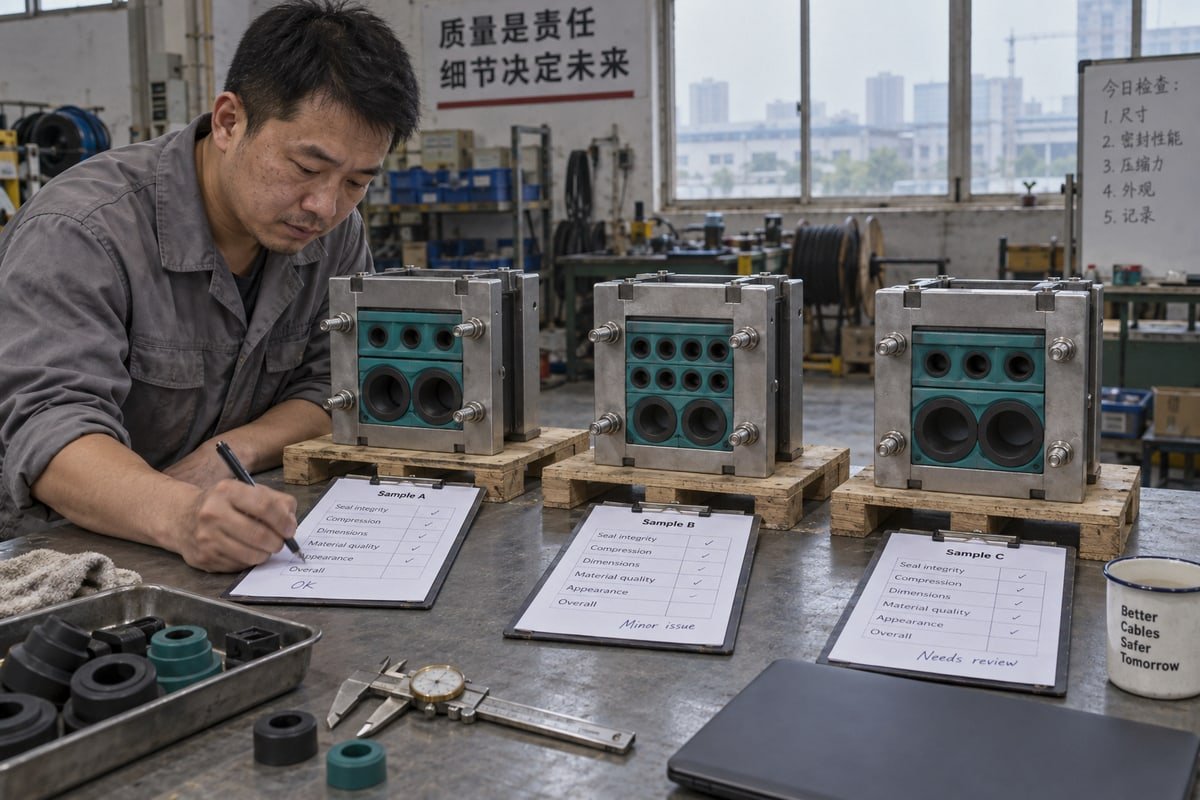
Buyers who compare MCT system samples from multiple suppliers often rely on gut feel; one wrong pick means rework on site. Our sample desk built a method to fix that.
To compare MCT system samples from multiple suppliers, define fixed criteria first, measure every sample against the same frame cutout under identical test conditions, verify certificates and traceability, then record results on one standardized scorecard per supplier so procurement, engineering, and QA can approve from the same evidence.
One clarification before we start. In this article, MCT means multi-cable transit 1: the modular frames and rubber blocks that seal cables and pipes through walls, bulkheads, and container panels. If you landed here while sourcing MCT oil, the discipline is similar—Certificates of Analysis, independent lab checks, weighted decision matrices—but the measurements differ. The four sections below cover criteria, fit checks, paperwork, and the final report.
What criteria should I use to evaluate MCT samples from different suppliers fairly?
Last year a sourcing engineer in the Netherlands returned our TSC sample with one line: "Looks fine, but what am I supposed to measure?" That question shaped this checklist.
Evaluate MCT samples on ten fixed criteria: certification evidence, dimensional fit, sealing performance, fire and water resistance, installation ease, material quality, documentation completeness, supplier responsiveness, lead time, and total cost of ownership. Weight safety-critical items as pass/fail and score the rest on a numeric scale.
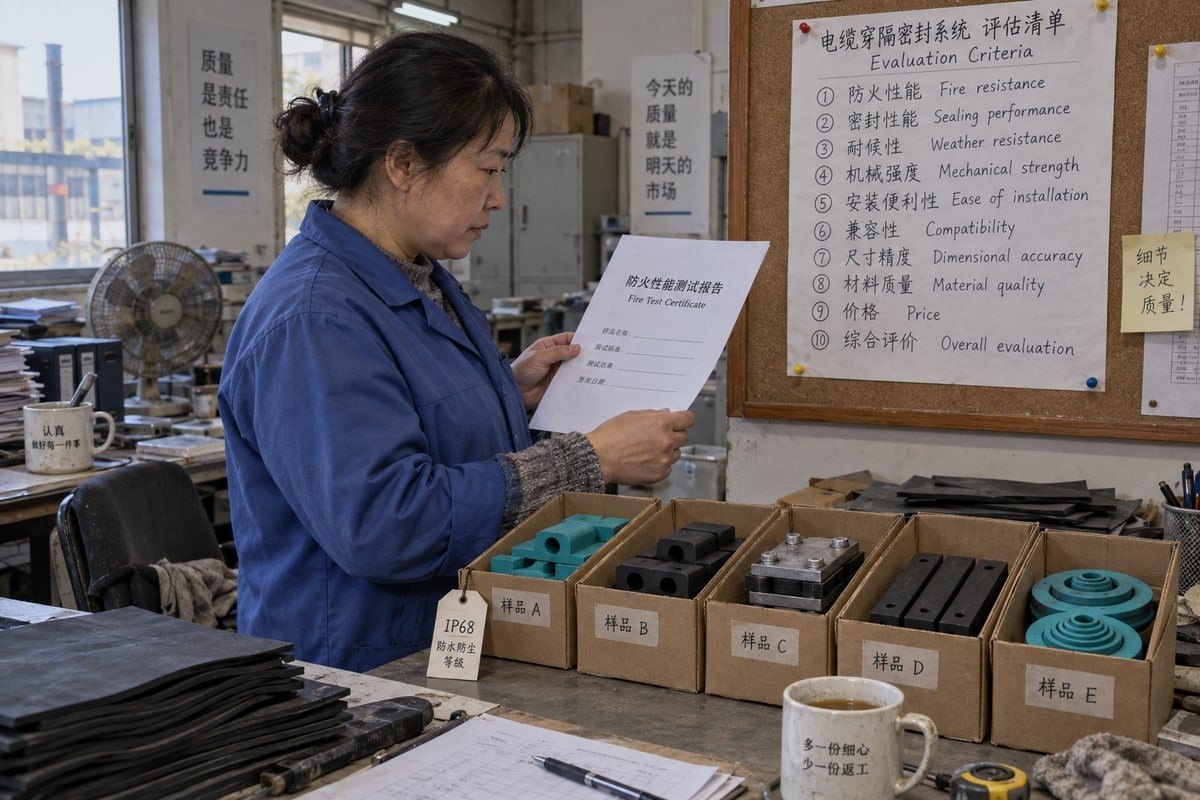
Fairness starts with writing the criteria down before any sample arrives. If you decide what matters after you have held the parts, the nicer-looking box wins. Here is the framework we hand to buyers who ask.
| Criterion | What to check on the sample | Scoring method | Owner |
|---|---|---|---|
| Fire rating certifications 2 | Named test body, class (e.g. A-0 / A-60), report date | Pass/fail | Engineering |
| Ingress protection | IP rating on report, matched to lot | Pass/fail | Engineering |
| Dimensional fit | Module height, width, depth vs 120-frame cutout | Pass/fail | Engineering |
| Sealing performance | Pressure held during watertight test | Pass/fail | QA |
| Installation ease | Minutes per transit, tools needed, errors | 1–5 | Operations |
| Material quality | EPDM hardness, surface finish, halogen-free declaration | 1–5 | QA |
| Documentation completeness | Packet items received vs requested | 1–5 | Procurement |
| Supplier responsiveness | Reply time, English technical answers, CAD files | 1–5 | Procurement |
| Lead time | Quoted vs actual sample delivery | 1–5 | Procurement |
| Total cost of ownership | Landed price plus labor, spares, rework | 1–5 | Finance |
Product review is not supplier qualification
A sample can pass every bench test and the supplier can still fail you. Our factory learned this from the other side. Early on, we shipped good EPDM rubber modules 3 but our export paperwork lagged behind, and a buyer's QA team flagged it. So we now treat the sample and the supplier as two separate columns. The sample column asks: does this part seal, fit, and resist pull-out? The supplier column asks: can this company ship the same part next year, trace the lot, and answer an engineer in English within a working day?
Resolving the "best sample" argument
Three teams usually disagree here. Engineering wants the strongest test record, even at a higher price. Procurement wants the lowest landed cost with the lowest supply risk. Operations wants the part that installs and inspects fastest. None of them is wrong. The fix is sequence, not compromise. Safety-critical items—fire rating certifications, IP rating, pull-out resistance, halogen-free materials—are gates. A sample that fails a gate leaves the table regardless of price. Only the survivors get weighted scores. This is how a drop-in second source at 40–60% lower cost can be judged on the same footing as an incumbent: it must clear identical gates first.
How do I verify dimensional compatibility when comparing sealing modules against my existing 120-frame cutouts?
Tighter tolerance on a module costs us mold time; looser tolerance costs the installer sealing pressure. We choose the first, because a drop-in second source must fit without shims.
Verify compatibility by measuring the existing frame's inner opening, packing depth, and compression unit travel with calipers, then checking each supplier's module height, width, and step-core diameter range against a cross-reference table. Dry-fit the full stack in a spare 120-frame before any sealing test.

Dimensional fit is the criterion buyers most often assume and least often measure. A "120-frame compatible" label on a datasheet is a claim. Your calipers turn it into a fact. Follow this sequence for every supplier's sample.
- Photograph the empty existing frame with a tape or ruler in the shot. Record frame model, inner width, inner height, and packing depth.
- Measure the compression wedge unit at rest and fully expanded. Note the travel in millimetres. A module stack that needs more travel than the unit can give will never seal.
- Measure each sample module: outer height, outer width, depth, and the diameter of each step in the core. Record the smallest and largest cable diameter the supplier states for that module size.
- Check stay plates. Their thickness eats packing height. Count how many plates your frame uses and subtract them from the available space.
- Dry-fit the complete stack—modules, spare blocks, stay plates, compression unit—in a spare frame. Do not use a frame that is already in service.
- Compare the result with the supplier's cross-reference table (existing model → replacement model). If the table and your measurement disagree, the measurement wins.
| Dimension | Existing frame | Supplier A sample | Supplier B sample | Tolerance you accept |
|---|---|---|---|---|
| Module width (mm) | ||||
| Module height (mm) | ||||
| Module depth (mm) | ||||
| Core step range (mm) | ||||
| Stay plate thickness (mm) | ||||
| Compression unit travel (mm) | ||||
| Total stack height vs opening (mm) |
Why the sample alone is not enough
Suppliers, including us, will tell you that an isolated module can mislead. That is not an excuse; it is a real risk. Sealing depends on the full system: the stack sequence, the number of spare blocks, and how much the compression unit is torqued. So ask each supplier for a packing diagram for your actual cable schedule, not a generic one. Cable schedule integration matters here. If your BESS container or switchgear panel has 14 cables of three diameters, the comparison should use those 14 cables. Spare capacity planning belongs in the same step: note how many empty modules each layout leaves for future cables, because that is capacity you are buying today. If you run transit management software, export the opening list and hand it to each supplier as the basis for their proposal. Every sample then answers the same question.
What test documentation and certifications should I request before comparing samples side by side?
Early in our export history, a buyer rejected a test report because the issuing lab was missing from page one. We fixed our document template that week.
Request a technical datasheet, installation guide, certificate of compliance, fire rating and IP test reports from named bodies, material declarations for halogen-free EPDM, quality system certificates such as ISO 9001, batch or lot traceability, and CAD/STEP files. Reject samples whose documents cannot be matched to the sample's lot number.

Documentation is where suppliers separate fastest. Some publish full technical libraries 4 you can download before you ever ask for a sample. Others offer a product page and a phone number. In our experience shipping to Europe, the Middle East, and Asia-Pacific, buyers now expect the digital packet first and the physical sample second. Treat the packet as part of the sample. Here is what to ask for and what to check.
| Document | What it must show | How to verify |
|---|---|---|
| Technical datasheet | Dimensions, core range, material, temperature range | Compare with your own caliper readings |
| Installation guide | Stack sequence, torque values, tools | Follow it during the trial, note gaps |
| Certificate of compliance | Product model, standard, issue date, signatory | Match model number to sample marking |
| Fire test report | Class (A-0 / A-60), test body, report number | Contact the issuing body or check its register |
| IP / watertight test report | IP68, pressure range (e.g. 0.01–0.4 MPa), duration | Repeat a watertight integrity test on your bench |
| Gas-tight seal report | Test medium, pressure, leak rate | Check test conditions match your application |
| Material declaration | Halogen-free EPDM, RoHS/REACH status | Request the compound supplier's declaration |
| Quality system certificates | ISO 9001 5, IATF 16949, class society factory approval | Check certificate number with the registrar |
| Lot traceability | Lot number on module or bag, linked to a batch record | Ask for the batch record for your sample's lot |
| CAD / STEP files | Native model of each module size | Overlay with your frame drawing |
Verify, do not file
A certificate you have not checked is a PDF, not evidence. Our factory holds ISO 9001 and IATF 16949 6 and a BV factory approval, and we expect buyers to look those numbers up. The same applies to any supplier. Ask for the report number, then ask the issuing body. For performance claims, do your own comparison under identical conditions. Run watertight integrity testing on all samples at the same pressure, for the same duration, with the same cable bundle. If you need independent confirmation, send one module from each supplier to a third-party lab with the same test brief. Vendor test reports set the expectation; your bench confirms it.
One sample is not a process
A single "gold standard" sample proves the supplier can make one good part. It does not prove they make good parts every month. Borrow a practice from raw-material sourcing: run a batch-to-batch variability audit. Request modules from at least two different production lots across roughly six months, and compare hardness, dimensions, and seal results between them. Ask for a Certificate of Analysis or batch inspection record for each lot and compare it against your internal specification, the same way a food buyer compares a COA on moisture and contaminants. If you report on ESG, also ask where the EPDM compound and steel frames originate. That information belongs in the same folder as the test reports.
How do I create a comparison report that captures cost, lead time, and performance data for internal approval?
Our own incoming-inspection log for EPDM compound uses one sheet per batch, and we borrowed that format when buyers asked how to report sample trials internally.
Build the report as one test form per supplier feeding a master comparison sheet with weighted scores. Include sample ID, lot number, measured dimensions, pass/fail on safety tests, install time per transit, rework count, landed unit cost, and lead time, then close with signatures from engineering, QA, and procurement.
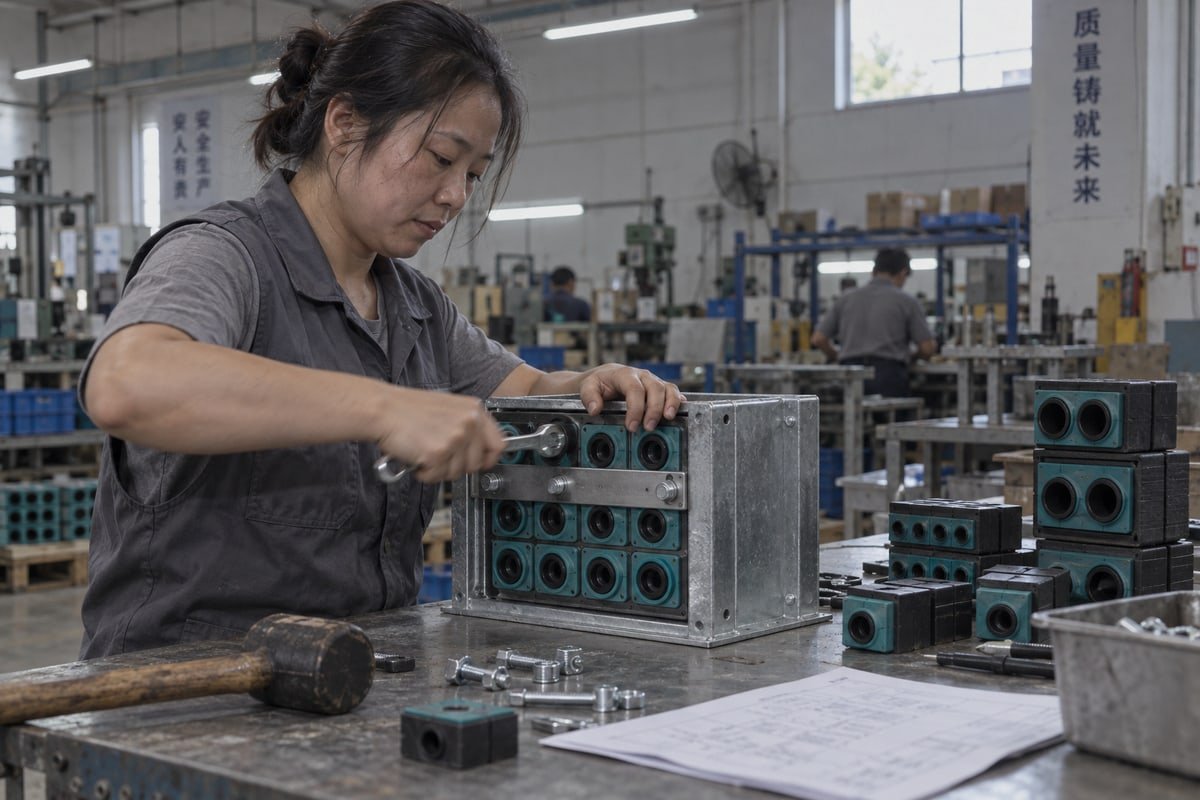
The report has one job: let someone who was not in the room approve the decision later, and defend it if asked. That means the structure must be boring and repeatable. Use two documents. The first is a test form, one per supplier. The second is a master sheet that pulls the numbers together.
The test form
Each form opens with identification: supplier name, sample ID, lot number, receipt date, and the name of the installer who ran the trial. Then it records conditions: frame model, cable bundle used, torque applied, test pressure, ambient temperature, and tools. Then it records results, split into gates and scores. Photos go in as a numbered log—before opening, during the dry-fit, after compression, after the pressure test. Inspection report templates from your existing QA system work well here; the aim is that the MCT form looks like every other incoming inspection your auditors already know.
The master comparison sheet
Turn qualitative factors into numbers with a weighted decision matrix. Agree the weights before scoring, with all three teams in the room.
| Factor | Weight | Supplier A | Supplier B | Supplier C |
|---|---|---|---|---|
| Fire / IP / pull-out gates | Gate | Pass | Pass | Fail |
| Dimensional fit (drop-in) | 20% | |||
| Sealing test result | 20% | |||
| Install time per transit | 15% | |||
| Documentation completeness | 15% | |||
| Landed cost per module | 15% | |||
| Lead time and MOQ | 10% | |||
| Technical support and CAD files | 5% | |||
| Weighted total | 100% |
Supplier C stops at the gate row. That is the point of the gate.
Cost is landed cost plus labor
Procurement will push unit price to the top. Engineering will push it to the bottom. Resolve this with total cost of ownership. Run installation time studies on each sample: same installer, same opening, same bundle, stopwatch running. Count rework events—modules pulled and re-seated, wrong core removed, torque re-applied. Add spare module pricing and delivery time, since a transit you cannot re-seal after a cable change is a stranded asset. When a compatible second source lands at 40–60% below the incumbent, that gap is real only if install time and rework stay level. Your form is what proves it.
Field trials versus bench tests
Standardized testing is not enough on its own, but it is not optional either. Give installer feedback a fixed weight—the 15% for install time above—so it counts without overriding the bench. Then archive everything: certificates, datasheets, emails, photos, forms, and the master sheet, in one folder with the decision date. Sign-off from engineering, QA, and procurement closes it.
Conclusion
Similar-looking samples hide different outcomes. Without a written method, that difference surfaces on site. Compare on fixed criteria, verify documents, score consistently—and request our free validation samples to start.
Footnotes
1. Authoritative classification society page for the certification of cable transit systems. ↩︎
2. Official IMO page regarding fire protection standards for marine and offshore structures. ↩︎
3. Technical overview of the synthetic rubber material used in the sealing modules. ↩︎
4. Major technical library for engineering and technology standards and research. ↩︎
5. Official ISO page for the global quality management standard mentioned in the text. ↩︎
6. Official site for the international automotive quality management standard. ↩︎



 English
  Español de México
  Deutsch
  Français
  العربية
  Русский