
A multi cable transit order that arrives with the wrong block sizes stalls an entire container line. I have watched that happen to buyers before they found our factory.
To confirm supplier specs match your multi cable transit order, compare the quote line by line against your cable schedule: cable diameter range per block, penetration count, frame type, material grade, and required fire and IP certifications. Then request model-specific test documents and a validation sample before release.
The rest of this article walks through that process in the order I use with our own customers. First, dimensions. Second, documents. Third, the cross-reference table. Fourth, physical samples. Each step closes one gap where a cable penetration seal can quietly go wrong between the quote and the shipment.
How Can I Verify Dimensional Compatibility Before Placing My MCT Order?
Last year our QC team pulled a TSC module batch off the line because one step-core layer measured outside tolerance. That habit is exactly what buyers need on their side.
Verify dimensional compatibility by matching every cable outer diameter to the block's cable diameter range, counting penetrations plus spares, measuring the frame's internal window against the 120-frame standard, and checking plate thickness and stayplate pitch on the supplier's dimensional drawing or STEP file before you sign the order.
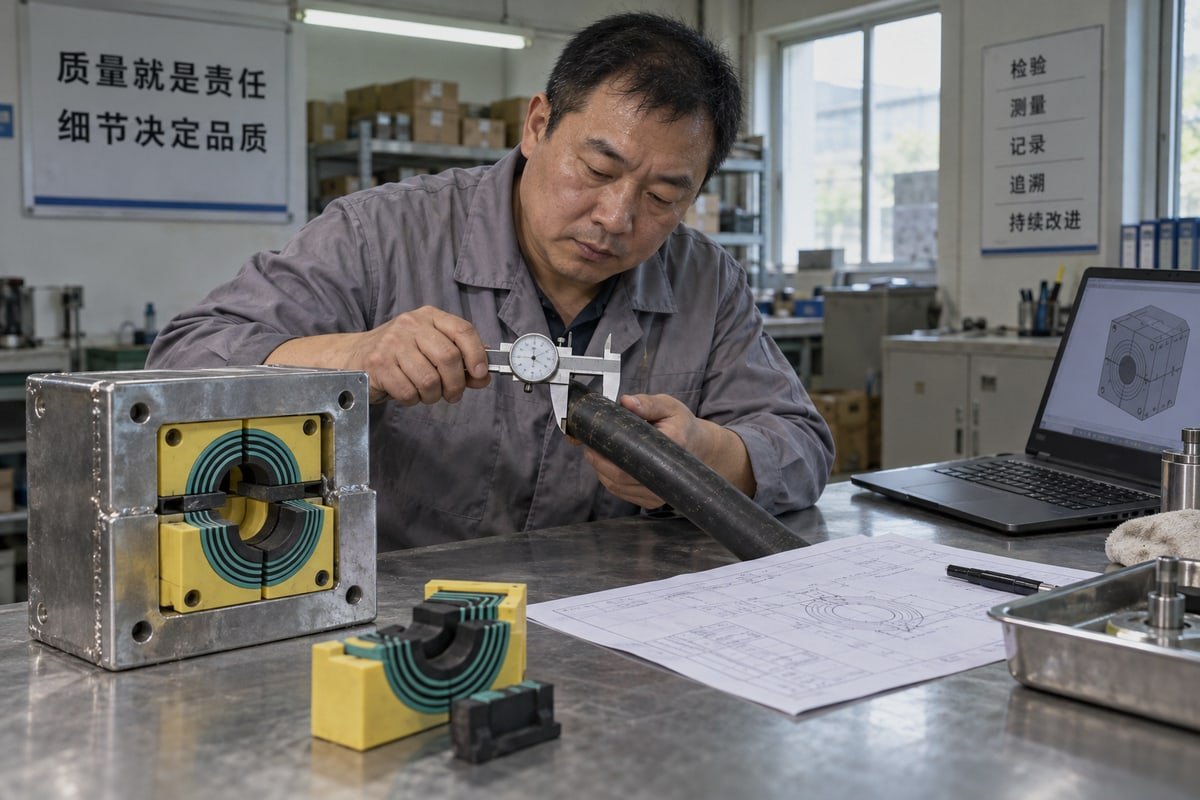
Most mismatches I see start with the cable schedule, not the transit itself. Buyers often copy nominal cable sizes from a catalog. Real outer diameters can differ from the nominal figure, especially on armored or double-sheathed cables. So the first step is simple. Measure the actual cables with calipers 1, or pull the OD from the cable maker's technical data sheets. Do not guess.
Match Every Cable to a Block Range
Modular sealing blocks are sold by cable diameter range, not by a single size. A standard MCT system can cover cables and pipes from about 3.5 mm up to 110 mm across its full block family. Each individual block only covers a slice of that span. Our step-core, halogen-free EPDM modules 2 widen that slice within one block size, because the installer peels layers until the core matches the cable. Even so, a cable sitting at the very edge of a range needs a decision on paper. I ask buyers to send us the full cable list. Our engineers then return a block layout drawing with every cable assigned to a specific block. That drawing becomes part of the order, and it is the document you compare against at delivery.
Count Penetrations, Spares, and Unused Openings
Count every cable, including spares for future expansion. Then decide how spare space is handled. Unused space must be filled with blank modules, because open area breaks the seal and the compression path. Oversizing the frame "just in case" carries its own risk. A larger window needs more blanks, more stayplates, and more compression force 3 to reach the rated pressure. In our experience, a frame sized to the real schedule plus a defined spare allowance is safer than a frame sized to a guess.
Check the Frame, Not Just the Blocks
The frame is where drop-in compatibility is won or lost. This table lists what I ask a buyer to reconcile before we cut steel or pack a single module.
| Item to verify | What to compare | Where to find it |
|---|---|---|
| Internal window dimensions | Site cutout vs. supplier frame drawing | Dimensional drawing, STEP file |
| Frame type | Welded, cast, or bolted | Project structural drawing |
| Plate or wall thickness | Bulkhead, container wall, or panel | Site measurement |
| Stayplates and wedge kits | Quantity per row, wedge size | Itemized BOM on the quote |
| Compression unit | Torque value and bolt size | Manufacturer installation manual |
| Material grade | 316L stainless vs. galvanized steel | Material traceability reports |
Some buyers now overlay our STEP files on their BIM model as a digital dry-fit before anything ships. I encourage that. It catches clashes with cable trays and adjacent penetrations that a 2D drawing hides. It also confirms that a second-source module for a multi cable transit order really lands in the existing cutout without rework.
What Certification and Test Documents Should I Request to Confirm Sealing Performance?
I weigh one trade-off whenever a buyer requests every certificate we hold: paperwork depth versus lead time. So I steer them toward documents that actually protect the project.
Request model-specific fire rating certificates (A-0 or A-60), an IP68 ingress test report, pressure testing reports covering the 0.01–0.4 MPa watertight and gas-tight range, material traceability reports for frames and EPDM, the ISO 9001 or IATF 16949 certificate, and Factory Acceptance Test records tied to your exact configuration.

Not every document carries the same weight. Some prove the factory runs a system. Others prove the product performs. A skeptical purchasing engineer should know which is which, because suppliers sometimes blur the line. The table below is the set I hand to buyers who are qualifying us as a second source.
| Document | What it actually proves | Red flag to watch for |
|---|---|---|
| Fire rating certificate (A-0 / A-60) | The tested assembly resists fire for the classified period | Certificate names a different frame or block family than your order |
| IP68 ingress test report | The seal keeps out dust and water under IP rating standards | Report covers a "product line" with no model number |
| Pressure testing reports | Watertight and gas-tight holding at 0.01–0.4 MPa | No test pressure or duration stated |
| Material traceability reports | Steel grade and EPDM compound match the spec | Frame marked 316L but MTR shows a different grade |
| ISO 9001 / IATF 16949 certificate | The quality system is audited | Expired certificate or wrong site address |
| BV factory approval | A classification society has surveyed the factory | Approval scope excludes the ordered series |
| Factory Acceptance Test record | Your specific units passed inspection before packing | Generic checklist with no serial or batch link |
Match Certification Scope to the Application
Fire rating certifications must fit the environment. A-60 fire classification is the marine bulkhead class buyers ask for on offshore modules and ship penetrations 4, while A-0 is often enough for onshore switchgear rooms. Marine and offshore standards from societies such as DNV or RINA, rail requirements under EN 45545-2, and flame classes such as UL 94-V0 5 all exist in the cable entry market, but each one applies to a defined product family. A certificate is only useful when it names the model and configuration you are ordering. I tell buyers to reject any certificate that covers the supplier's "general range" and nothing more.
Verify the Markings on the Hardware
Paper is one half. The hardware is the other. Frames and modules from a serious factory carry embossed or etched markings: series, size, and often a batch code. At delivery, compare those markings with the certificate and the packing list. Some suppliers now add QR codes or RFID tags on the frame that open a digital record with the test documents attached. We support that on request. For projects with ESG reporting, an Environmental Product Declaration for the steel and rubber may also be required, so ask early rather than after the shipment lands.
How Do I Use a Model Cross-Reference Table to Match My Current MCT Specs?
A sourcing manager in Germany once sent me a spreadsheet of legacy part numbers and one question: which of these can you replace? That request shaped our cross-reference table.
Use a model cross-reference table by listing each existing MCT part number, reading across to the DEWIN equivalent, then checking four key columns: block outer size, cable diameter range, frame window dimension, and certification scope. Treat any row without a full match as a custom item, not a drop-in.

A cross-reference table is not a marketing sheet. It is a reconciliation tool. Used well, it turns a supplier switch into a row-by-row engineering check that both purchasing and engineering can sign. Used badly, it becomes a list of part numbers that "look similar." I want to show you how we build ours and how to read it critically.
Step by Step: Working Through the Table
- Export your current bill of materials for the transit. Include frames, modules, blanks, stayplates and wedge kits, and compression units.
- Send that list to the supplier. Ask for the cross-reference with the four matching columns filled in, not just a new part number.
- Mark every row as one of three states: full match, match with a note, or no match.
- For "match with a note" rows, ask what the note changes. Usually it is a wider cable diameter range or a different color code.
- For "no match" rows, decide whether a custom mold is worth it. Our in-house mold shop handles custom sizes, but a custom part needs its own drawing and its own approval.
- Attach the completed table to the purchase order. It then becomes the baseline for pre-shipment checks.
What a Reconciled Row Looks Like
Here is an illustrative layout. The values are examples of the format, and your own table will carry your real part numbers.
| Your existing item | DEWIN series | Block outer size | Cable diameter range | Frame compatibility | Status |
|---|---|---|---|---|---|
| Square module, small band | TSC square module | Same outer dimension | Step-core covers the band | 120-frame drop-in | Full match |
| Square module, mid band | TSC square module | Same outer dimension | Range extends slightly wider | 120-frame drop-in | Match with note |
| Round assembly, single pipe | TSR round assembly | Same bore | Matched by pipe OD | Existing sleeve | Full match |
| Blank filler module | TSC blank | Same outer dimension | Not applicable | 120-frame drop-in | Full match |
| Special oversize block | Custom mold required | To be defined | To be defined | Requires drawing | No match |
Two details deserve attention. First, color coding. Some suppliers mark cable diameter range by color, others by printed numbers on the block face. Our modules carry the diameter range stamped on the face, so a "match with note" row may simply mean the marking style differs while the range is equal or wider. Second, certification scope. A row can be dimensionally perfect and still fail if the project requires an A-60 assembly and the matched series is only tested to A-0. That is why the table must carry certification as a column, not as a footnote in an email. When the table is complete, your multi cable transit order references DEWIN part numbers with a clear audit trail back to the originals.
Can Free Validation Samples Help Me Confirm Fit Before Committing to Bulk Orders?
One lesson took me years to accept: a drawing can pass review while the part still binds in the frame. So we ship free validation samples before bulk orders.
Yes. Free validation samples let you dry-fit the module in your existing frame, insert your actual cables, torque the compression unit per the manual, and run your own pressure or ingress check. Passing that first-article test in your own workshop confirms fit and sealing before you commit to bulk volumes.

A sample is the cheapest insurance in this process. It costs the supplier a few modules and a courier fee. It saves the buyer from discovering a mismatch on a container floor with an installer waiting. I treat sample approval as a mini Factory Acceptance Test that the customer runs on their own bench, and I ask them to document it the same way.
How to Run a Sample Validation
- Request samples that match specific rows in your cross-reference table, not random sizes. Include at least one blank and one stayplate if the frame layout depends on them.
- Check the markings on arrival. Series, size, and diameter range should be stamped on the block face and should match the packing list.
- Dry-fit the module into your existing frame. It should slide in with normal hand pressure and sit flush with neighboring blocks.
- Insert a real cable from your schedule. Peel the step-core layers until the core matches the measured OD.
- Fit the compression unit and tighten to the torque value in the installation manual. Record the value.
- If you have the equipment, apply a water or air test within the working range shown on the supplier's pressure testing reports. If not, at least run a soap-bubble check under low air pressure.
- Write up the result and share it with the supplier. That sheet becomes the reference for every later batch.
What the Sample Cannot Tell You
Be honest about the limits. A sample proves fit, marking, and basic sealing on one assembly. It does not prove batch consistency across a bulk shipment. That is where pre-shipment evidence takes over. Before release, compare the packing list and the itemized BOM against the purchase order and the reconciled cross-reference table. For orders with many variants, insist on model-by-model reconciliation rather than a single total quantity. Some buyers now use AI-assisted visual inspection on the assembled transit face to flag any block arrangement that deviates from the approved cable schedule. We welcome those photos, because they close the loop between your sample sheet and the delivered goods. Together, the sample, the documents, and the shipment check give you three independent confirmations that the multi cable transit order matches what you approved.
Conclusion
Mismatched transits cost weeks. Reconcile dimensions, documents, and cross-references in writing, then prove fit with a free sample. That is how we help buyers switch suppliers without risk.
Footnotes
1. Technical overview of calipers, the standard tool for measuring precise cable outer diameters. ↩︎
2. Technical overview of EPDM rubber, the standard material for high-performance cable seals. ↩︎
3. International standards body for mechanical and engineering specifications including pressure and force ratings. ↩︎
4. Authoritative source for international maritime fire safety standards and A-60 classifications. ↩︎
5. Global safety science leader providing testing and certification for plastic flame ratings. ↩︎



 English
 Español de México
 Deutsch
 Français
 العربية
 Русский