
Country-of-origin marking for Chinese MCTs in E-house assembly creates more customs friction than sealing performance does. One unmarked frame can hold an entire shipment. Our export desk learned this early.
Country-of-origin marking for Chinese MCTs in E-house assembly means tagging each frame “Made in China” permanently and legibly, unless assembly substantially transforms it into a new article. Keep a Certificate of Origin and Bill of Materials documentation per module, and confirm HS code classification early.
That short answer hides four real decisions. Which rule applies. Where the tag goes. What paper backs it up. And what it does to your duty bill and CE file. I will take them one at a time.
What Country-of-Origin Marking Requirements Apply to MCT Components in My E-House Builds?
Every TSC frame that leaves our Shaanxi line gets its nameplate stamped before final QC, not after. That sequence started when an integrator asked us where origin marking legally begins.
Under Section 304 of the U.S. Tariff Act, every imported foreign article must carry a conspicuous, legible, permanent English marking of its country of origin for the ultimate purchaser. Chinese MCT frames keep that requirement unless substantial transformation during E-house assembly changes their name, character, or use.

The legal core is short. Origin is the country of manufacture. Later work in another country only changes origin if it creates a new article with a different name, character, or use. That is the substantial transformation test. It sounds simple. In practice it decides everything for cable transit systems inside prefabricated electrical substations.
The three-question decision tree
I use this sequence with buyers before any shipment leaves our plant.
- Was the MCT frame and its EPDM module set manufactured in China? For our TSR and TSC products, yes.
- What exactly happens to it in the E-house yard? Is it bolted into a wall cutout and loaded with cables, or is it built into something that no longer resembles a transit?
- After that work, does the frame still have the name "cable transit," the character of a sealing frame, and the use of a penetration seal?
If the answer to question three is yes, the MCT stays China-origin. Bolting, cable loading, and compression tightening are low-complexity mechanical steps. CBP rulings on comparable products treat simple attachment or housing installation as insufficient to shift origin. The frame keeps its essential identity.
Compare that with electronics. CBP has found that soldering a full component set onto a bare PCB 1 can substantially transform the inputs into a new PCBA of the assembly country. That work is skilled, time-consuming, and functionally decisive. Mounting a sealing frame is none of those things.
Three jurisdictions, one concept, different triggers
| Framework | Origin rule | Marking obligation | Practical result for an MCT |
|---|---|---|---|
| United States (19 U.S.C. 1304, 19 CFR 134) | Country of manufacture, changed only by substantial transformation | Mandatory, in English, for the ultimate purchaser | Frame must show "Made in China" unless an exception applies |
| European Union (Union Customs Code, Art. 60) | Last substantial, economically justified processing | No general mandatory origin mark on industrial goods | Origin drives duty rate and documents, not a required label |
| China (Regulations on Origin of Import and Export Goods) | Last substantial transformation | Origin mark defined as words or figures on goods or packaging | Our export declaration and CCPIT Certificate of Origin state China |
The E-house itself may carry a different origin from its parts. If the assembly country performs the complex engineering integration, the finished substation can be marked with that country while the MCT frames inside still require their own China mark if they reach a U.S. ultimate purchaser as identifiable articles. Firestop penetration seals rated A-0 or A-60 remain distinct commercial goods after installation, so we advise buyers to plan for individual marking by default.
Where Should I Physically Mark or Label Cable Transit Modules to Meet Customs Rules?
We weigh one trade-off on every frame: a deep-engraved stainless tag survives years of salt spray, but it costs more than a printed label and needs its own jig.
Mark the MCT frame itself with a die-stamped or engraved metal tag on a face that stays visible after installation, typically beside the compression bolts. Mark the outermost shipping carton too. Container marking alone is acceptable only when the frame reaches the ultimate purchaser in that sealed container.
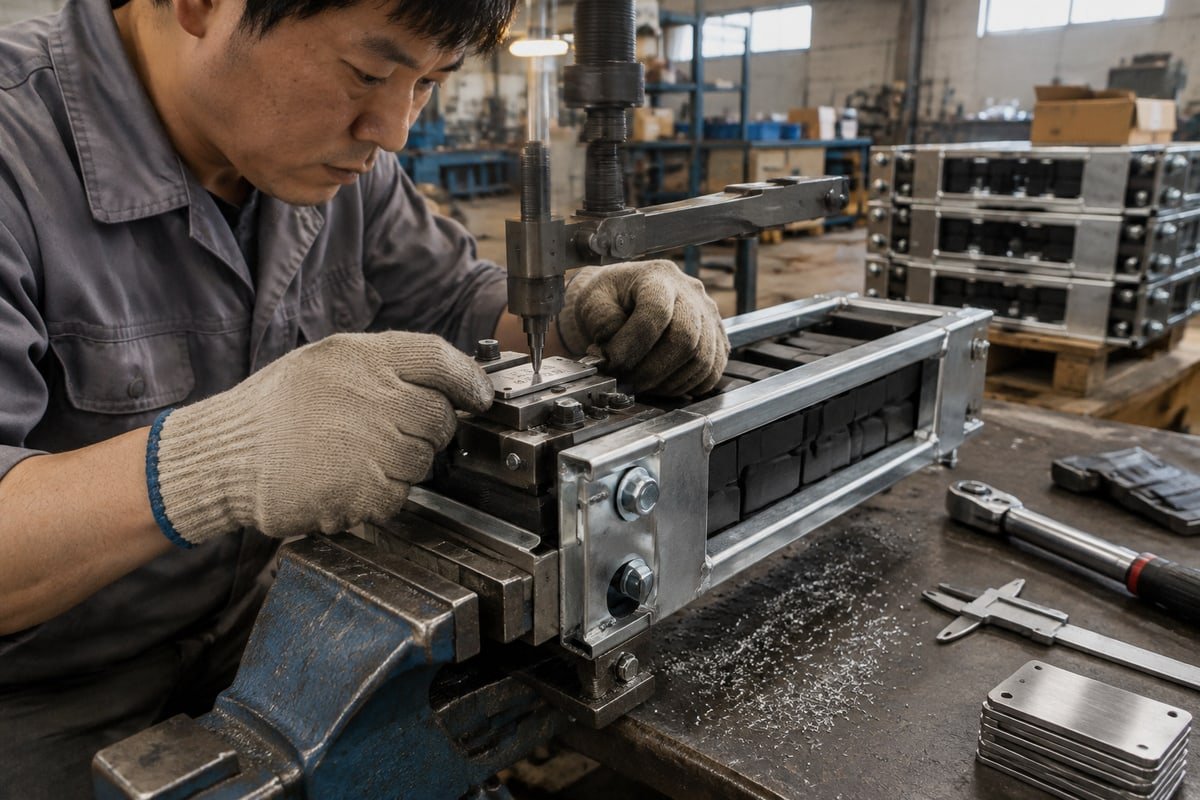
Customs officers do not care about your internal traceability system. They care whether the person who buys the finished E-house can find the origin statement without tools. That is the ultimate purchaser standard. So placement is a design question, not a paperwork question.
A placement sequence that has worked for our frames
- Choose the frame face that remains exposed after the wall cutout is closed. On a standard 120-frame this is the flange with the two hex bolts.
- Fix the tag before galvanizing inspection so the coating does not fill the engraving.
- Repeat the origin statement on each carton of spare EPDM modules, because spares often ship separately and reach a different purchaser.
- Photograph the tag in situ during outgoing QC and file the image with the frame serial.
- Ask the E-house integrator to confirm that the external substation nameplate does not state a single origin that contradicts the internal MCT tags.
Marking methods compared
| Method | Permanence in E-house conditions | Relative cost | When we recommend it |
|---|---|---|---|
| Die-stamped into frame steel | Highest; survives welding heat and coating | Low per unit, tooling upfront | Standard TSC and TSR frames |
| Riveted engraved stainless tag | High; readable after paint | Medium | Private-label frames with buyer logo |
| Laser-marked EPDM module | Medium; abrasion can dull it | Low | Spare module kits |
| Adhesive printed label | Low; fails in heat and oil | Lowest | Never as the sole mark |
The J-List under 19 CFR 134.33 exempts certain items from individual marking. Cable transit frames are not on it, so do not rely on it. The container exception exists, but it applies only when the article reaches the ultimate purchaser unopened. An E-house integrator opens every crate. That breaks the exception, and the frame must carry its own mark.
One more risk is commingling. Our modules are dimensionally compatible with common 120-frame standards, which is the point of drop-in second sourcing. It also means a Chinese frame and a European frame look identical on a pallet. We ask buyers to keep separate racks in the assembly yard. Accidental mislabeling is a marking violation, and intent does not matter to CBP.
How Do I Document Origin Compliance When Sourcing MCTs from a Chinese Manufacturer?
A sourcing manager once sent back our document pack because the Certificate of Origin batch numbers did not match the frame serials on the packing list.
Collect a supplier origin declaration, a chamber-issued Certificate of Origin, commercial invoices, and Bill of Materials documentation for each MCT lot. Add mill certificates for the frame steel, assembly photos, and HS code classification records. Cross-reference every document to frame serial numbers so customs audits trace cleanly.
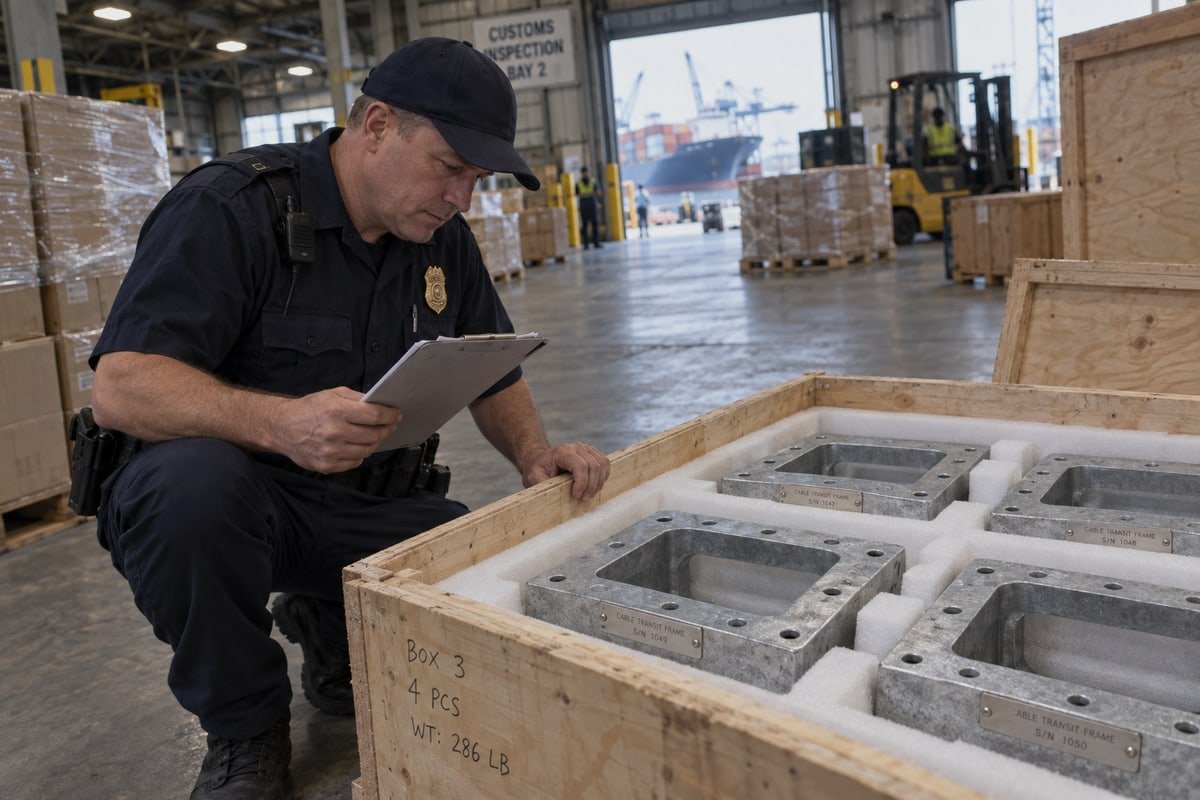
That returned document pack changed how we structure paperwork. The lesson was simple. Customs disputes rarely come from a missing document. They come from documents that disagree with each other. Procurement, production flow, and customs paperwork drift apart, and an auditor finds the gap.
The document set and what each one proves
| Document | Issued by | What it establishes | Common failure |
|---|---|---|---|
| Supplier origin declaration | Our factory | Frame and modules manufactured in Shaanxi, Shandong, or Hunan | Not tied to specific serials |
| Certificate of Origin | CCPIT or local chamber | Non-preferential China origin for customs | Batch reference differs from packing list |
| Commercial invoice | Our export desk | Value, quantity, and origin per line | Origin stated only in the header |
| Bill of Materials documentation | Our engineering team | Which sub-parts are Chinese and which, if any, are imported | Missing for spare module kits |
| Mill certificate | Steel supplier | Steel origin and grade, relevant for AD/CVD review | Filed separately from the frame lot |
| Assembly process record | E-house integrator | What work happened in the destination country | Never written down |
The last row matters most. If you ever want to argue that the E-house assembly changed origin, you need evidence of what the assembly involved. Photos, labor hours, and a process map. Without them the default position holds, and the default is China.
Building the paper trail into the product
We now put a QR code on the frame tag beside the origin stamp. It links to a record with the batch, the EPDM compound lot, the mill certificate, and the test documents behind our IP68 and 0.01–0.4 MPa sealing claims. A buyer with a phone can pull the record in the yard. A customs officer can do the same.
For European integrators, this also prepares the ground for Digital Product Passport 2 rules. Origin data that lives in the frame record can be exported into the E-house BIM file. That helps at decommissioning and material recovery. It is a small step now and a large saving later.
Our ISO 9001 3 and IATF 16949 systems already require lot traceability. Extending that to origin documentation costs us little. We handle the export documentation for every order, and free validation samples ship with the same pack so your customs broker can review the format before a production order.
Will Country-of-Origin Marking on My MCTs Affect Tariffs or CE Compliance in My Target Market?
One lesson cost us a delayed container: origin marking and tariff classification are separate questions, and getting the label right does not fix a wrong HS code.
Yes for tariffs, no for CE. China origin triggers Section 301 tariffs and possible AD/CVD scrutiny on steel frames in the United States, and sets the non-preferential duty rate in the EU. CE marking depends on conformity with EU directives and is independent of where the MCT was made.
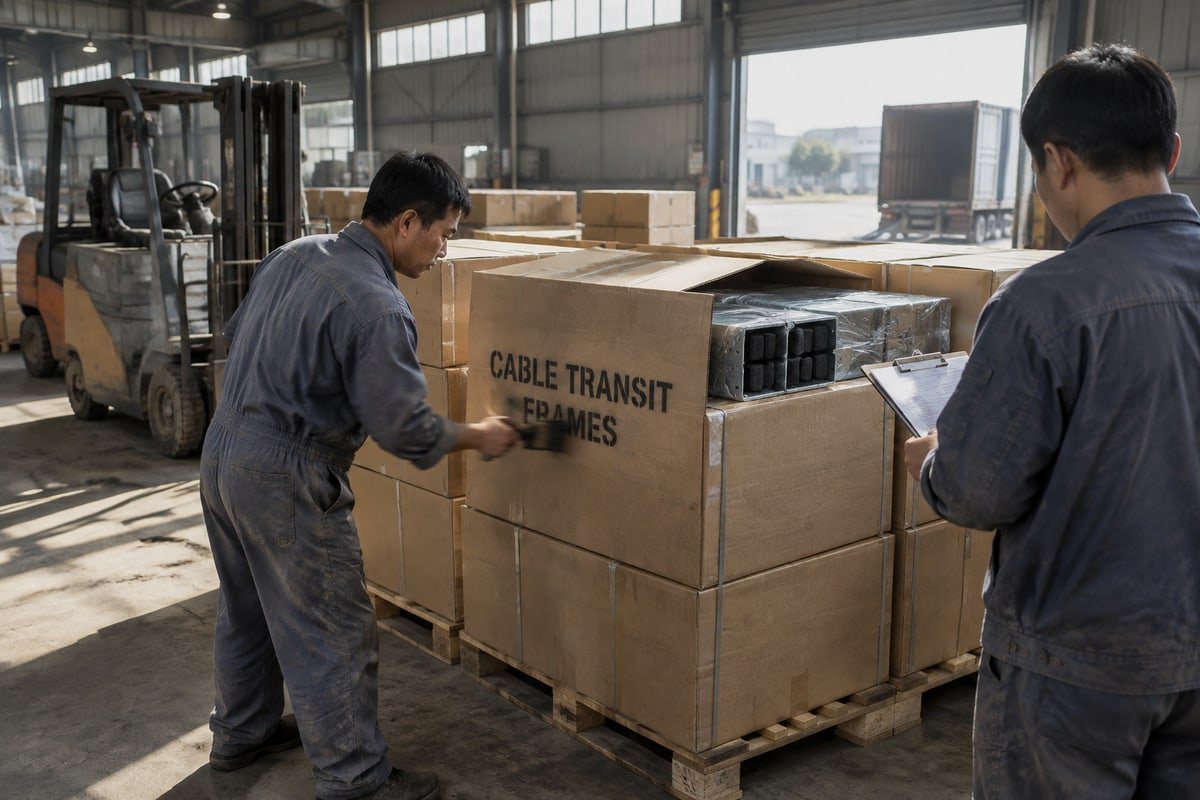
Buyers raise two opposing objections here, and both deserve a direct answer.
The first objection says the MCT was unquestionably made in China, it is physically present in the E-house, so it must stay China-origin and carry China duties forever. The second says the E-house is the real article of commerce, the assembly country made it, so the whole unit including the MCTs should take that origin and that duty rate.
Neither is fully right. The outcome turns on facts. If the E-house integration is complex, skilled, and creates a new commercial article 4, the finished substation can take the assembly country's origin for its own import. But that does not erase the China origin of the MCT frames at the moment they are imported into the assembly country. The frames pay their own duty on entry. What happens to the E-house afterwards is a second, separate customs event.
How origin flows into duty and conformity
| Question | United States | European Union |
|---|---|---|
| Base import duty rates on the MCT | Set by HS code classification | Set by HS code classification under the Common Customs Tariff |
| Extra duty from China origin | Section 301 tariffs on listed HTS lines | No Section 301 equivalent; standard third-country rate |
| Steel frame scrutiny | AD/CVD review possible on structural steel content | Safeguard and AD measures on certain steel products |
| Conformity marking | Not origin-linked | CE marking based on directives, not origin |
Why CE and origin never overlap
CE marking is a declaration that the product meets applicable EU requirements. It is issued by the manufacturer on the basis of technical evidence. Our fire rating documents for A-0 and A-60, our IP68 test reports, and our BV factory approval support that evidence. None of it references where the frame was cast. A Chinese MCT with a complete technical file 5 is as CE-eligible as a European one. A European MCT with no file is not.
The reverse is also true. A perfect CE file does nothing for CBP compliance. If a U.S. buyer imports our frames, Section 301 exposure follows the HTS line, and the origin tag confirms that exposure. The tag does not create the duty. The classification and the origin together create it.
This is where the 40–60% cost advantage of a drop-in second source needs an honest calculation. In Europe, the saving stands largely intact. In the United States, subtract the Section 301 line before you compare. We show buyers that math up front, with the cross-reference table from their existing model to the DEWIN equivalent, so the landed cost is real and not a brochure number.
Conclusion
Unmarked Chinese MCTs stall shipments. Mark every frame permanently, document each lot from mill certificate to HS code, and let our export desk supply the paperwork with the samples.
Footnotes
1. Official U.S. Customs and Border Protection site for trade regulations and substantial transformation rulings. ↩︎
2. European Commission customs portal covering trade regulations and the Digital Product Passport initiative. ↩︎
3. Official site for the International Organization for Standardization, providing details on the ISO 9001 standard. ↩︎
4. The WCO Harmonized System is the global standard for identifying every commercial article in international trade. ↩︎
5. European Commission guidance on CE marking requirements and the necessary technical documentation for compliance. ↩︎


 English
  Español de México
  Deutsch
  Français
  العربية
  Русский