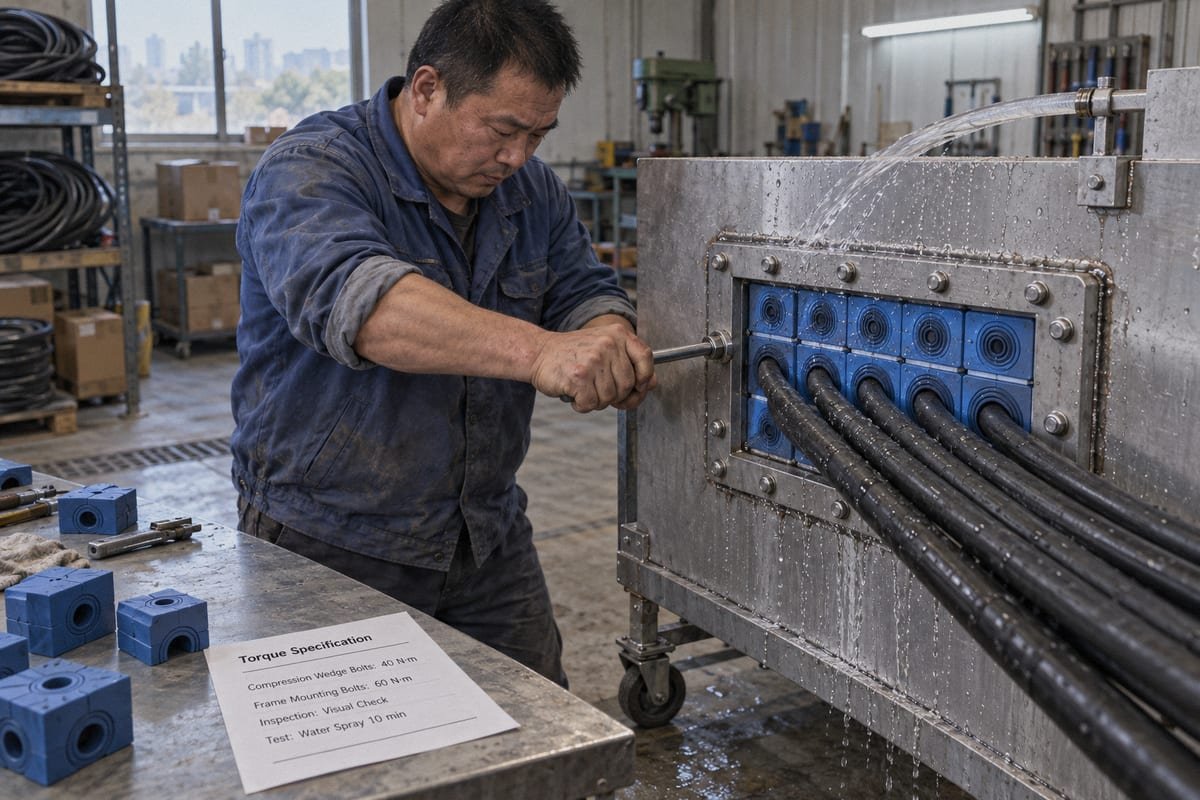
Cable penetrations leak, and a wet cutout stalls a whole BESS container. Our production line builds rubber modules for multi cable transit systems to stop exactly that failure.
Rubber modules create a sealing barrier in multi cable transit systems through mechanical compression. A compression wedge tightens the module stack inside a rigid frame, forcing the EPDM rubber to expand against each cable jacket and the frame walls. This removes every void, blocking water, gas, smoke, and fire.
That is the short answer. The rest of this article walks through the four questions I get most often from purchasing engineers. I will cover the step-core design, the EPDM compound, the test documents, and the fit inside existing 120-frame cutouts.
How Does the Step-Core Design Let My Rubber Modules Seal Multiple Cable Diameters in One Size?
During final inspection last quarter, our QC team pulled a batch of TSC modules and peeled every step layer by hand to check the cut depth.
The step-core design gives each rubber module a set of concentric peelable layers around a removable center core. You remove layers until the remaining bore matches the cable outside diameter. One module size then seals several diameters with uniform radial pressure, without gaps or sealant.

Why a loose fit fails and a compressed fit holds
A cable never sits perfectly centred in a hole. A loose grommet leaves a crescent-shaped gap on one side. Water finds that gap first. Compression removes it. When the compression wedge is tightened, it pushes axially on the stack. The rubber cannot escape, so it expands laterally against the cable jacket and the cable transit frame walls. Every microscopic void closes.
The step-core is what makes that expansion even. Each layer is cut to a set depth. When you peel to the correct step, the bore is only slightly smaller than the cable. The remaining wall thickness is uniform around the circumference, so the radial pressure is uniform too. That is the difference between a module that seals and a module that only touches.
The peel-and-pack sequence we teach installers
- Measure the cable outside diameter with callipers, not by eye.
- Peel layers until the diameter mark on the module matches or sits just under the measured value.
- Apply the supplied lubricant to the module faces. This lets modules slide against each other and settle instead of binding.
- Pack modules row by row, and insert stay plates between the rows.
- Fit the compression wedge and tighten it to the stated position.
Stay plates matter more than most buyers expect. They spread the wedge force evenly through the whole stack. They also give the cables mechanical resistance against pull-out, so a tug on the outside of a bulkhead does not move the seal.
| Fit condition | Contact pattern | Result |
|---|---|---|
| Bore oversized | Line contact on one side only | Leak path, cable can slide |
| Correct step peeled | Full-circumference contact | Uniform radial pressure, gas-tight seal |
| Bore undersized by two steps | Crushed rubber, rolled edges | Wedge cannot close, frame overstressed |
The objection I hear: this all depends on the installer
That is a fair point. Critics of modular systems say the result depends on correct module selection, correct layer removal, and correct tightening. They are right. Our answer is to make the correct choice the easy one. Module families on the market commonly cover cable outside diameters from roughly 3 mm to 99 mm, and our TSC and TSR ranges are mapped to those same sizes. Every step carries a diameter mark. And we send free validation samples so an installer can practice on the bench before the first site job.
What Makes Halogen-Free EPDM the Right Material for My Long-Term Sealing Barrier?
Softer rubber seals easier but creeps faster. Harder rubber holds force but fights the installer. We weigh that trade-off every time we tune a compound batch.
Halogen-free EPDM is the right material because it stays elastic for decades, resists ozone, UV, and aging, and produces no corrosive halogen gases in a fire. Its low creep keeps sealing force on the cable jacket long after installation, so the barrier stays gas-tight and watertight.

A seal is only as good as its pressure on year ten, not on day one. All polymers relax under sustained stress. Engineers call this viscoelastic creep. A cheap compound loses a large share of its contact pressure 1 within the first months. The cable then sits in a loose sleeve that looks sealed but is not. Our EPDM rubber insert blocks are compounded to keep that relaxation low, so the force the compression wedge applied on day one is still working years later.
Property by property, why EPDM earns its place
| EPDM property | What it does inside the transit | Why it matters to the buyer |
|---|---|---|
| High elasticity | Conforms to cable tolerance and jacket irregularities | Uniform contact on real-world cables, not just nominal sizes |
| Low compression set | Holds sealing force after long-term loading | Pressure resistance and watertight integrity over the service life |
| Ozone, UV, and weather resistance | No surface cracking outdoors or in containers | Suitable for offshore decks, BESS enclosures, rooftop plant |
| Halogen-free formulation | No acidic, corrosive smoke when heated | Protects switchgear and electronics during a fire event |
| Controlled Shore A hardness 2 | Acts as a mechanical damper | Absorbs vibration and protects conductors from fatigue |
| Electrical insulation | Provides a dielectric barrier | Galvanic isolation between cable armour and the frame |
Two benefits buyers rarely ask about
The first is vibration. A module with the right Shore A hardness and density behaves like a damper. High-frequency vibration from a compressor or a ship's engine is absorbed in the rubber rather than transmitted into the cable and its terminations. The second is corrosion. Because the module is a dielectric, the steel frame cannot become an electrical bridge between the cable armour and the structure. That closes off one common galvanic corrosion path in marine and process installations.
On fire behaviour and the limits of a standard compound
Some rubber formulations on the market now include intumescent additives 3 that expand a second time during a fire, filling gaps left by melting cable jackets. That is a real industry trend and worth asking any supplier about. Our own A-0/A-60 fire performance 4 is documented in test reports, and I would rather you read those than take a slogan on trust.
I also want to raise a limit honestly. Standard EPDM is not the answer for every environment. Heavy solvent exposure or a strict electromagnetic shielding 5 (EMC) requirement calls for a dedicated solution, and we say so up front. For the typical BESS container, modular data center, and switchgear cabinet, halogen-free EPDM covers the need. For the edge cases, we discuss a custom mould or a specialised frame before you place an order.
Can I Verify That These Modules Meet IP68 and Fire-Rating Requirements Before I Install Them?
A sourcing engineer in Germany once replied to our quote with one line: send the test reports first. We did, and that is the right order.
Yes. You can verify IP68 and fire-rating compliance before installation by requesting the test documents. Our modules carry A-0/A-60 fire ratings and IP68 ingress protection, hold 0.01–0.4 MPa watertight and gas-tight, and are produced under ISO 9001 and IATF 16949 in a BV-approved factory.
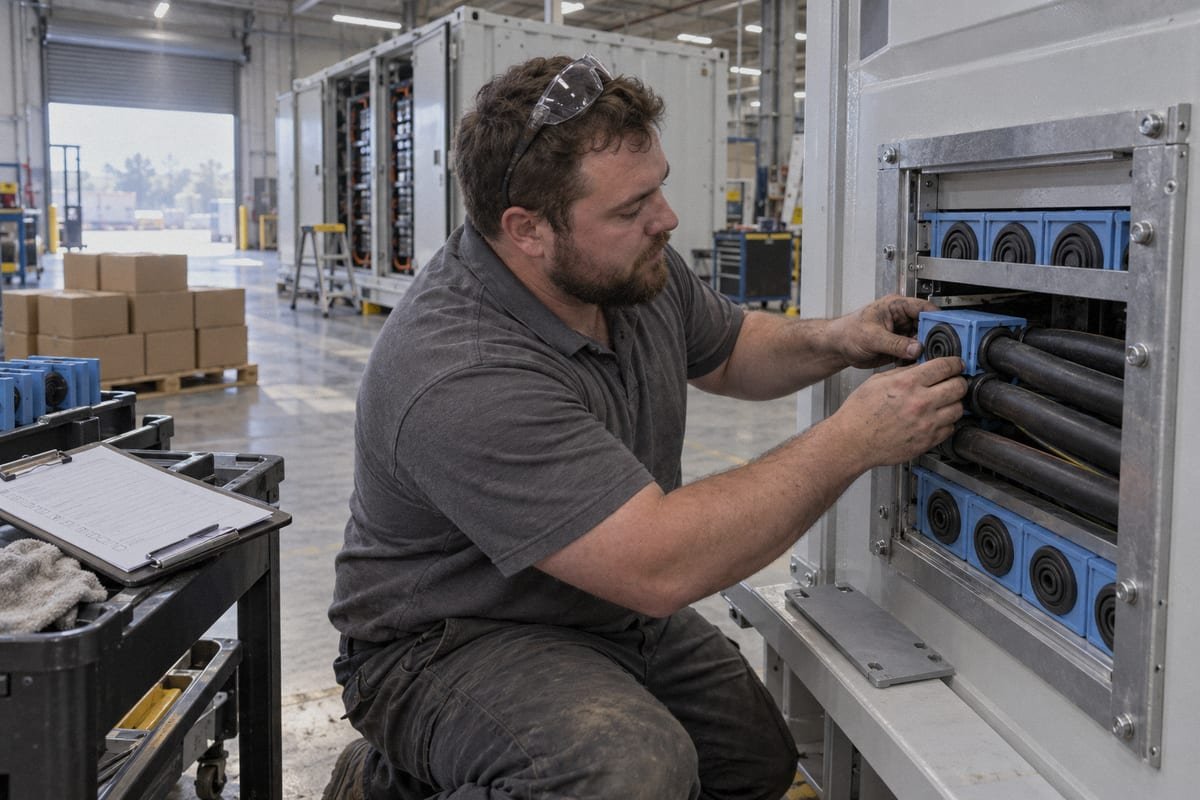
Skeptical buyers are our favourite buyers. They read the spec sheet before they reply. So this section is written for that reader. Below is what we can put on the table, and what each item actually proves.
| Requirement | Our documented status | What the document shows |
|---|---|---|
| Fire division | A-0 / A-60 | Integrity and, for A-60, limited temperature rise on the unexposed side for 60 minutes |
| Ingress protection | IP68 | Continuous immersion under agreed depth and time, beyond the IP67 protection rating |
| Watertight / gas-tight | 0.01–0.4 MPa | Pressure resistance across the sealed transit with no leakage |
| Quality system | ISO 9001, IATF 16949 | Controlled processes, traceability, corrective action |
| Factory approval | BV-approved | Third-party audit of the production site |
What the ratings mean in practice
IP67 and IP68 are not interchangeable. IP67 covers short, shallow immersion. IP68 covers longer, deeper immersion under conditions stated by the manufacturer. For a firestop cable penetration on a container floor that may stand in water, that distinction decides whether the batteries stay dry. The 0.01–0.4 MPa figure covers the pressure resistance of the complete assembly, which is the number a marine or process engineer will actually check.
A verification path you can run before the first order
- Request the fire and IP test documents and check that the tested frame, module, and cable configuration resembles yours.
- Request the ISO 9001 and IATF 16949 certificates and the BV factory approval.
- Order free validation samples of the exact TSC or TSR modules and the matching compression wedge.
- Build one transit on the bench, tighten it, and run your own immersion or pressure check.
- Only then release the cross-referenced part numbers into your BOM.
The objection: a poured sealant looks simpler
At first glance it does. A tube of firestop compound needs no frame and no wedge. But the sealant seals once. Add a cable a year later and you cut the seal open, repack it, and you are relying on a field-applied material that was never re-tested in that state. A modular transit is re-openable by design. Loosen the compression wedge, swap or add modules, tighten again, and the tested configuration is restored. For a data center or an energy storage fleet that adds cables every year, that is the cheaper path over the life of the asset.
Will These Sealing Modules Fit My Existing 120-Frame Cutouts Without Modifying My Current Design?
Early on, we learned that a module one millimetre oversize does not drop in. It gets forced in, and the frame stack no longer compresses evenly. Dimensions come first now.
Yes. Our TSC square modules, TSR round assemblies, stay plates, and compression wedges are dimensionally compatible with common 120-frame standards, so they fit existing cutouts unchanged. A model cross-reference table maps your current part numbers to DEWIN equivalents, and free validation samples confirm fit before you order.
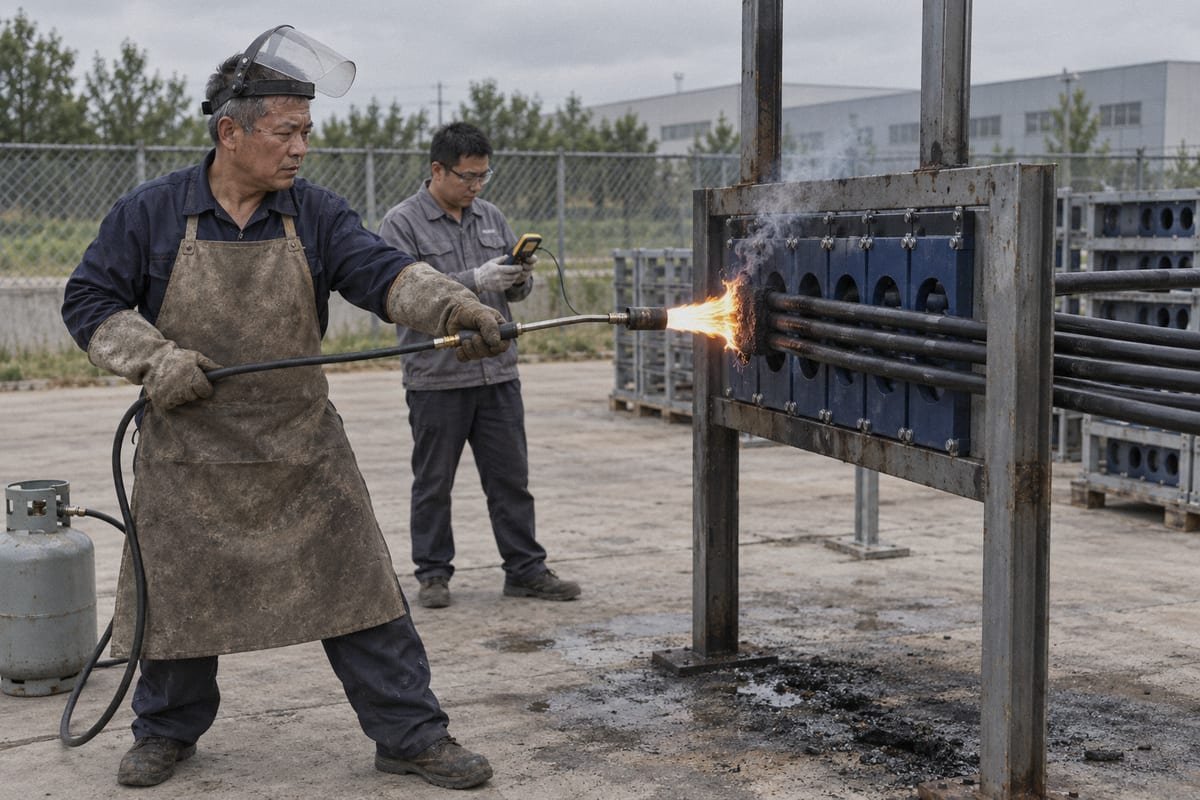
Drop-in compatibility is the whole reason a second source is worth qualifying. If your cutouts, frames, or CAD models have to change, the cost saving disappears into engineering hours. So we designed the TSC and TSR series to match the 120-frame envelope from the start. The frame stays. The stay plates stay. The compression wedge geometry stays. Only the supplier name on the module changes.
How the cross-reference works
| Your existing component | DEWIN equivalent | What we send to confirm |
|---|---|---|
| Square step-core modules for 120-frame | TSC series, matching outer dimensions and step increments | Cross-reference sheet plus free sample |
| Round sealing assemblies | TSR series | Dimensional drawing plus free sample |
| Stay plates | DEWIN stay plates, same thickness and slot pattern | Drawing |
| Compression unit / wedge | DEWIN compression unit | CAD/STEP file |
| Blank filler modules and spares | DEWIN spare sealing parts | Sample on request |
The cross-reference table is the document our purchasing contacts use most. It lists the existing model on the left and the DEWIN model on the right, with the outer dimensions and the diameter range beside each. You can read it against your BOM in a few minutes. CAD and STEP files follow on request so your drawing office can check clearances without redrawing anything.
Why the saving is 40–60% and not a race to zero
We are a factory, not a trading company. Headquartered in Shaanxi with additional production in Shandong and Hunan, we mould the EPDM rubber insert blocks ourselves and cut the steel frames in-house. That removes the distributor layers that inflate the price of a branded module. The 40–60% lower cost comes from that structure, while the certifications from the previous section stay attached to the part.
The objection: mixing sources inside one transit
Some engineers worry about mixing modules from two suppliers in one cable transit frame. I understand the concern. Our position is simple. Qualify our modules through the sample and bench test, then run complete transits on one source per penetration. When you need a custom size for an odd cable bundle, our in-house mould making covers that, and private-label production means the module can carry your own marking if that simplifies your parts control.
Conclusion
Unsealed penetrations threaten uptime and compliance. Compressed, step-core, halogen-free EPDM modules close that gap, and our certified, drop-in TSC and TSR series make second sourcing simple.
Footnotes
1. Scientific explanation of how polymers lose contact pressure over time due to material relaxation and creep. ↩︎
2. Standardized measurement of the hardness of materials, critical for ensuring proper sealing compression in rubber. ↩︎
3. Technical overview of materials that expand when exposed to heat to provide fire protection. ↩︎
4. Official maritime safety standards governing fire protection and integrity for offshore and marine structures. ↩︎
5. The FCC provides regulatory standards for electromagnetic compatibility and interference shielding in electronic equipment. ↩︎



 English
  Español de México
  Deutsch
  Français
  العربية
  Русский