
NFPA 70 compliance for multi cable transits from China worries every US-bound buyer who emails our factory. A vague “compliant” claim can fail inspection. Here is how to verify it.
To verify NFPA 70 compliance for multi cable transits, request UL 1479 or ASTM E814 test reports, confirm the listing is active in UL Product iQ or FM Approvals Guide, match the tested system drawing to your wall, cable fill, and NEC edition, and inspect samples for NRTL markings.
Compliance is not a country-of-origin question. It is a listing, installation, and documentation question. The four sections below walk through what to request, how to check it, how to confirm fit, and what to inspect in a sample.
What test documents should I request to confirm NFPA 70 compliance before ordering?
A sourcing manager in Rotterdam once asked us for "the NFPA certificate." There is no such single document. That question shaped the document list we now send for US-bound projects.
Before ordering, request the UL 1479 or ASTM E814 fire test report, the listed system drawing showing F-rating, T-rating, wall type and cable fill, the installation manual, product marking photos, an LSZH material declaration, and third-party inspection reports tied to the specific factory that will build your order.

The first thing I separate for a buyer is product certification from site compliance. The National Electrical Code does not certify products. It requires installations to use products that are listed and labeled for the use, and installed within the limits of that listing. So the documents you request must let an inspector connect three things: the product, the test, and your wall.
Why UL 1479 and ASTM E814 sit at the center
NEC Article 300.21 requires openings through fire-rated assemblies 1 to be firestopped so the spread of fire is not substantially increased. In the US, the accepted evidence for a cable penetration seal 2 is ASTM E814 testing 3, published as UL 1479 certification. The report gives an F-rating for flame passage and a T-rating for temperature rise, both in hours. Those hours must meet or exceed the fire resistance rating of the wall or floor. A two-hour rated wall needs at least a two-hour F-rating. Ask for the full report, not a one-page summary.
| Document | What it must show | Why the inspector cares |
|---|---|---|
| UL 1479 / ASTM E814 test report | F-rating, T-rating, tested assembly, cable types, fill percentage | Proves the seal was tested for the actual barrier |
| Listed system drawing | Frame, modules, stay plates, compression unit, annulus limits | Defines what the listing covers and what it does not |
| Installation manual | Torque values, packing order, accessories | Installation outside the manual voids the listing |
| Marking and label photos | NRTL mark, listing number, model, factory code | Confirms the product on site is the product tested |
| LSZH / halogen-free declaration | Smoke and halogen data for the EPDM or silicone | Often required alongside NFPA 70 in confined spaces |
| Third-party inspection reports | Follow-up audit dates and results for the production site | Shows ongoing control, not a one-time test |
Firestop system documentation vs a marketing certificate
A common objection I hear is this: "The supplier passed an IEC or EN fire test. Isn't that enough?" On a US project, no. An IEC or EN 1366-3 result is useful engineering history, but it is not a US listing. An AHJ may accept an equivalency argument or an engineering judgment in some cases. That path costs time and carries risk. The least risky path is a listed system with matching documentation.
I say this about our own paperwork too. Our BV-approved factory holds A-0/A-60 fire rating documents and IP68 test records, and we share them on request. Those show real fire and ingress performance. They are not a substitute for UL 1479 certification or FM Global approval when a US inspector opens the file.
Documents for Chapter 8 and cable-side issues
If communications cables pass through the transit, Chapter 8 matters. NEC text requires cable routing assemblies and communications raceways to be listed and marked. It also covers grounding and bonding of metallic sheath members where communications cables enter a building, and separation from power conductors. Not every MCT is a firestop product in the strict sense. Some are sold as cable-entry or routing products. Ask which category the product is listed under.
Finally, confirm the code edition. NFPA provides free online access to NEC editions, but the enforceable edition is the one adopted by your AHJ. A 2025 Prysmian technical document notes that fire-resistive cables are required by NFPA 70 in several article areas, so document the cable types passing through the transit as carefully as the seal itself.
How do I verify a Chinese MCT manufacturer's certifications are genuine and current?
Years ago we learned that a scanned certificate PDF proves very little. Anyone can edit one. Verification has to happen inside the certifier's own database, not in your inbox.
Verify a Chinese MCT manufacturer's certifications by searching the file or listing number directly in UL Product iQ, the FM Approvals Guide, or the certifier's public register, confirming the listed factory address matches the production site, checking the expiry date, and asking for the latest follow-up inspection report.

I recommend a fixed order of steps. It takes about an hour and it removes most of the risk of a counterfeit or expired claim.
A seven-step verification process
- Ask for the number, not the PDF. Request the UL file number, FM approval number, or certificate number in plain text.
- Search the public database yourself. Do not follow a link the supplier sends. Type the number into UL Product iQ or the FM Approvals Guide directly.
- Read the scope. The listing entry names the model series, the tested configurations, and sometimes the maximum ratings. Compare that scope to the quotation.
- Match the factory address. Listings are tied to a production location. Confirm the plant on the listing is the plant that will build your order, not just the parent company's registered office.
- Check the status and date. Look for "active" status and a current certificate period. Expired or withdrawn listings still circulate as PDFs.
- Request follow-up evidence. UL Follow-Up Services conducts unannounced factory inspections, often quarterly, at the listed facility. Ask for the most recent visit report.
- Verify quality system certificates separately. ISO 9001 4 and IATF 16949 certificates can be checked through the certification body or the IAF CertSearch database.
| Certification type | Where to verify | Key detail to check |
|---|---|---|
| UL 1479 firestop listing | UL Product iQ | Active status, factory location, system numbers |
| FM Global approval | FM Approvals Guide | Approval scope and model coverage |
| Intertek (ETL) listing | Intertek Directory of Listed Products | Standard referenced, report number |
| ISO 9001 / IATF 16949 5 | Certifier register or IAF CertSearch | Site address, expiry, certified scope |
| BV factory approval | Bureau Veritas directly | Covered products and production site |
Why the production site matters more than the brand
This is the point I press hardest. Our company runs three production sites: headquarters in Shaanxi, plus plants in Shandong and Hunan. A buyer who receives an ISO 9001 or IATF 16949 certificate from us should ask which site will produce the order, then confirm that site appears in the certificate scope. The same logic applies to any supplier. A listing on a parent company does not extend to a subsidiary plant unless that plant is named and inspected.
Third-party inspection reports close the loop. A listing proves the product passed once. Follow-up inspections prove the factory still builds the same product with the same quality control standards. Ask for both.
Can dimensional compatibility with my existing frame system be confirmed before I commit to a supplier?
On our mold-making floor, every new TSC module is gauged against the 120-frame cutout before it leaves the press. A drop-in claim is only worth the millimeters behind it.
Yes. Dimensional compatibility can be confirmed before commitment by comparing the supplier's model cross-reference table and CAD or STEP files against your frame cutout, then fitting a free validation sample into an actual frame to check module stack height, stay plate seating, and compression unit travel.

Dimensional compatibility is the easiest part to confirm and the easiest part to get wrong. Modular sealing systems look alike. Small differences in module height, frame depth, or compression travel can leave a stack loose or overcompressed. Both conditions can affect the seal and can put the installation outside the listed system limits.
The measurements to confirm on paper first
We provide cross-reference tables that map an existing module model to the equivalent DEWIN TSC or TSR part number, plus CAD and STEP files. Use those files to check the items below before any sample ships.
| Parameter | How to confirm | Why it matters for NFPA 70 |
|---|---|---|
| Frame inner opening | Compare STEP file to your frame drawing | Fill percentage in the listing is based on this opening |
| Module height and width | Cross-reference table, then physical gauge | Stack must fill the frame within the tested annulus |
| Step-core diameter range | Module data sheet | Cable diameters must fall inside the tested range |
| Stay plate thickness | Drawing dimension | Plates are part of the tested assembly |
| Compression unit travel | Data sheet and manual | Correct compression is a listed installation condition |
| Frame material and coating | Material certificate | Galvanic compatibility with local structural steel |
Our step-core, halogen-free EPDM modules accept a range of cable diameters within one module size. That flexibility helps stock control. It also means you must check that your actual cable diameters sit inside the range shown on the tested system drawing, not just inside the module's mechanical range.
Compatible fit is not the same as a shared listing
Here I raise the objection buyers should raise themselves. A second-source module that fits an existing frame perfectly does not inherit that frame's UL 1479 listing. The listed system names the frame, modules, stay plates, and compression hardware as tested together. Mixing brands can put the assembly outside the listing.
There are two ways to resolve this. First, install the second source as its own complete listed system, frame included. Second, ask the supplier whether a tested configuration or an engineering judgment covers the mixed assembly, then confirm acceptance with the AHJ before ordering. Either path needs the system drawing in hand. I tell buyers this directly, even when it slows a sale, because a drop-in module at 40–60% lower cost only saves money if it passes inspection.
Galvanic compatibility of the frame
One point that ranks high in US buyer checklists is corrosion. A galvanized frame welded to carbon steel behaves differently from a stainless frame bolted to galvanized structure. Ask for the frame material certificate and check it against your local structural steel. Long-term electrochemical corrosion can loosen a frame and compromise the mechanical integrity of cable penetration seals over the life of the building.
What should I check in a validation sample to ensure it meets NFPA 70 requirements?
Free validation samples cost us mold time and freight. We send them anyway. A sample failing on your bench costs far less than a module failing an inspection.
In a validation sample, check for permanent NRTL markings matching the listing, compare module dimensions and step-core layers to the system drawing, confirm hardware matches the tested compression unit, verify halogen-free EPDM composition with an FTIR test against the listed formula, and record batch traceability numbers.
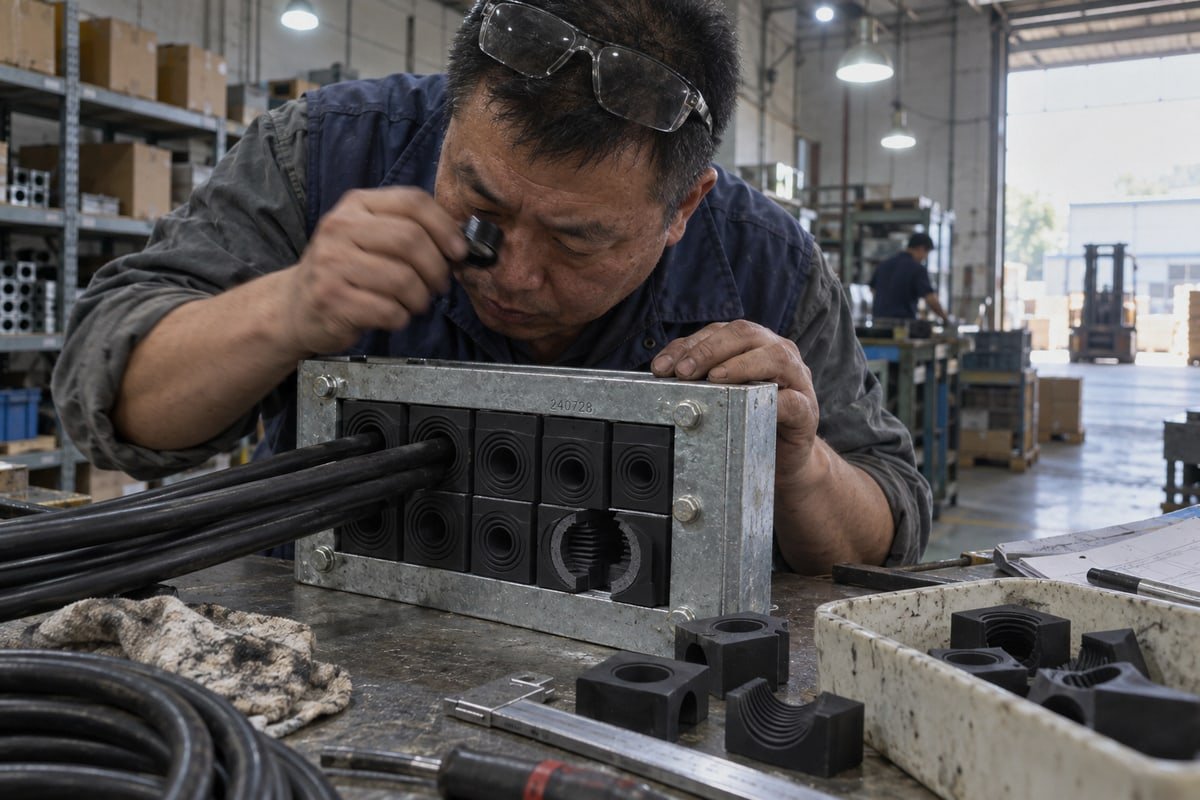
A validation sample is your only chance to compare the physical product to the paperwork before money changes hands. I suggest treating it like an incoming inspection with a written record. Below is the checklist I share with purchasing engineers.
| Check | Method | Pass criterion |
|---|---|---|
| Listing and labeling | Visual inspection under good light | Permanent embossed or serialized NRTL mark from UL, Intertek, or FM matching the database entry |
| Dimensions | Caliper and gauge | Within drawing tolerance for height, width, and step-core diameters |
| Hardware | Compare bolts, washers, stay plates to manual | Same type and grade as the tested compression unit |
| Material composition | FTIR spectroscopy on an insert block | Spectrum matches the listed intumescent or elastomer formula |
| LSZH properties | Supplier traceability log plus optional lab test | Halogen-free EPDM or silicone confirmed by batch |
| Traceability | Batch or lot code on module and nameplate | Code appears in the factory production record |
| Sealing function | Bench compression and water or air test | Holds pressure in the supplier's stated range |
Markings that survive installation
Paper labels peel off in dusty switchgear rooms and BESS containers. Look for markings molded into the rubber or stamped into the metal nameplate. The listing number on the product must match the number you searched in the database. If the sample has no NRTL mark at all, stop there.
Material verification and substitution risk
Material substitution is the quiet failure mode. A module can look correct and measure correctly while using a cheaper rubber compound. An FTIR scan 6 on a small slice of the insert block compares the polymer fingerprint against the certified formula. Our own halogen-free EPDM comes from a controlled compound, and we log raw material batches for exactly this reason. Ask any supplier for that log and check it against the sample's lot code.
Cable arrangement and ampacity derating requirements
The seal is only half the picture. The NEC applies adjustment factors where more than three current-carrying conductors are bundled together over a length that exceeds the code's short-bundle allowance. A densely packed transit can create that condition. The transit does not change the rule, but your electrical designer must count conductors passing through and apply ampacity derating requirements where needed. Also confirm that power and communications cables keep the separation Chapter 8 requires, and that any metallic frame or sheath entering the building is bonded as the code directs.
Keep the record
File the sample photos, measurements, FTIR result, batch codes, and the listing printout together. Inspectors ask for this later. So do maintenance teams when they order spare sealing modules years after commissioning. On our side, we test finished modules for watertight and gas-tight sealing across 0.01–0.4 MPa and record IP68 results. A buyer's bench test on the sample should reproduce that behaviour before the purchase order is signed.
Conclusion
A "compliant" label alone can stop your inspection. Verify listing, tested configuration, markings, fit and AHJ acceptance before ordering, and a China-sourced MCT becomes a defensible second source.
Footnotes
1. Official NFPA 70 standard details for electrical safety and fire-rated assembly requirements. ↩︎
2. UL fire resistance testing services for penetration seals and firestop systems. ↩︎
3. Standard test method for evaluating the fire resistance of penetration firestop systems. ↩︎
4. International standard for quality management systems used to verify manufacturer production controls. ↩︎
5. Global quality management standard for the automotive industry often required for high-spec manufacturing. ↩︎
6. Scientific overview of FTIR spectroscopy used to verify the chemical composition of elastomer compounds. ↩︎


 English
  Español de México
  Deutsch
  Français
  العربية
  Русский