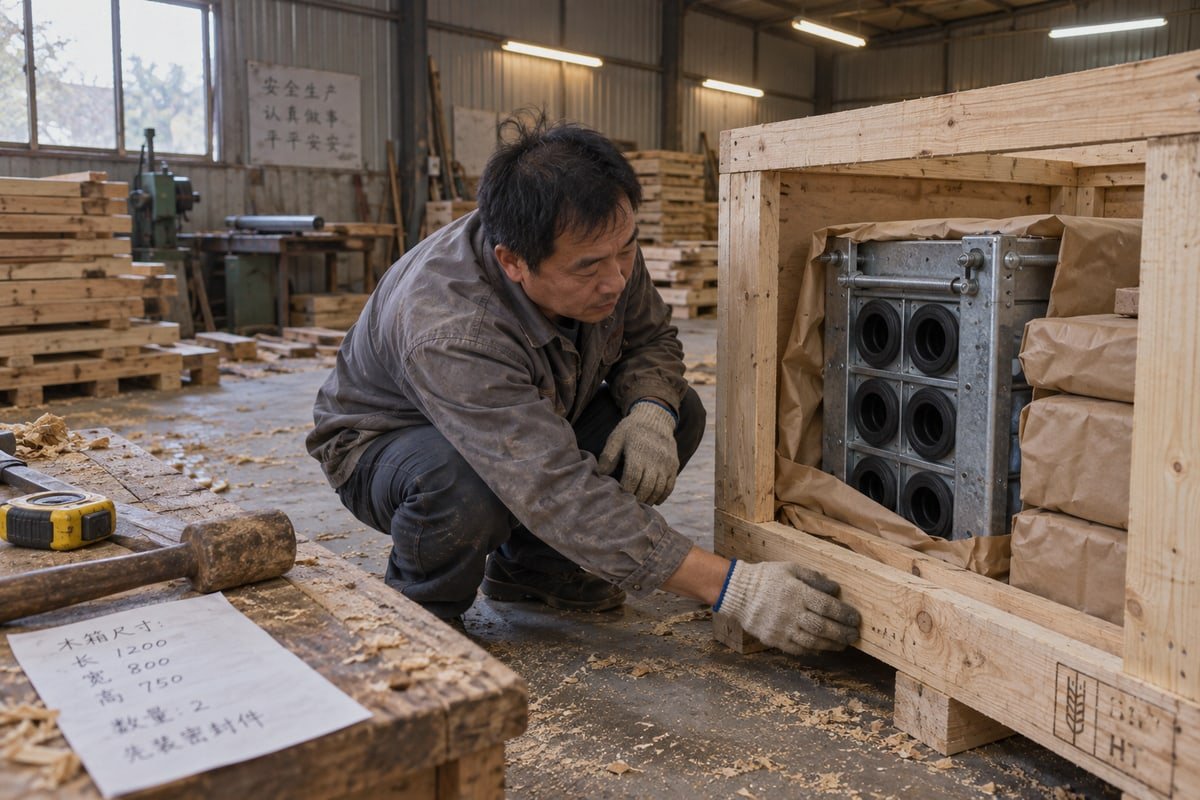
Wooden crates for multi cable transit hardware can pass our factory QC, ship on time, and still get held at a US port. That risk shapes how we pack.
Yes. Wooden crates for multi cable transit shipped from China to the US count as Wood Packaging Material. They must be debarked, heat-treated at 56°C for 30 minutes or fumigated with methyl bromide, and stamped with a permanent IPPC mark showing CN, the facility code, and HT or MB.
The cable transit frame, the EPDM modules, and the compression unit are not the problem. The raw wood around them is. Below I walk through how to verify the crate, what happens when it fails, what to demand from your supplier, and what a failure costs your project.
How do I know if my wooden crates from a Chinese MCT supplier actually meet ISPM 15 requirements?
Last spring our packing team rejected a batch of frame crates because the stamp sat on one side only. The wood was treated. The mark placement was not.
Check the IPPC certification mark on at least two opposite sides of every solid wood piece. It must show the IPPC wheat symbol, ISO code CN, a registered facility number, and HT or MB. Confirm the timber is debarked, and that internal bracing and dunnage carry the same stamp.

Verification starts with one question. Is the wood regulated at all? ISPM 15 covers Wood Packaging Material 1 (WPM) made from raw wood and used to support, protect, or carry cargo. That includes crates, boxes, pallets, skids, load boards, packing blocks, and dunnage. A galvanized 120-frame with a stay plate weighs enough that most exporters crate it on a solid wood base. That base is WPM.
Solid wood vs plywood: which parts are exempt?
Manufactured wood products are exempt. Plywood, OSB, and MDF go through heat and pressure during production, so pests do not survive. Raw sawn timber is different. It must be debarked timber, then treated. The trouble comes from hybrid crates. Many custom MCT crates use plywood panels on a solid wood frame. Some exporters assume the plywood exemption covers the whole unit. It does not. The frame, the skids, and the corner posts still need the stamp.
| Crate component | Typical material | ISPM 15 status |
|---|---|---|
| Side and top panels | Plywood or OSB | Exempt |
| Base skids and runners | Solid pine or fir | Regulated, must be marked |
| Corner posts and frame | Solid wood | Regulated, must be marked |
| Internal blocking and bracing | Solid wood offcuts | Regulated, must be marked |
| Loose dunnage | Solid wood | Regulated, must be marked |
Reading the mark itself
A compliant mark has four parts. First is the IPPC wheat symbol. Second is the two-letter ISO country code 2, which must read CN for a China-made crate. Third is the unique registration number of the treatment facility. Fourth is the treatment code, HT for heat treatment 3 or MB for methyl bromide fumigation. The mark must be permanent and legible. Stencil or brand is fine. A paper label is not. Note one 2026 detail. APHIS ended its temporary suspension of the hyphen requirement on December 31, 2025, and resumed enforcement on January 1, 2026. Since then the separator between country code and facility code matters again. Ask for a close-up photo and check it.
The hidden dunnage risk
Heavy TSC square modules and frames often sit on internal blocking to stop movement in transit. Those blocks are the piece we see missed most often in phytosanitary requirements 4 audits. If they are unstamped, the whole shipment fails even when the outer crate is perfect. In our packing bay, every loose block is cut from the same stamped stock and stamped again after cutting.
What happens at US customs if my cable transit shipment arrives without proper IPPC marking?
We weigh a small trade-off on every export order: a compliant crate costs a bit more than a rough box. The alternative outcome at a US port costs far more.
Customs and Border Protection treats an unmarked crate as non-compliant Wood Packaging Material. The US applies a no-remedy policy: the crate cannot be treated on arrival. CBP orders re-exportation of the packaging, and often the entire cable transit shipment, at the importer's expense, with possible penalties.

The legal basis is USDA APHIS regulations on wood packaging material, found in 7 CFR 319.40. APHIS writes the rule. Customs and Border Protection (CBP) enforces it at the pier and at the container yard. The rule applies to WPM entering or transiting the United States. That means a crate moving through a US port to Mexico or Canada faces the same check.
The no-remedy policy in practice
Many buyers assume a missing stamp can be fixed locally. It cannot. Some countries allow treatment on arrival. The US does not. When an inspector finds unmarked solid wood, or a stamp that fails inspection, the default order is non-compliance re-exportation. The wood leaves the country. Because your TSR sealing assemblies and frames are packed inside that wood, they usually leave with it.
| CBP finding | Typical action | Who bears the cost |
|---|---|---|
| Valid mark, clean wood | Release | Nobody |
| Mark missing on outer crate | Hold, then re-export of crate and cargo | Importer |
| Mark present, unstamped internal dunnage | Hold, then re-export or ordered destruction of wood | Importer |
| Live pest found, even with mark | Emergency action, re-export or destruction | Importer |
| Mark illegible or wrong format | Hold pending review, often re-export | Importer |
Why the cargo goes too
In theory, CBP can separate compliant cargo from non-compliant wood. In practice, this requires a bonded facility, labor, and approval. It rarely happens with heavy industrial goods. A cable transit frame bolted to a skid is not something a dock worker can lift free. So the practical result is a full container heading back across the Pacific. On top of that, the importer of record can face a penalty. The responsibility sits with the importer, not the Chinese factory. That is why buyers who know this rule push the check upstream, before the box closes.
Can I ask my supplier to provide heat-treatment certificates and the IPPC stamp before shipment?
A sourcing engineer from a switchgear builder asked us for the treatment certificate before releasing payment. We sent it, plus photos of the stamped crate. Both matter, but not equally.
Yes, and you should. Request the heat treatment (HT) certificate from the registered Chinese facility, plus dated photos of the IPPC stamp on every solid wood component before the container closes. CBP does not accept paper certificates in place of the mark, so the stamp is what counts.

You are entitled to ask. A serious factory expects it. Our export team handles documentation for Europe, Asia-Pacific, and the Middle East, and the packing evidence pack is the same for all of them. Here is the sequence I suggest you write into your purchase order.
A pre-shipment verification process
- Specify ISPM 15 compliant WPM in the PO. Name the treatment, HT or methyl bromide fumigation 5, and state that all solid wood including dunnage must be marked.
- Ask for the facility registration number before crating starts. Check it against the General Administration of Customs of China (GACC) registered list. CBP increasingly cross-references this list to catch expired or fraudulent stamps.
- Request photos of raw stamped lumber in the packing bay, before assembly.
- Request photos of the finished crate showing marks on two opposite sides, plus the internal blocking.
- Request the treatment certificate with the same facility number as the stamp.
- Cross-check the packing list line by line against crate numbers in the photos.
What each document actually proves
| Evidence item | What it proves | Accepted by CBP as compliance? |
|---|---|---|
| Heat treatment certificate | Facility treated a lot of wood at 56°C for 30 minutes | No, supporting only |
| Photo of IPPC mark on crate | Mark exists and is legible before departure | No, but it is your best pre-shipment check |
| Physical IPPC mark on wood at port | Compliance with ISPM 15 | Yes |
| GACC facility listing | Facility is registered and active | Indirectly, it supports the mark |
| Fumigation certificate | Methyl bromide applied and aerated | No, supporting only |
Notice that only the mark itself satisfies CBP. The certificate is still worth having. It tells you who did the work, when, and to what standard. It also gives you something to check against the facility number on the stamp. If the two numbers disagree, stop the shipment. A mismatch is the most common sign of a stamp borrowed from another supplier's stock.
We are a factory, not a trading company, so the crate is built and stamped on our own site and the evidence pack comes from our own people. If your supplier cannot show you the raw stamped lumber, that is a signal the packaging is subcontracted with no control.
Will non-compliant packaging delay my project timeline or cause extra costs at the port?
One lesson stuck with us early: a crate problem is never a crate problem. It becomes a site problem when the frames arrive after the wall opening is poured.
Yes. Non-compliant Wood Packaging Material triggers a hold, inspection, and usually re-exportation. Expect days to weeks of delay, plus demurrage, storage, re-crating, return freight, and re-shipping costs. For MCT frames tied to a pour or hull-closure date, the schedule slip often costs more than the hardware.

Think about where MCT hardware sits in a build. Frames are welded or cast into a bulkhead, a container wall, or a concrete penetration early. Sealing modules and compression units go in later, when cables are pulled. If the frames miss the pour date, the civil or fabrication crew either waits or improvises a temporary opening. Both cost money. The crate itself is a rounding error by comparison.
Where the money goes after a hold
| Cost or delay item | Trigger | Rough scale |
|---|---|---|
| Container demurrage and detention | Hold while CBP decides | Daily, starts immediately |
| Exam and handling fees | Intensive exam or devanning | One-time, per container |
| Return ocean freight | Re-export order | Full westbound rate |
| Re-crating at origin | Cargo returns to China | Materials plus labor |
| Second eastbound freight | Re-shipment | Full eastbound rate |
| Schedule penalty on site | Missed installation window | Depends on contract |
The mold problem nobody warns you about
Heat-treated pine from China is dry and open-grained. In a humid container crossing the Pacific, it grows surface mold easily. Mold is not a pest and is not an ISPM 15 violation. But an inspector who sees dark patches on a crate may order a hold and inspect to rule out live activity. The mark is valid. The delay still happens. We reduce this by letting stamped lumber acclimatize before crating, using desiccant inside the box, and avoiding fresh-cut wood on export orders. It is a small step that keeps a compliant crate from looking suspicious.
Designing the delay out
The cheapest fix is to treat the crate as part of the product specification. When we validate a drop-in replacement module for a buyer's existing 120-frame cutout, we send free samples first. The sample crate goes through the same stamping and photo process as a production order. That way the buyer's receiving team sees what a compliant box looks like before the first full container ships. The qualification covers the seal and the packaging together, and there is no surprise at the port.
Conclusion
Untreated wood can strand a compliant shipment. For US import, assume wooden crates for multi cable transit need ISPM 15 heat treatment and a verified IPPC mark before departure.
Footnotes
1. Official source for ISPM 15, the international standard regulating wood packaging in trade. ↩︎
2. ISO is the global authority for the country codes required on the IPPC certification mark. ↩︎
3. USDA APHIS is the primary US authority regulating heat treatment requirements for imported wood packaging. ↩︎
4. The WTO SPS Agreement sets the international framework for phytosanitary requirements in global trade. ↩︎
5. The EPA provides authoritative information on the regulation and use of methyl bromide as a fumigant. ↩︎


 English
  Español de México
  Deutsch
  Français
  العربية
  Русский