
Buyers keep telling our export desk the same story: multi cable transit suppliers with borrowed certificates and mismatched invoice names Bureau Veritas approval documents 1. That costs projects months. A document stack fixes it.
Supplier documents that verify multi cable transit suppliers aren’t shell companies include a business registration license showing registered capital, tax and export registration, beneficial ownership records, ISO 9001 and IATF 16949 certificates listing the factory address, a third-party factory audit report, product test reports, and patents. Cross-checking them matters most.
Below I walk through each document group in the order our own customers usually request them. I explain what each one proves, what it does not prove, and how to cross-check it against the others. The goal is simple: confirm the legal entity, confirm who controls it, confirm the operating site, and confirm the product compliance trail. If those four layers line up, you have a real factory. If they do not, you have a risk.
What documents should I request to confirm a factory actually manufactures its own MCT systems?
Our mold shop in Shaanxi cuts new step-core cavities in-house, and we keep the machining logs. Those logs became our best proof of manufacturing when buyers questioned whether we outsource.
To confirm a factory manufactures its own MCT systems, request an equipment list with photos or video of molding presses and frame welding, raw material mill certificates for EPDM and steel, in-house mold-making evidence, granted patents, a production capacity statement, and dated test reports naming that site.
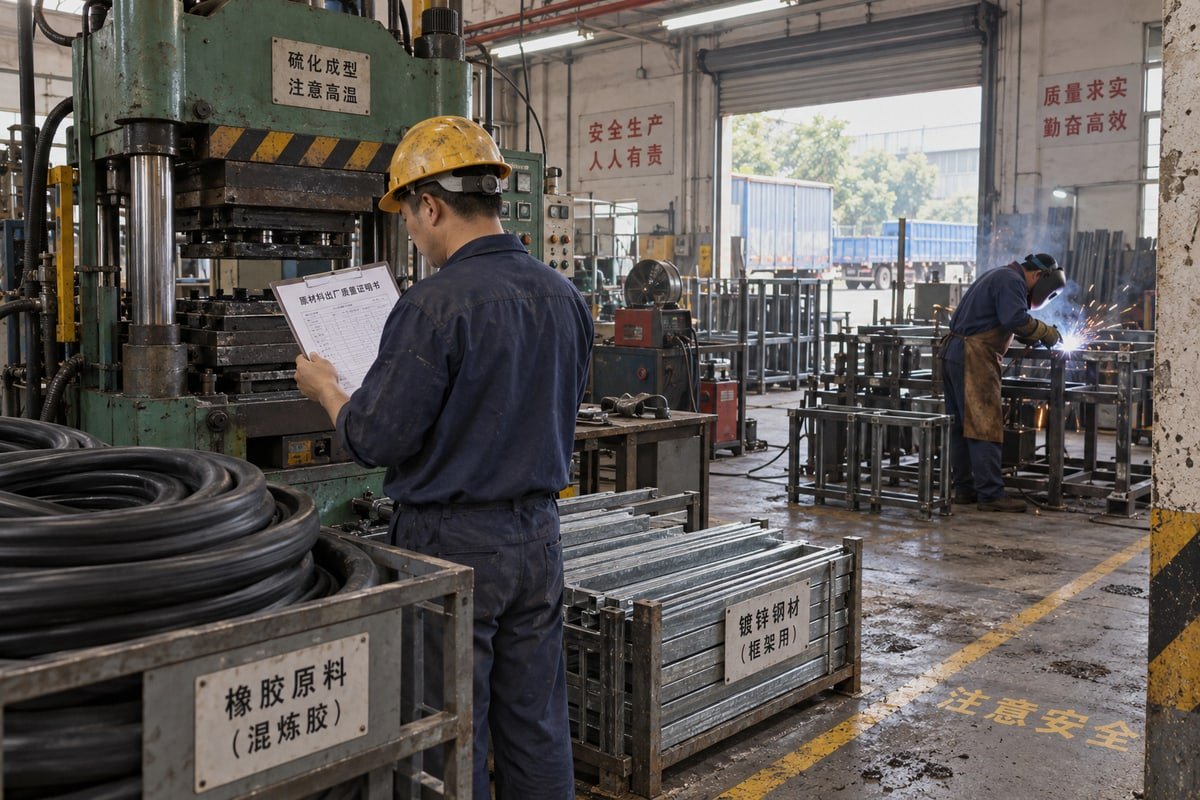
A shell company can register a name, build a website, and copy a catalogue in a week. It cannot fake a molding line, a steel stock yard, or a granted patent portfolio. That is why manufacturing facility verification should come before price talks, not after.
Why multi cable transit suppliers need operational proof, not brochures
A multi cable transit module has three physical inputs: EPDM rubber compound, a steel or stainless frame, and compression hardware. A genuine producer buys those inputs in volume. So ask for raw material mill certificates. For EPDM, the certificate should show the compound grade and the halogen-free declaration. For steel, it should show the mill, the grade, and the heat number. A trading front has no reason to hold these documents, because it never bought the raw material.
Then ask for evidence of tooling. We make our own molds for custom sizes, so we can show mold drawings, CNC job records, and the finished cavity. A supplier that outsources everything usually cannot name its mold shop.
| Document | What it proves | What it does not prove | How to cross-check |
|---|---|---|---|
| Equipment list with dated photos or video | Real machines exist on a real floor | That the machines belong to this legal entity | Match the floor address to the ISO certificate and business registration license |
| Raw material mill certificates | Actual purchasing of EPDM and steel | Product performance | Compare compound grade to the test report |
| Mold drawings and CNC records | In-house tooling capability | Volume capacity | Ask for a mold for one of your own custom sizes |
| Granted patents or design registrations | Original R&D investment | Current production | Look up the patent number in the national IP office database |
| Production capacity statement | Scale and continuity | Quality | Compare with workforce count and shift pattern |
| Test reports naming the site | Product compliance documentation is tied to this factory | Legal ownership | Confirm the lab is accredited and the model number matches |
The patent and IP signal
Our factory holds 38+ granted patents. I mention that not to boast but because a patent record is a public document. Anyone can look up the applicant name and filing date. A shell company almost never invests years in IP filings, because IP only pays off when you actually produce.
Product-level traceability
For a safety product like an MCT system, the chain must run from the corporate name to the factory to the test report to the exact model. Our TSR and TSC series test documents name the model, the sealing pressure range of 0.01–0.4 MPa, and the IP68 result. If a supplier's test report names a different brand, a different model, or no site at all, stop there.
How can I verify a supplier's ISO 9001 and IATF 16949 certificates are genuine and current?
We learned early that emailing a certificate PDF convinces nobody in Europe. Buyers now ask for the certificate number, the registrar's verification link, and the scope line.
Verify ISO 9001 and IATF 16949 certificates by checking the certificate number on the certification body's online register, confirming the body is accredited (for example through IAF CertSearch), matching the listed factory address and scope to the supplier's real site, and checking the expiry and last surveillance audit date.
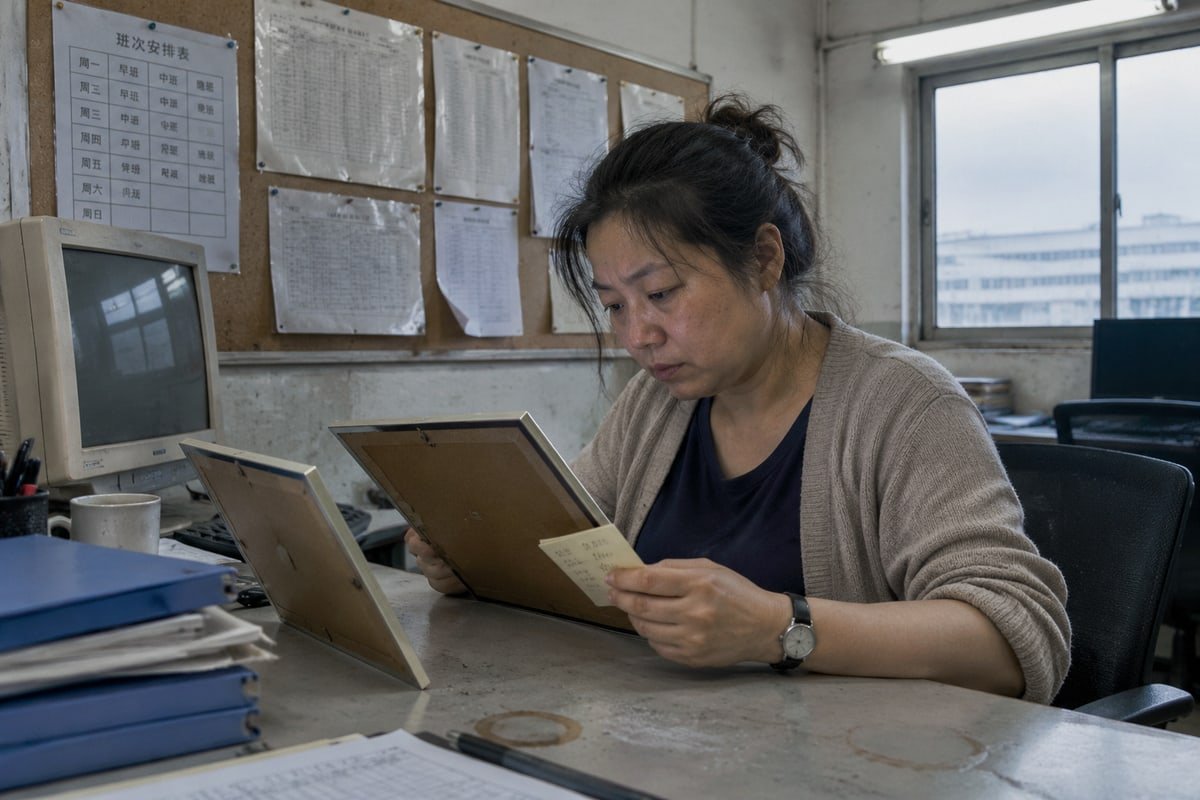
Fake and expired certificates are the most common shortcut in industrial sourcing. The PDF looks right. The stamp looks right. The problem is that the PDF is not the certificate. The register entry is the certificate.
A four-step verification process
- Read the certificate number and the issuing body. Every ISO 9001 certification 2 carries a unique number and the name of the certification body. Write both down.
- Confirm the body is accredited. Search the body on IAF CertSearch 3 or on the national accreditation body's website. An unaccredited "registrar" can issue a certificate to anyone, and that certificate is worthless.
- Look up the certificate in the body's own database. Most large bodies run a public search. For IATF 16949, the IATF Global Oversight database 4 lists valid certificates directly. If the number returns no result, ask the supplier to explain. If the address returned is a residential unit or a virtual office, the Quality Management System covers a desk, not a factory.
- Check dates and scope. ISO 9001 and IATF 16949 certificates run on a three-year cycle with annual surveillance audits. A certificate past its expiry, or one with no surveillance stamp for over a year, is not current. The scope line must say something like "design and manufacture of cable and pipe transit sealing systems." A scope that only says "trading" or "sales" tells you what the entity really does.
Certificates to verify beyond ISO
| Certificate type | Where to verify | What must match |
|---|---|---|
| ISO 9001 certification | Certification body register, IAF CertSearch | Factory address, scope, expiry |
| IATF 16949 | IATF Global Oversight database | Site address, surveillance date |
| Type Approval certificates (ABS, DNV, Lloyd's Register) | Classification society product databases | Manufacturer name, product model, manufacturing site |
| Fire test reports to IMO FTP Code | Issuing accredited laboratory | Model number, A-0 or A-60 class, report date |
| Bureau Veritas factory approval | Bureau Veritas | Legal entity name and site |
One note on DNV GL certification: the society renamed itself DNV in 2021. A certificate still showing the DNV GL logo may be genuine but old, so check the validity date rather than the logo. The same logic applies to any Type Approval certificates. A classification society certificate always names the manufacturing site. If the supplier's site is not on it, the supplier is reselling someone else's approval.
In our own case, buyers verify our ISO 9001 and IATF 16949 numbers with the registrar before we ship validation samples. We prefer that. It means the qualification file is clean on day one.
What registration and capital records prove a company is a real factory, not a trading intermediary?
Registered capital is a real trade-off for us: RMB 50M on the company record signals commitment, but it also lets any buyer pull our filing and test our claims.
Registration and capital records that prove a real factory include the business registration license with a business scope covering manufacturing, paid-in registered capital, a factory address that matches the certificates, tax and export registration numbers, beneficial ownership disclosure, and optionally a Legal Entity Identifier, cross-referenced with the national enterprise registry.
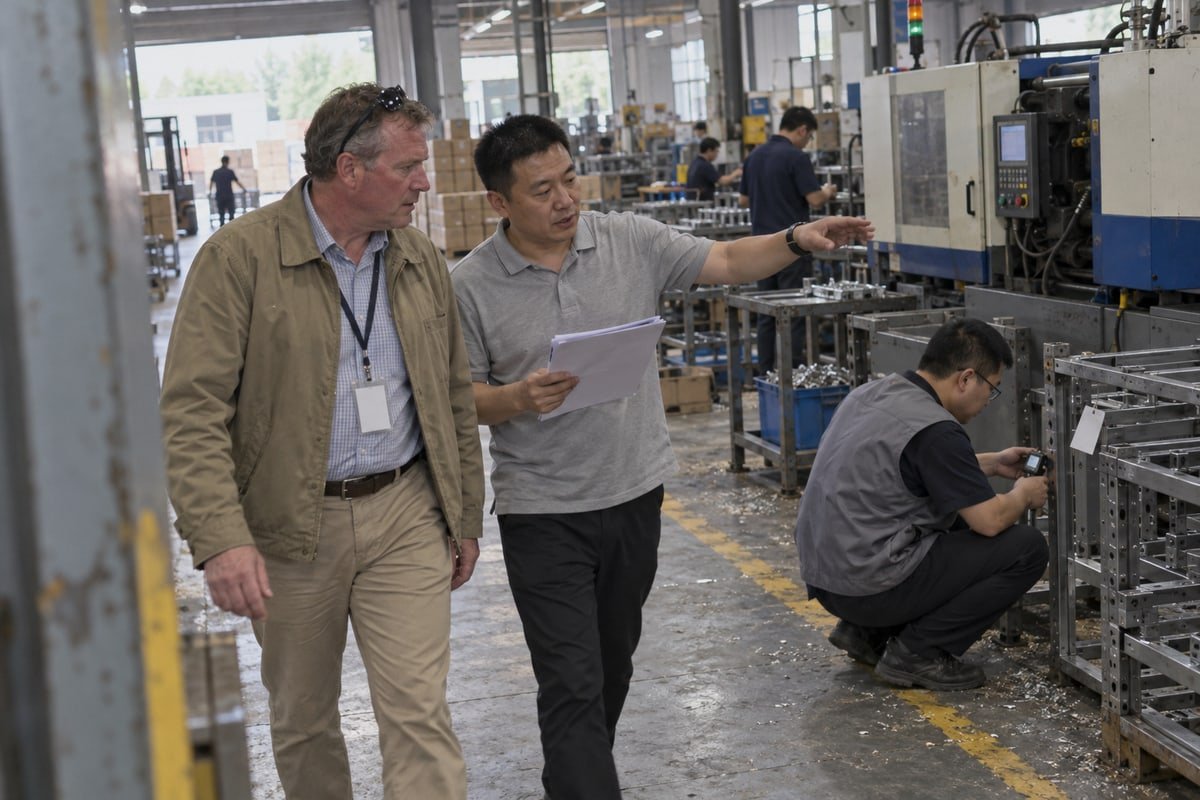
Here is the objection I hear most often from procurement teams: "The company is registered, so it exists. Why go further?" My answer is that a registered company can still be a trading intermediary. Registration proves existence. It does not prove production. The two must never be treated as the same thing.
What a business registration license actually tells you
In China, every company carries an 18-digit Unified Social Credit Code on its business registration license. That code is searchable on the National Enterprise Credit Information Publicity System. The public record shows the legal representative, the registered capital, the shareholders, the registered address 5, and the business scope. Read the business scope carefully. A factory's scope says manufacturing, processing, or production of the product. A trader's scope says sales, import, and export only.
Then compare addresses. Our headquarters is registered in Shaanxi, and we run additional production in Shandong and Hunan. A buyer can check each site against our certificates. That is the test: does the registered address, the ISO address, the audit address, and the shipping origin all point to the same places?
| Record | Signal of a real factory | Signal of a trading intermediary |
|---|---|---|
| Business scope | Manufacturing and production listed | Sales, wholesale, or export only |
| Registered and paid-in capital | Capital consistent with plant and tooling investment | Minimal capital, often recently registered |
| Registered address | Industrial zone matching certificates | Office tower, residential unit, or virtual office |
| Tax and VAT filings | Continuous filings in the operating country | Gaps, or filings in a different jurisdiction from the claimed factory |
| Export registration | Customs registration in the manufacturer's own name | Exports routed through an unrelated agent |
| Beneficial ownership | Named individuals with a traceable history in the industry | Nominee shareholders or layered holding companies |
| Legal Entity Identifier | Globally searchable corporate hierarchy | Usually absent |
Ownership matters more than a polished website
Beneficial ownership is where shell companies hide. A shell often has a clean registration but an owner nobody can name. Large buyers have caught on. Shell plc's own supplier guidance now references independently verified ultimate beneficial ownership documentation and control documentation as part of supplier checks. If an energy major asks for it, a project procurement team can ask for it too.
An LEI code 6 is a useful extra. It is voluntary, but it gives a globally standardized view of the corporate parent and its subsidiaries. A supplier with an LEI has chosen transparency.
Financial records and the payee test
Financial audit statements do not prove legitimacy on their own. A trader can have clean books. But the absence of bankable records is a red flag, and so is a payment request to an unrelated entity. The bank account name must match the legal entity on the business registration license, the invoice, and the certificate holder. If a supplier asks you to pay a different company or an offshore account that does not fit its stated location, treat that as a stop signal.
Can I request an audited site visit report or BV approval documentation before qualifying a new supplier?
A switchgear buyer in Germany once told me he would not sample until he saw our BV audit paperwork. We sent the report, and the sample followed a week later.
Yes. A credible supplier will share a third-party factory audit report or site inspection record and its Bureau Veritas approval documents before qualification. Check that the audit lists the same address as the ISO certificates, includes machinery and inventory photos, and was completed within the last twelve to twenty-four months.

Some sourcing managers push back here. They say document-heavy screening slows the buy, and for a commodity bolt that may be true. A multi cable transit system is not a commodity bolt. It holds the A-0 or A-60 fire boundary in a BESS container. It keeps IP68 water ingress out of a data center cable entry. When that seal fails, the cost is not a returned pallet. It is a fire compartment that no longer works. So the cost of weak verification is far higher than the cost of one audit report.
What a good factory audit report contains
A factory audit report from a recognized inspection firm is the single most direct answer to the shell-company question. It puts an independent person on the floor. Third-party inspection reports vary in depth, so check that yours covers at least the items below.
| Audit section | What to look for | Why it exposes a shell |
|---|---|---|
| Site identity | Photos of the gate, signage, and address plate | Confirms the audited site is the registered site |
| Production equipment | Rubber molding presses, frame welding, CNC for molds | A front company has no equipment to photograph |
| Inventory | EPDM compound stock, steel, finished TSR/TSC modules | Shows continuous production, not one-off buying |
| Workforce | Headcount by department, shift pattern | Matches the capacity statement |
| Quality system | Incoming inspection, in-process checks, final test records | Shows the ISO system is used, not framed |
| Test capability | Pressure testing, ingress testing, sample retention | Links product compliance documentation to the site |
How to commission or request one
You have three options. First, ask the supplier for its most recent audit report from a customer or an inspection body. Second, commission your own through SGS, TÜV, or Bureau Veritas; the fee is small against a multi-year supply agreement. Third, do a live video audit where the supplier walks the floor on camera and you direct where it points. We accept all three. Our Bureau Veritas approval documentation is on file, and we send the certificate reference so buyers can confirm it with BV directly.
Making the audit step fast
This is where drop-in second sourcing helps. Because our modules are dimensionally compatible with common 120-frame standards, a buyer can run the audit, receive free validation samples, and test them in an existing frame cutout in parallel. The cross-reference table from the incumbent model to the DEWIN model shortens engineering review. The audit confirms the factory. The sample confirms the fit. Both land in the same qualification window.
Conclusion
Shell companies hide behind PDFs. Every missing link costs a project. Triangulate registration, ownership, factory audit, and product compliance, then request our validation samples with the documents attached.
Footnotes
1. Authoritative global testing, inspection, and certification body. ↩︎
2. Official ISO page for the ISO 9001 quality management standard. ↩︎
3. Global database for verifying accredited management system certifications. ↩︎
4. Official oversight body for the IATF 16949 automotive quality standard. ↩︎
5. Official Chinese government enterprise credit information system. ↩︎
6. Official global standard for identifying legal entities in financial transactions. ↩︎

 English
 Español de México
 Deutsch
 Français
 العربية
 Русский