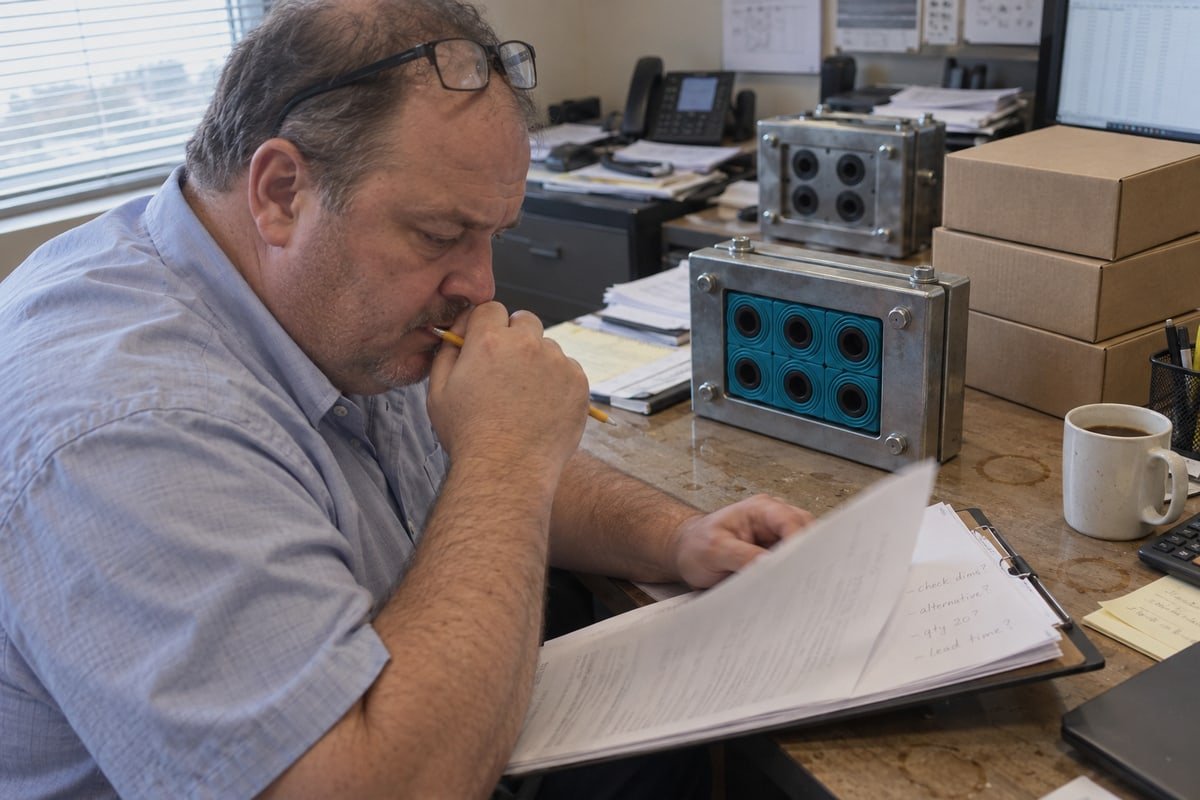
A supplier’s multi cable transit quote arrived far below the incumbent’s price. Cheap looks good until site engineers find missing modules. Our factory sees this pattern every month.
A multi cable transit quote is reasonable when it matches your exact specification, lists every module, frame, and compression unit, states Incoterm and lead time, and is backed by fire, IP, and pressure test documents. Compare total landed cost against normalized scope, not the unit price alone.
The rest of this article breaks that answer into four checks. Each check comes with a table or a step list you can copy into your own bid comparison sheet. I will also share where I have seen buyers get burned, and how we structure our own quotes so they survive the same scrutiny.
What Should I Compare Beyond the Unit Price When Evaluating an MCT Quote?
A sourcing manager in the Netherlands once sent us three MCT quotes side by side. The lowest one had no blanking modules and no stay plates. It was not cheaper.
Beyond unit price, compare the full bill of materials, sealing and fire performance basis, frame material, Incoterm and destination, payment terms, validity period, packing, documentation, and lead time. Then convert each quote to total landed cost and score it on a weighted scorecard.

A multi cable transit quote only becomes comparable after you normalize it. Two suppliers can quote "one 120-frame transit for 24 cables" and mean very different things. One includes stay plates, blanking modules, and the compression wedge assembly. The other quotes the frame and the sealing modules alone. The second quote is not lower. It is incomplete.
Normalize the Scope Line by Line
I recommend building a single scope sheet before you look at any number. Each supplier then fills the same lines. Here is the version we hand to buyers who are qualifying us as a second source.
| Scope item | What to confirm | Why it changes price |
|---|---|---|
| Frame type and material | Weld-in, bolt-on, or split frame; stainless steel vs galvanized | Stainless frames cost more but suit corrosive or marine sites |
| Sealing module count and size | Number of modules per frame row, sealing module dimensions | Fewer, larger modules can be cheaper but waste cable density |
| Cable diameter range | Min and max diameter per module | Step-core or multidiameter modules cut spare inventory |
| Blanking modules | Quantity for spare capacity planning | Often omitted from low quotes |
| Stay plates and end packing | Quantity per frame | Small items, but they are essential |
| Compression unit | Type of compression wedge assembly, bolt hardware | Some quotes exclude hardware entirely |
| Fire and sealing basis | A-0/A-60 fire rating, IP68 1, gas-tight pressure range | Tested performance costs more than untested rubber |
| Documentation | Test reports, type approval certificates, CAD/STEP files | Free from some suppliers, billed by others |
| Packing and export docs | Export cartons, pallets, certificates of origin | Ex-works quotes often skip this |
Convert Every Quote to Total Landed Cost
Once scope is equal, move to the commercial basis. An EXW price from China and a DAP price to a warehouse in Rotterdam are not the same number. Add freight, insurance, duties, customs brokerage, and inland delivery to every quote. Then convert to one currency at one date. This gives you total landed cost.
For a modular sealing system, I also add two soft costs. The first is installation time efficiency. A frame that needs no hot work or welding on site saves labor hours. The second is future re-entry cost. If a module cannot be reopened to add a cable later, you pay again. Both belong in total cost of ownership, even if they do not sit on the invoice.
The Lowest-Price Objection, and Why It Fails
Some buyers push back here. They say: if the technical spec is identical, the lowest landed cost should simply win. I agree with the logic. I disagree with the premise. In my experience, specs are almost never identical on the first quote. Suppliers substitute module sizes, change rubber compounds, or quote galvanized where stainless was written. The risk-adjusted view is stronger. Score compliance and evidence first, then let price decide among the compliant bids.
A Simple Weighted Scorecard
| Criterion | Suggested weight | Adjust upward when |
|---|---|---|
| Technical compliance | 30–40% | Hazardous area or marine and offshore standards apply |
| Total landed cost | 30–40% | Standard indoor installation, mature spec |
| Delivery lead time | 10–20% | Shutdown or container build slot is fixed |
| Quality and compliance evidence | 10–15% | Certificates must be shown to a classification society 2 |
| Supplier risk and support | 5–10% | You need CAD/STEP files and English technical support |
Our own second-source quotes typically land 40–60% below the incumbent's price. That gap is only meaningful because we fill in every line of the scope sheet above. A quote that is 40% cheaper because it forgot the stay plates is a different thing entirely.
How Can I Verify That a Supplier's Certification and Test Documents Justify Their Price?
During our last Bureau Veritas factory audit, the auditor asked for the pressure test log behind one certificate. That is exactly the question a buyer should ask a supplier.
Ask for the actual certificates, not logos: ISO 9001 or IATF 16949 scope pages, fire rating certificates such as A-0 or A-60, IP68 reports, and gas-tight pressure test records. Check the certificate holder, tested product model, issuing body, and expiry date against the quoted items.
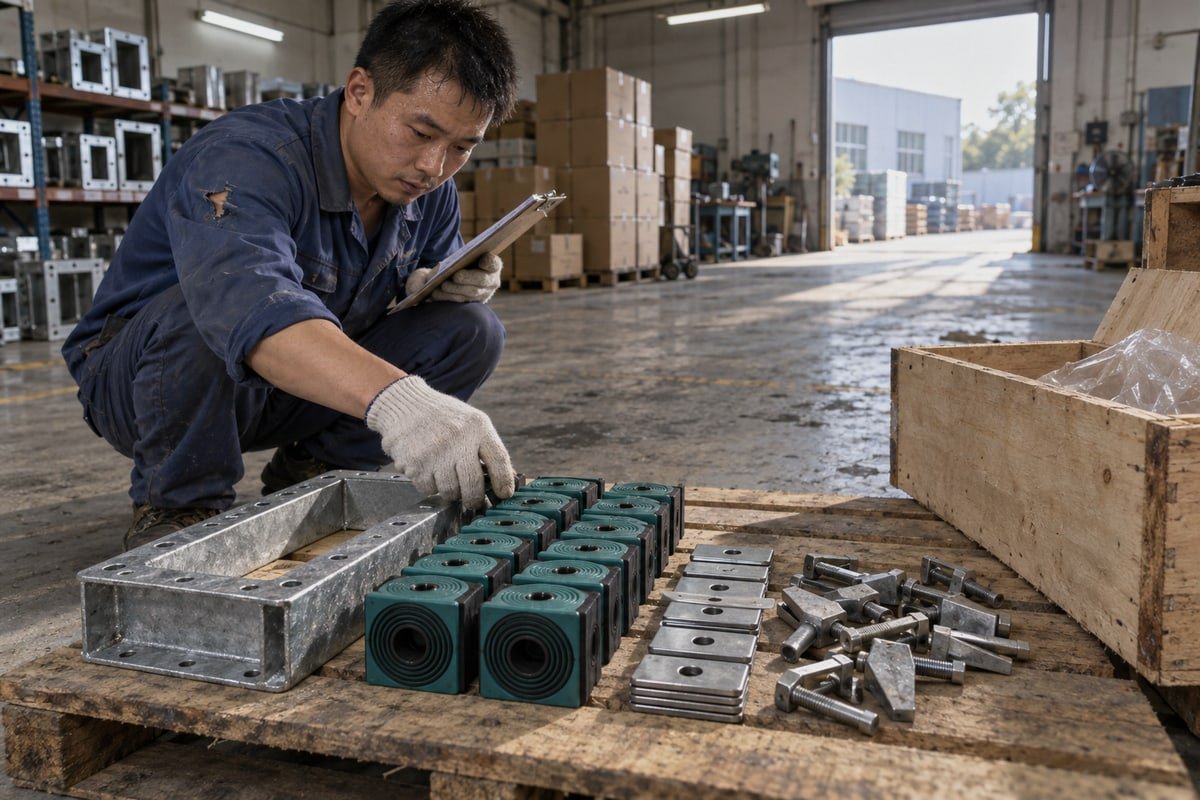
A higher price is justified when the paperwork proves the performance. A higher price is not justified when the paperwork is a PDF of a logo. I have seen both. The buyer's job is to separate them, and it takes about twenty minutes per supplier if you know what to request.
Match Each Document to the Claim It Supports
Cable penetration seals carry several distinct performance claims. Each one needs its own evidence. Here is how I map them.
| Claim on the quote | Document that proves it | What to check on the document |
|---|---|---|
| Quality management | ISO 9001 3 certificate; IATF 16949 if you build for automotive-grade programs | Certificate holder is the factory, not a trading company; scope covers sealing systems |
| Factory approval | Classification society factory approval (for example, BV) | Approval names the production site and product family |
| Fire rating | A-0 or A-60 fire rating certificates | Tested assembly matches the quoted frame and module type |
| Ingress protection | IP68 test report | Immersion depth and duration are stated |
| Watertight and gas-tight sealing | Pressure test record, for example 0.01–0.4 MPa | Test pressure range covers your application pressure |
| Hazardous area use | ATEX and IECEx 4 compliance documents, where the application requires them | Equipment category matches your zone classification |
| Marine or naval use | Type approval certificates against marine and offshore standards | Certificate is current and the model number is listed |
| Shielding | EMI or EMP test data, if your data center or naval spec demands it | Attenuation figures are stated, not implied |
The Five Questions I Ask of Any Certificate
- Who holds it? The name should be the factory that will produce your order. If a trader holds it, ask how they control the factory.
- What was tested? The tested model should be the model on the quote. A fire test on a different frame depth does not transfer.
- Who issued it? A recognized body or accredited lab should appear. If you cannot find the issuer, that is a red flag.
- Is it current? Certificates expire. Check the date.
- Can they show the raw test record? A confident supplier can produce the log, not just the summary page.
We keep our fire, IP68, and pressure test documents ready to send on request because buyers in Europe ask for them before they reply to a quote. In my view, that is correct behavior. A quote with no test evidence should be treated as a quote for uncertified rubber, and priced accordingly in your comparison.
When the Price Gap Is Legitimate
A quote can be higher and still reasonable. Fire rating certifications for A-60 require tested steel frame construction and specific rubber compounds. Gas-tight sealing at the upper end of a pressure range requires tighter module tolerances. If a supplier's documents show these, the premium is explained. If two suppliers show equivalent documents and one is far cheaper, the cheaper one is not automatically suspicious. It may simply be a factory-direct source with lower overhead. That is where the next two checks matter.
How Do I Confirm Dimensional Compatibility Before Trusting a "Drop-In Replacement" Quote?
When we open a new TSC module mold, I weigh tolerance tightness against compression range. Too tight, and the block fights the frame. Too loose, and it leaks.
Confirm drop-in compatibility by requesting the supplier's model cross-reference table, CAD or STEP files, and a free validation sample. Then measure module width, height, and depth against your existing 120-frame cutout, check the cable diameter range per module, and trial-fit the compression wedge assembly before ordering.

"Drop-in replacement" is the phrase that makes a second-source quote attractive. It is also the phrase most often written without proof. Our TSC square modules and TSR round assemblies are dimensionally compatible with common 120-frame standards. I still tell every buyer to verify that on their own bench, because their frame may have been modified, painted, or welded out of square on site.
A Six-Step Compatibility Check
- Request the cross-reference table. The supplier should map your existing model numbers to their own. If they cannot produce one, "drop-in" is a guess.
- Request CAD or STEP files. Overlay them on your existing frame drawing. Look at module height, width, and depth, plus the compression unit travel.
- Request a free validation sample. A supplier who charges for a single module to qualify a multi-frame order is telling you something about their confidence.
- Measure the sample. Compare sealing module dimensions to the frame opening at room temperature. Record the result.
- Check the cable diameter range. Step-core or multidiameter modules cover a range of cable sizes within one module size. Confirm the range covers your cable schedule, including the largest power cable.
- Trial-fit in a spare frame. Load the modules, stay plates, and compression wedge assembly. Torque the bolts to the supplier's figure. Confirm the pack compresses evenly.
Dimensions That Break Compatibility
| Dimension | Why it matters | What to compare |
|---|---|---|
| Module depth | Must match frame depth for full face seal | Sample depth vs frame depth |
| Module width and height | Must fill the frame row without gaps | Row total vs frame inner opening |
| Compression unit stroke | Must reach the compressed height of the module stack | Wedge travel vs stack height |
| Stay plate thickness | Sets row spacing | Plate thickness vs existing plates |
| Cable range per module | Determines if one module size covers your cables | Min/max diameter vs cable schedule |
Area Efficiency and Cable Density
A less obvious compatibility question is area efficiency. Two systems can fit the same 120-frame cutout but seal a different number of cables. Multidiameter step-core modules usually improve cable density because the installer peels the core to the cable size rather than stocking many fixed bores. That reduces the number of blanking modules and simplifies spare capacity planning. When you compare quotes, count cables sealed per frame, not just modules per frame.
Installation Effects
Compatibility also affects installation time efficiency. A module that requires trimming, shimming, or hot work to fit is not a drop-in part. It adds labor and, on a BESS container or data center module line, it adds risk to the build schedule. Halogen-free EPDM 5 matters here too. It keeps the installed pack within the same material class as the original, which simplifies your compliance file.
What Hidden Costs Should I Watch for in Lead Times, Samples, and MOQs?
We learned early, back when our first export orders shipped from Shaanxi, that a missed spare-module delivery costs a BESS integrator more than the whole MCT order.
Hidden costs include paid or slow samples, MOQs that force excess inventory, unstated lead times for elastomer modules, expedite fees, missing export documentation, and freight excluded from ex-works pricing. Ask for validity period, sample terms, MOQ per SKU, and spare-module lead time in writing before comparing.

The final check is the one buyers most often skip. The quote looks complete. The certificates check out. The sample fits. Then the purchase order goes in, and the commercial terms start to bite. Here is where I look.
Hidden Cost Map
| Hidden cost | How it appears | How to expose it before award |
|---|---|---|
| Sample charges | Validation sample billed, or shipped only with a deposit | Ask for free validation samples in the RFQ |
| MOQ per SKU | Small modules quoted at attractive prices but only in large packs | Request MOQ per module size, not per order |
| Elastomer lead time | Frames in stock, rubber modules made to order | Ask for lead time per line item |
| Expedite fees | Surcharge for meeting the stated project date | Ask for standard and expedited lead time in writing |
| Export documentation | Certificate of origin or packing list billed separately | Confirm export docs are included |
| Quote validity | Price expires before your approval cycle ends | Ask for validity aligned to your PO timeline |
| Currency | Quote in one currency, invoice in another | Fix currency in the quote |
| Spare parts pricing | Cheap initial order, expensive spare sealing modules later | Request a spare module price list with the quote |
Lead Times and Local Stock
Specialized elastomer modules are where lead times slip. The metal frame is easy to source. The rubber pack with the right compound and step-core geometry is not. When we quote, we separate frame lead time from module lead time because buyers plan container builds around the longer one. Ask each supplier to do the same. Then ask whether spare sealing modules ship faster than a full frame kit. A supplier with in-house mold making can usually turn a custom module size faster than one who outsources tooling, and that matters when a cable schedule changes late in a project.
Also weigh last-mile logistics. A quote that ends at the port is not a quote to your site. If your integrator plant is inland, add that leg.
MOQs and Spare Capacity Planning
MOQs interact with spare capacity planning in a way that inflates cost quietly. If a supplier's MOQ for a small module size forces you to buy far more than your frame layout needs, you are stocking rubber you may never install. Multidiameter modules soften this. One module size covers a range of cable diameters, so you hold fewer SKUs and hit fewer MOQ thresholds. That is a real saving, but it only shows up if you ask for MOQ per SKU.
Red Flags in Commercial Terms
- No lead time stated, or a single lead time for all items.
- No validity period.
- No Incoterm 6, or an Incoterm with no named destination.
- Resistance to a line-item breakdown.
- Reluctance to send a sample without a deposit.
- Export documentation "available on request" with no confirmation of cost.
None of these prove a quote is bad. Together, they tell you the supplier has not priced the whole job. A reasonable multi cable transit quote leaves none of them open.
Conclusion
An unclear quote is a risk, not a saving. Normalize scope, verify documents, trial-fit a sample, and price the hidden terms. Then a fair MCT quote proves itself.
Footnotes
1. Wikipedia explains the ingress protection rating standard used to verify supplier documents. ↩︎
2. DNV represents classification societies referenced for factory approval and type approval checks. ↩︎
3. ISO official page defines the quality management certification referenced in the article. ↩︎
4. Background on hazardous area compliance directives mentioned for classification checks. ↩︎
5. Wikipedia describes the elastomer material class used in sealing modules discussed. ↩︎
6. Updated 404 link to the official International Trade Administration guide on Incoterms. ↩︎



 English
 Español de México
 Deutsch
 Français
 العربية
 Русский